77
Strategies for Ecumenical Student
Ministry
SCM Needs to Reclaim the Christian Faith
By
SCM Aotearoa
SCM Aotearoa
is experiencing some renewal now. We would like to share with you those elements
that have contributed to renewal in Aotearoa, and those things, which are part
of our vision for SCM.
SCM needs to
reclaim the Christian faith. Christianity is not the sole property of
fundamentalists or evangelicals. We in the SCM have to be strong in our
identity as disciples of Jesus Christ. We have to be familiar with the stories
and traditions of our faith.
We need an
identity that is different from other Christian student groups. In Aotearoa, we
are often asked: Why do we need an SCM when there are already five (or more)
other Christian groups? Our programs ought to include topics that no other
Christian group will study; we ought to take action that no other Christian
group will take. SCM is not the same as other Christian groups, and that is
good.
SCM alone
amongst Christian student groups is truly ecumenical. We welcome not just
Christians, but people of other faiths, and people of no faith. We need to be
confident in our Ecumenical identity.
78
As well as
being an alternative to other Christian groups, SCM can provide an alternative
to mainstream society. To do this requires systematic atheism towards
dominant structures and ideologies. For example, SCM can say:
We do not
believe in the gods of greed, status and elitism. We do not believe in
individualism. We do not believe in profit before people. BUT we do believe in
the God of peace, love and justice; we do believe in community; we do believe
in the economy serving the people.
SCM Aotearoa is
an alternative to our society in that we aim to be spiritual, non-hierarchical,
non-sexist, non-capitalist, non-homophobic and non-racist.
We cannot
build if we do not understand the context. SCM has to be in the student context
but we have to be in the context critically. We need to stand amongst students
and help them analyze their situations.
SCM Aotearoa
aims to work with students, with their concerns and problems. We aim to help
students develop in every area of their lives. This means we must not be afraid
in SCM to talk about sex, unbelief or societal problems.
Aotearoa has
the highest youth suicide rate in the world. Many of our young people can see
no alternative but to kill them. This is the context SCM Aotearoa is in, but we
are in the context critically, therefore we can say, there is hope. We
can point to alternatives and lead students out of destructive ways of thinking
and acting.
Our programs aim
to have a balance of three things:
79
Student — We respond to
the immediate concerns of students, e.g. questions of relationships, work,
leaving home, etc.
Christian — we encourage exploration of the Bible, sharing and
celebration of the diversity of Christian traditions; we facilitate spiritual
growth and empower students in their Christian journeys.
Movement — we inform
students of the realities of the political situation. Students need to be
taught to critic society and to hear the stories of people's movements.
Students need communities,
communities in which they can be nurtured, challenged and inspired. This is
SCM's role. We aim to provide a place where students may nurture each other,
reflect, analyze, re-create and be accountable to each other.
In Aotearoa,
SCM is making links with people who have aims consistent with those of SCM. We
have links with senior friends, chaplains, church and ecumenical comrades. We
also link with other student groups, women's groups, gay and lesbian groups,
and indigenous people's solidarity groups. We support these groups and they
support us.
If it is to
survive, SCM cannot be a secret. We need to gossip the gospel. We need
to talk to students about SCM. We have to share the SCM stories with young
people. This is a vital step in building and planting.
80
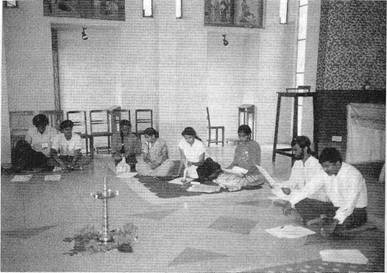
SCM
India at worship — communing with God and with each other.
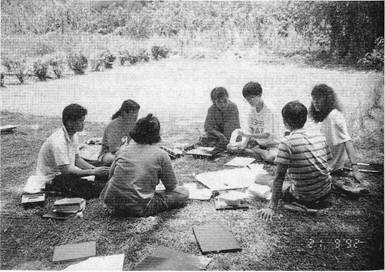
Some participants of the 1992 Student Empowerment for
Transformation program gathered for group discussion / reflection.