117
SCM
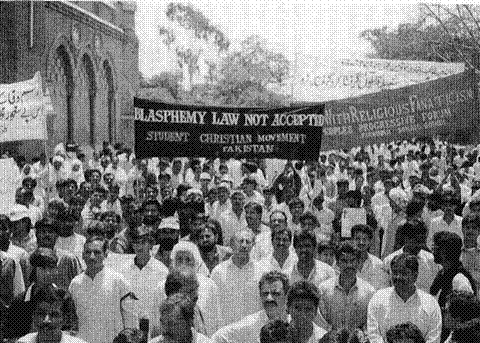
Pakistan joining other Christians to protest against blasphemy law.
111
For Better Partnership of SCM and Churches
By
Christine Ledger
I joined the
Australian SCM when a young university student and attended my first national
conference in 1974. It was a time when the SCM in Australia was at low ebb
after the turbulence of the 1960s, turbulence that I had vague childhood
memories of but no deep understanding at the time. When I joined SCM, I was one
of the few new student members in a movement largely kept alive and afloat by
senior friends. There was much pain, even trauma in a movement in transition
accompanied by nostalgia for the past. The spirit of the SCM remained strong,
however, providing a forum for open-minded exploration of the Bible, political
action and community support.
The workshops
at my first national conference ranged from consideration of political issues
of the time (e.g. uranium mining, overseas aid), liberation theology, women's
issues and an intriguing one called SCM and the Churches. I remember, in
my naiveté, thinking how tame and out of place this last topic, SCM and the
Churches, seemed compared to all the other workshops. I went along out of
curiosity.
112
SCM
Cannot be Neutral About the Church
I was in for a
surprise. The depth of feelings displayed in that workshop and the spirit of
the debate demonstrated to me that the relationship between SCM and the
churches is deeply important to
SCM and SCMers. There were students in that workshop who, in tears, spoke of
the pain of feeling marginalized, shut out of the church community because of their
political views or their questioning attitude of long-standing church
traditions and practices. There were chaplains and some senior friends who
advised the students to be more patient and tolerant of the slow moving
mechanisms of the institution of the church. There were students who had given
up on the church and embraced the SCM as their faith community, and others who
were enrolled in theological college, committed to a life of ordained service.
There were women who felt called to ordination, but could not be ordained.
Students spoke of the pain of the divided church, of not being able to share
communion with those of a different tradition. One thing was clear, it is
impossible to be a member of SCM and be neutral about the church. Even when the relationship is strained, for
the SCM the churches are important, never irrelevant. This is something
distinctive to SCM and is to be celebrated.
Another
incident stands out in my memory as an insight to SCM-church relationships.
Five years after that first ASCM conference, I was well and truly involved in
the movement and had joined the staff. With an enthusiastic gleam in my eye, I
went knocking on the doors of church offices in a bid to strengthen
relationships and seek deeper moral and financial support for the struggling
SCM. I came out of those offices with some bruises. I had expected to be
welcomed with open arms as the representative of hard-working and committed
Christian students on campus. Instead, I was received with either nostalgia for
the past or disinterest, even hostility, for a movement that had lost its way
113
and was
perceived as irrelevant. There was little moral support and even less financial
assistance despite what I thought was genuine interest and goodwill towards the
churches by that current generation of SCMers.
These
experiences are typical of my generation of SCMers, certainly in Australia, and
in many other countries around the world. While it is not possible to
generalize to all SCMs, my time on the staff of the WSCF has convinced me that
many movements have been through similar experiences at one time or another.
Senior friends
older than I speak of the 1960s as a watershed period for SCMs, including their
relationship with the churches. Fely Carino, in his address to the WSCF-CCA
consultation in 1985 charts this in some detail, pointing to the involvement of
SCMs in liberation struggles beyond the boundaries of academic university life
and subsequent alienation from the churches. For the students of the 1970s,
'80s and '90s, the echoes of this disruption are still heard. One related outcome has been the growth of
fundamentalist groups and the increasing difficulty of SCMs to be even visible
to enquiring students.
In the 1990s,
it seems it is even harder for SCMs in many countries to receive serious
consideration by mainline churches. In terms of membership, SCM has declined in
membership in many countries as non-denominational groups of a more
conservative evangelical persuasion have grown.
Fewer and fewer church leaders have been nurtured by SCM and so have no
first hand experience of the ecumenical formation it provides. In discussions
of church support of student ministry, it is common for churches to seek an even-handed
approach, according recognition and support to a wide range of student
Christian groups on campus.
SCM
as Presence of the Churches
The history of
WSCF and its member movements is firmly embedded in the life of the churches
and the journey of unity of churches. After all, it was largely through the
vision and efforts of the WSCF that the World Council of Churches (WCC) came
into being and that dialogue and relationships between Protestant, Orthodox and
Catholic churches has been strengthened and deepened.
Yet, today there
is little recognition or even knowledge of the specific historical role of SCMs
as the presence of the churches and the ecumenical movement on campus. This was
the tacit understanding when the World Council of Churches was formed in 1948,
an understanding under strain since the 1960s. SCM / WSCF were to retain its
autonomy as a lay movement independent of institutional church governance while
being recognized as the official ecumenical student movement.
The ongoing
supportive relationship between the Christian Conference of Asia (CCA) and the
WSCF Asia-Pacific is testimony to the fact that this agreement is not
completely forgotten, especially at the international level. The recent Ecumenical Global Gathering of
Youth and Students, involving WCC
Youth, WSCF. IMCS, IYCS, YMCA, YWCA is another indication. However, the lines of relationship are no
longer simple and clear-cut. In the planning of the EGGYS process, the
traditional partners among the youth and student movements themselves had great
difficulty in deciding how far to cast the net in seeking partners in the
organizing process. Should the dominant
Christian groups on campus be part of the circle even though their
self-identity is not primarily ecumenical in the traditional sense?
115
The definition
of mainstream churches and mainstream movements is shifting in
contemporary understanding. The
churches themselves are losing membership to Christian groups and churches,
which are not active in national councils of churches and other expressions of
mainstream ecumenism.
As the
churches' support for SCMs has become more clouded, the financial support has
also waned. This in turn has led to many SCMs being caught in a spiral whereby
they have found it even more difficult to organize and run their programs
effectively due to lack of resources. This in turn leads to more criticism of
the SCM as ineffective and marginalized. At the international level, church
funding agencies, especially those guided by a strong emphasis on development,
do not accord high priority to the support of student movements on the
simplistic grounds that students are the elite of society. There is a strange
irony in this as it was the SCMs themselves, which challenged the churches to
take an option for the poor. At the local level, a shift to a
denominational student ministry in some countries has squeezed out support for
ecumenical approaches and organizations.
For
a Better Partnership of SCMs and Churches
What then are
the ways forward for SCMs and WSCF in relationship to the churches?
It strikes me
that despite the relative smallness of SCMs today; they still provide an
extraordinary number of young leaders to the churches and councils of churches.
Despite the difficulties, there remains a spirit in the SCM, which resonates
with the theology, witness, mission and striving to unity of churches engaged
in ecumenism. It is imperative that SCM claim and nurture its basic ecumenical
vocation, a vocation that makes it distinctive from other Christian groups
whose identity is Para church or non-denominational and so peripheral to the
ecumenical life of the churches.
116
Second, there
is an ongoing need for the SCMs to be open and intently listening to the
questions and concerns of young people today.
The context of SCM's work is very different from previous decades. It
follows that the styles of organization and program must also change. I believe
that there is a deep spiritual yearning in young people that is not being
addressed in an increasingly materialistic dollar driven world. SCM, through
its open-minded reading of the Bible, may provide a place where students may
find the grounding in values to guide them in pursuing justice, peace and love
in such a world.
Third, and I
say this as a student of the 1970s, it is time for SCM and the churches to
leave behind the trauma in their relationship, which marked the 1960s. Today's
student generation was not born then.
While it is helpful and important for them to understand the origins of
their movement and its stormy relationship with the churches, it is imperative
for them to address the rapidly changing world in which they live today, to understand the stresses and strains on a
world in pain, and to find a community of prayer and loving action. For the
churches, we need to learn to trust young people again and to provide them with
the resources to undertake their own ministry in their own way with the freedom
to make their own mistakes.
Finally, I would
strongly support the suggestion of CCA and WSCF Asia-Pacific that churches be
encouraged to host national consultations to address the needs of student
ministry today. It is time for a serious analysis and study of student
ministry. SCMs may seem like small players today, but the depth of experience,
faithfulness and ecumenical commitment is a well to draw upon in these
consultations. It is a well that refuses to run dry, despite the difficulties,
and which may be renewed, refreshed, and yes, even spill over with grace of God
and the vision and the joining hands of churches with students.
117
SCM
Pakistan joining other Christians to protest against blasphemy law.