Merit System. Students often see the root of their control in universities
is the examination system only. With the emphasis of merit system, mugging
their studies become an end rather than a means of achieving a better
understanding of life. Thus with this. Kiasu mentality, students will
pursue their studies and / or extracurricular activities at all costs to
ensure that in the end they will be able to have better job, more income, etc.,
than their peers will.
Modular System. Recently, universities have switched to the modular system
or academic unit system, which aims to give undergraduates a certain degree of
choice in subjects and flexibility to widen their education that leads to a
broadening of their perspective. But far from removing the pressure from the
shoulders of the students in this initial phase of implementation, students
have instead experienced the problem of balancing the time for studies and time
for social activities. The rat race instead becomes more competitive.
Anti-social Behavior. It is written that one should try to improve lives and not
merely one's ability to attain the material good in life. In addition, to
attain that good life, some university students have resorted to blatant
anti-social behavior such as the hogging of computer terminals and books, the
reservation of library seats. Friendships are often shallow since it is
I-scratch-you, you-scratch-me attitude for mutual benefit.
University
students' social circles were inevitably restricted to their own faculty and/or
departments. This resulted in a disturbing trend of friendships being
formed during tutorials and lectures based on rather selfish motives such as
hideous forms of networking. Undertaken in a calculated manner, many of
these friendships remained dormant until the pre-examination period
(also known as collection of model essays) frenzy. Many such
60
friends faded
away after the academic year was over. Friendship was thus reduced to being a
tool of pragmatic gains.
Is this
undergraduates' behavior symptomatic of a greater social ill? We need to
realize that it is a disease that affects all strata of our society. We should
not be content to have excellent goals; we must pursue them by excellent means.
Should such behavior be allowed to continue and eventually become a norm
in our university, which is at the public expense? However, this is not a case
of the ugly undergraduates but a case of the ugly Singapore.
We should not
forget that before our young people became undergraduates, local or foreign,
they learned their manners at home, in school, from parents, siblings, friends
plus other influences like television programs. They did not become antisocial
after they entered the university. They were so before they came to our
campuses and would remain so whether they became graduates or not. If we want
to tackle the issue of anti-social behavior, we need to ask ourselves what it
is in our society that produces such behavior even in people who have received
the best opportunities our society has to offer. That is the root of the
problem.
School fees and loans. University fees rose by 30% for non-medical courses in 1989
and a further 35-40% in 1991 mainly because of cut in government subsidies.
Many students have taken out loans to pay for their own education. However,
recently we had the situation of students taking advantage of the easy loan
schemes. They took the loan indiscriminately buying things such as computer,
branded goods, and even going for holidays. The phenomenon was criticized by
other Singaporeans who came to know about it through newspapers, which resulted
in a change of the loan policies. Now students are complaining that they are
deprived of the opportunities to travel which can widen their horizons and
personal computer facilities are vital in their study life.
61
Gender. The other aim
of education is to promote equality. This however is not the case in the
present educational institutions. One example is the quota on female medical
students, which is limited to 1/3 of the total intake of medical students.
Sub-cultures. When people observe the university from the outside,
students appear to constitute a cohesive group. However, the students'
subculture is actually much more complex and diverse. University cliques and social
groups may be established based on race, social class, placement in courses and
leadership roles in the school and community.
Conclusion
In a developed
country like Singapore, many students are so absorbed in their own lives with
their personal computers, expensive clothes and so on that they do not see
beyond their ivory tower. Unconcerned with local problems, they are even less
aware of the problems and situations that the developing and less developing
countries are facing such as poverty, illiteracy, famines, etc. Hence, they
have very little deep feelings for and thoughts of people living there.
However,
university students are young people who have the power to put forward their
new ideas to change society in small or large ways. Yet, to do this, they must
have the space and avenue to participate in voicing out their opinions of what
they believe an all rounded education should be. This means defining the right
spiritual, moral and social orientation in accordance with their inborn gifts
and potentials. A breath of air will thus be given to the society if this is
ensured and universities will not be seen as only a place of getting a piece of
paper.
62
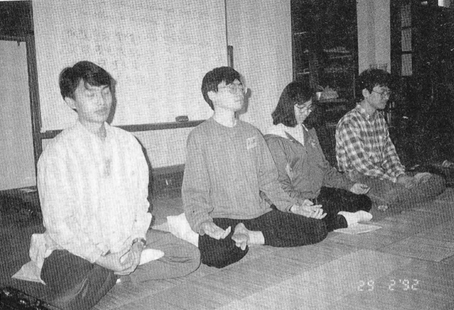
Hong
Kong SCM doing a meditation exercise in self – reflection to check one’s self –
value and be aware one’s limitations in relation to their peers, their work and
their environment.