37
asean: observations and projection
Dr. Dorodjatun Kuntjoro-Jakti
The
Problem of the New International Economic Order (NIEO)
Studies have been made on the idea of a new economic order, which is also known as the Restructuring of the New International Order. For example, the UN has set up a committee led by Prof. W. Leontieff from the USA. The findings of this committee have been published. The World Bank also has had a study on the idea. In both studies, there are some aspects of the problem, which have not been dealt with realistically.
The fact is that within the period between 1977-78, there have been dialogues on the NIEO but which have been failures. In 1977, 8 representatives of the developed countries and 19 Third World countries- taken from the larger group of 77 (UNCTAD) met in Paris. The meeting lasted for 18 months intermittently. Then the meeting broke down. The UN decided to take over. It set up a Committee a larger group including all those participating in the dialogue in Paris. Last September, this second meeting also broke down.
Within this kind of situation, we see rapid changes, unforeseeable four or two years ago. Take for example, the growing rapproachment between China and Japan, which quickly translated itself into an economic agreement/long farm trade relations for about eight years. Also, the setting up of the European monetary system in the other part of the world. This is an important step, perhaps one which will bring about the unification of Europe after the re-ordering of the budget, allocation of resources, etc.
Not all countries have the proper reactions to the rapproachment of China and Japan or the setting up of the EEC monetary system. Especially we note the US'
38
reaction which is not a pleasant one, because these events have taken place when the situation of the US dollar is declining very fast (Only during the last four days, I saw this trend somewhat stopped by the drastic action from the part of President Carter).
Within this bewildering situation, we have to discuss the problem of Indonesian reality within global and Asian realities. In Kuala Lumpur, we (in the ASEAN) decided that we cannot solve these problems. So we are going to call for another meeting next year in Manila with a larger delegation from each respective country.
Why
such a stress on this problem of the NIEO?
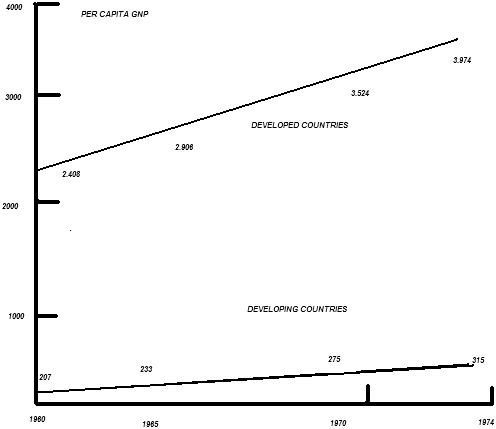
If we study tables 1 and 5, we see that there are two measures of the gap between the developed and developing countries. Apparently, the gap of per capita income between developing countries and developed countries is not lessening; as a matter of fact, it is widening, from the ratio of 1:12 to 1:13. In 1974, per capita income of the developed countries taken together is US$4,000. In developing countries, it is US$ 315.00, which is not far different from US$ 207.00 in 1960.
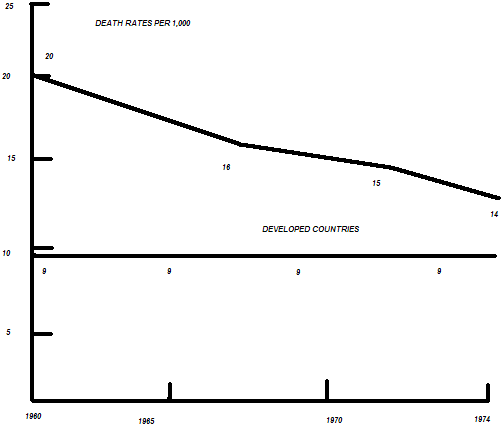
At the same time, you are facing the problem of population. Because the death rates per 1000 population decrease in developing countries faster than developed countries due to the result of health programs, etc.
It is an open knowledge that since the 1950s, the UN tried to have an international program for the development of developing countries. The First Development Decade was formulated for the 1960s; the Second for the 1970s, and now they are preparing for the 1980s. And the targets of the second and third development decades are much lower than expected. Unexpected problems such as the oil problem, the food problem, etc. make situations deteriorate.
In this situation, ASEAN is quite all right. During recession (see Table 1), Indonesia's rate of growth 1970-75 was 2.2% per year which is above average of 2.0 per year for the lower income countries. Other ASEAN countries are better. The average mid-income countries' rate of growth of GDP between 1970 and 1975 was 6.0%: Thailand had 6.5%, Philippines 6.3%, Malaysia 7.8% and Singapore, 8.9%.
In general, ASEAN felt that we don't have much to
39
scream about in this kind of a situation. Despite the difficulties in the world oil prices, ASEAN countries fairly well. Much better than the average industrialized countries which in 1970-76 is 3.2% in terms of GDI.
However, we do not have much fun using this as we go deeper into the data presented from population research. For example, in Indonesia, from 130 million of population in 1965, 55% live below the poverty line, which is 71 5 million. The largest number of this will be in rural areas. They live with an average of about US100 annually (or 30c per day) or Rp. 100 per day.
This problem is also happening in Malaysia, Philippines, Thailand and - though not so bad- in Singapore. But the 4 larger countries in ASEAN have the problems of unemployment, unequal distribution of income, rural population living under the basic needs, etc.
Let us see the situation of poverty in developing countries by region, (see Appendix 3). In 1972 from the total population of Asia of 1.2 billion, those who can be classified as seriously poor is around 853 million, 71% of the total population in Asia suffer from lack of basic needs. The destitute is 499 million, i.e. 42% of the population. The definition of the seriously poor according to ILO is "those with annual per capita income of US$115 in Africa, US$100 in Asia and US$180 in Latin America. The destitute are defined as that portion of the seriously poor with annual per capita incomes of US$59 in Africa, US$50 in Asia and US$90 in Latin America.
What will be the situation in 1985? (see Appendix 4) . Based on all sorts of complex calculation of the World Bank by August 1978, it is suggested that at the most, the low income Asia rate of growth of 75-85 will reach only 5.1%, Africa 4.1%, middle income 5.9%; all developing countries 5.7%; industrialized countries 4.2% and socialist blocks, 5.1%. From this figure you can draw a conclusion that the developing countries are trying very hard to develop. But seeing the income gap shown earlier, there is no possibility for us to close the gap by the year 2000 with this kind of rate of growth. This is the conclusion of the Leontieff Commission of the UN. We need about 10% rate of growth per year if we will seriously do that.
The more serious problem is: what is going to happen by the year 2000 with the number of the people living below poverty line? (See Appendix 6). In 1975, 770 million people are absolutely poor in developing countries. The World Bank suggested 2 scenarios:
40
The Base Scenario. It is to reduce that number, but by the year 2000, we still have 600 million people of the third world living under poverty line; the largest of which will live in low-income countries. 540 million in low-income countries and 60 million in middle income countries. In this scenario Indonesia will join the middle-income countries in the year 2000.
The Alternative Scenario. Here they will try to reduce the poverty situation by using a target in which 60% of the population will control 45% of the GDP to manage the problem of income distribution. Using economics terminology, the best way to calculate the situation of the income distribution is to use the Gini coefficient. Gini coefficient moving cowards "0" means better, moving towards "1" means worse distribution of income. Based on this scenario, the World Bank suggested that we can do a lot. Not only by fiscal policy, but also in re-ordering the international situation, asking the developed countries to provide more foreign aid, etc.
But we know the experience of the First Development Decade as well as the Second. The UN requested the developed countries to contribute 1% of their GDP every year to help the developing countries. This target was never reached. Thus during the Second Development Decade, the level was reduced to 0.7% and in fact by 1977, the level was up to only 0.3%, half of what was requested by the UN. The developing countries spend more for weapons than helping in the development of the third world countries.
To understand the situation better, please look at the appendices 7-11. Here I have listed the agreements and disagreements that have been achieved in Paris in 1977 (the talks eventually broke down). From so many requests, we had agreed only on 3 things as per June 3.
1. The industrial nations undertook to contribute, subject to necessary legislative approval one billion dollars in a Special Action Program to help meet the urgent needs of individual low income countries facing general problems of transfer of resources. (This is easily said, but knowing the parliamentary system, it becomes very difficult. We do not predict that the rate of growth of the developed countries will be much lower than what the World Bank and the UN suggested 3 years ago. Based on the present situation, the rate of growth of the developed countries will be only more or less 5% annually till 1985. This means that developed countries will have more problems at hand at home. This makes it difficult for them to approve the program promised by their representatives in the dialogues.
41
2. The industrial nations agreed in principle to underwrite a "Common Fund" to finance buffer stocks for certain raw materials exported by the less developed countries, (this we hope will be discussed again in a more detailed manner in UNCTAD v meeting in Manila. The discussion in UNCTAD IV in Nairobi was nearly a disaster if not for the immediate participation of certain leaders of the developed countries at that time. This will become a sore point for Manila because we demand about US$ 6 billion.)
3. The industrial donor countries pledged to increase their volume of official development assistance (ODA) effectively and substantially in real terms. (This is of course subject to approval of legislative body of each country.)
Some consensus, or uncommitted pledge to be more precise, happened in the Commission on Energy, on Raw Materials, on Development, etc.
But look at the disagreements. If we take the list of disagreements and put together with uncommitted pledges we know it numbers way beyond the agreements we reached. And for that we have talked for eighteen months in Paris, a very expensive place to live!
It is interesting to see why this kind of debacle happens twice on a problem, which is, acknowledged even by the World Bank. There are three principles, which NIEO debated on in the North-South Dialogue:
1. The Conservatives (USA, West Germany & Japan)
They have certain characteristics/opinions:
a. there can be economic growth for the developing countries only if there continues to be economic growth in the industrialized countries;
b. such simultaneous growth must be achieved a-long the lines of a free-market economy;
c. the present order is to be improved gradually, in a step-by-step fashion, and on a case-to-case basis to bring about needed marginal adjustments.
2. The Radicals (Group of 19 – UNCTAD V)
A return by the industrialized countries to past Pattern of growth, with benefits to the developing countries ensuing as a by-product only will not do. Long term structural changes in the world economy urgently required.
3. The Moderates (EEC).
Emphasizing the growing interdependence between the
42
North and the South and the need to utilize it as a base for a "mutual survival pact", whereby access to the Western markets, technology, management skills, and investment capital, by the Third World is to be matched by access by the industrial countries to energy and other raw materials of the Third World.
Where is the place of Indonesia and ASEAN here? It is embarrassing to say that the place of all ASEAN countries is in the place of the moderates. The reasons are:
1. That we have no reason to scream because we are better off than anybody else in the Third World. A very selfish point of view, actually.
2. All of us are still trying to redefine what actually is happening. Everything is breaking down - no block, be it political or economic, can be relied on these days. No friends in the world, it seems. Everything is based on tough calculations and bargaining. Even between ourselves, we have not come to a point where we decide substantively to pursue an extra ASEAN target vis-a-vis, for example, Japan or Europe.
In a paper to the conference in Kuala, knowing the situation in the world today that it is difficult for all the Third World to fight all the industrial countries, knowing that we have different problems in each region, I suggested that we better discuss the matter clearly and in detailed manner with Japan rather than Europe or USA. We do not have leverage with the US anymore as they are withdrawing from this area. Europe is not interested in SEA, but more in Middle East and Africa. So, as a matter of strategy, I suggested to just talk things over with Japan. Whatever we can get with Japan can be used as a precedent to discuss with other groups. We'll bring matters to UNCTAD V. So, let us have division of labor: Africans face Europe; Latin Americans face US, and ASESN face Japan.
This way, probably we can come to a clearer position. Instead of meeting in the big places, faraway and expensive like what we did, I suggested we just go to Hong Kong, or Taiwan, or Tokyo, or Philippines and discuss things over with Japan according to what we need in this region. There is a great expectancy from ASEAN nations at the moment, because we are seeing the emergence of EEC type in Asia consisting of Japan, South Korea, Taiwan and Hong Kong. The People's Republic of China welcomes this. The reason is that anything that can block the Russians is very good. Any spill-over of development
43
from Northeast Asia common market will eventually need fuel/oil which China can supply and they can supply on agro-product which China can also supply. Don’t forget the labor force in China which cannot strike.
If China is participating in directly, then we are in trouble. We are not in trouble if China uses the new benefits of the new economic development in common market for increasing the consumption level within China for the people. So the people can begin to enjoy the fruits of development after 3 decades of suffering. What we are afraid of is that China will need more guns, more technology, so they will demand that the consumption level of the people be almost the same as 10-30 years ago. They will throw everything – as a result, of the division of labor with Japan- to Southeast Asia and our market will be invaded. Then we will be in trouble. So we would like very much for China to be more reasonable in helping increase the welfare of their people.
Discussion
On the theory of Gattung, i.e. the Principle
of Feudal Interaction, whereby one industrialized country relates economically
to a 3rd world country in reference to bilateral relation with Japan. In Gattung's scenario, unless 3rd world countries bind
themselves together against a particular country wherein feudal relations still
exist, then there is no hope for the 3rd world countries.
ASEAN is 11 years old now. From 1967-75/76 nothing happened in ASEAN. Firstly, the organization started on the political assumption that US is withdrawing from SEA and we need security. Secondly, the ASEAN leaders only thought of economic matters during the summit in Ball in 1976, when the war in Vietnam assured them of how a people can go against the biggest economic arid military power in the world. Since '76 till now, about 400 meetings have been held, but most were talk shops. Nothing substantial has come out. And we meet in big hotels, etc.
It is quite difficult to organize the ASEAN, made up only of 5 members, to have a common stance on anything. For example, the Singapore government takes it more easily because in comparison with the other 4, its problems are not that many. In the last 5-6
44
years, its economic growth is the highest in ASEAN. The other 3 countries have better industrial system than Indonesia. Having been set up since the '50s, they have undergone import substitution stage by which you have marginal skills, labor force, etc. They need a bigger market. So they suggested in many meetings the best way to unify ASEAN is to have a 10% cut across the board of all tariffs in SEA. Indonesia protested as our industrial system is only 5 years old. Besides, we have troubles inside with labor, etc.
Since it is difficult for a block of 5 members to come to a substantive agreement, Japan always insisted to have bilateral discussions. ASEAN has demanded that for some problems Japan cannot do this. She has to discuss them with ASEAN or not at all. But many a time, this kind of attitude breaks up easily. The reason again is self-interest.
You can imagine if the situation is enlarged to include Africa, Latin America and South Asia; the situation will be unmanageable.
How can the present economic/political structure be able to achieve an
equitable system of income distribution using your economic forecast?
No forecasting has been made for this kind of problem in SEA. In fact, we have difficulties in trying to understand what really is the poverty problem in SEA. We have meetings on urban poverty problem, on rural poverty problems. As the easiest way out, everybody insists on GDP approach. They try to put up projects that really bring resources down to people immediately. For instance in Malaysia, they suggested more equal sharing of resources by Malay and Chinese by the year 2000. In Indonesia, funds are being allocated to villages. But so far no plan in SEA that really tries to use as a target the equalization of the distribution of income and the GDP rate of growth can be calculated as a consequence of that.
Is the problem primarily political, or economical?
More political in the sense of the distribution of economic power. You cannot plan the sharing of economic power. Even the best economic theory will not achieve anything without political power. That is why all developing countries have to stick together. We do not believe in the theory of comparative advantage. The worse is always on our side in terms of trade:
45
a) they have more Synthetic coining;
b) the tendency of the developed countries' trade with other developed countries is based on their need of certain standard of raw materials;
c) official development assistance is not coming, it is getting tougher to get aid from abroad.
One another school of thought In this the change of reduction system is a pre-condition
for solving the problems of poverty and unemployment. If not, the development
benefits only the landlords, who own the means of production and control the
power. In Indonesia 55% are landless and the few who rule never experience
poverty and unemployment.
I think it is the same argument with different terminologies. I use the same economic theory to explain the whole matter. It is non-Marxist, but it is plain. We can use the whole econometry, etc. Why should I use terminology which nobody will accept? I can convince people with language that everybody can understand. That we have to change the structure, etc. is accepted, but to interpret that without using other terminology and still come up with the same result is my problem.
It is difficult to separate power and economy in the Third World. We do not have strong labor unions, no independent organization aside from those of the government's. One of the dicta in SEA history is that the King is the first trader. It is difficult not to have a patrimonial bureaucracy. It is a bazaar type of economy where the civil servants are the capitalists.
So, if I use terms, it should be those which people understand. Like when you say, "class", I am not sure how many people can grasp the meaning immediately. Once I had a discussion on Communism. The best professor on China said that Mao was not a Marxist. He used a lot of examples where a great number of cultural facts were used to interpret the situation, and as a result, people understood much better than if we are using abstract terminologies, In SEA what we have to do is to understand our people according to cultural phenomena which are specific to our nations. I do not say that we cannot compare Indonesia with Africa because of that. Or to always say that we are unique. That already is an apologia. But truth is difficult to find. The only thing to do is to keep on fighting.
Is your rejection that of non-ASEAN terminology or of non-ASEAN
analysis?
46
I reject both. WE need a specific type of analysis. For example, it is very difficult to explain certain phenomena like the concept of incentives in the western world. In the western world, if you give incentives, people will work harder. I do not think this is true for our countries. After a certain point, they will say, "it is enough" and the productivity will decrease. So, we have to find another way to increase productivity of the people.
Now, in social organization. Our houses in the village form like clusters, with houses facing each other, a playground in the middle. Nobody has private holdings over it. Everybody can pass through. What are we doing to increase productivity via using economic theory? We build roads! Because things can go faster and we economize on time. This is supposed to be a sign of modernization. But problems arise. If you divide village by roads, the community will disintegrate. The rich will move to the side of the roads. Walls are built around the houses.
So we destroy what the people have and we do not have anything to replace it. We build roads and that is it. We do not analyze what happens to the villagers afterwards. The sense of welfare in Indonesia for instance can not be seen only in terms of material achievements only. We also want a feeling of togetherness.
Once the city of Jakarta called upon me to sit on a jury to select 40 plans of "kampung" improvement program, I saw the pictures of the architects - they all look like an urban renewal in London. I asked them: Are you familiar with the people here? The usual way people build their houses is to buy material piece by piece. Buy a piece of plywood for today, next week, buy again another piece. The structure may not be called a house until probably 5 years later. For the people build door by door, window by window. That is why the kampung always looks messy, because people are always cutting, painting, etc. Then one day the city government would come in and say: this is dirty. They build flats and destroy the whole system. More than that they destroy the initiative of the people and the love of the people for the kampong.
For me, if we want to change things for the better, we have to start with community building. We have to build consciousness among the people of what it means to live as integral parts of an independent nation.
47
Appendix 1
Development Indicators 1960-1976: ASEAN vis-à-vis the World
|
|
GNP per Capita (US $) |
Average Annual Growth (%) |
GDP Ave. Annual Growth Rates (%) |
GDI Ave. Annual Growth
Rates (%) |
Average Annual Growth
Rates (%) |
|||||||
|
Total Population |
Urban Population |
Labor Force |
||||||||||
|
1976 |
1960-76 |
1960-70 |
1970-76 |
1960-70 |
1970-76 |
1960-70 |
1970-75 |
1960-70 |
1970-75 |
1960-70 |
1970-75 |
|
|
Low income Countries (34) |
150 |
0.9 |
3.6 |
2.9 |
5.7 |
3.4 |
2.4 |
2.4 |
5.4 |
5.5 |
1.9 |
2.0 |
|
Indonesia (31) |
240 |
3.4 |
3.5 |
8.3 |
3.2 |
17.9 |
2.2 |
2.4 |
4.4 |
4.7 |
2.2 |
2.2 |
|
Middle income countries (57) |
750 |
2.8 |
5.7 |
6.0 |
7.4 |
8.9 |
2.7 |
2.7 |
4.8 |
4.5 |
2.3 |
2.7 |
|
Thailand
(43) |
380 |
4.5 |
8.2 |
6.5 |
15.4 |
6.6 |
3.1 |
2.9 |
4.8 |
5.3 |
2.1 |
2.9 |
|
Philippines
(47) |
410 |
2.4 |
5.1 |
6.3 |
8.2 |
12.2 |
3.0 |
2.8 |
4.3 |
4.8 |
2.3 |
2.7 |
|
Malaysia
(68) |
860 |
3.9 |
6.5 |
7.8 |
7.5 |
7.8 |
2.9 |
2.7 |
3.6 |
4.7 |
2.7 |
3.2 |
|
Singapore (90) |
2700 |
7.5 |
8.8 |
8.9 |
20.5 |
8.8 |
2.3 |
1.7 |
4.7 |
2.5 |
2.8 |
3.2 |
|
Industrialized countries (18) |
6200 |
3.4 |
4.7 |
3.2 |
5.7 |
0.7 |
1.0 |
0.8 |
1.9 |
1.8 |
1.0 |
1.0 |
|
Capital surplus oil exporters (3) |
6340 |
7.0 |
– |
– |
– |
31.7 |
4.0 |
4.2 |
6.6 |
6.3 |
3.4 |
2.4 |
|
Centrally planned economics (10) |
2280 |
3.5 |
4.3 |
3.9 |
– |
– |
1.2 |
0.9 |
3.2 |
2.8 |
0.9 |
1.5 |
Source:
IBRD, August 1978
– not available
( ) number of countries in the group
[ ] rank number per GNP/Capita 1976
48
Appendix 2
A – 4. Two measures of the Gap Between Developed and Developing countries, 1960-75
($ and per thousand)
while some indicators measuring well being
(such as per capita GNP) reflect a widening gap over time between developed
countries other indicators (such as death rates per 1,000) reflect a
diminishing gap between the two groups of countries. From 1960 to 1974 the gap
in per capita GNP between developed and developing countries grew from a ratio
of 12.1 to 13.1. by 1975, the number of deaths per
1,000 in the developing countries was only one and one half times that in the
developed countries. In 1960, the death rates had been twice as high in the
developing as in the developed countries.
49
Appendix 3
A – 8. Poverty in Developing Countries, by Region, 1972
|
|
Total Pop. |
Seriously
Poor (a) |
Destitute
(b) |
||
|
(M) |
(M) |
(%
pop.} |
(M) |
(%
pop.) |
|
|
Africa |
345 |
239 |
69 |
134 |
39 |
|
Asia (c) |
1,196 |
853 |
71 |
499 |
42 |
|
Latin America |
274 |
118 |
43 |
73 |
27 |
|
Total
(d) |
1.815 |
1,210 |
67 |
706 |
39 |
(a) The “seriously poor” are defined as those
with annual per capita incomes of US$ 115 in Africa, US$ 100 in Asia, and US$
180 in Latin America.
(b) The “destitute” are defined as that
portion of the seriously poor with annual per capita incomes of US$ 59 in
Africa, US$ 50 in Asia, and US$ 90 in Latin America.
(c) Excludes People’s Republic of China,
with a 1972 population of approximately 800 million.
(d) Total of only the above. Excludes
People’s Republic of China, also excludes developing countries in Europe and Oceania
with a 1972 population of about 25 million.
Source: ILO
international Labor Office. Employment, Growth, and basic Needs a One-World
Problem.
Originally published by the International Labor Office (Geneva 1976)
Also published for the Overseas Development Council by Praeger Publishers, Inc. (New York, 1977) p.22
50
Appendix 4
Growth of GDP, 1960-1985
(average annual percentage growth rates, at 1975 prices)
|
|
1960-70 |
1970-75 |
1975-85 |
|
Low income Asia |
2.4 |
3.9 |
5.1 |
|
Low income Africa |
4.3 |
2.8 |
4.1 |
|
Middle income |
6.3 |
6.4 |
5.9 |
|
All developing countries |
5.5 |
5.9 |
5.7 |
|
Industrial countries |
4.9 |
2.8 |
4.2 |
|
Centrally planned economics and socialist blocks |
6.8 |
6.4 |
5.1 |
Source: IBRD,
August 1978
51
Appendix 5
A – 7. Disparities Between Groups of Countries, 1975
(millions and $)
|
|
population (millions) |
per capita income (a) (in constant 1975 U.S. $) |
|||||
|
total |
absolute poor |
under-nourished |
1965 |
1975 |
1985 (bc) |
2000 (bd) |
|
|
poorest
countries (under
$200 per capita GNP) |
1,200 |
750 (e) |
600 |
130 |
150 |
160 - 180 |
180 - 230 |
|
middle
income developing
countries (over
$200 per capita GNP) |
900 |
170 (e) |
140 |
630 |
950 |
1,130 - 1,350 |
1,510 - 2,400 |
|
developed
countries |
700 |
< 20 (f) |
< 20 (f) |
4,200 |
5,500 |
6,700 - 8,100 |
9,000 - 14,600 |
(a) based on official exchange rates rather that purchasing
power comparisons and therefore represents only broad orders of magnitude.
(b) Long
term projections of economic growth are, of course, highly speculative, they
are represented here not as predictions, but only to call attention to problems
that may develop if present trends continue.
(c) The
higher the figures are World Bank projections based on 1975-1985 annual per
capita growth rates of 1.6% for the poorest countries, 3.9% for the middle
income countries, and 4% for the developed countries. The lower figures are ODC
projections based on annual per capita growth rates only half that good.
(d) ODC derived the higher figures by
projecting a continuation of the 1975-1985 growth rates assumed by the World
Bank and the lower figures by projecting a continuation of growth rates half
that high.
(e) In
the developing countries, defined as those with annual per capita incomes of
less than $100 in 1975 US dollars. They are considered to have only a slight
chance of being able to increase their incomes by more than $2 annually over
the next decade. In addition, there are hundreds of millions more with incomes
that are somewhat above this minimum level of poverty but still less than one
third the national average.
(f) Even
in the rich countries, there are millions who suffer from poverty and
undernourishment.
NOTE: data for centrally planned economics are
not included in this table.
Sources: adapted,
with revision, from Robert S. McNamara, “Address to the Board of Governors”,
Manila, Philippines, October 4, 1976 (Washington D.C. World Bank, 1976) . pp 3, 5, and 15
52
Appendix 6
Projected Decline in Absolute Poverty 1975-2000
|
|
1975 |
Simulated Result in 2000 |
||||
|
Base Scenario |
Alternative Scenario |
|||||
|
% of population |
# of absolute poor (millions) |
% of population |
# of absolute poor (millions) |
% of population |
# of absolute poor (millions) |
|
|
low
income countries |
52 |
630 |
27 |
540 |
13 |
260 |
|
middle
income countries |
16 |
140 |
4 |
60 |
– |
– |
|
all
developing countries |
37 |
770 |
17 |
600 |
7 |
260 |
– negligible
Source: IBRD,
AUGUST 1978
53
Appendix 7
North-South Dialogue:
Agreements per June 3, 1977
1. The industrial nations undertook to contribute, subject to necessary legislative approval, one billion dollars in a Special Action Program to help meet the urgent needs of individual low income countries facing general problems of transfer of resources.
2. The industrial nations agreed in principle to underwrite a "Cannon Fund" to finance buffer stocks for certain raw materials exported by the LDCs.
3. The industrial donor countries pledged to increase their -volume of official development assistance(ODa) effectively and substantially in real terms.
Consensus per June 3, 1977
1. Commission on Energy
• importance of energy availability and supply within a commercial sense for world economic advancement
• the depletable nature of oil and gas, and the urgency of transition from an oil-based energy mix to more permanent and renewable sources
• the need for conservation and increased efficiency of energy utilization
• international cooperation in the energy field, energy research. and development, the diversification and development of energy resources in LDCs
• national action for the development of all forms of energy
2. Commission on Raw Materials
• international cooperation in marketing and distribution of primary commodities
• research and development and other measures to help natural products carpeting with synthetics
• measures to assist LDC’s to develop and diversify their indigenous natural resources
• improving the GSP system
• identifying areas for special and more favorable treatment for LDCs in the MTN
3. Commission on Development
• assistance for infrastructural development in the Third World-particularly in Africa
• implementation of several aspects of the industrialization of LDC’s contained in the Lima Declaration
• implementation of relevant UNCTAD resolutions on the transfer of technology
54
Appendix 8
• meeting of minds on stressing some broad and agricultural issues
• meeting of minds on the need for other financial flows.
4. Commission on Money and Finance
• consensus was reached on a number of non-controversial aspects of private foreign investment; LDCs access to capital markets; and cooperation among developing countries
North-South Dialogue: Disagreements per June 3,1977
1. Commission on Energy
• the Group of Eight was not willing to accept the principle of basing oil prices on "replacement costs", as insisted by OPEC
• no agreement on the maintenance of the purchasing power of oil export earnings
• no agreement on protection of the accumulated revenues and foreign investments of the OPEC members
• no agreement on financial assistance to bridge the external payments problems of oil-importing nations
• no agreement on a new Mechanism for continued discussion of energy problems between major oil exporters and consumers
2. Commission on Raw Materials
• UNCTAD's Integrated Program for Commodities, approved at Nairobi in the spring of 1976, arid the establishment of the six-billion-dollar Common Fund, which the LDCs considered an integral part of NIEO, were largely sidestepped
• the maintenance of the purchasing power of primary commodities exported by the LDCs did not receive the necessary support of the industrial nations
• no support also for the measures relating to the LDCs interests in world shipping rates and trade representation on commodity exchanges
• deadlocks on sane issues related to compensatory financing, local processing and diversification
• deadlock on the matter of control over the production of synthetics
• no agreement on unimpaired access of the LDCs exports to the industrial countries
3. Commission on Development
• the negotiations stalled over the demand by some "most seriously affected" countries for an immediate and generalized debt relief
55
Appendix 9
• no agreement on procedures for initiating a dialogue on debt re-organization
• no agreement on access by LDCs to Western markets for manufactured and semi - manufactured products
• no agreement on assistance measures for industrialization of the Third World
• no agreement en a code of conduct for "transnational" corporations
4. Commission on Financial Affairs
• no agreed text could be produced on measure against inflation
• no special treatment could be devised to protect the financial assets of oil-exporting developing nations
• disagreement continued on sane crucial aspects of foreign direct investments
Principles for NIEO Debated in the North-South Dialogue
A. Conservatives (USA, West Germany, Japan)
• there can be economic growth for the developing countries only of there continues to be economic growth in the industrialized countries
• such simultaneous growth must be achieved along the lines of a free-market economy
• the present order is to be improved gradually, in a step-by-step fashion, and on a case-by-case basis to bring about needed marginal adjustments
B. Radicals (Group of 19, UNCTAD V)
• a return by the industrialized countries to past pattern of growth, with benefits to the developing countries ensuing as a by-product only, will not do- long term structural changes in the world economy is urgently required
C. Moderates (EEC)
• emphasizing the growing interdependence between the North and the South and the need to utilize it as a base for "mutual survival pact," whereby access to the Western markets, technology, management skills, and investment capital, by the Third World is t be matched by access by the industrial countries to energy and other raw materials of the Third World.