93
liberating
education
Rev. John England
Session I Criticism and Essential Response
We want to change gear – from
talking of education from the outside to placing ourselves in the process. So we'll
do things a different way. From the reflection in ASFOR so far and especially
on the plunge-in, I can see two steps which can be taken: first, to take the
responsibility, that is each and every one of us, to risk putting ourselves
into the story, and, second, to help me ask/face the questions, so we can tell
each other where we are:
1) in
education – is it worth talking about? After all, real change is impossible,
and education is decided by others. Can you direct even your own education? Or
is basic change unnecessary since learning occurs, produces knowledge, and
qualifies us?
2) in
liberation and development – what image of these do you have? Does development
mean modernization, industrialization, urbanization? And is it liberation from
feudalism, colonialism, neo-colonialism, dictatorship, transnational
corporations... from education that serves these?
3) in ASFOR
– is it educational? Can you begin to say what you have learnt - the most
important thing that happened to you in the plunge-in experience? Has the
experience changed you in any way?
The biggest question, however, is
how critical, how searching, how serious you will be.
It means looking very sharply at the
failure/distortions of education: to put together these mean not only crisis in
education (cf. Philip Coombs, UNESCO 1968) but the collapse, real terms, of
educational systems–
94
philosophy, justification, functions.
Educational systems, particularly the universities, are under increasingly
heavy criticism throughout the world, wherever questions are asked as to their
real outcomes. And the criticisms are made on at least two levels:
1) A criticism of their
effectiveness, without radically questioning their nature. So we recognize that
western-type education systems fail to produce the appropriate trained manpower
for particular complex economies in Asia, for example. The elaborate and
expensive structure produces on the one hand, a vast majority who have been
classed as failures in education as in the Philippines where 80% have not gone
beyond elementary school, for brutal economic reasons? The picture is similar
in Indonesia, where at university level also, only 15% of those who enroll graduate.
Of those who do go through the
system, as for example, with those who finish law and qualify to practice, what
proportion of them are equipped to work for those whose rights and freedoms are
not yet recognized, rather than to support and depend on the power of large
corporations and the owners of property. What proportions of our physicians are
equipped and ready, to provide preventative medicine and community health care
– where these are most needed – rather than to prolong the life of the affluent
and work in costly institutions which 80-90% of our fellows will never be able
to use?
Many other criticisms could be made
on this level, but the more radical questions force us to "re-invert
education".
2) The key problem may well be that
we have too much rather than two little formal education; it has become not
just ineffective but dangerous. It is
Divisive: it divides society into those who
"know" and who don't; into those who direct and those who produce'
into modernized / westernized and traditional.
Unjust: it is unjust in its outcomes-
perpetuates inequalities and exaggerates the wealth of the few at the cost of
the vast majority.
Alienating: it is destructive of a people's
culture and identity, and alienates them from creative tradition and life in
community.
Anti-People: it strengthens the militarization
of politics (through compulsory military training, e.g.), therefore, it makes
the vast majority politically powerless.
Tool of Oppression: Universities in particular
are the tool of government and industry, and through
95
these, of the ruling classes. They cannot therefore
be an instrument of fundamental social change. (In fact, no education system
can, as it merely reflects and under girds the existing structure of society.)
Universities transmit a mainly Western capitalist culture, and are therefore
instruments of underdevelopment.
Now I wonder what your reactions to
these criticisms are. They can be multiplied many times, but our main purpose
is to go beyond them, and to examine what responses are concretely possible for
us.
There are four types of strategy,
which may help us in making our initial response. And these I have borrowed
from the Working Paper of the WSCF. Project on Education.
1) Identification with the education system, in so far as its
hierarchal structure, content, methods and system of selection reproduce the
social status quo and external dependence. In this perspective, the student
movement, where it exists, is usually a movement, which seeks to improve the
status, living conditions and sometimes the privileged position of students as
social minorities in a world in which education and particularly higher
education are un-accessible to the majority of the people.
2) Marginalization of the educational system, introduced in a number
of countries at different moments in time by over-politicized and radical
segments of the student movement. Here, the educational system is considered as
entirely dependent on the political system, inextricably linked to the
strategies and interests of the governing classes and therefore useless in the
struggle for the radical transformation of society. As a result, sections of
the student movement, which were considered, show no interest in the
educational system and withdraw from it to concentrate on direct action and
confrontation with the political powers. This strategy has frequently led at
one and the same time to complete control of the educational system by the most
reactionary forces and the destruction of these political student groups in the
movement which were committed to a confrontation with the authorities.
3) Internal Subversion or Transformation of the educational system.
This strategy seems most likely to succeed in those advanced capitalist
countries in which organized progressive forces obtain a certain amount of
power within the educational institutions, strive to reorientate
the form, content and method of
96
teaching and research to serve the people,
and promote a wider democratization in active cooperation with workers and
peasants organization.
4) Counter Education and Alternative Education. This strategy occurs
most frequently when internal transformation of the educational system is held
back by the repression or complete control exercised by the machinery of the
State, or by the all-embracing power of the academic oligarchy and dominant
pseudo-liberal values.
A section of the student movement
then creates grass roots institutions and structures outside and parallel to
the educational system which sometimes reach sectors deprived of access to the
educational system (racial minorities, immigrants, drop-outs, delinquents,
etc.) and sometimes strive to popularize methods which revolutionize the
content of education and its relationship to active social life and the needs
of the social groups affected.
Session II Education can be
Different
We are however not just thinking of
our reactions to the education systems we encounter. We affirm that it can be
very different, in fact in many places, it already is. There are already
alternatives which are radical in purpose and liberating in process.
Four Types:
If much education we know is merely Prefabricated
– (ready-packaged, highly westernized, imposed from outside, a means of
domination) – or perhaps Modernizing
– (superficially updated, seemingly reformist, a tool of western and
neo-colonial patterns of "development"), there are other models.
Community-Oriented education, has in many places, broken the older hierarchal and
domesticating patterns by stressing problem-centered
methods, community resources for education, partnership of teacher and learner,
"Free Schools", Learning Exchanges, Community Colleges, High Schools
of the Streets, non-formal village education are all attempts to root education
in the community's life, and to make it a participatory, localized process of
change.
97
However, it is only in Prophetic or Conscienticizing education that
learning becomes the means of personal and community transformation. Such
education is "prophetic" because it critically assesses and
challenges existing systems: it is concerned, as Socrates was, to search out
and criticize the popular assumptions on which social hypocrisy and injustice
stand. It is "conscientisizing" because it
brings a change of consciousness regarding one's locus in nature and society, a
capacity to analyze critically causes and consequences and a readiness to act
for a personal and cultural transformation.
Freire on Banking and
Communion
Some of you will recognize the
terminology of Paulo Freire here, as he has done more than anyone else in
recent decades to develop such a pattern of education? First, in the
poverty-stricken villages of N.E. Brazil, and later in Chile, Guinea-Bissau,
and many other countries, Freire has worked out revolutionary educational methods.
For him, education is either liberating or it is domesticating and oppressive.
To be liberating means that in a process of dialogue- between 'teacher' and
'learner' and between 'learners' – each becomes more capable of saying their
own word, the word which expresses deepest experience and aspiration, which
names, creates and changes reality, and which therefore brings transformation.
It is a critical word, using no official vocabulary. It does not adapt man to
particular class-values, nor accept the present position as being already
freedom, humanization, full creativity. It is also
critical because it demands that we both "say what we do/what we
live" and "do/live what we say" – nothing can be more truly
prophetic and revolutionary than this.
A diagram will show more clearly the
contrast that Freire makes. (It is possible to present Nai
Talim, the basic education of the Mahatma Gandhi, as
essentially the same process.) Freire terms our existing education systems,
Banking Education;
The teacher  studies / reflects on the world
  is supposed to do so), and thereby produces a
curriculum.
is supposed to do so), and thereby produces a
curriculum.
 The educational process is therefore the
imposition of this curriculum upon the learner, by the teacher. The world,
human experience has been codified and the learner need not therefore be in
touch with real life at all.
The educational process is therefore the
imposition of this curriculum upon the learner, by the teacher. The world,
human experience has been codified and the learner need not therefore be in
touch with real life at all. 
This, of course, is what makes it
possible for complete systems of schooling to continue their domesticating,
dominating process with no relationship at all to the concrete life-situations
in which the learners them-
98
selves are tin many Asian countries) being
literally destroyed.
The alternative to this, Freire
calls "Communion" – a mutual sharing of life in which both teacher and learner,  reflect on the real world, and act to
transform it. (Freire also describes this as "education for cultural
action").
reflect on the real world, and act to
transform it. (Freire also describes this as "education for cultural
action").

But this means clearly that both
teacher and learner, both learn and teach. For this to
happen, the teacher must die to being teacher- only to be reborn as teacher-learner,
in the dialogue and action for freedom. Similarly, the learner must die to
being learner only and be reborn as learner-teacher.
Cultural Experience
Central
In case you think this is simplistic
or abstract, it is important to know that such a process is deeply rooted both
in fundamental Christian understanding – true education, is like life with and
for others, an Easter experience of dying to new life – and in a Marxist
analysis of the causes and remedies of economic, political and social
oppression.
To take such education seriously
demands that we do our own analysis -much more thoroughly, while we also
interpret and reflect on the central experiences of a prophetic Christian
faith. It also demands that we look much more closely at the nature of human
culture, and in particular, at the cultural process, which enfolds us, in our
particular country and district. In terming a liberating education
"cultural action for freedom", Freire is making it quite clear that
true education involves:
– a dynamic unity of
saying and doing;
– the purpose of
personal and social liberation;
– the total socio-political reality in which particular
communities live... and die.
This education occurs in the
transmission, and transformation of total culture, a shared way of life – not
only beliefs, knowledge, arts, morals, law and custom of a given community but
also socio-economic structure, pol-
99
itical norms and systems, which determine
human life. Most importantly, it includes the consciousness of identity, and
the self-esteem in which alone grow the relationships and the purposes that
make us human.
Culture then is that dynamic matrix
of social relations, of perception and use of the total environment,
that depends upon a certain quality of consciousness, from which comes
the continuity of a people's selfhood and the sources for its renewal.
Human development and therefore
education begin not in solving of technical problems of industry and trade,
distribution and aid, not in adding to these a number of "cultural
activities or social studies". But it begins where particular communities
and peoples are assisted in their own search for, and affirmation of, the
personal and social values which have sustaining and creative power in their
own culture - and in the establishment of the just economic and political
orders which are their necessary condition.
Change of
Consciousness
Our central educational concern,
then, is with whatever sharpens a people's awareness of the dilemmas and
possibilities in their culture, history, environment, and political power. For
Christians, we see this to be directly related to God's work in the world.
One possible way of describing such
process or movement is;
The Development of
Critical Consciousness is a process which results in increasing ability on the part of
individuals and groups, as they become involved in concrete situations, to:
– identify
and analyze in these situations the contradictions and oppressive forces in
structures, in groups, in individuals, and in one’s self, which restrict or
inhibit human freedom to shape and transform the world.
– identify
and develop a strategy for entering those specific situations where action can
be effective in achieving a greater degree of justice, freedom arid wholeness.
– identify
and mobilize sufficient power to begin to bring about the desired changes
through individual and corporate action, and to
– reflect
on the total experience, identifying and analyzing in the resulting new
situation, the oppressive forces and contradictions....
100
Now without further treatment of,
the theoretical and practical basis for a liberating, transforming education,
let us look at a concrete; model by which this is being shaped and developed in
Asian countries.
Models
There is a clear ideology informing
most of these programs, where the goal is to make available in a concrete
situation, the tools by which the operation of socio-political forces can be
understood and patterns of poverty and exploitation can be eliminated through
critical reflection and action. It is also accepted as a basic promise that the
changes to be sought are only possible through recovery of those life-values of
a. particular people, which have creative power for them. Hence, the essential
pre-requisite is a cadre at least partly drawn from, and over a long-term
willing to be immensed in the life and struggles of a
localized community.
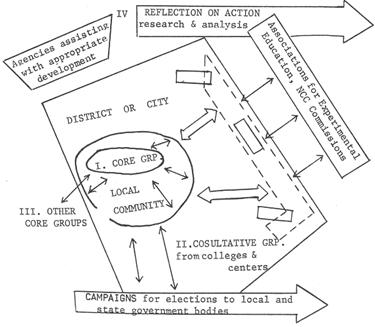
But along with the formation of such
cadres other no less necessary processes are being built, admittedly in varying
forms and degrees, in each of the program observed, so the emerging strategy
looks like this:
101
1) A People's Group or Movement
experiments with political and cultural education within a defined community of
village or city settlement. In India, the Philippines, Sri Lanka and Indonesia
for example, a cell-group of both those from the village and from outside
commit themselves for a long-term period to the everyday life and work of
village or settlement, while critically reflecting on the political and
educational issues arising.
No attempt is made to undertake
formal education or organization, but the goal is to experience and understand
the life of the masses directly, to develop an appropriate lifestyle while
living in the slum or village, to analyze the pattern of poverty, exploitation
and caste, and to study, in situation, the insights of Gandhi, Marx Vinoba, Freire, etc. in order to develop an appropriate
methodology for mass-education.
2) In the surrounding district or
city, a Consultative Group of faculty members, clergy and lay leaders, forms of
close association with the cell-group. In many cases, staff and students in
nearby schools and colleges are already engaged in a praxis
of involvement and reflection in slum-settlement or village.
One prime reason for the development
of such consultative groups, however, is that the widespread attempts to
experiment within the college or Seminary, or to reorient formal education to
the life situation of the masses, can only succeed when these same institutions
face the radical challenges of rice-roots educational movements. In some areas
(e.g. Hong Kong, Manila), such consultative groups take the form of
study-action committees: both studying particular educational issues, and
making representations to government and other bodies.
The emerging tasks of many such
consultative groups are therefore the dissemination of insights arising from
the village cells; surveys of particular dysfunctional processes in the
education system; a self-critical reflection upon their own work as educators;
as well as a variety of seminars and workshops on the work of such innovators
as Paulo Freire and Vinoba Bhave.
3) Another stage has now been
reached in India, for example, where in addition to the above elements, an
informal network is grouping in groups working in mass education. The exchange
of experience and of staff provides an essential stimulation and support which
is especially valuable where rural teams experimenting in conscientization are
frequently isolated both from each other.
102
The NCC of India assisted in the
formation of such a network by its Consultation on Mass Education. It is hoped
that this will mobilize more of the resources of Lay Centers
and Movements, and of Study and Training Institutes, in the same work of
mass-education.
It is significant that many local
teams are engaged both in adult education of a Freire type and in community
organization as both emerge naturally from their full immersion in the villagers'
struggles. Many also give priority to the formation of coalitions with other
people's movements, as well as with ecumenical-agencies involved in mass
education, and appropriate development assistance.
4) The very nature of the
educational praxis undertaken requires of course, continuing reflection and
analysis, not only upon the detailed experience of the people's aspirations and
work, but upon many aspects of rural and urban structures of power and
domination. For this, regular sessions for interpretation and critical analysis
are added to the many informal processes of team and village interaction - and
in some cases, a withdrawal phase for some months of thoroughgoing reflection
and assessment is carried out in association with a related research institute.
Notes
For surveys of the major criticisms
made of western-type education systems, see for example,
Coombs, P.H. – The World Educational Crisis-
Oxford, 1968
Curie, A. – Educational Strategy for Developing
Societies – Tavistock 1963.
See also The School of Barbiana – Letter to a Teacher- Penguin 1970.
1) The four categories here are
suggested by Sr. Collete Humbert
of INODEP, Paris.
2) Refer Plato, The
Socratic Dialogues, Apology, Crito
3) The best introduction to Freire's thought and practice is found in "Pedagogy in
Process: Letters to Guinea Bissau" – Paulo Freire, Seabury-WCC, 1978. Cf,"Teacher"
Sylvia Ashton-Warner, Simon and Schuster, 1963.
4) See for
example, Vinoba Bhave,
"Thoughts on Education" – Akhil Baharat Sarva Seva
Sangh, Raghat, Kashi
5) Examples of this being done are
given in England, J.C. – An Encounter with Education for Liberation and
Community-Christian Conference of Asia, 1975 (Singapore).