18
plunge-in
...reports reflection...
as for participants
Yogyakarta
During our first days of plunge-in,
our group stayed at a centre for studies in Salam run
by the Catholic church. In residence are the director of
the centre who also organizes some courses, and the local parish priest.
Near Salam
is an active volcano, which has a history of erupting every ten years (due
again in 1979 / 80). The Volcano, for the people of Salam,
is in one way a curse, in that their village may be destroyed. In another way,
it is a blessing as they can use the volcanic boulders to make floor tiles and
this gives them higher income than a local farmer receives. Before the next
eruption, the government has told the people that they are to be transmigrated
to Sumatra. Many do not want to go and believe in the concept of nasip or fate, that if they are destroyed, then it is God's
will.
We visited a family in Salam and were able to talk with the father who was a
teacher and farmer. He had five children and owned no land. He told us that the
general problems of the village are
19
the threat of the volcano, teenagers leaving home,
poverty and lack of progress. But the education of the children sends them away
from the villages as they go to the towns and cities to find jobs. He still
wanted to see his children well educated yet he could see this was bad for the
community.
We visited next a Catholic Minor
Seminary in Metuyudan. The Seminary has 276 boys, 8
priests and 15 lay staff. It costs the parents Rp.8000 a month to send their
children to this school and only 20% of them will go to the major seminary in
Jogyakarta to train as priests.
However, the education they receive
there is a stepping-stone to acceptance in a university or a reasonable job in
the city. We talked with some of the boys who were of average age of nineteen.
Education for them is a passport to a good job. They would not get leadership
jobs without a diploma or a degree. They understood leadership as serving the
people yet they felt helpless in doing anything to suppress the oppression of
the poor people of Indonesia. They were interested in the politics of Indonesia
but they knew little about it because of lack of media information. We were
told that many of these students would be the future bureaucrats and
businessmen.
The next few days we visited a
Community Development Program, which covers twenty low income per capita villages, it involves most of the mothers, 200 trainees or
nutrition motivators and 5000 malnourished children. This is a community-based
program including:
1) A
training program for nutrition motivators-professional health workers, e.g.
nurses, midwives, family planners as well as voluntary workers, etc. They are
given upgrading and teaching in basic concepts of nutrition and related
subjects.
2) Public
nutrition motivation in mass nutrition education especially of parents. This
involves non-formal education e.g. concepts of nutrition, breast feeding,
practical courses, etc.
3) Rehabilitation
of an estimated 5000 malnourished children in the area. This is achieved by a
food supplement program called "the under five nutrition garden"
where the children receive a nutritious meal twice a week until they reach
normal standard. The mothers and children come together for these supplements
so this gives the nutrition motivators an opportunity to educate the mothers.
We also visited Gulurejo
in the Projo district. There
20
they grow rice, coconut and bananas. Besides
agriculture, some of the people are employed in copper and silver work and
batik making. The village has recently been involved in a "food for
work" project and is soon to start on a coconut tree-planting project.
Because this is such a poverty-stricken area, a USA funding agency decided to
give food to the people on condition that they work for it. The people chose to
build roads.
The reforestation of coconut trees
is a future project for this area. At the moment, the people are making coconut
sugar from the sap of the trees. This involves cutting the tree before the
fruit is produced. It takes 25 trees to make 1 kg of coconut sugar per day,
which gives an income of Rp. 175. If they had waited
for the coconut fruit they would receive an income of Rp.
2000 per day; however, because they are so poor they need immediate income.
One night in Yogya,
we visited the people under the bridge. These people have left the villages
because they had no land and have formed a community in the last three to five
years. There are about 70 families. Many of these are thieves, prostitutes, or
garbage scavengers. About six months ago, the people were asked by the
Indonesian SCM in Yogya what the SCM could do to help
them. They asked for spiritual guidance. Since then, most of them have become
Christians and services and Sunday schools are held every week. The GMKI (SCM)
is intending to help and encourage them to find jobs and to set up cooperatives
so that the community can survive.
Some Problems We
Observed
A free listing of problems we saw
would include corruption, bribery, nepotism, subsistence living leading to
health and nutrition problems, unequal distribution of land and wealth,
exploitation of cheap labor, unemployment leading to
crime and prostitution, illiteracy, lack of free information, individualism as
against traditional community values, elitism of students, etc.
We also observed structural problems
such as traditions, which encourage passivity and fatalism, economic dependency
of villages on the city, and the whole political and economic structure.
We have several questions like: are
funding agencies achievement-oriented? Are projects set up on a part-
21
nership basis or imperialist-criteria for
funding? Are positive cultural values safeguarded or are they being replaced?
How does modern technology affect the villages? Is Pancasila
a philosophy or an ideology? What is the role of multinational corporations in
the development of the country?
Reflection
Although our experience and exposure
is limited, we have seen enough to lead us to believe that the current
Indonesian concept of development bears very little difference to the mode of
social development found throughout the capitalist world. In Indonesia, we have
seen this reflected in attempts to promote social, cultural and community
development without prior analysis and understanding of the dominant economic
and political forces at work in society and the structures, which
institutionalize those forces. Such an analysis reveals that economic and
political power in Indonesia is exercised by a ruling class whose interests lie
in sharp conflict with the welfare of the majority of the people.
Indonesia is a class-ridden society
sustained by a very complex network of ideological controls over people's
minds, principally through the media, the education system and the system of
government appointees to positions of community leadership. In Indonesia this
control is perhaps more visibly pervasive than it is in many other capitalist
states.
Given this situation, the deeply
held traditional Indonesian concept of consensus as a means of decision-making
becomes an enormously serious problem. The notion of consensus forms the basis
of the Pancasila – the five principles upon which
Indonesia is based. The Pancasila is used to hold
together the people despite differences of language, race and culture. But
while this in itself may be admirable, in reality the Pancasila
has become an instrument for ideological control since it creates an illusory
unity between social classes, which is used to justify the grotesquely unjust
distribution of wealth. For example, we interviewed one village chief who told
us at great length of his profound respect and allegiance to the Pancasila, and to the unity of the Indonesian people which
cuts across barriers of class. He then went on to tell us that the average
family earns 6000 rupias per month and own less than
0.5 ha. of land, while he, himself, receives a
government pension of 64,000 rupian per month and
owned 3.6 ha. of land.
22
Accordingly, the development
programs we interviewed are similarly based upon the notion that Indonesian
society is a harmonious whole, and the social problems are merely the
unfortunate legacy of years of backwardness. It appeared to us that there was a
serious ignoring of the reality that where there are the oppressed, there is
also is an oppressor, where there are the exploited, there is also an
exploiter.
In addition, from our end of seeing
things, we think that Pancasila presents a big obstacle
to Christians who would take the Gospel seriously. The first principle of Pancasila calls for other religious traditions. But if
Christians in Indonesia wish to proclaim the Gospel of liberation, they must
challenge themselves and others to radically question their deeply held
religious beliefs in order to determine whether those beliefs are truly
liberating or whether those beliefs serve to hinder the people's capacity to
change their circumstances for the better. However, we encountered situations
where, for example, Christians were very reluctant to even engage in discussion
with Moslems over religious and social questions on the grounds, that this
would contravene the established practice of non-interference with the religion
of another.
Semarang
The Rural Encounter
Ringin Kidul is
the name of the village we visited which is about 37 kilometers
northwest of the city of Semarang. It has a
population of about 1,166 individuals coming from about 215 registered
families. The village has a land area of 158.5 ha. And
approximately 5 to 6 ha. are used to house the
village hall, educational buildings and playgrounds.
Eleven families own pieces of land
between 2.25 to 0.5 ha. in size; 13 own 1.01 to 2 ha.;
2 families own 2.1 to 3 ha. and 2 families own lands
that vary from 3.1-5 has. in size. This means that
there are 32 families (equivalent to 15% of the total family population) which
own land. The rest, 198 families, representing 85 % of the total family
population, do now own any land at all. This non-land group
23
is the source of the labor
force in the village.
Based on the above data, we can say
that 1% of the total family population owns the biggest portion of land;3% own the second biggest area; 6% own moderately big
portion, 5% own a negligible portion and 85% own no land at all. What this
means is that wealth (as land is the main source of wealth) is very much
concentrated in the hands of the very few. So, the majority of the people in
the village suffer economically; creating a deep cleavage between those who
have and those who do not have.
The above economic structure makes
it possible for us to understand the social structure of Ringin
Kidul. The social structure based on the economic
foundation would indicate that 1% belongs to the upper class; 3% to the upper
middle class; 6% to the lower middle class; 5% to a stratum, which is between
the middle and the lowest class; and finally, 85% belong to the masses, who are not only landless, but powerless.
A thorough consideration of both the
economic and social structures of the village gives us an insight into the
nature of the political system that operates in various levels of the
community. We would think that this village's political structure could perhaps
be a prototype or micro-picture of the political reality at work in the
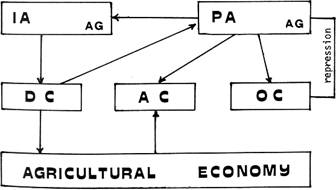
country. The diagram below pictures the political ideology in operation in the
village.
24
Explanation of terms:
IA – Ideological apparatus (mass media and
government representative)
PA – Political apparatus (military)
AG – Agent
DC – Dominant class – ruling class
AC – Auxilliary class
middle class (nice people around)
OC – Oppressed class – masses
OI –
Organic intellectual
It is obvious from the diagram that
the political ideology is carried out in the village in the dynamic interplay
between the economic and social structures prevailing. Take note that the
diagram speaks of a significant fact – that whoever controls the economy of the
village becomes the ruling class – which in the final analysis manipulates the
whole political structure to serve its interests.
We had some time to look into the
educational structure of the village. We think the structure can be exemplified
in terms of the classroom situation. In the classroom, the teacher assumes full
authority. The teacher is regarded as the only source of what is to be known
and what is to be learned. The teacher does the talking most of the time and
the pupils become the listeners and spectators. Likewise, the curriculum
followed in the school does not have any bearing with the real needs for the
people in the village. Because of this, the students learn things, which are
not relevant to their particular needs and conditions. They then become
detached to their own particular situations.
Education in the village is free
from the first six years and even up to the first two years in the secondary
school. Nonetheless, there are those who cannot really go on to pursue their
education. Only about 20% of the graduates from secondary school can afford to
proceed to the university. 30% of elementary graduates proceed to the secondary
school. The cause of children and youth inability to continue schooling boils
down to the economic condition of the majority of the people. It is clear that
only those who have the economic means can pursue higher education. What kind
of education the people who go to the university or higher than secondary
school get is another problem.
But the education instilled in the
village children would, we surmise, help in domesticating the people and is an
instrument in creating a submissive consciousness among the people.
25
SOLO
Group One
Our plunge-in in
different areas in Solo centered on rejects sponsored
by YAKKUM (Yayasan Kristen Untuk
kesehatan Umum), a health
service and a Christian foundation of Public Health, and also some kind of a
social pastoral institution. It is a combined operation of the Synod of the Indonesian Christian
Church in Central Java and Synod Javanese Christian Church. Its first goal was
a hospital, which conducts only curative and preventive measures. But it has
changed its goals according to the needs of the people, so that this – has led
to a community-based health program. The YAKKUM program helps the people
develop by way of using their own resources and has priorities in rural places
where harvesting is done only once a year due to lack of water and irrigation
system. It has 14 full branches and 10 preparatory branches in the provinces of
Central Java, Yogyakarta. It has one pharmaceutical
factory in Solo which supplies medicine to all YAKKUM branches all over Central
Java.
Rural Communities: Selokaton Solo
In Selokaton
Solo, we visited the local church, two small villages where we were informed on
the activities if YAKKUM. We also talked with one village chief and a policeman
on the economic and social problems of the village people.
While the East and West of Solo are
fertile and have plenty of water, the North and South of Solo suffer from lack
of water and barrenness of the soil. In Selokaton
Solo, insufficient water is the major agricultural problem and desperate
efforts are being made to fertilize the soil by digging in garbage brought by
trucks from Solo.
In the village of Gendikan, the average family income is 200 Rp a day, which means that the people are extremely poor.
Rice is grown twice a year with a yield of only 1.2 - 1.5 tons a hectare. Beans
and vegetables are also grown; few cattle provide milk plus providing labor tools on the farms.
Because of the poor economic
condition of the people, YAKKUM established some projects in 1974, which
assisted in improving the welfare of women, the nutritional level of the
people, and the overall hygiene of the village. It has also helped in build-
26
ing a school, a road and a bridge.
Women are being taught how to sew;
70% of the children now have six years of free education; fanners can get loans
from the government at 1% interest a month to buy fertilizer and seeds, and to
dig their own fishponds. 60% of the fanners who get loans are able to pay back
within the allotted time, but the rest (.40%) are in debt. Because of this
indebtedness and the general low income of the family, most farmers try to get
seasonal labor in urban areas. Generally farmers still
face the problem of increased water supply- most of them do not have the
capital to drill the necessary 100 feet through the calcium rock or bring water
from the Solo river, four kilometers from their
place. As in many parts of Indonesia, farmers are solely reliant on the rain
for watering their crops.
As earlier mentioned, the Church in
this region has showed concern for this village. This may be due to the fact,
that the population is 95% Christian. How this came about was narrated to us by
our interviewees. After 1965, the government required everyone in Indonesia to
choose a religion. In Selokaton Solo, there was mass
baptism arranged by the local Christian church. Probably due to the
encouragement of the village chief and the local policeman, many village people
were turned into at least statistical Christians. It was difficult to know
exactly whether the people in this village became Christians due to the
patron/client relations existing in a good part of Indonesian society or it was
a product of real belief.
Purwodadi
Purwodadi is situated about 60 kms. from Solo, at the mountain-side, secluded from city life.
The people live in very backward conditions of life, isolated from the
communications, the amenities and facilities available in urban areas.
The people of the area had a
historical background of having been under strong influence of the communist
movement in Indonesia before 1965. After 1972, the communist influence had
almost vanished. We were not able to inquire into the conditions, which made
the village people espouse communism.
YAKKUM opened up a centre here and
provided it with the services of a doctor, two nurses and paramedic-
27
cal staff. YAKKUM has also provided the services
of an instructor on the community welfare program. He lives in Solo and comes
to the centre twice a week and holds classes there. We observed that there were
only women in his class. And that he used the old type of lecture-style in
teaching. We did not observe any of the students asking any questions or
discussing with him. But the instructor assured us that the people discuss with
him problems and issues.
The instructor told us that the
primary needs of the people are basic: food, clothing and shelter. Health is
secondary.
Tamanan Kalasan
This village is about 50 kms. from Solo and really belongs to Yogyakarta.
The Yogyakarta branch of YAKKUM operates a family
planning clinic and a community centre in this village.
In our discussion with the YAKKUM
worker, we learned that the basic problems of the area are two-fold: the dense
population-827 inhabitants per square kilometer - it
being the second most densely populated area in Indonesia, after Jakarta; and
the limited arable land. 50% of the land is mountainous, not fit for plantation
and of the other 50%, only 11% can be planted with rice. The long dry seasons
and the pests that destroy the padi, add more difficulties. Then there are the
problems of malnutrition and the unemployment and under-employment of people.
There are also a good number of dropouts who are attracted to the city.
YAKKUM's community project started in 1975
with the introduction of family planning and health and nutrition education. It
also introduced the knowledge of rearing rabbits, chickens and fishes. For the
drop-outs, vocational training is provided. The idea of promoting opportunities
to increase employment and the per capita income is being considered. A youth
program on leadership and interest groups is organized to help promote a sense
of belonging and identity among the young people in the village.
These programs however do not solve
the basic problems of the area. Thus, a plan of transmigration to South Sumatra
is being considered. But YAKKUM had a bitter experience in transmigration of
people in 1972 when it failed to move the people to Sulawesi due mainly to the
unwillingness of the village lead-
28
ers who were afraid that they might
lose their status in the new place. Also there is the factor of a belief among
the people that “whether there is food or not does not matter; the important
thing is that we should live together”.
Reflection
We are very aware that our plunge-in
experience is limited as much of the information we gathered are the result of
our interviews of YAKKUM workers, government officials. Based on such limited
data, we would venture our collective reflection.
It seems to us that many people both
in urban Solo and rural areas surrounding the city live at a subsistence level
or even below. For many of the farmers, life is one long struggle, although our
contacts did not emphasize this point. In fact it appeared that there was not
much freedom of expression among the people we met. There seemed to be no
expression of struggle; the general spirit would adhere to the Javanese saying
"one should not go against the flow of the water". We did not come
across any organization among the farmers that would protect the interests of
the farmers and their families, unlike in some Asian countries. Likewise, in
the city, there does not seem to be any trade unions that are working for the
genuine interests of the workers.
While it is said that education in
Indonesia is free only 40% of the school-age population are able to attend
elementary schools, and the percentage gets smaller as one goes up the ladder.
Many of the children do not go to school as they are a needed force in
contributing to the family income. The universities seem to train people only
for elitist and highly paid positions in society.
We have more questions now than when
we started our plunge-in such as why are the majority of the people of
Indonesia poor while Indonesia has many rich resources and such a vast
potential for economic development? We feel that our
little understanding of the culture, particularly the Javanese culture, has
been an impediment to our investigation. But we are grateful for the
opportunity of visiting the various urban and rural areas and to the help
extended to us by our friends at YAKKUM.
29
Group Two
Our plunge-in was arranged by the
Solo YIS office, non-governmental welfare organization, which is mainly
involved in community development programs. Our main difficulty in our
experiences was language – since no one among us knew how to speak Indonesian
and almost nobody spoke English. Fortunately, we were able to manage with the
help of some foreigners who had stayed in the villages for sometime.
Karangkober
The villagers in Karangkober
have organized themselves into community groups to run their own development
programs. Each RT (the smallest local government unit consisting of 2-40
families) has organized its own health system. Each family in the RT pays 50 Rp. a month although this varies from area to area. With
this fund, they buy simple drugs to treat minor illnesses, administered by a
volunteer health cadre. Major cases are brought to the local government clinic,
also subsidized by the RT. The village people also run nutrition education
programs to improve the health standards.
In a nearby village, Gumelar, the people decided that their priority is housing.
So each family in the village contributes a certain amount of money each month.
Every month there is a lottery drawn to choose the family for whom the house
will be built.
In each case, YIS provides training
on how to run the scheme. We were told that only a small capital is needed to
make the projects operational.
Semarang
Two slums areas were visited. The
people here, mostly laborers and drawn from all over
central Java, are very poor. The YIS program here is not as successful as it is
in the other areas visited. The reason given was that there was not a strong
feeling or community among the people. The program on health education and
welfare had to stop momentarily because there was difficulty in collecting the
dues.
A confusing contradiction observed in
the area was the presence of the “luxury goods” such as television and
motorbikes. It seemed that people would spend more on
30
these luxury goods than the basic things such as
food, clothing and better housing. An explanation of why this is so was never
given.
Megalang
Megalang is a semi-urban area, 100 kms away
from Solo. Although we visited two nearby villages, the highlight of our
plunge-in was Pasantrean in Pabelan.
A Pasantrean
may be simply described as an Islamic boarding school. We were informed that in
Java alone there are nearly 17,000 Pasantrean
educational institutions with 5 million students. The Pabelan
Pasantrean, as most other Pasantreans
in Java, is situated in a rural atmosphere. There are 900 students, 250 of whom
are girls. Out of the 42 teachers, 6 are women. This Pasantrean
was re-started in 1960.
Students come here at the age of 13
and stay here for 6 years to complete the equivalence of high school education.
The education they receive however is not recognized by the government. They
say the aim of education in a Pasantrean is a
preparation for moral and religious leaders. It is expected that the students
will go back to their respective communities to become informal, and in some
case, formal leaders of the people. They lead a community life with a degree of
"we" feeling. They learn not only in the classroom but also in the
paddy fields. In addition to the religious studies and other subjects like
Mathematics, Arabic, English, Sociology, etc. the student also learns agriculture,
horticulture, carpentry, handicrafts, etc.
The teacher informed us that the
teachers are not only teachers, they are also students. They said that they
learn from their students, the villagers and even from guests like us. This
kind of education reminded us of Ivan Illich's
"de-schooling" and also Gandhi's ideas on basic education.
The day we spent in the Pasantrean was really the best day during our plunge-in
period. The elite – based Christian educational institutions in Asia certainly
have a lot to learn from this type of rural-based education.
Group Three
As orientation to the problems and
needs of Solo, we were introduced to the work of the Social Welf-
31
are Guidance Foundation (SWGF). This organization,
under the Council of Churches, was involved in grass roots action, promoting
productive and development – oriented activities among the people. The group
consisted of about 15 workers, each involved in a specific area and project.
For instance, there was the industrial coordinator who worked with the industrial
workers by helping them organize themselves into a cohesive group. There was
the community nurse who went as far as 30-50 kms. to
teach Javanese women hygiene, baby care, nutrition and home economics. There
was also a poultry farmer who acted as a go-between or contact person between
the SWGF and the kampongs or villages.
The orientation leader explained
that their aim was to organize people in action and development-oriented programs
and also provide orientation regarding these programs to churches by means of
seminars. Very often, the Church tends to be isolated from the people, and we
thought that it was a good job the SWGF was doing in providing conscientization
to the churches regarding the problems of the common masses
Their main areas of activity were
outlined as:
1) Theological reflection
2) Human development
3) People's education
4) Documentation and information
5) Community organization
6) Ecumenical
network
During our plunge-in, we had
meetings with local leaders in the Semanggi area.
These leaders were elected by the people and they organize educational and
cultural activities and also act as spokesmen to the community in general. They
are recognized by the government and many of them are retired school teachers,
army men, officers in the government, etc. Their help and cooperation is deemed
to be indispensable.
Much work is done among industrial
workers by means of contact persons. The centre director has consistently
stressed the idea of working, thinking and developing with the people. They
never try to do anything for the people, except to encourage them to organize
and help themselves. The SWGF helps by instructing the workers on their rights
and look into methods on how to fight for their rights. At present, the
organization is assisting workers in the “Terpedo”
textile factory to fight against the injustice meted out to them by the
managers of the
32
company. Among the problems faced by the
workers are:
1) low wages,
approximately 25 US cents for 9 hours of work plus US 12 cents as an incentive
for attendance;
2) unfulfilled promises
of promotion;
3) improper industrial
health treatment;
4) money compensation
and various bureaucratic fines for workers; and
5) forced labor when fatigued or ill
or during holidays.
Since one of their problems was the
immense power of the companies (usually jointly owned by a few government
people), the workers had to resort to direct contact with the Jakarta
authorities for help in settling their grievances. Even the union was
emasculated by bribing top officials. At the time of this reporting, the Centre
director was away in Jakarta, with some workers, trying to voice out their
problems to some sympathetic governmental men or agency.
We also visited different areas of
community activity such as cottage industries e.g. batik making, tile and brick
making, and also production of copper-ware. These rural communities showed
great self-sufficiency in their life-style. We learned that batik workers
averaged Rp.500 a day. In one batik factory, comprising several workers, only
the man in charge of the printing got the highest wage of Rp.1500 per day. In
the brick and tile cottage industry, using backyard level technology, the
return depended upon the amount of production. This production depended on the
time allotted, given the other competing activities of a rural community.
In a kampong north of Boyolali, between Solo and Salatiga, the workers were
involved in quite artistic copper smithing. The
government encouraged work by helping train some locals to improve the
techniques of production and marketing. There were 30 families engaged in this
activity. Here the mark-up over the cost of production was around Rp.500, yet
though this could come out of a day's production, the
marketing of the goods was difficult because of the distance and uncertain
prices.
In farming, there was a distinct
absence of mechanization and almost all cultivation was done manually. In one
area we visited, the average land holding was around 4 acres and then only
about 30%-50% of the folks actually owned some land. Most had to
33
find other paid work to supplement their income.
In the sphere of social activity, the
SWGF workers work with prostitutes. Prostitution was government organized in
Solo. A visit to the Silir or local government
organized brothel was an eye-opener to what was called the "second best
solution" to the problem of prostitution. Two such government organized
communities in Solo were banned to foreigners. Most of the women were
particularly young, usually around 18 years old. Working from 9:00 a.m. to 12
p.m. midnight, these women could earn from 7,500-10,000 Rp.
In Silir,
the SWGF workers were also engaged in bible study groups and
rehabilitation-oriented training schemes since according to them the women had
happily accepted their profession as a useful vocation. There is no attempt of
weaning these women from prostitution.
Another problem being tackled by
SWGF was the human resettlement or relocation schemes of the government.
Compensation for land expropriated for dams or other projects of the government
had not been fully paid to the people after they shifted to Sumatra. At best
about 20% of the amount due the people was paid; the rest lost in red tapes of
the government bureaucracy.
We were also informed of the
widespread poverty. For example, the "beca"
or peddle-taxis, might on the average, earn Rp400 per day. Of this, they have
to pay the rent to the owners of the vehicle Rp300, which leaves the driver /
worker a measly Rp.100 per day. Another example given us was the push for youth
to join the army for the simple reason that they can earn more easily here. A
graduate from the junior high school after 2 years of training would earn Rp.2,500 per month, while a graduate of senior high after 4
years of training would receive Rp.4000 per month.
Another area of interest was the
school system. There are two class sessions with different pupils. This is to
absorb the great number of school age children and also to maximize the use of
limited space. In the rural areas, there are many children who cannot 90 to
school. A great need for teachers is reflected in the fact that 18 year-old
high school leavers are often recruited to teach in elementary schools.
On the whole, we found our
experience and encounter of community life at grassroots level quite reward-
34
ing. The 10 days of
"plunge-in" into the culture and language of the Indonesian families
we stayed with has provided us valuable insights into the people and their ways
of life.
Relection
Outlined below are some of the
peculiar things we observed. They are peculiar because they are quite different
from the situations back in our respective countries – Japan, Sri Lanka and
Fiji.
There is a distinct military
presence as we move from one area to another. The attitude of the bureaucracy
seems to be militaristic as could be gathered from the many sculptures,
monuments and the widespread use of security guards and uniforms.
The presence and influence of
foreign commerce and industry cannot be ignored. There just seems to be lots of
plastic stuff around.
Even though there are low wages in
the unskilled jobs people will accept these jobs. There are low prices for
basic foodstuffs and transportation. There is such a contrast in the means and
modes of transportation, from the beca, horse drawn
carts, trucks, motorcycles to the Mercedes Benz without the middle class cars
or the range of cars. There seems to be distinct upper and very low class in
terms of income.
The transmigration
scheme of the government-shifting people to Sumatra to ease the high density of
Java. But these
carry a lot of problems – among them the lack of adequate compensation to the
settlers.
The Chinese are regarded with
antagonism, probably because they belong to the upper merchant and property
owning class.
The practice of religious activities
is not as free as in our countries. For some reasons, there are laws banning
straight evangelizing or conversion programs. But we also discovered some
churches using new forms of liturgy to conscientise
the church members.