86
WSCF:
History and thrusts
Emidio Campi
There are two things I would want to
take up with you tonight. One, to give you a sense of a
history of the Federation. We are after all one of the older national
ecumenical Christian organizations existing. It would be a pity if we ignore
our history.
The second is the basic idea that
the little groups and movements scattered around the world which constitute the
basis and hope of the Federation are part of a worldwide fellowship. So that
whatever you do in Papua New Guinea, in Japan, in Fiji or in Iceland, in Europe
in Madagascar, we are all part of a worldwide family which we call the World
Student Christian Federation.
Now a few historical notes:
1. The Federation was organized in
1895 to become WSCF, a federation of national Student Christian Movements. I
wish I brought a picture to show to you of the founding fathers of the
Federation. It was on 21 August 1895 that five distinguished gentleman in Wadstena, Sweden and they were certainly conscious of their
historical role. Five gentlemen – an American, 2
Scandinavians, one British and one German. Mind you, there was no Asian,
no African, no Latin-European. I was not represented
by those people. There were no women. And those five gentlemen had basically
one idea – to create an organization whose role was to
86
contribute to the emergence and
conceptualization of the modern missionary movement. Of course, mission was one
way – Europe towards the pagans.
It was no accident that the
Federation was founded in 1895 for this was a very important year. It was
during this year when the Berlin Congress took place, when the super powers
divided up the world. The missionary movement was in a way the response of the
churches to this kind of imperialist expansion from Europe and North Atlantic
countries into the third world areas. I emphasize the fact that it was the
Europeans and Americans doing this. In fact, the American who was there
represented what, if not the triumphalistic Protestant
churches in the USA at that time. The two Scandinavians represented the
Protestant welfare states; the British was certainly H.M. the King and the
British empire; and the German representing the
so-called Culture (with capital C), the German university.
Now those five gentlemen had another
idea – the conceptualization and expansion of modern missionary movement should
tap specific forces, the students, young intellectuals. And their strategy was
very simple: to reach out to students, to motivate them, to mobilize them and
to send them out into the world – to Asia, Africa, Latin America – to
evangelize. This was the strategy of WSCF from 1895 until World War I.
Why until World War I? Because the
five gentlemen did in fact represent the bourgeoisie, the Christian
bourgeoisie. But the Christian bourgeoisie lost its battle at the end of World
War I. The optimistic friends in Europe were destroyed because thousands,
millions of young people died in the battlefields in Europe. And the young
people no longer believed in the endless triumph of the bourgeoisie.
2. 1917 was the period of the
October revolution. New forces were emerging in history. The bourgeoisie became
aware; the Federation also became aware that mission was not as simple as that.
That mission does not mean moving from Europe to Africa, to Asia. And that superior attitudes imposed upon emerging peoples in
Africa and Asia were no longer valid.
And so, it was that generations of
students joined the Federation immediately after the First World War. We began
to see here and there groups joining such as the Chinese SCM in 1921, the SCM
of India in 1922 and some emerging movements in Latin America. These new
movements began to realize that there should be a shift in the Federation and
indeed, in the period between the first and second
World War, the Federation changed its
87
emphasis. It began focusing on the whole
question of ecumenism. There is hardly a church historian who could seriously
deny the role and importance, which the Federation has played in bringing about
the ecumenical idea. So the Federation embarked itself on a major program of
motivating young students, young intellectuals, young
church leaders on the ideals of ecumenism for the renewal of the church. That
was in the '20s. Still today, churches are provincial and parochial. But you
can imagine how they were in the '20s! And how progressive
the stance of the Federation was. The old Biblical ecumenical renewal
came about largely due to the work and role of WSCF.
These were the first two phases of
the Federation- missionary and ecumenical phases. If you consider the
missionary and ecumenical movements as the most important events in modern
Christian history, one can understand why the Federation can claim to be one of
the most formative organizations, which gave key features to modern
Christianity. And I say that historically speaking, the leaders and members of
the Federation were people who took a very advanced position in the missionary
and ecumenical movements.
3. The years following World War II
found the Federation re-thinking its raison d' etre
from one born as a wing of the missionary movement to one shifting its emphasis
to the ecumenical movement. A number of factors compelled the Federation to
re-think its reason for being:
i) The erosion of the clear but
somewhat simplistic concept of mission of the church that under girded the
missionary movement, which was brought about by the traumatic experiences both
of the churches and the world. It was the end of the foreign missionary era. There
was serious questioning of so many of the assumptions about the relation of the
church and the world, and the role and function of WSCF and the SCMs.
ii) 1948, another momentous event took
place in modern church history as this marked the formation of the World
Council of Churches, which saw the subsequent integration of the missionary
movement and the ecumenical movement in an organizational structure. So when
people tell you that the Federation is a sort of a kindergarten organization,
don't forget that it is much older than WCC and that the WCC is the retirement
house! But we maintain cordial relations anyhow.
iii) The dramatic expansion of the
work of the Federation from its predominantly Western origin to that of a
Federation of movements in all continents. The coming in of movements from Asia
particularly in the early '50s and from Africa and Latin America in the '60s
changed entirely the self-understanding of the Federation.
88
So the initial result of this
rethinking was the understanding of the peculiar place of the Federation in the
university and also institutions of education and higher learning. The trend
was from missions to ecumenical movement to the university. And perhaps the
most important event which influenced this change happened here in Asia,
actually in India at the Nasrapur Assembly in 1952. This Assembly provided a
serious look at the reality of the history of Christianity and for the
Federation it marked the new emphasis on the university. In a flurry of
subsequent meetings of the Federation, this frontier on the university, higher
education, was thoroughly explored. This was the period when all movements and
parts of the Federation all over the world would have booklets published on
themes like "The Role of the University in Asia", "The
Professional Outreach for Students in Africa", etc. Perhaps the high point
in this emphasis was the production of a document, which the generation of
senior friends present tonight should know quite well, which was produced in
the General Assembly in Embalse Rio Tersero in Argentina in 1964, Christian Presence in the
Academic Community.
During this stage, the Federation
understands itself as the specialized agency, which takes care of the Christian
presence in the university world. But the process of re-thinking did not stop
with the theme: the Christian Presence in the Academic Community. The period of
the early '60s was one when new movements entered the Federation. It was during
this period when most of African countries fought and won their independence
like Kenya, Tanzania and Uganda. And those students who fought for their
national independence joined the SCMs and the WSCF. You can imagine what kind
of problematic those students brought to the SCM, which was not in keeping with
the Christian presence in the academic community. Those who had spent their
lives in guerrilla warfare could not find themselves at home in the SCMs
discussing the future of the university. The Cuban revolution in 1962, for
example, was extremely important for the Federation because a movement was
created and those students who participated in the struggle against Batista and
the dictatorship could not find their place in the Federation where we could
discuss the role of the University in general and with a capital letter.
Little by little, our students began
to explore other frontiers of the world. And so, when we came to the General
Assembly in 1968, where incidentally I met Supardan who represented Indonesia
and I represented my national movement, we began to realize that the Federation
should begin to be involved in world politics, with
89
the question of the relation between faith and
politics. And it is only in the light of this development which, I tried to
describe briefly that the current pre-occupation of the Federation can be fully
understood. So at the General Assembly in Addis Ababa in 1973, two major lines
of action wire defined which expressed the desire to pursue a clearer
perception of the political challenges to which both the churches and
universities should respond to at this time:
i) The first line of action was,
embodied in the adoption of a quadrennial theme, which was re-confirmed and
endorsed at the last General Assembly in Sri Lanka in 1977 – the quadrennial
theme of liberation. In adopting this theme, I remember the debates in Addis
Ababa, for the Federation did not only commit itself to the study and
exploration of the meaning of liberation, but affirmed that more than any other
concept, liberation summed up the human aspirations of our time, and,
therefore, constitutes the primary challenge to which Christian churches,
Christian communities must respond.
ii) The second line of action was
the adoption of regionalization as the basic structural framework through which
the programming and decision-making processes are to be undertaken. Up to 1968,
the Federation was a very centralized structure, with all the staff based in
Geneva and decisions made in Geneva. In Addis Ababa, we formally accepted a
regionalized structure with regional committees, regional offices, regional
programs and decision-making. This should not be understood as a structural
adjustment. I would say regionalization for the Federation in its simplest
probable terms was the positive answer to one of the greatest challenges facing
humanity today, i.e. the relationship of North and South, whether you take it
in political or geographical terms. The issue is: How can we exist together
while knowing that we have had 400 years of dominance from the North towards
the South. And the answer of the Federation was not a sort of withdrawal which
would say, "let us put our things together", or a kind of masochistic
attitude which we find very often in international organizations where people
from Africa, Asia and Latin America would shout at the Europeans and North
Americans, "You big imperialists" and that's all. But the
Federation's answer was positive. It was a creative answer. It was
regionalization, which means that we shall attempt to reconcile the demands for
identity and self-determination with the fact that a world of community must be
built on the foundations allowing freedom of each member.
So over the last four years since
Addis Ababa arid then
90
at the last General Assembly in 1977, the world
of the Federation was dominated by the theme of liberation. In fact, the
current theme is "Christian Witness in the Struggles for Human
Liberation". On one hand, this theme represents the overall concern of the
Federation; on the other hand, precisely because we have given up, hopefully,
forever the idea of world strategy, we are more concerned with the life of our
movements, this theme is interpreted in many different ways, according to
different situations. And so, for example, Asia would stress more the problem
of self-reliance and theology in Asia, the struggle for justice and its
relation with faith; for Africa it will be the question of struggles against
imperialism, neo-colonialism, apartheid and the search for an African identity;
in Latin America, it will be more on the struggles against fascism,
militarization of societies, search for theology of liberation, etc. One of the
latest statements of the Federation says succinctly: "The Federation
considers itself as part of today's community of believers called the Church
and strives to become a community of believers looking for new ways of
expressing faith in the context of a political commitment to the struggles of
people for economic, social and political liberation".
That briefly is the history of the
Federation. I wish I had more time to deal with other valuable aspects of our
history. But let me just say that the more I look at our history in the
Federation, the more I see discontinuity in this history. And I would say, happily
so, because it is a history of witness and witness to be incarnate must be
attuned to the signs of the times. It would be a pity if the history of the
Federation would be continuity. It was born as a missionary movement, it became
a champion and forerunner of ecumenism, it focused on the university, and now,
it pre-occupies itself with the frontier of the relationship between faith and
social and political issues. And in the history of this witness, you as well as
other Christians all over the world, are invited to
participate. It is a fascinating history, I think one
can even be proud of it. But the glory is to God and not to us or to our
forefathers.
4. Now let me say briefly what are the major thrusts in the Federation today as they
emerged out of the last General Assembly.
i) To make the Federation a
school of ecumenism. Let me explain what is meant by this. The Greek word
oikoumene means the whole inhabited earth. I would say everything which is human
is a concern for us,
91
everything which expresses the aspirations and
hopes of the people's struggles for a new society, for a new world, where
hopefully there would be justice, more freedom- the task of the Federation is
there. One of the primary tasks of the Federation is to mobilize young people,
to reach out to young people, to make them aware that we are living in a
divided world between those who have too much and those who are hungry, between
those who have power and those without power, between those who rule and those
who obey, and to make this divided world, one world. To make the SCMs in Fiji,
in Madagascar, or wherever the SCM is, a place where young people can learn
together not only for their youth time or student time, but for all their life
time, to commit themselves to the struggles for a just and human society. A place where we in the SCMs learn the contradictions of society
and try to overcome them.
ii) To take up again the
education issue. Here I need to make myself clear. The Federation in its
history has always had the concern for educational issues. But this concern has
shifted. In the '50s, it was the concern for Science and Culture, THE
University. Today, when we approach the question of education, we should be
aware of one major problem, i.e., that the over-all political context has
become gloomy. We must be aware that the process of liberation to which we have
committed ourselves as a Federation is a rather difficult one. Arid there is no
guarantee that light will triumph over darkness. We are probably seeing today
the dawn of a new society. If there is any wisdom in Mao Tse Tung, in my modest
view, it is that he saw that the process towards socialism will take years arid years. And therefore, at this stage of human
history, when the struggles for liberation are so difficult, so complex, it is
important that education as a means of thinking in long terms, becomes a
concern, And any organization which will be able to help people become aware of
the difficulties and overcome them is welcome in the process of liberation. I
hope the Federation will be one among those organizations. That is why we in
the Federation have this special emphasis on education for the current
quadrennium. Again, not looking at the institutional higher education as
isolated from society, but part of this process of awareness-building for
people who are participating in the struggles for liberation.
iii) To underscore our identity as a
Christian organization. This aspect is very dear to me - we should never be
ashamed of it. The present position of all our work as we struggle for a more
human, a more sustainable society, as we struggle for new patterns
92
of education is the question; How do we relate
these struggles with our Christian faith? Therefore, as our statement says in a
marvellous way, "looking for new ways of expressing our faith in the
context of a political commitment to the struggles of the people for economic,
social and political liberation" How can we prefigure a new way of being
Christians? a new way of praying, a new way of singing, of sharing the
sacraments while struggling for a new world and a new society; while struggling
not for the people but with the people, because we do not have anything to give
to them, they know what to do. How can we prefigure a new Christianity? The
Federation historically has always prefigured Christianity: it has prefigured
missions; it has prefigured the ecumenical movement; it has prefigured
Christian presence in the university and the academic community. It is possible
that all over the world while respecting national characteristics will emerge a
new community of believers who confesses, who
expresses a firm stand on the hopes and problems of the peoples' struggles and
at the same time confesses Jesus Christ as the Lord of history. When shall we
be able to build this kind of community? This is the kind of wager, which we in
the Federation have to make. And I would say to all of you, "You are
invited in this struggle, in this search".
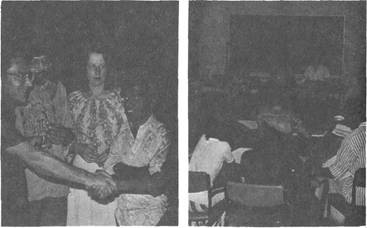
Emidio meeting some of the ASFORians (l) and ASFOR in session (r)