21
CENTRAL LUZON REPORT
Central
Luzon is regarded as the rice granary region of the whole Philippines. This
report covers two areas in this region: Pangasinan
and Bulacan provinces.
Despite
the differences between the two areas, the report covers common problems faced
by the farmers, peasants and fishermen to whom the groups were exposed.
a) Pangasinan - Calonutian and Soubul
b)
Bulacan - Pulang Tamo
and Bananawan
Pangasinan: San
Nicolas-Barrios Calonutian and Soubul
Barrio
Calonutian is situated at the tributary of Chico and Agno rivers and is about 5 kms. from
San Nicolas town. It has an estimated population of about 800 inhabitants. The
primary livelihood of the people is the cultivation of rice and their secondary
means of living is collecting of gold dust (black gold mining) near the river
bank.
Our
group was informed that the barrio is regarded as one of the poorest barrios in
the town. We were first exposed to the situations and problems of the farmers
during a brief meeting with the people on the night of our arrival.
Most
of the peasants are tenants, i.e. they do not own the lands they till. The
lands are owned by landlords who either live in Manila or other cities and
towns. The peasants still use traditional methods of cultivation such as animals
(buffalos) and ploughs. Most of the work of planting and harvesting are done
manually. This indicates that 1) the farmers are that poor not to be able to
purchase any machines to help them in their farming, and 2) their productivity
is relatively low when compared to using "modern methods" with the
aid of machines and fertilizers.
The sharing system,
characteristic of their feudal
condition, is being practiced. The sharing
is on 50-50 basis, which means that
out of the total net earning, 50% goes to
the landlords and the other 50% to the peasants. The average income
earnings of the peasants are about P2, 000 per annum depending upon the
produce. To supplement their diet, the farmers grow root crops such as sweet
potato, cassava and crops \'^ bananas, etc. but on a very small scale
Besides
farming, the peasants also spend a lot of time in collecting gold dust. This is
not an easy task because they have to work long hours under the hot sun before
they get even one gram of gold dust in one or two days. The gold dust usually
is valued for about P29-30 per 2 grams.
Living
or subsisting in such conditions we could see and observe some visible signs of
the poverty of the people in the area:
— some of them wear the same clothes for a long stretch
— the kind of food they eat
— the frequency they eat (some
cannot afford to eat 3 meals a day)
— no electricity — they use coffee
bottles for lamps
—
no modern conveniences such as radio
We
have noticed a very strong sense of collective life among the people. This is
seen not only during harvest time but even in daily activities. There is one
cooperative store which serves the whole barrio.
Some
of the problems which press high on the people are the following:
1)
Infrastructure — no
roads connecting them to the town of San Nicolas; therefore, they have no
access to means of transporting their crops to the town market. To reach the
town, they have to walk a distance of about 8 kms. and
cross 4 rivers with the products weighing heavily on their shoulders.
Sometimes during the rainy season, they are not able to ford the rivers because
of floods and this means that their income is greatly affected.
2)
Health care - there is
no hospital around the area, not
even a clinic which will ten" the people for minimum medical services.
The problem becomes more acute
when
22
people get very sick and they need to be rushed to San Nicolas
and during rainy or typhoon seasons, the problem is immensely compounded. Once a person who was very sick had to be carried by his family to
the hospital but because of the distance and the difficulty in bringing him to
town, the sick person died on the way.
3)
Education — there is
only one primary school in the barrio, which serves 200 pupils. After primary grades,
the very few who can afford go to town for secondary schooling. There are no
school fees in the primary school although the parents pay P1.00 for Boy Scout
activities.
4)
Pollution — the
farmers are facing grave water pollution problem which affects their paddy
fields. The Agno river, from which they get their
water for their rice fields, has been heavily polluted by the copper mine at
the upper part of the river. The degree of pollution has been accelerating
since the establishment, of the copper mine forty years ago. A lot of crops
have been destroyed affecting the very livelihood of the people.
5)
Protection Dike
Construction — this is the most pressing problem of the peasants. The dike,
which is a government project, will, according to the authorities, protect the
rice fields should floods come. It will cover about 500 to 600 meters from the
bank of the rivers and is now under construction. The peasants have been
opposing the construction because even though the dike shall protect the farms
and houses from floods, it will also leave the fields unproductive due to lack
of water. That is, unless the engineers can build breaches through it to allow
the water to flow into the rice fields. The farmers have organized themselves
into an association and have sent a petition to the government. On two counts,
the authorities had turned them down: first, the government refused to
recognize the peasants' association and, second, the government responded
negatively to their petition. Instead, it gave the farmers an alternative
solution: migrate and be
evacuated some where else.
6)
Resettlement — against
the will of the people, the plan is to move the people to Palawan,
southern Philippines. The people together with the social action group, are still trying to elevate their problems to higher
authorities. But so far no response to their petitions has been received.
Although
feeling frustrated because of so many disappointments, the people with the help
of some social workers are trying hard to solve their problems. One of the
things they do is to try to understand their situation and why they are
neglected by the government.
Our
group spent only one night in the next barrio — Soubol
which is located at the tributary of the two rivers, about 6 kms. from San Nicolas. About 1000 people inhabit the place. We
have found the problems and situation in this barrio very much akin to those
found in Calonutan. And again, the most urgent of
their problems is the construction of the protection dike which will also mean
the drying up of their farmlands and the eventual uprooting of the whole
barrio.
Bulacan: Pulangtamo and Bananawan
Pulangtamo has a
population of about 1,000 and is located about 17 kms. from
Malolos. The farmers here are mostly tenants, which
mean they work for landlords. Their food is mainly rice, root crops and other
forest crops as substitutes. Although in general, the peasants use traditional
methods of farming, there a handful of them who have hand tractors for use in
the rice fields. They also have access to roads which enable them to market
their harvests and crops.
The
average income of the farmers is P3.000 to P4.000 per annum. This is a little
bit more than what the farmers earn in Calonutan and
Soubul.
The
group discussed with the farmers mostly problems concerning their work of
farming.
23
The
foremost problem is irrigation. The lack of water has done a lot of damage on
the crops; thus, the farmers can only plant and harvest once a year. The farmers
have also experienced some pestilence like the rats' plague, rice diseases like
"tongu" and most lately, a pernicious type
of wild weeds have been destroying their crops. Also, the lack of resources to
buy fertilizers was mentioned.
Bananawan
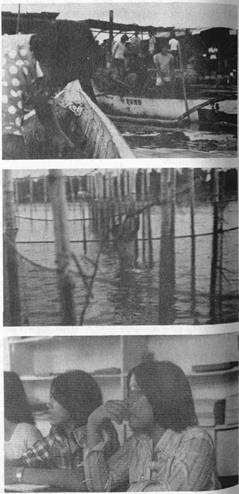
Bananawan, which
has a population of about 2,000, is located near the sea. People there derive
their income largely from fishing. An average fisherman may earn about P25 to
P30 per day, depending on the catch of the day. The annual income of a fisherman
in the fisher village could range from P7.000 to P8,000
per annum. This means that by and large, the people in Bananawan
are a bit better off than those in the other barrios visited by the group.
Even
on the physical level and through short observation, the groups were impressed
with the relatively better living conditions of the people in the barrio. We
saw a number of houses with radios, some with television sets, and other
luxurious items, which we never encountered in the other barrios. We also
observed that a greater time of the day was spent by many fishermen in talking
and drinking beer.
Such
appearance, however, does not represent the whole reality in the village. For
the reality is that about 90% of the fishermen are poor. They do not have motor
boats or big fishing nets. They rent the motor boats and big nets from the rich
fishermen. To square off their debt, they give up 50% of their daily income to
the rich fishermen. So here we see the sharing system based on 50-50 operating
in a feudal set-up.
Conclusions
The
group concluded that the realities they were confronted with in the four
barrios visited during the live-in experiences reflect in a great similar way
the problems in almost all the third world countries: the exploitation of the
masses by the few, the enjoyment of the wealth and resources of the earth by
the powerful at the cost of the great many, and the continuing dependency of
the masses on the very "haves" who constitute only a very small
percentage of the total population.
Group Members:
Paul Masta, Paul Sarkar, Alongkorn Panlaboot, Sushil Jacob and Zulkifly Lubis