28
28
ZAMBOANGA REPORT
Basilan Province: Some General
Notes
Basilan
is one and a half hour boat ride from Zamboanga City. Transportation cost from
the city is P3.00 for ordinary class and B4.95 for first class.
Basilan's
population is 18,0000, 40% of whom are Christians. In
the seven towns of the province, only one, Isabela,
is under a Christian mayor. The rest are Muslims and more often are relatives
of rebels. All the mayors are appointed by the President. Curfew is still
imposed at 12:00 midnight up to 4:00 a.m. People have reached a point of
resignation to the peace and order situation in the province.
There
are five groups of armed men roving the area: 1) Wanted men, 2) robbers (tulisan), 3) copra battalion, 4) MNLF (Muslim National
Liberation Front) and 5) the Military.
The
military has always been alert. Basilan was always under continuous attack by
the rebels as there is a great military concentration in the area. In Isabela alone, there are three battalions of the army. This
is however far less than the ten battalions deployed at the outset of Martial
Law.
To
counteract the rebels, the military use the carrot-and-stick trick. A ‘balikbayan’ (meaning one who capitulates) is accorded the
following privileges: 1) P5.000 loan 2) a motorcycle, 3) a sack of rice and
canned goods monthly, and 4) retention of guns. Most
of these people, however, late become 'balikbukid'
(meaning one who returns to the rebels' side).
The
military conducts punitive actions against the MNLF, Muslims and Christians who
co–exist with each other. The people resent the military's intrussion on
their daily life. Searches of houses, bags, persons’ belongings are not
infrequent. Anywhere and anytime the military can call a person to produce
his/her residence certificate.
A Glimpse at the American Rubber Company
The
American Rubber Company is located at Baluno, Isabela. The Company which is managed by B.F. Goodrich, occupies 1,300 hectares of land. Everyday about
15,000 to 16,000 liters of latex enter the milling machines.
The
workers of American Rubber Corporation number about 300 and most of then are
tappers and the rest are either drivers
29
or factory workers.
Here are some observations on the similar fate from which they all suffer.
1)
The agricultural workers receive an average wage of P12.50 per day. This includes
the minimum wage of P7.00, salary adjustments, company merits and premiums. The
industrial milling workers receive P11.50 which includes their minimum wage of
P9.00. The company's accountant receive P1,800 a
month; the production manager, P2,000 and the resident manager gets a salary of
P28,000. The resident manager is a Dutch. One is staggered by the incredible
gap in the wage structure!
2)
The workers work 6 hours a day, from 6:00 a.m. to 12:00 noon from Monday to
Saturday. They are allowed 15-day vacation and 15-day sick leave with pay in a
year.
3)
For violation of company policies, they are reprimanded, suspended, dismissed
on fired depending on the nature of the offence. Some of the violations are:
a) excessive bark consumption, b) absence without leave, c) unfinished work
assignment, d) making wounds on the rubber trees.
An
example was the case of Victor Alboro who was
suspended for 5 years and was only reinstated recently with only one year
back-wages paid.
4)
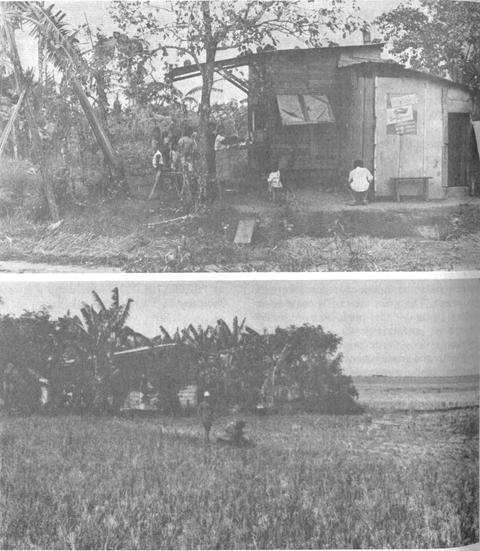
Most of the families live in quadruplex provided by
the company. The roofs are galvanized iron and the wall, logs, and the flooring
is wood. The company provides light and water.
5)
The average children's allowance is P7.00. This means a daily consumption of 2
½ kgs. of corn grits which cost them P4.40. The viand
per meal costs them P2.00. Almost nothing is left for education, clothing and
medicine.
6)
An elementary school is at the rear of the barrio (village). For high school
and college education, the children have to travel every day to Isabela.
7)
Likewise, there is a company clinic with a doctor who comes three times a week.
8)
The former union president, Cornelio Tumambos, with
his family of 7 children | lives in one of the rooms of the 47 quadruplex.
9)
The workers still use the legal means of negotiating with the company. So far
there has not been any union strike since 1957.
A Visit to
Zamboanga City
Three
of us arrived at Zamboanga on the morning of the 6th of November to learn about
the situation in the city. We visited a place called Magoti.
It is a kind of a refugee camp of 200 families who mostly are evacuees from
depressed areas. A government project, it provides housing and food for the
inhabitants. Majority of the people in the place are Muslims. The living conditions
are deplorable. Two families share a house with only one bedroom.
From
Magoti we went to Sihaya
Integrated Project. It is also a government resettlement project and the
inhabitants are mostly refugees from other areas. People pay the government by
installment until the full amount of the house is fully paid. Most of the
people residing in this project are low-paid workers.
Due
to some security reason the visit to International Copra Factory could not be
made. However we were able to meet with the president of the workers' union who
gave us some insights into the plight of the workers in the factory. There are
about 300 workers who get P12.00 maximum wage a day. Housing conditions are
very poor: no sanitary facilities. The wages cannot provide even the
necessities for the family. Another visit we made was to Zamboanga Plywood
Factory about 15 kms. from the city. It is a big plant
with 60% foreign and 40% local investments. The workers suffer the same
condition as the others we saw in the different factories we visited earlier.
As
we lived and stayed with some families, we knew how it was for them to subsist
in such conditions. We can see that the Philippine workers like their Asian fellow
workers are the victims of their
socio-eco-
30
nomic
system. As we talked and discussed with them, we could see a ray of hope in
that they were aware of their objective conditions. For us this was a bright sign
that the struggle to change the prevailing system has begun.
Zambales
Base Metals, Incorporated — Mine Area
The
mining is located south-west of the Zamboanga mountain range, western part of
Mindanao and 28 kms. from Zamboanga City. The area is
covered by various plants and tall trees and the topography is from 600 to
1,063 m. above sea level. Some portions of the area are left for logging operations.
The
mine has prediction deposit quarry of about 800 to 900 tons per day with 7-8%
grade; but the Mill Plant produces 70 to 80 tons per day with 50% grade. The
mining is capitalized by a Chinese national, nevertheless,
the Japanese have also invested in it. There are about 400 workers and most of
the production supplies the demands in Japanese markets.
There
is a local labor union whose officers are elected by the members. But the union
seems to be very weak because the members are generally passive. Even meetings
are hardly held due to lack of response from the members. The main interest is
centered on salary issue — the only issue to which members enthusiastically respond. The labor unions' basic
principle in negotiating with the management is through collective bargaining
agreement (CBA).
A Case of
Negotiations
On
5 January 1976, the Union submitted its proposal for a 25% wage increase at
base rates effective 1 January 1976 to the Company for collective bargaining
agreement. The first session ended up on a deadlock; the second session in
March 24 suffered the same fate. During the third session of negotiation, the
Company declared that the financial position of the company did not warrant a
general wage increase but that it could
grant merit increase, on a case
to case basis.
The
4th session was held 01 August 17 and here the Company issued it counter-proposal
of a general wage increase of P.25 effective August 1, 1976 and P.25 effective
May 1, 1977.
The
Union refused the counter-proposal. From that negotiation, nothing has moved
because the Company refuses to enter into negotiations.
Meanwhile
on September 1, 1976, the Company granted a unilateral increase of P.50 to 149
workers (selective and classified) and again on February 1, 1977, the Company
granted another unilateral ton – increase to 69 workers ranging from P1.00 to
P5.00 per day.
The
case simply shows the Company's bad faith and unfair attitude towards labor.
Their unilateral action of giving wage increase to selective
employees undermine the existence of the labor union.
The
Mindanao Federation Labor which conducted a study on the workers and their
families' conditions reported that malnutrition is most severe among children
(75%) followed by workers (58%) and the least severe was among the workers'
wives (47%).
The
study further revealed that the Company's capital on December 31, 1976 was P30,093.116.00 and the total assets were at P62,050,706.000
which stood a growth indicated by the sales shown below:
Year Gross
Sales
1974 P
5, 626, 268. 55
1975 15,
692, 644. 00
1976 29,
625, 483. 00
The
total wage proposed by the Union for 1976, was about P388,760.00,
which the Company could very well absorb.
The
report further stated that the Company is comparatively small based on its
production of 70-80 tons per day with a concentrate grade of 7-8%. The
equipment of the Company are also old – fashioned. The average wage for rank and file employees
is P11.00 which is lower compared to Zambawood
Manufacturing which is P13.06, with Zambawood logging
which is P17.41. But compare-
31
ed to Marcopper, a copper
mining firm operating in Sta. Cruz Marinduque,
which is P8.35, it is higher.
The
case study of this mining company reveals that the workers salaries are low in
comparison with a good number of other mining workers. It also shows that
unjust relationships obtaining between the management and the labor union by
the way the Company undermines the bargaining position of the Union. This opens
an alternative to the workers to be more aware of their rights and the need for
them to be more aware of the important role of a labor union.
Group Members:
R. Criamo, Safeer Alam and F. Allolerung