69
Chapter
Four
WORKING
WITH IMAGES
At the time
of the Falkland Islands war between Britain and Argentina, my son, Martin, was
ten. The war issues were discussed at his primary school, and I was impressed when
he came home and gave his judgment, that the war was rather like two kids in
the school playground having an argument about whose ball it was. For all the
obvious differences, it still seems to me that this image captures something
essential about that particular international confrontation. Images can suggest
new ways of seeing, which make new actions and reactions possible; they seem
able to connect very directly with the less rational aspects of our being.
Provided we do not forget that images inevitably simplify genuine complexity,
we can welcome the illuminating ways in which images link the various levels of
our experience.
One
activity that I have frequently used with classes on peace education has been
to invite everyone, myself included, to draw our own image of peace. I have
found that virtually everyone can do this with a minimum of further
instructions. It has proved an excellent basis for sharing our different
perceptions of the issues of peace and war. Each person talks about what they have
drawn, and why, and there is room for questions and observations by others.
Images provide a way of seeing overall patterns as well as particular features
of experience; they tend to be positive because they are definite, and not
structured by negation.
There were
some persistent themes in the pictures produced. One common picture expressed a
vision of multi-racial unity, showing a circle (earth) with a motley collection
of stick people holding hands all around the circle. A variant on this theme
was the image of two different people embracing or shaking hands. Another
common picture was of a landscape without people, suggesting the despondent
perception that people inevitably fail in the centrally human task of living
in peace. Alternatively, some landscapes included a few people who were living
a dramatically simplified lifestyle. While most Australian people live in
cities, the city frequently appeared as a place of un-peace, with a stultifying
and dehumanizing kind of order. A third kind of picture typical of politically
involved people contained traditional symbols of
70
the peace movement, such
as ban-the-bomb signs, doves with olive branches in their mouths, and various
ways of turning swords into ploughshares.
A somewhat
different theme was that of the harmony that can be achieved by the exquisite
balancing of natural forces. One such picture showed an arrow in mid-flight,
perfectly balanced, and speeding on into infinity. Another was of a person
sailing a small sailboat in a stiff breeze, and having to lean overboard to
maintain the balance of the craft. Christian people sometimes drew a picture of
Jesus on the cross, referring to the associated
biblical statement that Christ is our peace. This picture raises the difficult
themes of innocent suffering by a righteous person, of atonement between God
and humanity, of sacrifice as the price of peace, and of the power of
non-violent confrontation with evil and irresponsible powers, although there
can also be a smugness of conventional piety here when the more difficult
aspects of this picture are not welcomed.
I am
interested that my own images from these sessions were concentrated on two
themes. The first was that of the natural landscape, and I started with one
that contained only myself and my family on a picnic.
Later versions showed a scene with lake and hills and scattered houses, with a
few grazing animals, or with houses built underground. The most recent in this
series also had a military blockhouse in the foreground with a sentry on guard
outside, and a person offering this soldier a flower. The other main image was
that of the calm at the centre of the cyclone, where the calm relates to, and
coordinates, the violent energy of the destructive winds. In another version
of this image, I had a tree of peace in the centre, with weapons of war
whirling about outside.
It will be
apparent that there is an incredible wealth of symbolic material available to
us in exercises of this sort, and that this kind of work engages the creative
imagination. I find that a rational, analytic approach to problems such as the
nuclear nightmare tends to convince us that there are no viable solutions, so
that feelings of depression and even despair tend to predominate. When these
same problems are approached in terms of the creative imagination, we seem to
become more hopeful and less stuck in perceptions of our own hopelessness and
powerlessness. This is not to deny the importance of an accurate knowledge of
facts and figures; it is to deny that a purely analytical approach to the
study of peace is sufficient. Facts supply realism, which we need; image-based
ways of studying peace can supply vision, which we need more.
A
People-Sculpture of Peace
The sculpture was something entirely new for me, – as I mentioned to you,
one of the lasting impressions for me was the integrity contained in the
presentation of one person's understanding and vision of
71
peace. The exercise engendered a respect for a person’s position/point of view
much more so than any verbal or written presentation would have achieved. Why? (John Adams)1.
I was
recently invited to a local parish family camp to contribute to their study of
the theme of peace by assisting the group to produce a
"people-sculpture" The method involves working with one person to
place other people in positions and roles that make up a sculpture that
expresses that person's concept. The sculpture can then be explored in ways
that bring out some less obvious aspects of this person's image, by inviting
comment and response from those involved. We have a tendency to dismiss such
images as subjective (and therefore worthless); such dismissal seriously
undervalues the validity of what each of us already knows.
I went down
to Phillip Island, where the camp was, and participated in a discussion on
peace issues, which enabled me to join the group and get some idea of their
concerns. I wrote up my reflections on what happened after I left the camp site
to go home, and this account is based on these notes. My account lacks the
ease, immediacy and spontaneity with which this process can flow, and so I have
attempted a fairly full description to convey something of the intellectual and
emotional impact that the linkage between bodily postures and explicit
meanings can achieve.
We met in a
large room, and the group sat around the edges of the room, creating a large
working space in the centre. I gave a very sketchy account of what we were
going to do and I asked people to say, in two or three words, what they found
hard about peace-making. Answers given included: "Where to start?",
"Feeling powerless", "Feeling angry with people who don't have
peace as an issue", "When people don't respond to overtures",
"Feeling insignificant", "People don't want peace until they
have got some security and position", and "Confused by
complexity".
I then
asked for someone to volunteer to be the protagonist, and present their
concerns about peace so that we could make a sculpture. This invitation is a
bit of a trap question, however it is phrased, because
the first person who talks thereafter is assumed to be the volunteer, even if
they are simply wanting further clarification. Richard (not his actual name)
volunteered, but he thought he was volunteering to be put into a role within a
sculpture that I would create, which was not what I had in mind. After this was
clarified, he agreed to continue.
I then
asked Richard to talk a bit about what he saw as the difficulty with
peace-making. He spoke about feeling powerless to make peace with respect to
all the violent and confusing things that happen in the wider world. When I
asked for some specific examples, he came up with terrorism and Ronald Reagan's
response to it (e.g. the then recent US raid on Libya). I then asked how he
was related to all that, and he said through the media. So that gave four
characters.
72
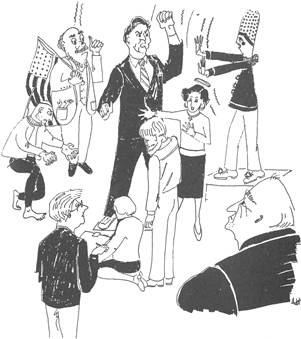
I asked him
to invite someone to play the role of himself, which he did, and then to give three
or four words and a physical posture to describe himself in this role. The
words were "confused, insignificant, weighed down, and powerless".
The posture was standing, a little slumped, hunched
forward, head down, arms by his side, in the centre of the room. The next
character was Ronald Reagan, played by a teenage girl. The words for Reagan
were "senile, macho, super powerful, and overbearing". He was up in
front of Richard, standing on a stool, with one arm raised, fist clenched,
ready to strike. He did indeed look overbearing. Terrorism,
"unpredictable, violent, threatening to break out destructively", was
placed on one knee on the floor to Reagan's right, and facing towards Richard.
He had his arms out, almost in the act of striking. Next to be placed was
Media, up on a table a little way behind Richard's right shoulder, marginally
higher even than Reagan. Her words were "beaming out a confusing mass of
information, manipulative, sensationalist". She stood up tall, arms raised, palms out, beaming out the messages.
I then
asked what else was needed for this sculpture, and heard about ordinary people,
politicians and church people. Other suggestions contributed by the group were
victims and dead people, but Richard did not take up these suggestions. He
picked three politicians. The first was a US Senator, “corrupt, jingoistic,
powerful” He stood slightly behind Reagan's right side, facing Richard, with
one hand holding an American flag, and the other hand extended with a"
thumbs up" sign, clearly in support of Reagan. The second was Australian
Politicians, "fence-sitting, concerned about, but caught between, the
western alliance and the craziness of the arms race, and lazy". She stood
somewhat behind Richard, facing towards him; she had to rock from one leg to
the other. The third was Russia, "defensive, vast, mysterious".
He was standing behind Richard and facing towards Reagan, with his arms
extended into a protective half-circle in front of him. Ordinary People, who
can also be victims, "oppressed, weighed down, a bit fearful" was
placed next to Richard, on his left and facing the same way, kneeling on the
floor. Finally, there was Church People, "do-gooding,
with a conscience, feeling superior to other people". She was standing
facing Richard, slightly in front and on his right, between Reagan and Media,
with one hand on her heart and the other flung out in a gesture of greeting and
good-will.
The
sculpture, now completed, has the form of a circle of people facing inward,
with Richard, flanked by Ordinary People, in the centre. One point of interest
is that, with the partial exception of Russia, all of the characters in the
circle seem to be primarily oriented on Richard and Ordinary People. Russia is
oriented defensively on Reagan. Reagan is threatening in the direction of
Richard and Russia, not Terrorism. The "up-front roles", from
Richard's perspective, are Reagan, US Senator, Terrorism, and Church People,
with a strong sense of identity with Ordinary People, Out of sight are
Australian Politicians, Russia and Media.
73
74
When we had
finished setting this up, and the characters had had time to feel what it was
like to be in their place in the sculpture, I asked Richard to go around and
ask them what it was like to be where they were. He did this, and the feedback
was quite rich, although I was later able to record only main points. The
character playing Richard felt confused and powerless, unaware of Media, Russia
and Australian Politicians, and threatened by Reagan and Terrorism. Reagan felt
above things, powerful, but with sore biceps. Terrorism also had sore biceps,
and felt the need to concentrate on hating, in order to be able to lash out. He
was aware of being able to scare Ordinary People and Australian Politicians,
and maybe even nip Reagan's ankle. He also felt isolated and out of it.
Media felt
detached, not an actor. She did not seem to feel particularly powerful, in
spite of her dominant position. US Senator felt good, being in support of a
strong President. He said that he did not feel threatened by Terrorism.
Australian Politicians felt comfortable standing still, uncomfortable when
moving onto one leg or the other. She really felt the significance of the fact
that Richard and Ordinary People had their backs to her. Russia had sore arms
and said that he felt like someone was trying to "dis-arm" him. He
also felt threatened by Reagan, and isolated, and a bit apprehensive about
this. Ordinary People felt low, heavy in the shoulders, vulnerable to
Terrorism, awed but also threatened by Reagan, whom he saw as a" hero','
but too aggressive. He liked being next to Richard. Church People felt ineffective,
a bit isolated, with nobody hearing her message. She also mentioned having
sore biceps in the gesturing arm.
These
reports on feelings include some very specific physical sensations, and these
provide "realistic" comment on the consequences of the posture
originally given. Soreness indicates that energy is needed to maintain some
postures. It is interesting that the threatening gestures of Reagan and
Terrorism produce a similar report to the generous gesture of Church People, in
terms of sore biceps, indicating the expenditure of energy in maintaining both
forms of gesture.
At this
point, there were various things that could have been done to work on this
picture. One would have been to ask Richard to stand in for himself, and see
what it felt like to have everything coming back at him from outside. Another
would have been to add another role, perhaps that of Richard's Confusion, or his
Powerlessness; it is good to engage in conversation with people playing roles
such as these, as this can often lead to a clarification of what the confusion,
or the powerlessness, is about. What I actually did was also a good option, and
that was to ask Richard how he would like to see this picture change for the
better.
The actual
Richard picked up this invitation with alacrity, and he directed a number of
changes. Ordinary People stood up, without any outside help, and became more
powerful. Church People then moved in to shake the hand of Ordinary People, in
support. Australian Politicians moved in behind, right hand under Ordinary
People's right
75
elbow, in further support.
Russia moved over much closer to the US characters, with arms relaxed. Media lowered
her hands a bit, signifying a reduction in tension. US Senator dropped his
flag, and his thumbs-up gesture, and put up one hand to restrain Reagan from
striking. Terrorism rose a little, and had a less aggressive posture though it
was still ambiguous. Reagan became less tense, and slumped down a little.
After these
changes, Richard asked for further feedback The
character playing Richard said that it was a much better feeling The girl playing
Reagan said that she felt less powerful, though still dominating. Terrorism
still felt isolated and down, though with a few

76
more options. Media felt a
bit less powerful, perhaps because the others knew more than formerly about
what she had to tell them, or perhaps because with reduced tensions they felt
less need to be informed. US Senator felt much the same, and still felt close
to President Reagan. His change appeared very major from outside, but did not
seem so important from his perspective. Australian Politicians found it more
work, less comfortable, and a strain in the right arm to offer support to
Ordinary People. Russia found it more comfortable to be inside the circle, and
closer to the US, though Reagan was still a bit threatening. Ordinary People
found it very much better; it was a more comfortable stance, and he had support
from Church People, Australian Politicians, and from Richard, which felt good.
Church People found it much more pleasant and fulfilling; shaking hands was both
more comfortable physically, and more involved and relevant, than her former
stance.
The overall
effect of these changes was a slight evening out of height (though there was
still a way to go there), and a consolidation around Richard and Ordinary People,
strengthening their position. I enjoyed the fact that the first thing to happen
was that Ordinary People simply stood up, without help. I also noted that
Russia did all the changing, and had much the less aggressive role, vis-à-vis
the superpower relationship. The positions of Reagan, Terrorism and Media were
the only ones to remain in the" too-hard" basket, even in the ideal
state. We stopped the sculpture after this round of feedback, when Richard
commented that it seemed about right. Under some pressure of time, I then
invited the actors to de-role, by saying," I am no longer X, I am... (own name)", and to
offer any further comments. Following this, I invited the patient watchers to
offer comments, which they did.
This was a
relatively public sculpture, even though it was one person's images that went
into it; it was an image of a worldwide situation that affects us all, and not
a more private situation whose actual reality would be largely unknown to the
rest of the group. This meant that comments expressing divergent perceptions of
these realities were very much to be expected. In fact, there was not much
strong disagreement expressed. I do remember comments such as," I have a
different view of Australian Politicians from you"; but there was also
"I tended to agree with your picture of Russia". Then there were
comments such as, "I really didn't like the original picture of Church
People", "Why didn't you include dead people, the victims of all this
mayhem?", "I would have shown more pain", and "I would have
brought in more help before Ordinary People could stand up". All these
comments highlight the individuality of Richard's picture.
There were
further comments on the session that are worth recording. One person said that
it left her feeling that peace involved lots of small, harmonizing changes in
many different areas of life, and that it was a recipe for powerlessness to
hanker after one overall change that will solve everything. Another person said
that, for him, the sculpture showed how peace came from the relationships
between
77
different people and
ideologies, when there is success in living with the differences. Another
person identified the attempt to impose values on others as a part of the
problem. Another person commented that the sculpture had brought home to him
that his own relationship of faith in Jesus was not an answer to all questions,
as he had previously tended to think. Another comment was that the sculpture
method developed a clarity and an impact (for the older children, as well as
for the adults), that would have been very hard to achieve by means of a more
purely verbal presentation. These comments suggest the wide range of
perceptions opened up by this shared experience.
For myself,
I enjoyed listening to Richard’s perceptions, and helping him to listen to them
himself. The most central issue seemed to be that of our own powerlessness in
the face of the threat of violence, both from those who seek to dominate others
(Reagan, but also Media), and from the dispossessed (terrorist). In the move
from confusion and powerlessness to hope, there was the emergence of a
non-dominating form of power, which began with Ordinary people who stand up.
People feel a need for support, and the suggestion is that violence flourishes
where people feel isolated and un-supported. It may be useful to review the
sculpture in terms of this theme.
At the
start, Richard is feeling powerless and vulnerable to the threat of violence in
the indirect confrontation between Reagan and Terrorism. This confrontation is
moving towards a pure form of conflict, where the party with the bigger and
better weapons threatens to destroy its enemy. The enemy lurks in hiding,
feeling isolated, and needing to maintain hate to maintain power. Media, cool but manipulative, exercises the different power
of influence. Russia is defensive, withdrawn and isolated, poised to retaliate
against attack with counter-violence. The only supportive character at this
stage is the US Senator, who is supporting Reagan. The other characters feel
powerless and ineffective, particularly Ordinary People, Church People and
Richard. Australian Politicians is more calm and self-possessed, perhaps
feeling safely on the sidelines. So at this stage, the effective power
portrayed is that of threat and attempted destruction or domination, in a
frozen, locked-in state.
The ideal
change introduced by Richard can be seen as the emergence of another form of
power, which is peace-making, and which introduces a new dynamic into the
picture. There is a mystery about how this form of power arises; in the
sculpture, it starts with Ordinary People standing up and claiming their own
power to live their own lives. The integrity of this stance attracts support
from Church People, who feels quite fulfilled through this relationship, and
from Australian Politicians. Effects of this change can be seen in the comment
from Media, that she felt somehow less powerful, with less notice being taken
of her. The changes around Terrorism, Russia, Reagan and the US Senator can
perhaps be seen in terms of a softening of the struggle for mastery; whether
there is more fundamental change in these relationships seems doubtful.
78
This final
state of the sculpture suggests a growing tension between power-struggle
conflicts as usual, and the self-affirming power displayed by Ordinary People,
which is not based in denying others. The power of domination defines its own
power in terms of whom it controls. The will of those who are controlled must
be somehow curbed by the controlling power, at least in areas defined as
crucial by that power. The significant shift is therefore in the definition of
power; self-affirming power need not be other-denying. This non-dominating,
non-dominated form of power makes peace through its own being, and through
reaching out to the isolated and hurting people to whom violence beckons as a
dubious but available remedy.
This
nurturing and peace-making form of power is available to us, whether we refer
to it as divine love, as the truth-force, soul-force or satya-graha
of Mahatma Gandhi, as the compassion of the Buddha, or as that friendship that
we receive from someone who really listens to us. We may be at a critical
juncture in the history of our world, where we either learn to live in love
from the personal to the planetary level, or, barring unexpectedly good
fortune, we perish.
Images
suggest and invite; they do not coerce or prove. This method of exploring
images assumes that we can co-operate and that we are free to listen to each
other and to ourselves; one result is that we find that we are listening to our
world as well.
Facing the
Nuclear Nightmare
Courage is the self-affirmation of being in spite of the fact of
non-being. It is the act of the individual self in taking the anxiety of
non-being upon itself by affirming itself.... Courage needs the power of being,
a power transcending the non-being which is experienced in the anxiety of fate
and death, which is present in the anxiety of emptiness and meaninglessness,
which is effective in the anxiety of guilt and condemnation. The courage which
takes this threefold anxiety into itself must be rooted in a power of being
that is greater than the power of oneself and the power of one's world. (Paul Tillich)2
In order to
live, we all take up space in the world, and this requires a continuing act of
self-affirmation. I can remember the comfort that I derived from Tillich's phrase "the courage to be" when I first
came across it. Under the influence of a protestant ethic of altruism, I was
very unsure of my justification for taking up space in the world; if someone
came asking for my life, what could I seriously give as a reason for refusing
to part with it? There is a wonderfully gratuitous self-affirmation in Tillich's phrase, which denies the need for elaborate
justification, and which invites us to set our own definition, presumably
non-imperialistic, on the space that we choose to occupy.
The nuclear
nightmare, raising as it does the threat of non-being for our civilization, and
possibly for life on earth, is a particularly
79
massive irruption of the
threat of non-being within our experience. It includes within it all the
elements listed by Tillich. In the nuclear nightmare,
there is the reality of fate and death, grossly expanded beyond the confines of
my individual death: there is the emptiness and meaninglessness of our
historical achievements, when we are collectively prepared to consign them to
oblivion in a self-inflicted holocaust: and there is guilt and condemnation in
the fact that, collectively, we could have prevented it and we did not. I find
this conception of a metaphysical power-struggle between being and non-being
to be helpful in clarifying what so much of our struggles are
about.
Tillich offers us two central
pointers for coming to terms with the nuclear nightmare. The first is that we
cannot overcome the anxiety and the despair that is here without taking the
threat into ourselves. This may seem overwhelmingly difficult when we believe
that we have no way of emotionally surviving this nightmare, but however
difficult, it is the way forward. The second pointer is that there is nothing
in ourselves or our world, nothing that might disappear in a nuclear holocaust, that can provide the resources that we need.
Beyond both self and world, there is the power of being.
This idea
of the power of being to overcome non-being is an abstract symbol which
expresses something of the substantiality of matter, which may change its form
without itself being destroyed, and something of the life force, which seems to
press forward beyond the non-being of death into new generations and new
biological forms, and something of the integrity and community that we humans
deeply desire. This is much more than saying that the physical universe will
survive a nuclear holocaust, because the power of being refers also to the
affirmation that the universe has value, regardless of whether this is
recognized by humans. The power of being connects with ideas of God, of a world
soul, of life force, and of a larger web of life.
Crumbling under the cumulative effect of the facts I had learned and the
pictures I had seen, my defenses gave way, forcing me to face within myself the
knowledge of our possible imminent extinction -as a species, as a planet... How
do I live with the horror of this knowledge? Do I go crazy with it, or do I
numb myself again? In the weeks and months that followed, I carried these
questions inside me like a bomb in my chest.
(Joanna Macy)3
American
culture is dedicated to optimism, so that pain, doubt and difficulty may be
harder to share there than elsewhere; but this seems to be balanced by the
resources for coping that a realistic optimism can offer. Cultures of
pessimism may cope with negative experiences by sharing them, but they may
also lack resources for moving beyond the resulting depression. Despair can
cripple our peacemaking efforts; Joanna Macy's "despair-work" offers
us guidelines for turning this debilitating experience into a positive,
energy-giving resource for our living.
80
1. Feelings of pain for our world are natural
and healthy.
2. This pain is morbid only if denied.
3. Information alone is not enough.
4. Unblocking repressed feelings releases energy, clears the mind.
5. Unblocking our pain for the world reconnects us with the larger web of
life.4
This is a
simple description of a process that will be as profound as the pain that we
feel. This pain comes from our caring and it connects us with the larger web
of life. What is mysterious is the transition from being stuck in despair and
powerlessness to being reconnected with the larger web of life, once again
powerful, self-affirming and world-affirming. Despair-work involves ways of
working with our own images that somehow give us access to the sources of our
pain and the sources of its healing; it connects us with the major spiritual
traditions of humanity, which are a substantial resource for coping with any
nightmare.
I no longer
see nightmares in a fully negative light, following a particular experience
with a dream that began as a classic nightmare. I have been writing down my
dreams for a number of years in order to reflect on what they might mean, and
without this discipline I doubt that I would have given this dream a second
thought. It occurred on the middle night of a five-day retreat, so that I had
time for reflection, and someone to talk with about it. There were a number of
details that were significant at the time, but which are not worth sharing
here. The main point is the surprise with which I discovered that it is
possible to revisit dream images through an intentional meditative process, and
the joy of finding the power of being in the stuff of nightmare.
A dream. I have basket of washing to do,
so I take it to the local church office. Inside the entrance, one of the
staff is talking with some kids. ”You have some sort of a record here. Firstly,
I came over especially at one o'clock in the morning, why I'll never know, just
because you asked me to...” I leave this area and enter a dark corridor in
search of a washing machine. There is a locked door, to which I have a key. I
am a bit concerned that I didn't bring soap power. I put the key in the lock
and start to turn it when the door is opened forcibly from the other side, and
I realize that whatever is there is about to attack me. I feel quite paralyzed,
and I finally manage to get my voice box to work and to call out for help, when
I realize that it is a dream, so I stop before I really make a noise. I have
quite a strong sense of fear, even panic.5
My further
initial reflections included the suggestion that it was to do with my sense of
vulnerability to violence, and fear of personal attack. I felt a continuing
subtle pressure to let it drop, and not to regard it as being important. The
next morning, still not thinking it
81
very important, I reported
this dream to Sue (not her real name), the person with whom I was sharing my
inner journey during this retreat. Sue said two things that helped me to focus
on this bad dream as a significant inner occurrence. The first was that the
entry into locked inner rooms in a building to which I had a key was an
archetypal image for my encounter with buried, despised and forgotten parts of myself. This made sense to me, and caught my interest. She
also said to me that when I could encounter the attacking force, I would find
that it was love. This surprised me, and aroused my interest even further. I
then resolved to attempt to make fresh contact with these dream images.
On this
retreat, we had been using a form of prayer called centering prayer, or the
prayer of the Cloud of Unknowing, which is outlined in the mystical work of
that title. The method involves repeating one word over and over again,
concentrating the conscious mind upon it. As other thoughts come, they are
gently noted and put out of awareness into a “cloud of forgetting”. That day, I
had four such prayer sessions. In two of these sessions, I experienced images
that somehow allowed me to complete this dream, and to reach a very different
conclusion about its meaning for myself.
Second session. There were a lot of thoughts and images
arising, including the elements of my dream of last night, though not the fear
or the attacker.
I remember, in succession, passing through and dismissing, the discussion in
the entrance, a vision of the crucifixion of Jesus, the dark passage, the dark
room behind the locked door, with a crack in the corner through which there
flowed an overwhelming, brilliant light. There was also a sense of the massive
movement of love associated with this light.
Fourth session. I started to get a sense of presence that
wouldn't go away, so I let it stay. Then I started to get elements of my dream
returning. I sent them away. They insisted. The staff member,
the dark corridor, the key going into the lock. I sent them all away.
Then there was a massive wall of light. I tried to send it away, but it didn 't
really go. Then I felt something of the fear, and clung onto my word. Then I
opened the door and found this overwhelming light all over me,
and a vision of the darkness in me (around the hips, and lower and upper back).
The darkness was being slowly washed away by the light. Then I sent that away.
Next came a side view of myself, in terror, opening
the door, and the light springing out and overpowering me, and the same sense
of the light washing away the darkness and the lack of life in me. The figure
that was me could have fainted, have died, have been
immobilized by panic/terror/fear. Send it away. The massiveness of the light...
There was a lift in my energy following this, the beginnings of joy. I was
reminded of the washing that I had brought; it seems that I got washed.
These
experiences helped me to see something ugly and fearful
82
as something of
overwhelming beauty, power and, yes, love. It was an ecstatic experience, and I
am aware that it has in some way alleviated my fear of being personally
attacked (which fear was certainly associated with this nightmare). I am not
very clear about what has changed, and I am aware that this experience borders
on the incommunicable because it is so personal in focus. I have told the
story because it is at this personal level that the threatening and foreboding
power of nightmares can be challenged and alleviated.
There is
also much to be learned from contemporary fantasy literature about facing those
things that we fear. An excellent and archetypal example is the story of Ged, in Wizard of Earthsea, by Ursula Le
Guin.6 In the story, Ged lets loose a fearful
blackness into the world through deeds of folly, and initially he tries to hide
from this blackness. When it becomes clear that this is impossible, and that
the blackness is pursuing him, Ged
is terrified. The story recounts how he finds ways, despite his terror, to turn
and to hunt the blackness, so that it flees before him. His quest, which has
the dimensions of a life-and-death struggle, is concluded when he catches the
blackness and is able to somehow claim it as his own, as an ugly and evil part
of himself.
In this
story, what is feared is deliberately portrayed as mysterious, nameless, and
without precedent in Ged's
experience; it is baffling even to the wise in his society, who tell Ged that he must deal with it himself. While we may not
encounter terror in anything like this pure and abstract form, anxious fears do
have this nameless and intangible aspect. At the level of individual
experience, we all have a degree of ignorance and uncertainty that provides a
base for the emergence of these intangible anxieties. In anxiety states, it
seems that our bodies mobilize for" fight or flight".7 The story of Ged, who tried flight before seeking to fight, can remind
us of the need to find, and to struggle with, the source of our anxiety.
This
pattern of courage and struggle as part of our personal and spiritual growth
crops up in many stories of human encounters with the unknown and the sacred. One
example is the story of Jacob wrestling with the angel, with his famous
refusal to cease from the fight, even though wounded in the hip, until his
opponent bless him (Genesis 32:22-32). Another example, which comes from Carlos
Castaneda's account of his apprenticeship to a yaqui
Indian sorceror called Don Juan Matus,8 concerns
encounters with spiritual beings known as allies, which, if overcome, are
thereafter a profound source of power. It seems that the best way out of threat
is through facing the source of the threat, provided that we have the courage
and the ability and the good fortune to survive the encounter. Successful
encounters with such challenges change and empower us.
This
pattern works at the level of individual experience, but there are also
significant parallels with our collective experience. As a world civilization,
we are like Ged in letting
loose the fearful blackness of the nuclear nightmare and other threats to our
physical survival. In
83
refusing to face the
fullness of what we are doing, we find that the black shadow becomes more
menacing and substantial. While we have great collective resources for facing
and overcoming these threats, we have not yet properly deployed these
resources. Reasons for this failure may lie with things like greed and
institutional inertia; but perhaps behind these things we fear that we cannot
cope with collective recognition of who we are, as
world humanity, because we have no answer for the pain, the anger, the hatred
and the despair that is there.
The story
of Ged suggests that we need courage to face whatever
is there to be faced, and to nurture, and work in terms of, a vision of the
wholeness of things. Threats arise from the disastrous separation and conflict
between elements in our world community that should constitute a harmoniously
functioning whole; unity is strength, although it must be real, and should
ideally operate without the requirement for an external enemy. To overcome the
nuclear nightmare, we need the courage to face it, and to learn the hard lesson
of our unity with other people and with the life of our planet.
In the
story of Ged, he was a
diminished person when first under threat from the shadow. Ged had power to do his duty, but lacked power to
face the shadow. The turning-point came when he returned to his teacher, Ogion, in a dehumanized and diminished state, and accepted
Ogion's advice that he turn and pursue his pursuer.
He reached the point of desperation where he recognized that to continue to run
is to be lost; and he found the courage that comes with this recognition.
Much of
what threatens us is of our own making, either through our actual deeds, or
through our fantasy life. This is literally true of the arms race, considered
on a collective level. We fail to recognize this only by fracturing our
awareness into "us and them" categories, thereby ignoring the evil
side of what we do, and the good side of what our so-called enemies do. We need
courage to take the risks involved in attempting to put together what is now so
disastrously separated into competing ideologies and conflicting nation-states;
and for this task we need to recognize how present divisions are created and
maintained.
We laugh
about the man who constantly blows a trumpet in order to keep the elephants away, and when told that there are no wild elephants in
Australia says, "See how effective it is?" Fears can lock us into
behavior that we literally do not dare to change. Consider how difficult it
could be for this man to hear the advice that he stop
blowing for a while, in order to see if any wild elephants come. There is
validity in his question," But how long a silence will prove that I can
stop expecting them? "Lacking our common-sense perspective on reality, he
will need some way of accepting a discrete new frame for his perceptions. To
resolve his fear, he will need to look at his own fear as well as at the empty
neighborhood. The pile-up of nuclear weapons seems like trumpet-blowing to keep
fears at bay, coupled with a covert enjoyment of noise-making; is it really
true that we need these devastating weapons so that we don't have to use them?
Making peace comes together with making sense when we can face our fears and
the despair
84
to which they lead us, and
reconnect, as Joanna Macy suggests, with the larger web of life.
As we
listen to our world, we can identify elements that lie to hand, awaiting
transformation. There is an unprecedented technological linking of human
societies around the planet, a growing awareness that we need to safeguard the
biosphere from the effects of our own activities, and an emerging consciousness
of world citizenship. If the fierce nationalistic commitment that directs the
arms race could only be bent to the service of world humanity, our nightmare
could indeed become a dream. The way out of the nuclear nightmare, like other
nightmares, is through, but only if enough of us do what is necessary to take
us through.
The
elements that I see to be required for finishing the nuclear nightmare in this
positive way include: the commitment by masses of people to hope rather than to
despair: intentional activity to imagine, receive and invent the hopeful future
in all its myriad aspects: rejection of all our personal and corporate
inadequacies that block this future: and a commitment to foster hope. I believe
that we do all know how to work on these tasks.
Imaging a World
without Weapons
The imaging techniques used in this workshop were developed originally by
Warren Ziegler.... They were designed to help organizations and community
groups, trapped in apparently unsoluable conflicts,
to break out of their deadlocks... Ziegler added to the imaging of a desired
future the idea of standing in that imagined future and "remembering"
how the parties got there. This technique has been repeatedly demonstrated to
be effective. Shifting the emphasis from a deadlocked present to a realized
future solution seems to release creative search behaviour
in participants. (Elise Boulding)9
Elise Boulding points out that we cannot work seriously for an
outcome that seems inherently impossible, and that this is how we do see the
idea that our world might become weapon-free. This can change when we visualize
a weapon-free world in concrete detail, covering all the various levels at
which we experience violent conflicts, and how our world could change to become
weapon-free in this pattern. It is important to exclude critical analysis
until the visualization is complete, as our critical sense tends to be
dominated by our present view of the world, which is a part of what we need to
challenge. This imaging draws on the coded store of our life experiences, and
what we get is unconsciously edited by our express desire to see how a world without
weapons would look.
The
workshop format involves seven steps, which are; formulating a goal statement
of the sort of world we want to see; contacting childhood memories, as a way
of exercising our imaging ability;
85
moving in
imagination to look at the world as it" is" thirty years from now;
clarification of what our imagined world looks like through explaining it to
others; constructing a model of this world; standing in this future world and
remembering how we got there; and action planning in the present in the light
of this future.
This
process can occupy any length of time from a few hours to a few days, or a
number of sessions over many weeks. Elise Boulding
suggests that two full days is optimal, and that fifteen participants is a
minimum number, with an optimum of twenty-five to thirty. In the two-day
workshop in which I participated, we had a group of sixty-six, which was a
little large for effective negotiation between the different world models that
emerged. I found it significant that symbolic, image-based forms of
presentation were used throughout, and that this made it much easier to see
connections rather than contradictions between the various world models;
differences were seen as a source of diversity and therefore strength, rather
than as a source of contradiction and therefore weakness.
It is
important that our images of the future world come through a spontaneous
imaginative process, and (as much as possible) from unconscious rather than
conscious sources. My own fantasy images of the world of 2017 included a
courtroom scene (in Italy?) where a kind of silent, listening process was
involved. I went home with one of the participants, to a pleasant, simple house
with solar hot water panels, which his wife was fixing, and a home computer.
Their water supply was clean, due to reforestation and controls on air
pollution. They lived with a happy teenager, with whom I went on a shopping
trip to a local supermarket where everybody was known by name. Then I went to
Melbourne to see my daughter and grandchildren, who lived in a house so
surrounded by greenery that I didn't know for sure -whether it was in the city
or the country. My daughter said to me, "I have to go to the neighborhood
meeting."
Other 2017
encounters were with someone in southern Africa standing beside a grass hut.
This man looked happy; when I asked why, he said, "Our people are in
power, and we have enough." Then I was with a friend in Seoul who had a
leadership role as historian with a local community group. Then I was in New
York City and spoke to someone in Harlem. I asked about the tenement in front
of us, and was told that it was no longer overcrowded; some apartments now
housed community facilities, and everybody received a guaranteed minimum income.
I asked about crime and was told that there were no more drug addicts; they had
joined the creative meditators and other community
activities. My final image was of a defunct nuclear reactor that was signposted
a Gedenkstatte, which is what the concentration camp
site at Dachau is now called.
I stress
that these images came spontaneously, but with conscious reception and
questioning. They obviously link with future scenarios and fictional images of
future worlds that I have previously read; I see no difficulty in finding that
my images link with what
86
others produce, provided
that I don't find that my imagination has no creativity of its own. There is
also value in rational assessment of the institutional and technological requirements
for any particular future world model, and there is a burgeoning academic
industry in this area.10 What I find important here is
the way in which scenarios and world models highlight possibilities as well as
problems. There is an experience of hope in hearing the images of others and in
constructing a shared model of a new world society, however sketchily; there is
also a sense of hope in identifying steps that would take us from here to
there. These images give us a sense of direction in the present, whatever their
exact relationship to the future state of our world.
The
workshop left me with a significantly more detailed image of a world without
weapons, and also with a sense that important questions remained to be
addressed; I then tended to discount the importance of the images that we had
produced because of these further questions. I am interested to find that I am
now, months later, much more aware of the positive value of what was achieved.
The images have an influence that persists powerfully over time, and the fact
that they do not address some questions is unimportant.
This
workshop has helped to confirm for me the value of image-based work. I
particularly value the way in which inner, personal work is here enabled to
contribute to a collective and public process. This general approach has the
advantage of being available to us all, whatever our other skills and life
experience. It is people who make and break world peace, and imaginative work
can offer practical vision to people. I find it hopeful that we don't seem to
have a choice to avoid imaginative work; whether it is nightmare or vision, we
do all seem to dream, both individually and collectively. Our choice seems to
be whether or not we seek for meaning and life-direction in our dreams.