1
Introduction
It is almost a decade now
since the process of the regional women's programme began in the World Student
Christian Federation Asia-Pacific Region. With the felt-needs of the
constituencies in mind, the programme has aimed to: (a) equip women for
leadership and participation in all levels of SCM work; (b) deepen analysis of
women's situation in the Asia-Pacific; and (c) renew faith reflections from the
experience and perspective of women in the region.
While many attempts have
been made towards the achievement of these aims, so much still has to be
desired to really promote critical consciousness of gender issues in the
region. As indicated in the mid-decade evaluation of the regional women's programme,
the fact remains that the Asian and Pacific SCMs, although bearing progressive
social themes, are still generally male-dominated. This characteristic reflects
the "highly patriarchal societal contexts of the movement and the
passivity or non-awareness of women of their rights and potentialities."
The same evaluation
pointed to the minimal participation of women as both the cause and effect of
the low level of consciousness of both women and men on gender issues. Another
factor cited for the weakness in awareness building is the fact that gender
issues are often regarded as least important.
Yet if the SCM is to be a
truly prophetic movement for the liberation of humanity, espousing an
alternative vision of the world order, then it must address the gender
question. It must in fact begin with its own constituent women members,
"empowering them to become empowering agents of positive change for
others."
2
And thus, the "Women
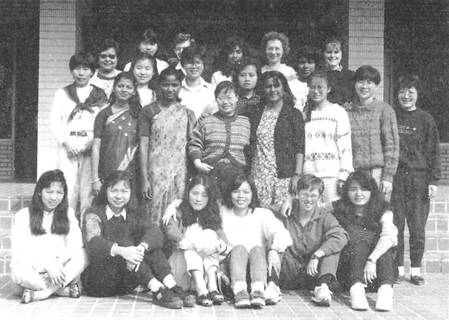
Doing Theology Workshop" was held on 1-12 February 1991 in Taiwan. It was
a gathering of 25 women from the Asia-Pacific region for learning and sharing
even as they set together to search, envision and act out their role as women
in the midst of human struggles. The whole process was that of participatory
interaction beginning with telling personal stories and re-reading the Bible,
and moving on to analysing women's situations and planning appropriate actions.
The workshop specifically
aimed to: (a) introduce and promote the importance of the need for women to do
theology from women's experience in the SCMs; (b) ensure the continuity of the
process of women doing theology; (c) deepen critical awareness and prepare
young SCM women to respond in concrete action to women's issues at the national
and regional levels; (d) interpret the Bible from the women's perspective; and
(e) share and listen to each one's personal stories and gain strength in
realising shared experiences.
These were the programme
areas of the workshop: (a) creative worship; (b) personal storytelling; (c)
Bible studies and faith reflections on "Women in the Old Testament,"
"Women in the New Testament," "The Woman Who Dared to Break
In" and "Ephesians and Workers;" (d) workshops on "Reading
the Bible from a Woman's Perspective," "Creating a Process and
Sharing Various Methodologies," "Worship as Women," and on
analysing women's situations; (e) inputs on women in the SCM, church and
society; (f) panel discussion on "Women Doing Theology;" and exposure
to the factory, construction workers, and Hakka community.
However, these programme
areas will not appear in such order in this resource book. Since we are
producing this for wider readership, we have taken the liberty to re-cluster
the topics for a more systematic arrangement of the materials.
Although it is difficult
to fully capture the workshop's dynamism and the women participants' energy and
spirit, we hope that
3
readers will find in this
resource book a model which can be adapted, improved or modified for local,
national or sub-regional use.
We gratefully acknowledge
the participants and resource persons of the "Women Doing Theology
Workshop" whose valuable contributions and active involvement inspired the
production of this resource book. Many thanks are also due to our Regional WSCF
A-P staff and friends who helped in the compiling, editing and proofreading of
the materials.
Part of the whole process
of producing this resource book has been to keep as close as possible to the
original intentions and styles of the resource persons and contributors - e.g.
the spelling of some words and the use of punctuation marks which may be
reflective of the British or American system of English. However, should there
be some marks of flexibility, it is because the editors and proofreaders also
use either or both of the two systems.
Yong
Ting Jin
March,
1992
Hong Kong