91
Women in
Taiwanese Folk Religions
Wang Ching-Ling
More than 90% of the population of Taiwan believe in some folk religions. These are Taoism, Confucianism, Buddhism and Animism. According to the traditional thought of these folk religions, there is not only one Supreme God, but many gods and goddesses.
The practice of worship in these folk religions may be classified as: (1) nature-worship, such as worship of stars or the sun; (2) great-person-worship; (3) ancestor-worship; (4) animal-worship; (5) fetish-ism, such as worshipping the bed, door, etc.; and (6) mythological (hero or heroine) worship.
There is a hierarchy of gods and goddesses in Taiwanese folk religions as deeply influenced by the Chinese patriarchal system. For instance, the Jade Emperor is the highest and the most powerful god who dominates heaven, earth and hell. He is a male god and under him are gods and goddesses corresponding to the different levels of a bureaucratic system. However, the highest god is not necessarily the most popular one. Some goddesses who are not as high as the Jade Emperor are more popular in Taiwanese folk religions, such as the Queen of heaven and the Golden Mother. But being under the concept of patriarchal ideology, the popularity of the goddesses does not at all elevate women's position in Taiwanese society.
In Chinese religious and philosophical thought, there are two opposite but interrelated active forces in the universe: yang and yin. The yang force is positive, light and dry. It is supposed to be
92
an attribute of the sun and the male. Thus, it is "believed to reflect the dominant position of the male in Chinese society and their importance in the perpetuation of a family line. The yin force is negative, dark, and wet. It is supposed to be an attribute of the moon and the female. The relationship between yin and yang is like the relationship between shadow and light; one is defined in relation to the other and contains within itself the generation germ of the other.
Nevertheless, from the Han Dynasty, the concept of yin and yang has generated the concept of evaluation, that is, yang is deemed more important and higher than yin. It is this same evaluation that is believed to permeate human relationships, especially between man and woman in society. As Dun Chun-Shu, a scholar in the Han Dynasty, said, "The man is yang, even if he is not royal, and the woman is yin, even if she is royal."
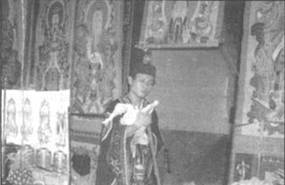
Photo: WCL
Consequently in the tradition of such Chinese culture present in the Taiwanese folk religions, the role played by women has been suppressed for thousands of years. In Confucian thinking, women ought to observe three kinds of obedience: obedience to her father before she is married, obedience to her husband after she is married, and obedience to her son after her husband dies. According to
93
the principle of the nature (the Tao), such an obedience is necessary in order to maintain the whole harmonious system. Consequently, such an obedience has rendered women dependent, passive, quiet, gentle, hard-working, changeable, and also subordinate to men. This patriarchal way of thinking has continued through history so that majority of women have remained voiceless and even nameless.
Although in Confucian thinking human beings are at the central position in the universe – they decide their future for themselves; they are all good-willed; everyone can become a sage – in the traditional society, the relations between individuals seem to be destined unfair. There are also the high and the low. Husbands, fathers and emperors have authority, whereas wives, children and subjects have only obligation.
Pollution
of Taiwanese Women
Having described the religious thought of Taiwanese folk religions, let me now share my own experience. About a month ago, I went to a new temple to videotape the ceremony of "Keeping Dragon and Exiling Tiger." It is a major Taoist ceremony for purifying a new temple. Unfortunately, I was not allowed to enter the area because "you are a woman." The men in the temple said women are unclean and will only pollute the temple that is being purified. Some older people said the gods will take offense if they are exposed to menstrual blood in any way; they may become angry and do harm to the offender. Thus, a menstruating woman who enters a temple and approaches the gods' images too closely is simply courting the gods' wrath. If she offers incense to the gods, a necessary part of the act of worship, such act of offering will only draw the gods' attention to her dirty state. Beside, any communication from a menstruating worshipper will not "get through" to the gods anyway.
This idea of "pollution" may be looked at in two ways. First, "polluted" or unclean women are not the only ones who are offensive to the gods and prevented from communicating with them. Any
94
person, male or female, child or adult, who has set foot inside the room where a woman has just given birth is equally offensive to the gods. No such person can offer incense to the gods or attend a firewalk. The uncleanness lasts for a month since the day of childbirth. The woman's husband is automatically considered polluted since it is assumed that he cannot avoid the pollution because of contact with his wife and child.
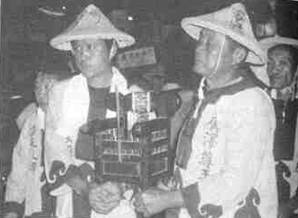
Photo: WCL
Second, other forms of "pollution" or uncleanness can produce the same effect. The gods are also offended by exposure to the pollution caused by death. Therefore, the doors of any temple along the route of a funeral procession are closed until the funeral procession has passed. In a room where a corpse is laid out and encoffining takes place, ancestral tablets and gods' images are¦ covered by blankets or mats. The bereaved must observe the prescribed 49-day mourning and refrain from offering incense to the gods. Sexual intercourse may also be a cause of pollution or uncleanness. Thus, before a major festival, people have to refrain
95
from engaging in sexual intercourse. However this is not mandatory for ordinary worship.
Women's
Role in Religious Service
What then is the women's role in the religious service in Taiwanese folk religions?
Some women play a dominant role in the worship of the low- ranking spirits. In Taoism, for instance, there are some women Taoists whose roles are to pray for sons or for healing of sick children. "Low-ranking goddesses" like the Bed Mother or Chu-shen Mother are associated with child birth which makes them less clean than other gods.
Some women also play the role of medium between the living world and the world of the dead. When the female psychic enters into a trance, travels to the underworld and visits deceased friends and relatives, women can participate fully either as observers or as mediums. The spirits of the dead and their world are believed to be unclean, hence; women who are also regarded as periodically unclean may appropriately enter into contact with them.
According to anthropologist Emily M. Ahern's analysis, the pollution of women is not in sexuality – not in being woman herself, but in her menstrual blood and postpartum discharge. Such a declaration brings out the following questions: Why has the contemporary understanding of human physiology not demythologized the meaning of pollution of women in Taiwanese folk religions? Better yet, in the interest of inter-religious dialogue, what has Christianity to offer in this regard?
Some
Reflections on Christianity
Feminist thinkers have shown in historical and theological detail a three-fold ideology concerning women in western tradition: (a) women as property, objects or tools; (b) women as polluting,
96
dangerously sexual or carnal; and (c) women romantically idealized as morally and spiritually superior to men, but childlike and in need of protection in the private realm.
Feminist scholars have also shown that despite the crippling ideologies which severely limited their autonomy and participation women have exercised significant leadership in virtually all the Christian traditions and historical periods. In other words, women have claimed a home in a tradition and a theology that have not fully claimed them, but have rather systematically denigrated and excluded them, or denied and impeded their autonomy as human beings and as Christians.
I do not think that many Christians are already conscious that the present church ethics and models of theology are still made and practised within the context of a very patriarchal structure and ideology.
For us in Taiwan, I believe the concept of "yin and yang" and "pollution" must be re-examined in order to find a new and positive understanding of women-men relationship. Of course we all should recognize that any theologizing must be internally self-critical, to avoid the reverse of dominant patterns. In Asia and in Taiwan, we are just beginning to formulate the kind of hermeneutic that is critical of present day realities as well as of the systemic distortion of history and tradition. We are also just beginning to enter into conversation with other religions especially with women in similar struggle for equal place with men in society. We are just beginning. Let's encourage each other in the light of God.