31
Bible Study 2
Women in the New Testament
Ann Wansbrough
|
Discussion 1: What are
the ways patriarchy would describe the following people? *priest *widow *young woman *male Christians *barren woman *female Christians *pharisee/doctor
of religion *male witness *woman of bad name *female witness What are the
stereotypes of these people which contribute to the power of men over women?
(Note: The question is not about what you think or what the Bible says – it
is about the ideas of patriarchy in the church or in society.) |
One of the reasons women face
oppression in the church is hat men, and many women, misuse the Bible in dealing
with the role of women. Some of the ways the Bible is misused are:
* using the Bible as a blueprint for
life today;
* treating individual verses as if
they contain absolute truth;
* interpreting biblical teaching
which tried to apply the gospel to the social, political and economic
circumstances of the writer's own day as if it applied to all times, places and
situations;
32
* taking verses out of their
literary and theological context'
* giving priority to teaching about
behaviour over teaching about salvation, instead of understanding behaviour as
something which flows from salvation; and
* substituting law for grace.
I suggest an alternative method
which has two major components. The first is the hermeneutic circle, which looks
at the Bible through questions raised by the reality of injustice in our own
day, and which challenges both ideology and biblical interpretation. The second
is to reverse the above process:
* using the Bible as a source of
vision rather than detailed precepts;
* looking at individual verses in
their context – their paragraph, the document of which they are part, and the
whole Bible;
* recognising that while our vision
needs to be inspired by the biblical vision – and by the Holy Spirit – we need
to reinterpret what that means in practical terms today in the light of the
social, political and economic realities of today;
* we need
to give grace precedence over law, justice precedence over ideas such as
obedience; and
* recognising that individual verses
and ideas derive their meaning from the whole. The Bible is revelation (it
enables us to understand God), not a lot of separate individual revelations in
every sentence or verse.
33
1. Reality
I do not need to say much about the
reality of injustice which women suffer. We know that women have been excluded
from power in both church and society. We know that women's gifts and abilities
and insights have been largely ignored. We know that millions upon millions of
women in Asia and Africa and Latin America struggle for survival against a
global economic system which does not allow them food, or shelter, or medicine,
or any human rights, whether economic, political, social or cultural. We know
that in many countries, women and girls experience physical and sexual violence
in various forms and find the family home a place of horror rather than love.
2. Ideological
Suspicion and
3. Critique
of the Ideological Superstructure
We know the ideology which supports
these situations is wrong. We know it in our hearts, and we know it from the
analyses we have done of our national situations. We know that however it is
dressed up in our particular nation, patriarchy deprives women of life, and
that all the rationalisation in the world will not make the injustice done to
women into justice.
We can simply summarise the relevant
ideology by saying that in patriarchy, women are treated as ignorant, disloyal,
unfaithful, indecisive, submissive, in need of direction by others, unable to
think, unwilling to think, unperceptive, passive, interesting only for their
bodies, unspiritual and so on. The same ideology
treats men as knowledgeable, responsible, loyal, able and willing to think,
Perceptive, spiritual, etc.
34
4. Exegetical
Suspicion
I also do not need to remind you of
the Bible passages which have been used to keep women subordinate and deprive
them of power in the church. When women have been deprived of the right to
leadership in the church, the church has also supported society in depriving
women of their human rights.
We all know that there are passages
in the New Testament which are used as weapons against us. And we know that
they are being misused. So I will move to the examination of passages which
might offer us some hope.
I could simply give you a list of women
in the New Testament and the range of things which they did in the early
church. This would be helpful, but it is something you can do for yourselves –
all you need to do is sit down with a New Testament and a pen and mark every
passage which refers to women.
That would remind us that women
exist in the Bible and were part of the life of Jesus and the early church, but
it would not provide us with theological tools for analysis of male theology.
It would not, by itself, contribute to change. What we need is a reconstruction
of New Testament theology.
So I will look at women in Luke's
gospel, and the way Luke sees the gospel as having special significance for
women. I will focus on four passages – Luke 1: 26-56, Luke 7:36-50, Luke 20:45
- 21:4, and Luke 23:49 and 24:1-2.
Each of these passages talks about
men, as well as women and we will need to note very carefully what it says
about men. The problem of patriarchy is not simply that it denigrates women
35
– it also makes
assumptions about men. If the gospel is to effectively challenge patriarchy, it
will need to challenge the way patriarchy views men as well as the way it views
women. Reconstruction of New Testament theology involves a reconstruction of
what theology says about men as well as women. If theology in the past has
ignored many of the positive things said about women in the New Testament, it
has also ignored many of the negative things said about men. patriarchy
is based on an idealised understanding of men which is totally inconsistent
with scripture.
Luke often refers to women. He seems
to have a policy of providing parallel stories which involve men and women.
Luke 1 includes two annunciations – Gabriel appears first to Zechariah, and
then to Mary. In Luke 2, at the temple, Simeon and Anna both recognise the
Christ child. In Luke 4, a man is healed, and then Simon Peter's mother-in-law
is healed. In Luke 7, the servant of the centurion is healed, then the son of the widow of Nain
is restored to life. In Luke 8, Luke describes the women disciples who
travelled with Jesus, in the same way as men did, and who provided for Jesus
out of their own resources – Jesus' ministry depended on the economic resources
of women! In Luke 8 also, the healing of the Gerasene
demoniac is followed by the healing of the woman with a haemorrhage, and the
raising to life of Jairus' daughter. In Luke 10, the
teaching of the lawyer through the story of the Good Samaritan is followed by
the story about Martha and Mary, which clearly shows Jesus approved of women
being disciples and not simply being concerned about the household needs.
In chapter 15, one of the parables
about God's mercy uses the image of a woman. In Luke 16:18, the teaching about
divorce ^n be taken as a challenge to the attitude of Jewish men that they are
entitled to divorce their wives for little or no reason. In Luke 21:1-4, the
widow who gave her tiny coin stands as a unique example of commitment to God.
36
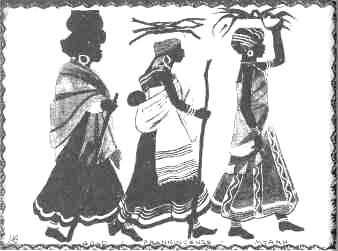
"Three Wise Women" Courtesy: Hilda Bernstein
|
Discussion 2: Read Luke 1:15-25 and 26-46. Summarise the main
things that happen. How does this story challenge the stereotype of priest,
barren woman and young woman? |
The four passages I have chosen share
a common theme in each of them, women and men are contrasted, and it is the
women who are commended for their insight, their faithfulness, their discipleship.
In Luke 1, Gabriel appears first to
Zechariah. Here is the epitome of the male religious leader. Here is a priest
who can enter the holy of holies in the temple, a place forbidden to most men
and all women. And what does he do when God offers him a vision which should
have fulfilled all his hopes and dreams – the thought that God would give him a
son leaves him dumbfounded. He is unable to speak! He has no response of faith
until the son is born
37
Luke surely intended us to laugh as
we read this story and the one which immediately follows – the visit of Gabriel
to Mary. Often this story has been interpreted according to patriarchal ideas
about what women should be like – Mary is depicted as demure, obedient, submissive. But this is an inadequate interpretation of the
story.
Whereas Zechariah gives in to his
turmoil with the demand that Gabriel "Prove it," Mary says:
"Don't flatter me! Explain what you mean." Zechariah cannot believe
Mary has a thinking faith which is open to the message, in spite of the
emotional turmoil which it causes. When Gabriel tells her what will happen, she
again asks for explanation – how can this be? In the end Gabriel has to simply
tell Zechariah what will happen, as if he has no will to make his own decision,
whereas Mary makes a deliberate decision to cooperate in God's plan. She is
obedient – but it is no mindless obedience. It is active faith. It is faith
which leads to insight and to prophecy, while the priest is dumb!
The two stories are told in a very
similar way. There can be no doubt that Luke intended us to compare them and to
see Mary as a woman of strong faith while Zechariah is said to lack faith. Luke
wanted us to laugh – the comparison is so clearly against all the stereotypes
about women and men. In the days of Jesus, women were generally forbidden to
study the Jewish scriptures because they were thought to be incapable of
understanding.
This interpretation is reinforced by
the next incident in Luke 1 – Mary goes to visit Elizabeth. In Mary we have a
believing woman, a decisive woman, an active woman. And her belief and decision
and action are rewarded.
Mary is rewarded by Elizabeth's
recognition that she is a woman of faith. Here Luke must have had a double
laugh Zechariah could not make sense of what Gabriel said, but his wife is more
perceptive than he. Elizabeth has neither entrance to the holy of holies nor
the visitation of an angel. All she has is the wonder
38
of her own unexpected pregnancy and the visit of
her woman cousin. Yet she realises what is happening. Her response to her own
pregnancy was recognition of God's action (1:25). Now she recognises what God
is doing through Mary: "Why should I be honoured with a visit from the
mother of my Lord?" The two women share their insights – they are both
women of awareness and of understanding faith, not blind faith.
However, Luke has not finished yet. He
goes on to provide a psalm which summarises the work of Christ as it is
described in his gospel – the Song of Mary, the Magnificat. But the song is not
merely a literary device. Luke is saying that what this psalm says will happen
is actually happening in this story and in the very saying of this psalm.
The Magnificat proclaims that God is
fulfilling God's promise and helping Israel (1:54-55). It celebrates the fact
that God is using a woman in this great event. The central idea of the psalm is
that God is reversing the world order – "He has shown the power of his
arm, he has routed the proud of heart. He has pulled down princes from their
thrones and exalted the lowly. The hungry he has filled with good things, the
rich sent empty away."
Surely this psalm is a commentary on
the priesthood which excluded women. Surely Luke intends that we see that the
priest Zechariah has been "routed" by his own lack of faith, in spite
of his rich opportunities for special religious experience, while the women
have been exalted by their hunger for God, which has even survived
oppressiveness and exclusion by patriarchy and hierarchy.
Luke is saying to us in chapter 1
that the very things this psalm is talking about actually happened! And we can
never look at women and men in the same way again! God has changed human
relationships!
39
Luke 1:54-55 refers to the promise
to Abraham. This promise is presumably Genesis 12:3 – that through Abraham all
the families of the earth will be blessed. In the transformation of human relationships,
in the shattering of patriarchal power, the families of the earth are blessed.
This will become particularly evident in the final section of this study.
The theme continues in Luke 2, where
it is Mary who ponders what is happening. Joseph is left in the shadows. The
reversal is also shown in chapter 2 by the story of the shepherds – the
outcasts of the religious establishment (because they could not keep the laws
of ritual purification) – they are the people to whom the angels appear and who
are the first people outside the family to know what has happened. We could
trace this theme of reversal through the gospel to show how other excluded
groups are included in the kingdom and active in what God is doing in Christ.
For Luke, salvation is a cooperative affair of God and human beings.
We must note that the reversal
envisaged by the Magnificat is all encompassing – it is not only about women.
Luke's gospel contains very strong teaching about rich and poor, wealth and poverty.
Mary's song is as economically and politically radical as it is socially
radical. If it offers hope to all women, it offers special hope to women who
are poor and to women who are oppressed politically.
|
Discussion 3: Read
Luke 7:36-50. Summarise the main
event of the story. How does this story challenge the stereotypes of pharisee/doctor of religion and woman of bad name? |
In Luke 7:36-50, he contrasts saint
and sinner, man and woman, pharisee and woman of bad name.
Who will show hospitality? Who will show understanding? Who will recognise the
Christ? Who will be open to the forgiveness of God?
40
The pharisees
studied the law and tried to live it. They rejoiced in the law, recognising in
it a gift rather than a burden. In the time of Jesus there were a number of
religious parties who had different understandings of Judaism. Zechariah
probably belonged to the sadducees,
the priestly party, who relied on the biblical tradition of law. The pharisees were a rival group who elaborated the biblical
tradition with a whole lot of other laws and regulations and customs. They
tried to find every way in which a law could be broken and provided a way of
avoiding that and keeping the law. They developed a complex set of written
commentaries on the scriptures. They prided themselves on their faithfulness
and their legal rectitude and found great joy in their study and debate about
what is right. They rightly saw the law as a gift from God to be rejoiced in,
but wrongly turned it into a burden for people who were different from
themselves.
It appears that few pharisees thought it appropriate that women study
scripture, although we know of one or two who did let their daughters study. In
other words, righteousness and thinking about righteousness were for men, not
women. Not even pious women were thought capable. We can imagine what they
thought of a woman "who had a bad name." What could she possibly know
or understand?
Luke's story is therefore either
shocking or hilarious – no doubt, how you respond to this story depends on your
own attitudes to people.
The pharisee
man invited Jesus to his home – but offered him none of the customary care when
he arrived. The pharisee man studied God's word, but
could not recognise God's promised saviour. The pharisee
man studied the law and knew its pitfalls, but could neither receive nor offer
the forgiveness which is essential if la\v is to be part of the gift of life
rather than death.
The woman has a bad reputation, but
honours the Christ. She knows not the complex customs of the pharisees, but she offers care
41
and love and hospitality. The woman has been
excluded from study of the religious tradition – but has faith in the one whom
God has sent in fulfillment of the promises found in
that tradition. The woman does not know the law, but she is able to love and to
be loved. The woman cannot define righteousness, but she is able to desire
forgiveness and receive it when offered.
Again, stereotypes are shattered. The stereotype of righteous and unrighteous. The stereotype of who knows and who does not. The stereotype
of who welcomes God when God enters into human life. The outcasts are not to be
considered outcasts in the Christian church, not because of their reputation,
and not because they are women.
Again, women are celebrated as
people of faith, insight, decision and action.
Again, the world order has been
reversed.
|
Discussion 4: Read Luke 21:1-4. What does this story
appear to be about? What stereotypes does it challenge? Read Luke 20 :45 - 21:4. How does the point of the story change when
it is enlarged in this way? How does it challenge the stereotypes now? |
The widow who gave all that she had is
perhaps one of the best known stories of women in the New Testament. This woman
is entitled to honour as a woman of outstanding faith, who placed her whole
future in the hands of God. Unfortunately, too often, this story has become
part of the rationale that the role of women in the church is to raise money
for the church so that male committees can decide what to do with it. We should
honour the women who have sacrificially given time and energy to the church to
ensure that it has a solid financial foundation. We should celebrate them – and
we should challenge male hierarchies which think that they are
42
entitled to take the money women raise and
to dispose of n without the women having any role in the decision-making.
However, this story is not an exhortation
to sacrificial giving It needs to be read in the context of the verses which
immediately precede it (20:45-47) and in the light of what we know is Luke's
basic theme – that in Christ, the world order is reversed.
Whereas in Luke 7, the pharisees were unfavourably contrasted with women, here a
related group, the scribes, are contrasted.
The scribes (or doctors of
religion/law), like the pharisees, studied the law
and prided themselves on their knowledge. But according to Luke, Jesus is not
impressed. The scribes are found inadequate to be role models of religious
faith because:
* they are
"show offs" – they wear religious garments in public to impress
people with their religiosity;
* they use their
religion for their own ends – as a means of obtaining religious and social
status and privilege;
* they are
hypocrites – they study the law, but do not follow one of its most basic
teachings, which is to ensure justice for widows and orphans. Instead they
"swallow up the property of widows." Many of the scribes and pharisees were well off – after all, if you are struggling
for survival it is hard to spend your life in religious activity and study.
They are accused of gaining that wealth by injustice. Luke surely intends us to
think of Old Testament passages like Isaiah 1, 5 and 58, all of which see true
worship and true religion as being linked to justice and care of the widows and
orphans.
So when Luke describes the rich
people who put their large offerings into the treasury and the poor widow who
only had a mite
43
to give, we must link this to the attack on the
scribes – why was this widow so poor? Who had swallowed up her property?
It seems to me that what Luke is
saying here is: see the contrast between the false religion of the wealthy male
scribes and, the true religion of this poor woman. Look at this woman, not the
learned men, if you want to understand what faith is about. Look at the men and
learn what faith and religion are not. Don't assume that wealth is a sign of
God's blessing. Don't assume that apparent generosity is a sign of true piety.
Look beyond the immediate and understand where people stand in the social and
economic and religious structures before you decide who they are or what they
are doing or what their motives are.
In Luke 23:49, 55-56 and 24:1-11, we
read about the men and women who watch the crucifixion. A man arranges and
carries out the burial, while women look on. But it is the women who are the
first witnesses to the resurrection and who withstand the terror of that
strange, yet amazing moment of discovery.
To understand this story, we need to
set aside the Easter hymns which celebrate the resurrection with such joy and
energy. One of the remarkable things that emerge from all the gospels when you
do this, is that the first witnesses to the
resurrection did not feel joy - they felt terror. The empty tomb was a
terrifying experience. And it is the women whom God trusted to face this terror
and become witnesses to the resurrection.
Of course these women have withstood
some hard experiences already. They have travelled with the Son of Man who has
nowhere to lay his head. They have stood near the cross, unable to disown their
friend even though religious Jews and military Romans have both condemned him.
They have come to a tomb to anoint a body. They are strong women who do not
give up easily. They are women who love the Christ who has given them the
dignity which is essential if human beings are to be fully alive.
44
The women come to the dismal tomb
carrying not only the spices and ointments but also the burden of their grief
for their friend who has died a horrifying death and their hopes of a new way
which have been buried with him. They think they know what to expect and what
to do. A stone to be rolled away, a tomb to be entered a body, dead for two
days, to be anointed.
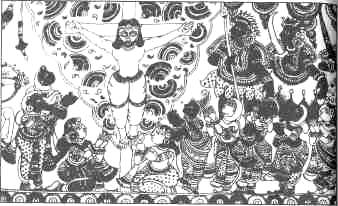
Jesus on the Cross (India) Courtesy: CCM New
And none of it happens as they
expect. They find the stone rolled away. They could have felt doubt about
whether this was the tomb, or what was going on, or who might be lurking in the
tomb. (Roman soldiers perhaps). But they simply get on with the job, until they
find there is no job to do because there is no body. And because these women
are there, the right people at the right place at the right time, living out
their love and loyalty as human beings, they are the first to hear the good
news and to remember. The women, who have no access to study, remember. They
have learned, and they have understood. They go to tell the others – the men.
But the men cannot believe the women
as witnesses. They, hang on to their grief. They stay away from the tomb. They
fail to remember. They fail to understand what they have been taught
45
and what they have experienced. "These words
seemed to them an idle tale, and they did not believe them." The apostles
are like Zechariah and the pharisees and the scribes
– slow to learn, slow to understand, slow to have insight.
Most modem translations omit verse
12, which says that one man, Peter, is willing to test what they have said. The
footnotes tell us that this verse has been added in some manuscripts. It
appears that those who copied the earliest manuscripts could not cope with the
shattering nature of this story. That is, the earliest testimony is that none
of the men believed. (However, if we accept verse 12, Peter is, perhaps, a sign
of hope – a sign that men can be open to the witness and ministry of women and
can thereby share in the new world order.)
The resurrection is the offer of new
life to the world, to men and to women. To share in that life requires that men
set aside their patriarchal assumptions and stereotypes. Luke challenges
religious tradition and assumption, but he is not only concerned about
religious institutions. Rather Luke is telling us that in Jesus Christ the
whole world has been changed. If we believe the gospel he proclaims, then all
our relationships and values will be different.
5. The
New Hermeneutic
This gospel calls us to give up
stereotypes of women as submissive, passive, inferior, unthinking, indecisive,
lacking in faith or faithfulness or loyalty or commitment. It calls us to give
up stereotypes of men as necessarily authoritative, active, superior, thinking,
decisive, faithful, loyal and committed. It recognises that women can be
thinking, decisive, active, faithful, insightful, inspired, loyal and
committed. So can men, but for Luke the men most likely to be faithful are the
men who are outcasts – shepherds, lepers, Samaritans. In Christ, men and women
can stop imposing stereotypes on one another and stop relating to one another
in terms of those stereotypes. We can all be open to the Spirit who enables us
to become people of mature faith, thought and action, and who can encounter one
another in mutual respect.
46
|
Discussion 5: Where do you see
transformation and new life in your society today? There are two ways you might
tackle this: Either take one of the above four stories and retell it in
"modem dress"; i.e. tell it as a story related to women and men in
your country. You may like to do this with each of the stories. Or you may
like to tell stories which have actually happened which are similar to the
events in the stories from Luke. |
6. Reality
and Action
How does this hermeneutical
principle address the reality with which women and men live in the real world?
Obviously this
hermeneutic challenges the churches. It exposes patriarchy and hierarchy
as ridiculous and as rebellion against the redemption Christ offers this world.
It is beyond belie¦ that men can sing the Magnificat in the liturgy Sunday by
Sunday and continue with patriarchy an<j hierarchy. As they sing, the}
foretell their own doom.
If we believe this gospel, then
church structures must change But this gospel is not
simply a latter of church structures. It is for many women, a matter of life or
death in their experience of the family.
As I was finishing the section on
the resurrection, I was interrupted by a colleague who wanted to show me a
document called "A Pastoral Report to the Churches on Sexual Assault Against Women and Children of the Church Community."*
Let me quote some of that report, which deals with sexual assault in Australia.
In Australia sexual assault in the home, against both women and children, is a
significant problem.
_______________
* CASA
House, Centre Against Sexual Assault, Royal Women's
Hospital Melbourne, Australia. Prepared m collaboration with
the Women, Church and Sexual Violence Project Advisory Group with
representative from the Uniting Church in Australia, the Catholic Church,
Church of Christ and Salvation Army.
47
Sexual assault against women and
children "cannot be put down to a single tidy 'cause' or readily isolated
in one set of practices, beliefs or institutions."
"It is evident, however, that a
framework reinforcing this massive social problem can be identified in our
common life. This framework is sexism."
7. Ideological
Suspicion and Ideological Critique
"Sexism is a belief system
which presumes and creates for men inherent male superiority, privilege and
power. It presupposes therefore female inferiority and submission..."
"Sexism results from cultural
conditioning that allocates certain social tasks and roles to men and other
tasks and roles to women. Where these 'male' tasks/roles are seen to be of
greater value, male dominance can also be seen controlling social, economic,
legal, political and ideological institutions and practices."
"For example, looking at the
issue as an economic one, on average, women still earn
only 66% of the male wage. Women are concentrated in the worst and lowest paid
jobs... Despite the fact that women constitute 51 % of the population, women
have not been a significant part of the political process."
"To address sexual violence, we
must critically examine the politics and economics of institutions and
structures (including the church) for the ways in which they impede equality
between women and men."
"Included in sexism is the
unhealthy belief that male sexuality bestows powers over and above women's
sexuality. Male sexuality is both presented and experienced in our culture as
something possessive, aggressive, hostile, harsh, violent and controlling with
a devaluing of tenderness, gentleness, mutuality and respect..."
48
8. Exegetical
Suspicion – A New Hermeneutic
The report continues:
"Sexual and family violence is a
product of sexism and its negative consequences in our society. It is the most
common form of violence in our society and the root cause of most of the
physical and emotional pain experienced by our women and children. And the
church has been equally guilty of spiritual violence. It has both created and
endorsed sexist systems, structures and teachings which devalue women, which
consequently trivialise violence to women and ignore the spiritual impact of
violence. Through silence and neglect it condones the behaviour of the
perpetrator. It is this spiritual violence that the church must confront!"
"Therefore it rests inevitably
with us, as individuals and members of church communities and institutions, to
take up an appropriate response by changing our personal values, beliefs and
behaviour that are rooted so deeply in sexism. Both personal and collective
change is necessary if we; are to work towards the elimination of sexual
violence in our church and in our society at larger (PP 14-16).
The report goes on to point out that
the church is the main perpetrator of the model family in which the man is seen
as the head, and the woman and children as subordinate and inferior. The church
has condoned and encouraged the very power relationships which violate women
and children and family relationships.
So we need to heed Luke, the
iconoclast -- banish stereotypes of women and men, and develop relationships in
family and community in which respect for persons is paramount. Christ invites
us all into the community of mutual respect which his birth, life, death and
resurrection have made possible. Women belong here as equals, not subordinates.
They belong as people who are respected1 and valued. Their insight and dynamism
need to be valued. Men belong in the kingdom not as superiors, but as people
who are often
49
weak and inadequate and who are nevertheless loved
by God and offered new life. There is no room in Christ's realm for the
man-woman power relationships so beloved of patriarchy.
9. Action/Reality
A Church which believes this gospel
will work against man's power over women and children in the home, and against
the violence which too often is the expression of that power.
|
Discussion 6: What would the church do
in your society if it really believed this gospel? |