24
25
Bible Study 1
Women in the Old Testament
Sharon Rose Joy Ruiz-Duremdes
|
I. Learning
Task (30 minutes only): 1. Get
into triads. 2. Share
with each other at least one occasion in the recent past when you said
"No" to an existing cultural pattern or to a request or order of a
person in authority (preferably, male). 3. How
did you say No? 4. What
were the consequences of your No? 5. How
did you feel after having said No? 6. After
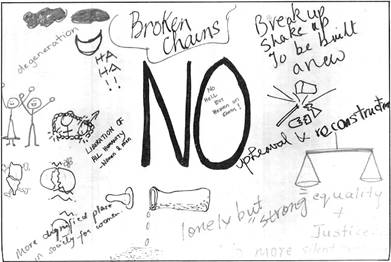
the sharing... On a piece of Manila paper with a large No
(tacked on the wall), come and write a word/phrase or draw a caricature of
what you believe will happen to society if more women said No. |
II. Deepening
A. Backgrounder:
Women in Biblical Patriarchy
1. Patriarchy
Defined
a) The
Bible arose out of a patriarchal system.
b) It
is a legal, social, and economic system that validates and enforces the
domination of male heads of families over the dependent persons in the
household (wives, dependent children, slaves).
26
c) It
is a basic principle underlying not only the subordination of women to men but
of one race to another, of colonies to master nations, of children to adults,
of nations to divine right monarchy, of believers to clergy.
d) Anthropological
research show that patriarchal social systems arose with the first developments
of large private landholding, the movement from gardening to animal ploughed
agriculture in approximately the beginning of the second millennium B.C.
2. Evidence
of Biblical Patriarchy
a) Women
as subordinate creatures in society
a.1. wives
under the control of their husbands
a.2. widows
dependent upon their sons
a.3. women
with no heirs were destined to a life of poverty and hopelessness
a.4. women
as part of the husband's property (Exodus 20:17)
a.5. sexual
disposal of daughters by their fathers (Gen. 19:4-8)
a.6. women
could not inherit property (Numbers 27:1-11)
a.7. women
had to marry within the class so the property would not move out of it (Numbers
36:1-9)
a.8. adultery
by women was a major crime punishable by death (burning or stoning); a man's
unfaithfulness to his wife was not a crime unless the woman involved was
herself married or engaged to be married
a.9. circumcision
was the rite to membership into the Israelitic
religious community (Gen. 17:10ff) which, naturally, excluded the women
a.10. in
the temple, the women were confined to the Court of Women which was 15 steps
lower than the Court of Israel (exclusive for males)
a.11. women
could not enter the Temple within 7 days after the end of their menstrual
period (Lev. 15:19ff)
a.12. mothers
could not enter the Temple within 40 days following the birth of a boy but 80
days after the birth of a girl (Lev12)
27
a.13. the young woman who lies about her virginity deserves the death
penalty because she deceived her husband-to-be and also her father who was
supposed to strictly take care of her (Deut. 22)
There are, however, a few women who
did not allow themselves to fit into the usual mold.
There are two types of responses to the natriarchal
system that the courageous women made.
Response A: Coped, maneuvered and resisted within
the framework of patriarchy.
Response B: Directly confronted the system of patriarchy.
B. Specific
Examples
1.
Response A: Coping, maneuvering, resisting within the framework of patriarchy.
The Woman: Ruth (The Book of Ruth)
a) Ruth
1:21 shows that in those days, a childless widow
lacked the male protection that provided security for women; a childless widow
is destined for a life of bitter impoverishment.
b) Ruth
does not allow herself to be swallowed up by despair as her mother-in-law is.
She exercises her initiative to look for food (Deut. 24:19-22).
c) Ruth
uses her beauty to persuade Boaz to marry her so that Naomi will have heirs.
Naomi becomes happy and the community sees the change in her.
d) Ruth,
in solidarity with Naomi, creates a situation of wellbeing for both of them.
e) Maneuvering within the patriarchal system, Ruth had said No
to a life of misery, the lot of widows.
f) However,
there is some question about Ruth being a role model for women since she
achieved her goal through her sexual allurement.
28
2.
Response B: Directly
Confronting the System of Patriarchy
The Woman: Queen Vashti
(The Book of Esther)
a) During
a royal banquet tendered by King Ahassuerus, when the
guests were drunk, the king ordered Queen Vashti to
make a personal appearance so that he could show her off to the guests.
b) Queen
Vashti defied the royal decree (Esther 1:12).
c) Her
simple No threatened the entire structure of patriarchy in the entire Persian
empire (Esther l:16b-18).
d) Her
refusal issued in a consequence of being removed as queen (Esther 2:2-4).
e) Women
can say No to the oppressive structures. Male dominance is not the only option
for women. We can take a different route but only at a great price.
C. The
Old Testament's Attitude towards Women
1. Genesis
2 and 3 depict Eve as an equal to Adam, the completion of creation. "Let
us make man in our own image" (man=ha adam is a generic Hebrew term for humanity -- Gen.
1:2627).
Gen. 2:18-20: "...it is not good for
humanity to be singular; to be fully human, there must be relationships or
dialogue between two equals."
2. Isaiah
32:9-14 – Women's non-involvement and unconcern have national consequences.
Therefore, women's issues are not peripheral, petty nor inconsequential. Women
have important roles to play in the society.
3. Feminine
images are used to describe God.
29
Courtesy: saheli