31
Jesus and the Faith of Women in the Gospels
Sharon Rose Joy
Ruiz-Duremdes
If we are to appreciate what some women in the
Bible did and draw inspiration from their lives, it is important to understand the
status of women in Hebrew society during the biblical times. Principally,
Hebrew culture was male-centered. Women were thought
of and treated as inferior. Men were given twice the autonomy and privilege.
Every young girl was subject to the authority of her father until given by him
to a husband who then became her master. When they became widows, they were
dependent on their sons because it was only through men that women gained
access to the economic resources of the community. If a man disliked his wife
because of some notable defect, he could divorce her and send her out of his
house (Deut. 24:1-4). And since a husband could take more than one wife, a
woman had feelings of insecurity.
The extent of masculine privilege is shown by
the ordeal for a suspected adulteress detailed in Numbers 5:11-31. A woman
underwent this ordeal even if there was lack of proof of her' infidelity or
even if her husband only felt jealous thus making him suspect his wife.
Needless to say, there was no provision for unfaithful husbands or any concern
for a wife's feeling of jealousy. Adultery by a woman was punishable by death –
she was either burned or stoned to death. Sexual transgressions by a woman were
considered serious crimes not because she sinned but because the husband's
property rights were violated.
32
Even in their religion, women were
discriminated. In the temple, women were confined to the Court of Women, which was fifteen steps lower than the Court of Israel, the
highest section in the temple. Only men were admitted in the Court of Israel. A
woman was also denied access to the temple seven days after the end of her
menstruation, forty days after bearing a son, and eighty days after giving
birth to a daughter because within these days she was considered
"unclean." Notice that a woman was more "unclean" after
giving birth to a girl than a boy.
Women were also the object of so much scorn.
The books of traditional Judaic wisdom have an anti-feminine message: women are
dangerous. Being weak, unfaithful and seductive, they easily lead men astray.
Wise men will not be seduced by the beauty of women (Ecc. 7:26); it is better
not to look at them and certainly one should not sit down in the company of
women (Sir 42:12-13). A woman's malice is above all other malice, her anger
worse, her wickedness totally destructive and contaminates even the good (Sir.
25:19-25). A man's wickedness is better than a woman's kindness (Sir. 42:14).
The main role of women was in bearing children.
And since she could not inherit property she simply served as blood link to
pass property from male to male within the family line (Num. 36:1-9). Her
citadel was her home, serving her husband and taking care
other children (Prov. 31:10-31).
During Jesus' time, women really had the rotten
end of the deal. The men never had it so good. From this milieu, however, were
women who broke out of the pre-determined social mold.
Many of them did not deliberately engage in confrontational battles with the
male-dominated society. They just did what they felt was right and by so doing,
they reversed the circumstances. Their modus operandi were not necessarily
aggressive, loud and, therefore, obnoxious but the consequences of such actions
were just as life
33
changing. Let us look at three of the women who had
direct contact with Jesus as the gospel’s attest.
The Woman Who Anointed Jesus (Matthew 26:6-13)
She was a nameless woman who broke ceremonial
rules to express her faith. Some Bible scholars maintain that she was the woman
who had been caught in the act of adultery. She was a victim of double
oppression: she was socially discriminated against for she was a
"sinner;" she was marginalized because of her gender. In the story,
she just barged in to Simon's house in Bethany where a party was underway and
the guest of honor was Jesus. She poured perfume on
Jesus' head. In other texts, she washed Jesus' feet with her tears. This was a
ritual done for a special guest by the host before a meal. But here, a woman
from off the street came in uninvited and performed a rite traditionally done
by the host. Needless to say, the people were scandalized. They even criticized
Jesus for allowing her to do it and using, as always, beautiful rhetoric: The
money could have been used to help the poor! How people love to parade their
generosity!
But Jesus praised the woman and said that her
act constituted a "fine and beautiful thing." What was so fine and
beautiful about a prostitute washing his feet? What was fine and beautiful was
that she broke out of the confines of the mold placed
on her by society. She believed that dignity was not a virtue bestowed upon
society or other people on a person. Dignity stemmed from the realization that
one was a child of God. Because she believed this, she had faith that Jesus would
not reject her nor turn her away.
Jesus praised the woman because she was
authentic and transparent. She believed it was imperative to express her love
and respect for Jesus. Never mind if people considered her
unclean or unworthy to anoint Jesus. Never mind if tradition had it that
the host (and this was almost always a male) was the only legitimate
34
person to anoint the guest of honor.
What men can do, woman can do better!
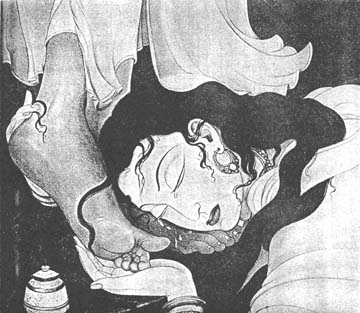
Mary Magdalene: Frank Wesley Courtesy:
Christian Art in Asia
35
In the text, where it says "she washed
Jesus' feet with her tears," I like to think she was shedding tears of
anger over a society so oppressive and biased. .And anointing Jesus was an act
of affirmation that indeed Jesus was the Messiah – the one who came to set
people free from the chains of bondage.
In Matthew 26:11, Jesus was not declaring the
eternity of poverty. He was attacking the blindness of the crowd. He was saying
that there are times when money is not the right kind of help to the poor or to
anyone. There comes a time when something more than routine giving of alms is
needed. He was saying: "Do not think that because you have collected a
benevolence offering that you have already performed your responsibility to the
poor." In other words, there is an appropriate way of helping the poor.
And the way to help the poor (women included) is to allow them to .exercise
their God-given right to participate in the mainstream of social and political
life. In this way, the walls that divide class and gender are broken down.
Mary, The
Sister of Martha (Luke 10:38-42)
The household of Mary and Martha was a favorite place of respite for Jesus. He was close to this
family, so close that when he heard that their brother Lazarus had died, Jesus
wept. It was, therefore, not unusual that as he was nearing his death, he would
spend a few days at this home. As the story goes, Mary sat at Jesus' feet and
listened to him.
The account highlights one very commendable yet
often overlooked trait of women: their sensitivity. This is confirmed by Jesus'
commendation of Mary's act – that of sitting down at his feet and talking with
him. It must be understood that Jesus here is on his way to Jerusalem to be
crucified. We can understand his fear, his anxiety, his tension and his need
for quiet. More important for him at this point in time was someone to talk to,
someone he
36
could open up to, someone who would allow him to
express his innermost concerns, even his insecurities or doubts. He had no need
for a housekeeper who would trouble about how he wanted his eggs, if he wanted
cream in his coffee, or if his crucifixion attire needed ironing! Mary chose
the better part because she perceived what Jesus needed at the moment. She was
sensitive to his need.
On the other hand, Martha busied herself with
domestic responsibilities. The reaction of Jesus to Martha's complaint is often
taken to mean the superiority of the spiritual over the physical, the priority
given to food for the soul over food for the body. Jesus, however, was not implying
that Martha's concern for household duties was unimportant. When Jesus said
that Mary had done the right thing, he meant that what is most important is
that a woman does what she wants and desires to do for her personal
development. A woman does not have to be chained to housekeeping functions. She
can sit down and study in order to broaden her horizons. The account shows
Martha's resentment over being pressured by domestic chores. She was upset and
jealous that Mary was more liberated. Martha was filled with self-pity (vs.
40). So Jesus admonished her: "Martha, the right thing to do is to free
yourself from the suffocating mold that society has
placed on you. Liberation from that pressure will not be taken away from
you."
Mary, the Mother of Jesus
There is another Mary – the daughter of Heli
from the tribe of Judah, the Mary who came from the royal line of David. But as
Joseph's wife, she suffered poverty. We know this because when they brought
Jesus to the temple to be dedicated, they brought with them two doves for their
offering. During those days, the rich offered animals while the poor gave
birds.
37
Very little is said about Mary in the New
Testament. Even as Jesus' mother, she is mentioned only four times during the entire
earthly ministry of Jesus. In other words, she was a nobody;
insignificant and marginalized.
Mary had a deep and profound faith in God. She
unreservedly committed herself to the mission that the angel told her to take
because she did not allow herself to be a subject to any other human being or
human law...only to God. When she was told that she would bear a son, she did
not ask: "How can this be? I'm not even married yet?" She responded:
"Be it done to me according to your word" – a simple receptivity that
is unencumbered by personal interests.
It is clear that there were times when Mary did
not fully understand the deep implications of her role as earthly mother of the
Messiah. But she spent time in analyzing and reflecting about what was going
on. In other words, she tried to grasp the deep meaning of events in her life.
She did not let things go unnoticed. Neither did she allow herself to be used
by a historical movement she did not understand. She gave herself to the
process of conscientization. The Magnificat was a reflection on the news she
heard that she was going to bear a son. In Luke 2:19 she reflects on the
meaning of the shepherds' visit to the stable. When Jesus was taken to the
temple at age twelve and when his parents discovered that he was missing from
among the group, the worried Mary returned to the temple, found him and
questioned her son to which Jesus replied: "Don't you know that I must be
about my Father's business?" The uncomprehending Mary must have thought:
"And your Father's business is in the carpenter shop building tables and
yokes, repairing beds and chairs – not here in the temple talking to lawyers
and philosophers!" Mary was taken aback by her young son's answer yet,
according to the account of Luke, she kept all these things and pondered them
in her heart.
38
Mary's deliberate-reflections caused her to
support her son's mission to the bitter end. Her theoretical formulations led
her to praxis. She was visible at the most significant and crucial moments of
Jesus' life: at the marriage in Cana – this was Jesus' first public appearance
as Messiah; at Capernaum where Jesus was in the thick of his work; at the cross
where Jesus was undergoing the most painful crisis in his life; at the
ascension where the glorified Jesus left important reminders to his disciples.
Her presence lent advocacy to the cause for which her son lived and died – the
cause of the poor and the dispossessed.
Mary, just like her son, was a woman for
others. At the wedding in Cana, she became concerned that the hosts had run out
of wine. She did not want them to be put in an embarrassing situation. This was
what prompted her to request Jesus to change water into wine. She got involved
in the search for a solution to a concrete problem.
In the account, too, we see that Jesus' first
reaction was to turn down the request because his "time had not yet
come." But Mary, with deep faith and confidence in her son, told the
servants: "Do as he tells you." From her reflections on Jesus' life,
she knew that he would save people from their predicaments. She fully trusted
in him and believed he would save the day. How many parents trust their
children especially in the path that the latter have chosen to tread?
But more than anything else, Mary was attuned
to the sentiments of her oppressed people. The Lukan account of the Magnificat
speaks about the final liberation of her people – the day when the "mighty
are put down from their throne and the lowly are exalted." She was
committed to the social destiny of her people. She was not only pious, she was
revolutionary. This "conscientized and committed Jewish woman sang of
solidarity in struggle with the poor and the oppressed." (Sr. Hilda Buhay,
OSB)
39
These are only three of the many women who
refused to be bound by the patriarchal society they found themselves in. By
what they did, they presented a challenge to the existing system. They used
their natural endowments to create conditions that were liberating. Women of
today who seek deep commitment in service to the people can draw inspiration
from these women of the gospels. And where does this put the men? Right in their places – alongside the women as partners, comrades
and co-workers for social transformation.
40
Suggested Procedures
1. Start
with an exercise called "reaching the prize." Divide into two groups
– a girls' group and a boys' group. You will need a big space to form two
concentric circles: the boys inside and the girls outside. In the middle of the
circles on the ground is a "prize." The object of the game is for the
girls to get the prize without being tagged by the boys. If by any chance a
girl is tagged, she is taken "prisoner" by the boys. The girls have
to retrieve the "prisoner" first before attempting to get the prize. Only when "prisoners" are returned to the outside circle
can the girls start reaching for the prize. The boys cannot leave their
places; they have to stay in the same circle formation. You are given 5-7
minutes to plan your strategies. After that, we will all go into circle
formation.
2. What
did you discover about yourself and your group (boys' group and girls' group)?
3. Proceed
with the Bible study presentation here. What lessons can we learn from these
women of the gospels for our own time and situation?
4. Compare
these women of the gospels to women of today who have presented themselves as a
challenge to the existing system of patriarchy. How can men and women be
liberated from this patriarchal domination?
5. After
you have done this Bible study, you may want to take each sub-section for
farther/deeper study and reflection with role-play of the story.