15
Judith: A Paradigm of Faith and Steadfastness
Hope S. Antone
This biblical reflection is based on the story
of a woman recorded in the apocryphal writings, and bearing the woman's name,
Judith. Although for many of us the book of Judith and all the apocryphal
writings are not in our protestant canon, I trust that we are ecumenical enough
to learn from other traditions or other denominations' sources of teaching. The
story of Judith has struck me the very first time I read it. And because of its
significance and relevance to our situation and time, I think it is worth
reflecting on.
Judith: the Story
Sometime during the reign of Assyrian King
Nebuchadnezzar shortly after the Israelite exile in Babylon, war was waged
against King Arphaxad of the Medes. Nebuchadnezzar issued an order to all
people in the West (including the Jewish territories) to rally with him against
Arphaxad. Many nations heeded his call but not those in the West. Learning this,
Nebuchadnezzar swore by his throne that he would avenge himself on all the
territories that did not come to his support. After some years of fighting, he
won the war and so he planned to carry out his revenge against the West.
He assigned Holofernes, general in chief of his
forces, to go ahead of him with 120,000 infantry and 12,000 cavalry and to take
possession of all the Western territories. Those who surrendered were to be
kept guarded until their "day of punishment" but
16
those who resisted were to be slaughtered right
away. News of the devastation and plunder of Chaldea, Mesopotamia, Cilicia,
Midian and Damascus reached the other areas and brought them great fear. Some
of the other places quickly sent word of surrender. However, although the people
of these territories received Holofernes with garlands and dancing, their homes
were still destroyed, their sacred groves devastated. For after all,
Nebuchadnezzar had commissioned him to destroy all gods so that every nation
might worship him alone.
Hearing this, the Israelites were greatly
alarmed for Jerusalem and the temple. They had just returned from exile,
re-gathered themselves and purified the temple from profanation. They, therefore,
decided to prepare for defense. All of Israel cried to God with great fervor,
did penance, and fasted for many days.
Word reached Holofernes that the Israelites
were ready for battle and had blocked the mountain passes, fortified the
summits, placed roadblocks in the plains. He inquired from the rulers of the
Moabites and Ammonites about what kind of people the Israelites were and why
they refused to surrender.
Achior, the leader of the Ammonites, narrated
to Holofernes the history of the Israelites – how they fled from Mesopotamia
to Canaan, then to Egypt and the long years of slavery there. Achior emphasized
to Holofernes that this people strongly believed in one God who was always with
them and who delivered them always. He told him that although this God did
punish them each time they sinned; this same God always listened to them when
they repented. "As long as the Israelites did not sin in the sight of
their God, they prospered, for their God, who hates wickedness, was with
them," Achior pointed out.
"So now, my lord and master, if these
people are at fault, and are sinning against their God, and if we verify this offense of
17
theirs, then we shall be able to go up and conquer
them. But if they are not a guilty nation, then your lordship should keep his
distance; otherwise their Lord and God will shield them, and we shall become
the laughing stock of the world," Achior warned Holofernes.
But that warning must have been taken as an
insult by Holofernes. He said, "Who are you, Achior, to prophesy among us
...and to tell us not to fight against the Israelites because their God
protects them? What God is there beside Nebuchadnezzar?" And Holofernes
had Achior severely punished and brought to the mountain region half-dead. The
Israelites found him in that state, brought him to their elders who questioned
him. When they heard Achior's account, the people fell prostrate, worshipped
God and cried out: "Lord, God of heavens, behold their arrogance! Have
pity on the lowliness of our people, and look with favor
this day on those who are consecrated to you."
The following day, Holofernes began his attack
on Israel by moving their camp closer to the city of Bethulia. On the second
day, he seized the water sources of the Israelites thinking that thirst would
carry them off to surrender.
With the enemies surrounding them and their
cisterns dry, the people called upon their elders saying: "God judge
between you and us! You have done us grave injustice in not making peace with
the Assyrians. Instead, God has sold us into their power by laying us prostrate
before them in thirst and utter exhaustion. Therefore, summon them and deliver
the whole city as booty to the troops of Holofernes... we would be better off
to become their prey. We should indeed be made slaves, but at least we should
live...."
Uzziah, one of the elders, pleaded with them to
wait for five days more for the Lord to show mercy believing that the Lord
would not forsake them. If however, five days would be over without help, then
he would give in to the people's clamor.
18
Learning about this compromise agreement,
Judith (a pious widow of three years and four months), asked to see the elders
and challenged them, saying:
Listen to me, you rulers of Bethulia. What you said to the people today
is not proper. When you promised to hand over the city to our
enemies at the end of five days unless the Lord comes to our aid, you
interposed between God and yourselves this oath which you took. Who are
you, then, that you should have put God to the test this day, setting
yourselves in the place of God in human affairs? It is the Lord Almighty for
whom you are laying down conditions.
No, my brothers, do not anger the Lord our God. For if God does not come
to our aid within the five days. God has equally within God's power to protect
us at such time as God pleases, or to destroy us in the face of our enemies.
Therefore, let us set an example for our people. Their lives depend on
us, and the defense of the sanctuary, the temple, and
the altar rests with us. Besides all this, we should be grateful to the Lord
our God for putting us to the test, as God did to our ancestors....Not for
vengeance did the Lord put them in the crucible to try their hearts, nor has
the Lord done so with us. It is by way of admonition that God chastises those
who are close to God. (Jud 8:11 ff.)
Uzziah explained to Judith that it was because
of the people's clamor, being tortured with thirst,
that the elders bound themselves by an oath they could no longer break. He then
asked her to pray for rain to fill up their cisterns and so hopefully pacify
the people. But Judith told them of her secret plan, to let the Lord rescue
Israel by her hand. The elders then blessed her for that.
19
Judith prostrated herself with ashes on her
head and sackcloth as her dress. She prayed hard to God for the plan she was
to carry out. In her prayer, she recalled how God always protected them in
their weakness:
Your strength is not in numbers, nor does your power depend upon
stalwart men; but you are the God of the lowly, the helper of the oppressed,
the supporter of the weak, the protector of the forsaken, and the savior of those without hope. Please, please God of my
ancestors... hear my prayer! Let my guileful speech bring wound and wale on
those who have planned dire things against your covenant, your holy temple and
the homes your children have inherited. Let your whole nation and all the
tribes know clearly that you are the God of all power and might, and that there
is no other who protects the people of Israel but you alone. (Judith 9)
Having concluded her prayer, she went to her
house and changed from her garments of widowhood. She arranged her hair and put
on festive attire she had worn when her husband was alive. She made herself
very beautiful to captivate the eyes of all men who should see her. (By the
way, Judith was not only God-fearing, "she was beautifully formed and
lovely to behold"– Judith 8:7.) She asked her maid to carry enough
provisions. The elders of Israel saw her off at the gate of the city and gave
her their blessings.
Soon Judith and her maid encountered the
Assyrian outpost where guards immediately captured them. Judith told them she
was Hebrew and had fled from her people as they were about to be delivered up
as prey. She said she had a trustworthy report for Holofernes that would show
the route by which to ascend and take possession of the whole area without loss
of their life. The men happily led her to Holofernes' tent. Looking at her, the
men at the
20
camp marveled at her
beauty and regarded the Israelites with wonder.
Now meeting with Holofernes, Judith threw
herself down prostrate before him but his servants raised her up. Holofernes
assured her that anyone who chose to serve Nebuchadnezzar would not be harmed.
Judith then told him she had come to wish him success. She told a similar story
as the one Achior had narrated about her people being punished by their God
each time they sinned. She said this time her people had sinned against God
because in their hunger and thirst they had resolved to eat even the forbidden
food and drink and now were just waiting for word from Jerusalem for
authorization on it. She said she immediately came to report this to Holofernes
and to update him on the Israelites' situation. She said she'd stay in the camp
but each night must go to the ravine to pray to God and to learn when the
Israelites had committed their crimes. By then, she said, she would right away
lead Holofernes' army through Judea to set up his judgment seat there. Holofernes
was so pleased by her speech, wisdom and beauty that he assured her she'd live
in Nebuchadnezzar's palace and be known widely. He invited her to a feast but
she refused saying she had her own provisions. She stayed there for three days;
each night going to the ravine with her maid to pray.
On the fourth day, Holofernes gave a banquet
for his servants and asked Judith to be invited as well. Judith did go after
putting on her festive garments and feminine adornments. Holofernes was burning
with desire to possess her. He asked her to drink but Judith drank her own
wine. Holofernes, so charmed by her, drank so much than he used to in one day.
When it was late, the servants withdrew and Judith was left alone in the tent
with Holofernes who lay prostrate on his bed, all sodden with wine. She ordered
her maid to stand outside the bedroom and wait for her. Judith then stood by
Holofernes' head and said within herself:
21
Lord God of all might, in this hour look graciously on my undertaking
for the exaltation of Jerusalem; now is the time for aiding your heritage and
for carrying out my design to shatter the enemies who have risen against us.
She went closer to the head of Holofernes, and
taking his sword from the bedpost, grasped the hair of his head, saying,
"Strengthen me this day 0 God of Israel." Then with all her might,
she struck him twice in the neck and cut off his head. She gave it to the maid
who put it in her food pouch and they went off together as accustomed, towards
the ravine. This time, however, they just skirted the ravine and went straight
to Bethulia where the people welcomed them. Judith showed them the head of
Holofernes, the people, greatly astonished, bowed down, and worshipped God
saying, "Blessed are you, our God, who today have brought to nought the
enemies of your people." The elders blessed Judith and glorified God as
well. Achior who was told all that happened blessed
Judith and seeing all that the God of Israel had done, believed firmly in God
and asked to be united with the house of Israel.
At daybreak, the Israelites prepared for an
offensive as Judith suggested. Seeing this preparation, the Assyrians notified
their leaders who then went to Holofernes' tent to awaken him. Discovering a
headless corpse, and the Hebrew women gone, the army was overcome with fear and
trembling. They scattered in all directions. But the Israelite warriors
overtook them. Gathering again in victory, Judith led all Israel in a song of
thanksgiving. The people went to Jerusalem to worship God and for three months
continued their celebration. When this was over, they all returned home. Judith
remained a widow although many wished to marry her. Before she died, she
distributed her goods among her and her husband's relatives and gave her maid
her freedom. It was noted that in her lifetime and for sometime after her
death, no one dared disturb Israel again.
22

Courtesy: Chandralekha
23
Judith: Woman of Faith and Steadfastness
For many Christians, there will be no end to
the debate on the "morality" of Judith's action. Some will find the
act too horrible and gruesome to be "Christian" while others may
justify it as the "lesser evil" or the "best thing under the
circumstances." And for as long as we do not empathize with her and the
Israelites, it will be difficult to try to understand what really happened.
Judith was a widow who had been in mourning for
at least three years. In the Jewish society, widowhood, especially before old
age, was considered an unfortunate state. In Hebrew belief, death before old
age was a calamity, a judgment for some sin which was extended to the wife who
was left behind. Thus, a widow was often subjected to harsh treatment. The
Hebrews, however, had several laws which considered the plight of the widows.
The law of levirate marriage was to ensure her security. The childless widow
could return to her father's house to wait for a younger brother or the closest
kin of the late husband to marry her. If there were no brothers at all or if
they were all too poor to support her, .there was no other recourse for her.
She therefore became an object of public concern, often grouped with the
orphans or fatherless. Indeed, to be a widow was to be the embodiment of
poverty and indigence.
Judith, however, was an exception. Her ancestry
could be traced to Joseph and even all the way to Israel. Her husband, a
certain Manasseh who had died of sunstroke, had left her gold and silver,
servants and slaves, livestock and fields, which she continued to supervise.
And being a very religious woman, no one said anything bad about her. In her
grief over the untimely death of her husband, she built a little shelter on the
roof of her house and lived there wearing a sackcloth,
fasting during the entire period of her mourning except when fasting was
forbidden.
24
But what makes Judith a paradigm of
steadfastness? I can cite three characteristics that Judith displayed as a
woman of steadfastness. First, her piety as a woman.
Her devotion as a Jew was displayed in her faithful following of the rituals of
widowhood. (I do not know if there is such a similar ritual for widower-hood
and if men could ever faithfully follow it anyway.) More than that, her piety
was not something bound to such outward forms of rituals alone. Neither was it
something detached from life's realities in her time. Her knowledge about the
history of her ancestors in their faith and life journey with God, her faith in
the liberating acts of God, and her conscious awareness of the historical
events of her own time all indicate to us the kind of piety that was so
grounded in historical events and not in mere abstract creeds or handed down
dogmas. It was with such kind of piety that she could bravely challenge the
elders of her nation and even preach to them the theology of steadfastness. It
was with such kind of piety that she could offer herself in utter dependence on
God as God's partner in a risky act of redemption.
Even in our time, I believe women are the more
pious than men are. In many churches I've been to, I always see more women than
men actively participating in the church's programs. But I think we have to
learn something more from Judith. We have to check our piety, our devotion, our
observance of religious rituals, our beliefs. Are they the abstract,
out-of-this-world kind of beliefs and practices that are so detached from
present life situations of our times? Are they the kind that
do not even connect to the rich heritage of our faith, the history of
our ancestors in their life and faith journey with God in God's liberating
action in our nation's life?
The rise of religious fundamentalist groups is
a phenomenon not only in Asia but worldwide. While we wonder at the wealth of
money and workers, they can just send around, we do notice how
25
effective they are in attracting our people as well as
in dividing our churches. While their theology is that of the other kind, the
pacifying kind (e.g. never mind if you suffer here now, for somewhere out there
in the next life there will be suffering no more), they do make us realize that
something is also missing in our Church’s life. The songs, the prayers, the
readings have been the same old ones that have already lost their meaning and
relevance. Even the tall, beautifully western styled church buildings seem to
lose meaning and significance today.
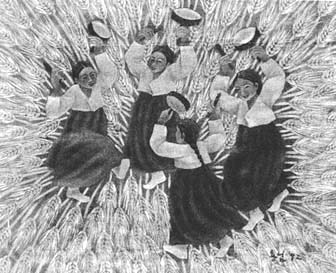
Courtesy: Kim Yong Im
26
Piety and all its accompanying forms/elements
must be truly alive and relevant to the people's situation right where they
are. It must provide for the recollection of the memory of the rich heritage of
the faith, the faith of the ancestors in their life journey with God. That way
we can also check how faithful we are to being steadfast as our ancestors were,
or whether our faith now has simply become a matter of routine or habit or
convenience. The rise of the grassroots churches in some urban-industrial areas
of Korea is a hopeful sign of this kind of piety. May the women's contribution
be more felt in their liturgies and leadership.
Second, her decisiveness in the time
of crisis.
Judith did not allow her personal crisis – loss of a husband – to overcome her.
While facing her own crisis of widowhood, she was not deterred from deciding to
do something about another crisis, a bigger crisis that affected the whole of
her nation. She was even willing to leave behind, at least for a while, her
personal and domestic duties to attend to the bigger duty to her people. The
impulse to be decisive at the call of the moment is indeed a mark of her
steadfastness.
In our crisis, deciding can be a most difficult
task. We do not even know where and how to start as the crises are usually
intertwined with each other. But maybe what we can learn from Judith is the
power of discernment, the power to discern God's will in spite of the crisis,
and so discerning it, to actualize it. Women, usually burdened with household
work or family duties on top of having to work hard for so little pay in order
to augment the meager family income, may have their
set priorities which will affect their decisions. But in the process they also
have been trained to be decisive, probably instinctively decisive. Women would
on impulse respond to a child's cry; cry (whether in pity or anger) over a
touching story or news; respond to a campaign against consumerism, etc. It is
usually attributed to the female's so-called "mother instinct" that
women do seem to be more impulsive in decision-making. May such gift indeed be
27
so utilized that like Judith, it will be useful
to meet a crisis.
Third, Judith's concern for the
general good over that of her personal good even to the point of risking her
own life. Apart
from thinking about not putting God to the test, Judith offered herself for the
welfare of her people. She knew she was risking her life and that of her maid.
She could just have been raped or killed before she could carry out her plan.
Something about her could have led the enemies to suspect her for a spy and
therefore watch her moves very closely and that would have been the end of her
life and of her people. But still she risked her life for the sake of her
people.
In our time, it can be difficult to follow the
steps of Judith. Of course we know of some widows who have come out into public
service like our own president Corazon Aquino. Unfortunately, she cannot even
be so decisive on her own as there are always the so-called
"advisers" around her. Unfortunately, too, we cannot just equate
Nebuchadnezzar or Holofernes to any one person now who, if only we can be rid
of him, will mean a stop to all our troubles. The Nebuchadnezzar and the
Holofernes of our time is a complex system, a network that is controlling not
only our individual countries but the whole of the world. Who can dare put an
end to the "head" of this symbolic enemy?
Judith alone will not be able to do it. But the
many Judith’s together can become a power to challenge the enemy. Together they
can plan better strategies and carry these out to crush the enemy and so be
God's partner in a new liberation act so needed in our time.
Let me end with a modem day parable, which was
translated to a group of women meeting in June 1990 in Seoul. The story was
told in Korean at a sermon delivered by the Rev. Park Hyung Kyu in a church
service on a street in Seoul.
28
There was a tiger in the forest that was feared
by all the other animals. No one knew when its turn was to be eaten by the
tiger. One day, all the little animals had a meeting to discuss what to do with
the tiger. They decided that they would all take turns in attracting the tiger
so that before the tiger could catch anyone to devour, another animal would get
into the chase and so spare the exhausted one. This they would do until the
tiger would himself be exhausted and then they would offer him their food. And
so the time came for the tiger to look for his food. But just as he was about
to catch a rabbit, the deer came in the way; when he was about to get hold of
the deer, another animal came. In his long chase for any one animal, he became
very tired. At this time the other animals would bring him the fruits of the
trees, the edible leaves and barks which were their kind of food. He was too
hungry he ate them all. Each time he longed for meat, the same kind of chase
would happen until he would end up being exhausted and being fed with the food
the other animals had prepared for him. Finally one day he said to the other
animals, "Now I have learned to like your food. I will no longer chase
animals for my food."
If the tiger represents to us now what
Holofernes and Nebuchadnezzar represented in Judith's time, then the little animals
represent the Judith’s of our time. And as the story goes, there is strength in
collective consciousness and action – even to change the heart of the tiger.
29
Suggested Procedures
1. Do a
character-reading of the story by picking a narrator, a female as Judith, a
male as Achior, a male as Holofernes, other voices as people, to read their
respective parts. You may use the biblical excerpts quoted in the presentation
here.
2. Do
these characters represent some of the personalities in your situation and
time? Is there any similarity/semblance of the situations then and now? (Identify these characters/ personalities.)
3. What
lessons can we learn from Judith? As SCMers, how can we appropriate her way of
solving a crisis to our own situation?