125
The Politics
and Economics of Creation
Ann Wansbrough
Read Genesis 1. As you read/listen to this passage, try to imagine in your mind what is happening.
No doubt, this is a very familiar passage. We all think we know that God is Creator. We sing hymns of praise to God and so we should. In those hymns, we remember that God is Creator and we rejoice in the abundance of creation.
If we wanted a simple hermeneutic or principle for interpreting life to come out of Genesis 1, it could be as simple as saying: "Yes, God is Creator. When God created heaven and earth, God supplied an abundance of good things." But what is the reality – e.g. in the Pacific?
Reality
At this consultation, we learned of what is happening in West Papua (Irian Jaya) - the Indonesians feel that they do not have enough land so they are taking over another land and destroying the local people and culture in the process.
____________________
This Bible
Study makes use of the hermeneutical circle, the method of relating theology
and reality. It was conducted at the 1989 Pacific Consultation.
126
Or we could think about 9 Mile Settlement and 6 Mile Dump – two places near Port Moresby which the consultation participants visited. They are places for people from rural Papua New Guinea who come to Port Moresby and have no land. They are places of poverty.
Or we could look at Fiji where people are using racial divisions as a way of trying to determine who should get what. We could think of the crisis in Bouganville, or the French in New Caledonia. Or you could go to Australia or Aotearoa/New Zealand where there are several situations to talk about – the simplest summary is to say that in both countries, the rich are getting richer and the poor are getting poorer. Then there is the idea of the brewery in the Solomon’s.
As we think about all these situations, we become suspicious that something is wrong. People are not benefiting from creation.
There is a trend emerging in the Pacific that says: "We're going to make lots of money. We're going to have lots of development." This trend is leading to some people getting richer, but many people are getting poorer. There are people whose very existence is being threatened. Many people are suffering because of the economic development.
Let me read to you an extract from a book published in Australia called "Development in the Pacific: What Women Say" (Australian Council for Overseas Aid, 1988). The author is describing the changes, which have happened in village life.
In the "custom days”, life for men and women focused on the village. Women were concerned with the production and preparation of food for the family, domestic chores and childcare. Men assisted women in the subsistence gardens,
127
hunted small animals and fished. Food was harvested daily from subsistence gardens and as the women returned to the village loaded with fruits, vegetables and firewood they collected nuts, coconuts and edible fungi from the jungle floor. Fish caught by the men and shellfish collected by women complemented a basic diet of fruits, vegetables, nuts and coconuts. Daily trips were made to the river to bathe and to collect water for drinking and domestic use. Occasionally a new house was built. Women prepared leaf thatch with which to make the walls and roof and men gathered and prepared timber for the house frame. There was plenty of time in those days for women to make palm leaf skirts, bark string bags and household utensils and to prepare natural dyes to decorate these products. Men made canoes, carved figure of gods from ebony and rosewood, which were in laid with pearl shell, and designed intricate fishhooks from mother of pearl, turtle shell and ebony.
Then came colonization and many changes to religion, culture and the economy.
Like all Solomon islanders, the people of Iriri were drawn into the national capitalist economy. The financial burdens of involvement in this new economy, new aspirations and the growth of the village population, which was outstripping Iriri resources, led to the village's request for overseas aid in 1977. The aid funds were to be used for a community development project, which was based on the establishment of a commercial farm and a small-scale sawmill. The initial project was not spectacular but subsequent events led to unprecedented change in Iriri from 1977, when the project began, to 1983.
In 1983, only six years after the aid project was implemented, Iriri village had solar panels, a micro-hydro elec-
128
tricity scheme which provided the village with electric lighting, permanent houses with tin roofs, a motorized transport system to take villagers to market and medical facilities, a tractor, a village school, a bakery selling bread and rolls, a plant nursery and a furniture building project. Numerous contracts had been obtained from government and non-government organizations for school furniture and timber. The people of lriri were awaiting replies to requests to aid agencies for a European teacher for their village school and for a small ship, which would be used for inter-island trade.
Yet, as I passed my days in Iriri in 1983, I watched women toiling in their dark kitchens filled with smoke, which burned the eyes and throat. I saw women bent in two carrying enormous loads of firewood and food after hours of work weeding and planting in their subsistence gardens. I saw their pride when women spoke of their gardens and the things they grew using the "old ways." I heard their silence... and I waited to hear their complaints, which never came. Then, the words of Vuru and Pigay came back to me: things were better in the "custom days" and I began to think about Iriri's progress and Iriri women.
[Quoted from Julia Nesbitt, "Women and Development: The Impact of a Community Development Project on a Village in the Solomon Islands."]
Ideological
Suspicion
Having read this story, you are left wondering: Is economic development all it is claimed to be? You come to ideological suspicion. Is economic development as good as people think it is? It seems to create benefits for some, and problems for others. There are many studies, which show that women are much worse off
129
under so-called economic development in many places around the world. Under economic development, a lot of the best land is used for cash crops (which usually benefit the men rather than the women), so women sometimes have to walk for hours each day to their gardens, where once the garden was close. The studies show that it takes up more time and energy that it used to and the women often can no longer take their children to the field with tem because it is too far. The life of the family is changed and it is not for the better.
Business development comes to all our countries and promises great things. But most of the benefits seem to go to the companies or to a small number of people. There seem to be a lot of people who pay the cost, who end up worse off than before. That does not seem right or just. Something is wrong. It does not measure up to the ideal we began with, that God created this world with, an abundance of everything that people need, and offered it to humankind to benefit from together.
Critique
of the Ideological Superstructure
So we need to ask the questions: What is the ideology, which makes people believe in development? Why are businesses able to inflict such damaging development on us? What is wrong with their ideology?
The ideology seems to be saying that the most important thing our nations need is money. They call money wealth and they tell us that business creates wealth. In Australia, when the churches talk about the distribution of wealth and income, there are business people who say: "Before you can distribute wealth, you have to create wealth." Often they are supported by Christians, sometimes even by clergy.
130
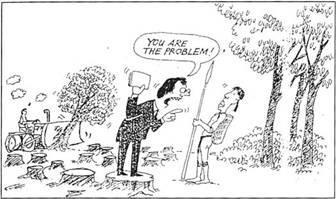
In other words business claims to create wealth. We must compare that claim with Genesis 1, which says that God created the heaven, the earth, and everything that exists. We must ask the question: Are businessmen putting themselves in the place of God?
Courtesy: Jatan News
Connected with the idea that businessmen create wealth is the idea that increase in GNP (Gross National Product) means that everyone will be better off. In other words, businessmen argue from the assumption that the more money that goes through your economic system, the wealthier and better off the nation is, and the wealthier and better off everyone in the nation is.
Often the measurement used is GNP per capita. Economists calculate this for each nation quite regularly. If it goes up for a particular nation, people claim that everyone is better off. The Bouganville mine will have increased the GNP of Papua New Guinea. That suggests that everyone in PNG should be better off because of the mine. It seems that the people who used to own the land, which is being mined, do not think they are better off. The
131
people who live at six-mile dump do not seem to be better off because of PNG has increased GNP.
The rich claim, "as the rich get richer, the poor will also get richer." In Australia, people call this the "trickle down theory." It assumes that if enough money accumulates at the top of the system among the few people who have most of the money, some of it will trickle down to everyone else. So they say: "You have to increase the wealth of the rich and then the poor will be better off." This is garbage. It is crazy. It is not the experience of most poor people. If we go back to the realities mentioned early in this study, it is obvious that many people are worse off rather than better off as development increases the GNP.
What is wrong with the ideology? One problem is that it ignores the need to have a method of distributing the benefits of development. Another problem is that usually the people are not asked what sort of development they want, or that they are only told part of the story about what will happen if they have development, so they cannot make a sensible decision. Developments proposals claim many benefits but do not usually describe the bad things, which will also happen.
In my denomination, the Uniting Church in Australia, we have tried over the last few years to tackle the question of economic justice. We have looked at the ideology and some of the facts, which suggest that the ideology is wrong. In 1985, our church assembly published a brief statement on economic justice. We prepared a short book explaining the statement. It questions the way wealth is distributed and then looks at what the Bible says about rich and poor and about the Kingdom of God. Last year, the assembly asked the councils of the church to study a document, "Economic Justice, The Equitable Distribution of Wealth." This document suggests that economic justice is not only about money. It is about people having access to what we called "genuine wealth."
132
The English word "wealth" has not always meant money. It is used to mean "all those things which contribute to the well-being, of the human community." That is what wealth really is. Money helps us organize wealth, but money itself does not actually do anything for people. You cannot wear money. It does not keep out rain or cold. You cannot eat it. It is simply a way of organizing society. It is not really, what people need for their well-being. In thinking about genuine wealth, we came up with a list of eleven types.
1. Material wealth – that is, we need some goods and services. These include enough food for people, adequate housing, clean water, sanitation, education (this is more than training people for a job), basic health care, help with personal and household chores when you are elderly or sick or disabled, care and protection when you are a child, basic transport and communication, and work which contributes to the genuine wealth of society.
People need all those things and we need an economic system to provide those things in most countries of the world. In some countries, like the Pacific Islands, people are often looked after for most of their needs without a big economic system. They have a village economic system to provide what people need. But with the development, the village get drawn into the national and global economic the system.
2. Technological wealth – the knowledge and skills which enable you to produce things. It might include the machinery to make things.
3. Resource wealth – all the raw materials to produce things we need – land, sea, air, water, fossils, fuels, minerals, oils, wood, sand, oceans and so on.
133
4. Intellectual wealth – the knowledge and wisdom which' humankind has accumulated through the ages. It is not just what you learn at university, although in Australia some people might think it is – especially those who have been through university. But it is all the understanding which people accumulate over the generations and pass on to one another. You might learn some of it at university, but you will learn some of it through communal discussion, the stories a community tells arts, literature and other ways.
5. Spiritual wealth – for us this is Christianity. It includes also traditional religions and other ways in which people1 have tried to express their spiritual life.
6. Natural wealth – the environment: its physical forms (hills, mountains, valleys, and plains), plants and animals, ecological systems, gene pools (that is, the inheritance passed on from one generation of a species to the next). It is the world, which we can change but that we did not create and cannot create. Genesis 1 describes the world.
7. Social wealth – includes the relationships of families, communities, races, nations, international relationships, customs, laws, human rights, languages, traditions.
8. Political wealth – power over one's own life or the life of .one's community or nation; the power of decision-making.
Genesis 1 says that we are created in God's image. That is, we have the same nature as God as it is described in Genesis. God made a decision to create the earth. Like God, human beings are made to be decision-makers. So When we let just a few people make the decisions, we 'deprive people of the power and ability which God has given them to make decisions for themselves.
134
9. Creativity – again, our nature is the same as God's in, Genesis 1. Like God, we have creativity, the power to design things, to make things, to think about things, to organize things in new ways.
10. Variety is a form of wealth – the variety of creation is emphasized in Genesis 1. There is the refrain that God made each thing after its own kind. The emphasis seems to be that there are many life forms; they are all different and they are all important.
11. Time – in giving us life, God gives us a certain amount of time to use. Take, for example, the women described at the beginning of this study. Once they only had to travel a short distance to their garden. They had time to stop on the way and talk to one another as is customary. Or they could hurry back from the garden and have time to do other things. In Africa, some women have to walk 20 miles a day just to get water and wood. By reorganizing land so that women have to travel further to gardens, water or wood, economic development steals time from women and their families.
When we consider these eleven forms of wealth, we find that we can attack the ideology. Wealth is not what the business people tell us it is. It is not money and much of it is not created by business. Some of it was created by God. Some of it is created by people together. Only some forms of material wealth needs factories and mines and so on to make it.
Exegetical
Suspicion
So when you work through ideological suspicion, drawing on what you know of Genesis and what you have experienced of reality, you find that it is possible to make fundamental criticisms
135
of ideology of business development. And as you make those criticisms, you start to see things in Genesis that you did not see before. Exegetical suspicion leads us to say: there is more to Genesis 1 than we have seen already. We can add now:
* God created a world with variety and that variety is important.
* God created night and day; God gave us time.
* God made us in God's image; we are all meant to be decision-makers.
* God made us in God's image; we all have some creative ability, which we should have opportunity to express. We should have opportunity to enjoy the creativity of other people.
* God made male and female. It is not part of our humanity to exist by ourselves. Relationships are important.
New
Hermeneutic
These things then become part of a new hermeneutic; i.e. a new set of principles for understanding life and God.
We have come full circle in our method. I have tried to go through it step by step, but in practice it is often less clear than that. When we start reflecting, many parts of the process may happen at once or we may go backwards and forwards between two stages for a while.
Exegetical suspicion can lead us to look at other passages as well. It does not mean we have to do detailed exegesis of every passage. It may mean that we take something, which is familiar to us, and apply it to a situation. We may find that the church usually
136
limits the context in which it discusses particular passages, and that they take on new depth of meaning when we think about them in the context of a particular ideological critique. We might go on using the same words to say what the passage means, but we will understand something different.
For example, psalms are often read only for devotional inspiration, not in the context of economic justice. As we let our exegetical suspicion guide us, we may find that what is normally only said or sung in church should also be used in discussing economic development.
Read
Psalm 65
(In English, the best version is the Jerusalem Bible.)
The Israelites knew they had to work for a living. They knew they had to till the soil and look after the sheep (we know this from Genesis 3 and from Proverbs). Yet in this psalm, they say that everything, including flocks and wheat, comes from God. Underlying all that we do and all that goes on in the world is God. Praise is given to God, not the earthly shepherds or the people who build ships and go off as traders, or the people who grow the wheat. It is God, not business, who keeps the world going and looks after the world.
In this psalm, they begin with confession. Only when they have confessed are they able to describe the wonders of what God does. Perhaps the right interpretation of this psalm is that the reason they needed to confess was that they had forgotten God and forgotten that all these wonderful things come from God. When they have repented of this, they are able to recognize all God's gifts, the wealth which God has given to them.
137
Read
Mathew 6:19-21, 24-34
Earlier in this study, I mentioned the debate in Australian society in which businessmen are saying, "Business enterprise creates wealth" and "The church should not talk about wealth distribution until it has talked about wealth creation." What they mean is "Let's get the economic development right, and then we can worry about justice." This stands in contrast to this passage where Jesus says: "Set your mind on God's kingdom and his justice before everything else, and the rest will come to you as well."
I do not want to be simplistic about this passage. Some Christians try to live as if they did not need to make any plans. They wait for everything to come from heaven. If we took this as our initial understanding of the passage, and as our hermeneutical principle for making sense of life, and went round the hermeneutic circle, we would find that it is an inadequate interpretation. We cannot simply be "spiritual" and not ever have anything to do with economic development or business or money. That would not help anyone.
The point of the passage is that we need to begin by being clear about the real nature of wealth and its source, and the principles by which we deal with the needs of humankind. Then we can deal with economic development and business in a sensible and responsible way.
This passage gives two fundamental principles: (a) God has provided what we need; and (b) God calls us to be just in the way we use what God has created for us. As we take these principles seriously, we can go on to plan for organizing things, making things. We can say to business people, "Don't tell us you can create wealth. You sometimes help us to organize, but often you help disorganize things. Often you seem to be going back to Genesis 1:1, to the time of chaos before God began the creative process! That is not creation, it is destruction. It is not justice, it is injustice."
138
Artwork: Ahn Joon Hyun
139
An example of this is the global share-market crash in October 1987. Every time shares are traded, a nation's GNP goes-up. But eventually the amount of speculation on the stock-market leads to chaos.
Business people do not want to hear these sorts of comments and questions. Two examples:
* Sometime ago, an Australian businessman, Alan Bond, who is one of the richest people in Australia, a billionaire, was being investigated by the Broadcasting Tribunal to see if he is "a fit and proper person" to own and control a large section of the media. The reason for investigating him was that he gave a large sum of money to the person who was Premier of Queensland. He was complaining because he was being investigated. He objected to them asking whether he is a suitable person to control the media. He thought he should be above question. But do you really want someone who gives bribes controlling a major national TV network and several newspapers? We need justice more than we need his business.
* In our discussion of Irian Jaya, we heard how the World Bank and several transnational corporations are investing in it. They will make huge profits from the resources there. For the sake of economic development, people are driven from their traditional land and deprived of their traditional resources. In Australia, when we look back on the way the British colonialists did that to the aboriginal people, it is called invasion, theft, murder, genocide. Is it any different in Irian Jaya where the army is used to settle the area with Indonesians, a different cultural and racial group entirely from the indigenous Melanesians?
140
We should be writing to the World Bank and the transnational corporations, challenging their involvement in Irian Jaya. But I suspect the World Bank and the TNCs would write back and say: "We are doing this for the good of the people. We know what is needed. How dare you question us? You are just plain ordinary people and you cannot really know anything or understand anything about economic development. But we are economic experts and business experts. We can be trusted. We are beyond question." I hope I am wrong, but that is what I think they will say.
Around the world, there are businessmen and economists who think they are beyond question. They see themselves as creators. They have turned themselves into gods. They think the rest of us should worship them by organizing our lives, the life of our village, city and nation; to fit what they tell is right.
Genesis 1, Psalm 65, Mathew 6 and many other biblical passages make it clear that such an attitude is wrong. Business people are not God. They are not beyond question. Like the rest of us, they are sinners. As Paul says in Romans, we are all sinners. That includes business people.
Read
Psalm 82
It seems to me when business people call themselves wealth creators, when they tell us they are experts and working for our good and we should not question them, then they are setting themselves up as gods. They seem to fit the image in this psalm: God takes his stand in the court of heaven and gathers around him all the minor gods, all the princes of the earth, who in our day might be the controllers of transnational corporations. He delivers judgment among them. He calls for justice for the vulnerable people of society, he reduces the princes to being mere mortals like the rest of us, and he reminds them that all nations belong to God.
141
We can surely join the prayer at the end of the psalm: “Arise O God, dispense justice throughout the world, since no nation is excluded from your ownership”.
In our day, some transnational corporations have bigger economies than whole nations do. There are at least five hundred companies, which have economies bigger than those of most nations do in the world. Only the "first world" countries have bigger economies than the biggest TNCs. Many, many more TNCs would have economies larger than the economies of Pacific island nations. Surely, they, too, come under God's judgment.
They are not creators and they are not gods. God will hold them accountable for the way they go about development.
[Useful information on the size of the TNCs and many related matters can be found in Michael Kidron and Ronald Segal: The New State of the World Atlas, Pluto Press, London and Sydney 1984.]
But we cannot get rid of all business. We do need some of the things they have to offer. We would not be able to meet here, or to communicate with one another when we return home, if it were not for transnational corporations. So we are left with the question: what is the new hermeneutic? What sensible principles can help us make sense of what we see happening in our nations and offer us help in deciding what economic development we want and how we want the development to happen?
On the basis of this study, the following seem important as the basis of our new hermeneutic:
* We need to recognize all the types of genuine wealth, which contribute to the well-being of people.
* We need to recognize God as Creator of much of this wealth. What God has created? God has given to all
142
humankind, not to any one group and not to individuals.
* We need to recognize the wealth, which is created in community. What the human community creates should benefit everyone.
* We need to recognize that some wealth can be destroyed in the quest for money, or for material goods. The obvious example is the environment. There are many examples. In some cases, factories have been built which polluted whole fishing grounds. Thousands of people have been left without their livelihood because one factory made a few things (probably for export) but destroyed the fishing ground that God had created.
* We need to weigh up what money can buy, what economic development can bring us, against what is destroyed to produce that money.
* We will not assume that money or development will automatically be good. We will not assume that foreign exchange will automatically make our nations better off. We will look at what it will be used for.
* We will not assume that what is imported is better than what we already have. For example, some Pacific islands import western food. It is often second rate compared to the natural foods of the Pacific islands, but people think that because it is western it is good. It is not.
* We need to weigh up the paid jobs, which are created against the traditional jobs, which are destroyed.
* We need to go back and seek justice before everything else, asking: Will the ordinary people benefit? Or will only a small elite benefit? How will it affect women?
143
We will then say: we will have economic development when it actually helps us to meet basic human needs, which we cannot now meet. We will have economic development when it does not destroy what we already have that we need. We will have economic development when it actually helps us provide good food, enough houses, enough clothes, education, health care, sanitation, clean water, essential communication and transport. But we will not have these things if they destroy our other forms of wealth - our nation's own intellectual, spiritual, political, natural wealth. We will say that money only has value as it enables us to improve these aspects of our lives. We will not accept the limited worldview of the materialistic western nations, which does not value the people of our nations' own forms of wealth.
On the seventh day. God looked at the world and saw that it was very good. I suspect God looked at the Pacific and laughed for joy. God believes the Pacific island nations are very good. May we share that belief and help our nations to believe it also, so that it may guide the development of our nations.
144
Suggested Procedures
1. What is our affirmation, as a church, about God's creation?
2. In comparison, what are our experience of development and its accompanying processes of modernization and industrialization? How has the so-called development affected God's creation? Give positive and negative aspects, if any.
3. Proceed with the Bible study presentation here.
4. What practical things can we do as the church, or the SCM, to affirm and uphold our responsibility for God's entrusted creation? Dramatize your answer.