105
The
Relationship between Theology and Reality
Ann Wansbrough
The church often talks about theology as if it were like mathematics: you have certain principles and rules, and can then apply them into everything. You go through a set method and come out with the right answer.
Good theology is not like that.
For example, take the situation of a government relying on military strength, or using its structures to support racism and elitism – e.g. the situation in Bouganville – the government- declared state of emergency and military harassment. That sort of situation should make us aware that we cannot just take biblical passages and say: "what it says is obvious; we can just take it and apply it to our situation." These situations are complicated. It is important that we think carefully about what would be an appropriate Christian response.
When I consider many of the activities of governments, I have ideological suspicion about them and the reasons, which are used to justify them. Militarism, violence, control by fear are all things which go against basic human freedoms. What sort of ideology supports these acts of violence?
____________________
This Bible Study was prepared during the 1989 Pacific Consultation,
taking account of stories told about particular situations. It uses the
hermeneutical circle, a principle of method is circular as interpreting life
never ends. And being circular, one can start from anywhere in the circle –
with reality, exegetical suspicion, or ideological, etc. – depending on the
situation.
106
Part of the ideology is that we are told that being a good citizen means being obedient. We are often told that the government has the right to take any action that it thinks is necessary. "Someone has to be in control; someone has to make the decisions." People often give the impression that if you protest, if you march in a demonstration or do something like that, you are dangerous. They claim you are undermining law and order.
The church often reinforces that ideology. Church people often say, "God wants us to be obedient" or "God gives governments their authority." We are told that Christians must be people for reconciliation and peace. "You should not be confrontationalist" or "You should be prepared to compromise."
Or, we get the sort of ideology which says "might is right." This is very prevalent in Australia. Many people say: "We do not have to worry about the aborigines. They have to put up with what is happening to them because the British were more powerful." They seem to think this justifies what has happened to aborigines. In China, Mao Tse Tung said, "Power comes out of the barrel of a gun."
Most of us face pressures to identify with our own racial or tribal group and not to question what that group does. In Australia, white people who identify with the aboriginal people are thought of as "rabble rousers," as people who are a bit strange and who really should not do what they are doing. But it happens in every country that people are encouraged to identify with their own particular racial or tribal group. We are often told that we are betraying our own people if we start to question. Questioning our group can lead to terrible accusations and experiences.
We will reflect on these situations in the light of the story of Job. Job was considered a good man. This is important because Job went through some terrible experiences. Job 1:13-21
107
gives us the account of some of those experiences.
Read
Job 1:13-21
Because of the response, Job made here, a lot of people in the church say, "Wasn't Job a patient man?" But that was only the start of his trials. By the end of the book, Job is not the patient man at all.
In Job chapter 2, the author describes God and Satan as having another little discussion. Satan says: "Well, look, you can do all sorts of things to a person. But it is not until you really touch their own body that they really feel suffering and pain." Satan then strikes Job with a disease. He is crushed into absolute misery. At first, he seems to go on being patient. He just sits there. Then some friends turn up. He starts to express some of his grief over all this suffering and misery, which has happened.
Most of the book of Job is in poetry form. It is a series of arguments. Scholars talk about three "cycles" of speeches because the author first has Job speak, then one friend, then Job, then another friend, then Job, then the third friend. Then they go through it all again. They do it three times.
The friends bring out everything they have ever been taught by religion about suffering – how suffering is to test you, how suffering is to teach you, how suffering is the result of being wicked, and so you should repent and then the suffering will go away. All these are nice pious ways of understanding suffering. The problem is that they all assume that there is something wrong with Job's relationship with God. We already know from the start of the story that they are wrong about this – God is proud of Job and boasts about him! The suffering has nothing to do with how good or bad Job is.
108
One of the things that often happen in the church in Australia, and probably in most other cultures, is that we have a habit of blaming the victim when something goes wrong. When someone suffers, we tend to think: "There must be something wrong with the way they live." According to students I taught at Rarongo Theological College, that way of thinking is very strong in Pacific cultures. Pacific people often think that suffering shows that people have done something wrong.
The story of Job is about the fact that suffering is not always the result of the person having done anything evil. Whole communities can suffer without having done anything evil. If there is anything evil in Job's suffering, it is the actions of the Chaldeans and Sabeans, the raiders in chapter 1. They are forerunners of the economic colonialists who come and take from people everything they need in order to live. They do that because they are evil, not because Job or his children are evil.
Job does not get much sympathy from his friends. Instead, they keep on wanting to give him good advice: "If you do something about your prayer life...," "...what you need to do is repent...," "...tell us what you have done wrong...," "...then everything will be alright." When Job does not do what they suggest, they get very offended especially when he expresses his grief and anger. The grief and anger mean that Job is getting in touch with his suffering.
He starts in chapter 3 by cursing the day he was born, wishing he were dead, wishing he had never been born. As he goes on in the dialogue, he suddenly starts to get some very sharp perceptions of the world around him as the argument gets harsher and harsher between him and his friends. He starts to see the world around him with his new eyes. His suffering becomes a way of opening his eyes to the suffering of others.
109
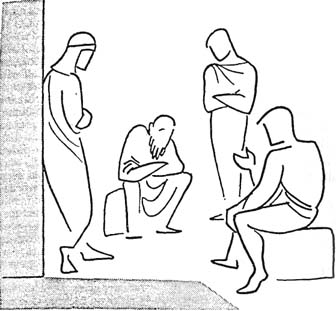
Job and his friends Courtesy: Good News Bible
All that Job gets from his friends is rejection, blame and refusal to listen. They keep on saying how wise they are. They claim that the very fact that Job gets angry and argues with them shows they are right and he is wrong and that he needs to learn wisdom.
Job listens to his friends but then he says: "Hey that does not fit." He starts to see that the theology he once believed in might be wrong and maybe the world does not work in the way he thought it did. He asks questions. He finds himself criticizing the friends' description of the world.
The friends say, "If you look at the world, you will see that the wicked are punished and the righteous prosper." However, Job
110
looks at the world and he sees that the wicked often prosper and the righteous often suffer, and that rulers and governments often allow this situation to continue. He hears the cries of the poor and describes their plight. He sees that there are a lot of rulers who are foolish and idiotic and he describes their madness.
We should not necessarily believe all the things Job says about God and the world. Some of his speeches are stages he goes through in learning about reality, as he tries to make sense of reality. The speeches are nevertheless terrific stuff – they are worth reading because they make us think about the world and what really happens in it.
Chapter 12:10-16 is what in English is called parody or satire. It is intended to be absurd and to make clear to us the absurdity of the situation or belief it is talking about.
Read 12:10-16
Now all that sounds straightforward. You would probably say: "We agree with that. God does have that sort of power." But we need to think about what we do with that belief because Job goes on to show how it can be used to draw absurd conclusions.
Read
Job 12:17-25
Many Christians put all the emphasis on God being in control of everything: "God has a wonderful plan for your life ...," "Just trust in God and everything will be under his control...” The result is the sort of conclusion Job arrives at in these verses. There is no room in it for human decision-making. However, we know from the rest of the Bible that human decision-making is really very important. We cannot just say: "God made me do it" or "The devil made me do it." We have to take responsibility for our decisions. A lot of simplistic theology takes us away from that responsibility.
111
Job's parody shows the absurdity of that sort of simplistic thinking. For Job, thinking in this way is terrifying. The problem is that he is taking his experiences as a direct way of understanding God. He finds God vindictive, intrusive, belligerent, sadistic, unjust and arrogant. This does not mean God is like that. Job is still hanging on to a simple way of understanding God. When he had good experiences, he concluded that God was kind and generous. Now he knows from experience that life can be a terrible experience. But he clings to his old method of thinking about God and concludes that because life is not fair and just, then God must be unjust and nasty. He has simply turned his thinking upside down because his experience is now the opposite of what it used to be.
That is Job has not, at this point, arrived at a satisfactory theology. But he has taken the first step. He has recognized that the tradition he has been taught does not take reality seriously. He has rejected the tradition on the basis of experience. He knows the friends are wrong, but he does not yet know how to solve his dilemma.
In the dialogues, Job keeps chopping and changing his ideas. This upsets Old Testament scholars because they want something predictable and logical. They seem to want to be able to go through it logically and derive a conclusion from each bit of the book. It is not like that. Job is in absolute turmoil and says everything and anything that comes into his head simply because he is struggling. These parts of the book are supposed to help us understand the human struggle to understand God; they are not meant to be the source of our theology.
Throughout it all, Job calls out to God to answer him. He often admits that he does not understand and does not have the answer, and that all things he says are absurd. He knows that he needs to understand and that he will only understand when he encounters God in the midst of these experiences. He believes he
112
has a right to demand that God answer him.
His friends, of course, all think that he is wicked to think this way and they say, "You wouldn't dare to call on God. If God turns up, he would wipe you off the face of the earth because you are saying all these terrible things about God." The friends say over and over again that they can speak on God's behalf and that they know exactly what God would do and what God would say. They are really very arrogant. They do not think they are, but it is shown by the way they keep on saying, "We know it all. Just listen to us. Stop saying these things or God will wipe you out."
As this goes on. Job finally starts to believe in a God who accepts human anger. He moves away from the sort of God he appeared to believe in at the very beginning, in chapter 1. That God expected obedience and subservience, perhaps even groveling. That God expected you to have your life and your ritual always and exactly in the right order. Job now discovers that God is not like that. He does not know what God will turn out to be like, but he goes on asking questions. He recognizes that what he has been taught is not good enough and that he does not have to accept what the friends say.
Perhaps at this point we should try to understand the friends' viewpoint. They are looking at a man who is suffering and they cannot understand his suffering. They have never seen him do anything wrong. But if they accept that he is righteous, then they will have to rethink all their theology. They might have to change their lives and do things like listening to his questions, or comforting him, or sharing their belongings with him. It is much more comfortable and safe to hang on to the theology they already know.
People in the church today are often like the friends. They do not want to hear any questions. They do not want to hear any different experiences because' their theology is very comfortable
113
for them. In many churches, most members do not experience terrible suffering and they have not let their theology be tested by the suffering of others.
Towards the end of the book, God speaks to Job and holds what is called a "wisdom contest" with him. This is very great honor. The book of Job is part of the literature called the "wisdom tradition." In that tradition, the most important thing was to be wise. They used to have contests between wise people to show their wisdom.
An example of this is the story of King Solomon and the Queen of Sheba. Solomon is supposed to be wise. The story is told of the Queen of Sheba going to talk to Solomon and asking him hard questions. Some people think the story means that she was typical of women who needed a man to tell her the right thing. They think she came to get information. However, the real point of the story is to show how wise Solomon is. The Queen of Sheba actually represents all the wisdom in the ancient near east and the story shows how wise Solomon is by showing that he can answer all the wise questions put to him. [Solomon is so wise; he is as wise as a woman is!]
It is this sort of contest that goes on in the last chapters of Job. God says to Job, "Alright. You know what all the questions are. You stand up, and I will ask you questions and you must answer them. Show how wise you are."
Read
Job 38:1-42:6
As well as being a wisdom contest, it is a theophany – an appearance of God to someone. In the Bible, this only happens to people who are very faithful, like Moses and Elijah. It only happens a few times. So in itself it is an honor for God to appear to Job in this way. For God to challenge someone to a wisdom contest must
114
be an even greater honor.
God asks Job very hard questions. In the end, Job finds out that what he has been saying is not much of an answer. However, because he was asking all these questions, God was able to open his eyes to a new way of looking at the universe and a new way of understanding how God works within the world.
Job begins to see that one cannot say that the world is set up to dole out rewards for those who are good and punishments for those who are evil. That is not the way the world works. The world has its own laws – the laws that govern the coming of the rain and the snow and the sun and the heat, the laws that govern animals' lives and plants' lives. There is a whole range of laws. But there is not a natural law that rewards some humans and punishes others. The very fact that all those other laws of the universe exist means that there cannot be a law of reward and punishment built into the universe. People suffer but that has nothing to do with reward and punishment.
Job discovers that the world exists for its own sake, not for the sake of human beings. It is a place of joy and delight, awe and terror. We need to be in touch with that world. We need to remember that we human beings are puny creatures. We are not the whole of creation, although we often think we are. There is order in the world but justice is not built into the world. Justice is something you and I have to choose to do. It is up to us to be just. It is not in the fabric of creation around us.
We should be grateful for this. If you had a universe that rewarded you every time you did the right thing and punished you when you did the wrong thing, life would be terrible. It would be chaotic. It would be frightening. It would be like having someone hanging around you looking over your shoulder all the time, at everything you did. The universe, and human beings, could
115
not function like that. Yet simplistic theologies often assume that that is the way the world operates.
There are many things we can learn from Job. The thing that seems most important for this consultation is the relationship between theology and reality.
The friends of Job had a theology which existed by itself, without contact with reality. Job suddenly discovered what reality was really like, with all its pain, grief and unpredictability. He had a taste of the way some people live all the time. It shattered his theology. He had to come up with a new theology.
A lot of people in the church are like the friends. They say: "We know what we believe. We only see those parts of reality, which fit our theology. We will look at the world through our theology and we will condemn everyone who does not fit the pattern of our thinking."
In the SCM tradition, and most of the ecumenical tradition, there is an attempt to say: "Reality forces us to rethink our theology, Reality helps us understand God in a new way." We do not need to be like the friends of Job. We need to identify with Job. We need to identify with the people who suffer. Our theology will be different when we do that. It will change from what it is like when we sit apart from suffering. As we enter into the reality of people and share their pain, we will find ourselves asking difficult questions. We will find that a lot of people in the church will not like us very much. SCM and WSCF will probably always be small because the way the friends carried on is more comfortable for the church and acceptable than the way Job carried on.
I would like to relate the story of Job to a method of doing theology, which was worked out by a Latin American theologian, a liberation theologian, Segundo. He has developed what he calls a
116
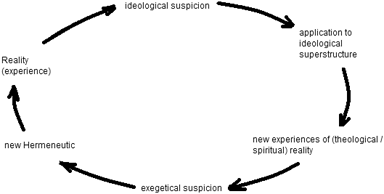
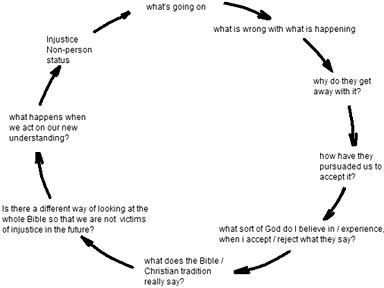
hermeneutic circle. This is a circle of interpretation, a process that helps you interpret God, yourself and the world. It is an ongoing process. It assumes that whatever you learn, there is always a new way of understanding it. Two versions of the circle are provided in this Bible study. The first uses Segundo's terms and the second uses my translation of those terms.
The circle starts with reality. We need to start with the reality of oppression and injustice. Then we will begin to see. Then there will be questions we need to ask because we see that not everything is as it should be. We will start becoming suspicious of the ideology which people use to support the situation of oppression and injustice – ideological suspicion. At this point, you have to become a bit of a detective, someone who is open to new things and looking for clues that you have been missing. You take your questions and your suspicions, and you look critically at the ideology of the society you are in – the ideology of the people who are doing the oppression – ideological critique.
As you become critical of the ideology, which supports, injustice, you will start to experience life differently. You will discover that you experience God differently. This leads into questions about theology and the way the Bible is understood.
Exegesis is the process of working out what a particular passage of the Bible is saying. As you go through the process of the hermeneutic circle, you find that you have to say: "Well, they might have taught me this and this about God, but I don't think I can believe that. So I had better go back to the Bible and see what it really says in the light of this new understanding," When you start to do this, you find that there are different themes in the Bible and different ways of understanding things. You will start to develop a new hermeneutic or new principle of looking at the world and at God. That is, hermeneutic is the principle you use to under-
117
118
stand and interpret things. When you start using a new hermeneutic, you start to see and experience reality differently and you find you have more questions. So you repeat the circle.
My translation of this jargon to everyday language is this. You start from a situation of injustice and say, "Hey, what's going on?" Then you say, "Should it be happening?" Then you ask the questions: "How do these people get away with doing these things? How have they persuaded us to accept what is happening?" Then you say: "What sort of God would I have to believe in if I accept what they are telling us to accept?"
One way of effectively criticizing different views is to look at the view of God they imply. What sort of God does this viewpoint require? What sort of God would you believe in if you adopted a different viewpoint? Is it the God, for example, who supports colonialism? Is it the God who supports slavery? What sort of God is the god of the colonialists? What sort of God did the missionaries believe in when they accepted colonialism and expected us to accept it? Then you ask: "What sort of God do I really believe in? What sort of God do I know? What sort of actions would that God accept? What sort of actions would that God reject?" We would want to say that God is a God of grace, a God of love, a God of justice and peace. Not a God who encourages economic colonialism or a God who supports the abuse of human rights. We then ask the question: What does the Bible really say?
For example, does it suggest that we should just accept another culture's coming in and being imposed on ours? Does the Bible really say we should accept that greed and competition are good, as a lot of large companies would tell us? Or does the Bible challenge such things?
One of the things women have found is that they are treated as inferiors in most cultures and in the church. When they
119
start to go through this process, they find that there are whole sections of the Bible, which the church has ignored and that need to be thought about again. They find that they are the children of God, baptized into Christ in the same way as men. In Christ, there is neither male nor female.
There is a need to criticize past misuse of the Bible as a way of ensuring we do not get misled in future and do not have to put up with injustice again.
There is not much point in this method if you simply develop a nice theory in your head about what the Bible says, or about whom God is, or about how we should relate to one another. We can only develop our understanding further as we start to act on our understanding. When we do that, new questions will arise. We will have new experiences, which lead us through the cycle again.
Segundo says that there are two conditions, which must be satisfied for the method to work. The first one is that "the questions arising out of our present be rich enough, general enough and basic enough to force us to change our customary conceptions of life, death, knowledge, society, politics and the world in general." Then it works if we get down to some basic general questions about life and reality.
The second one is that "if theology somehow assumes that it can respond to the new questions without changing its customary interpretation of scriptures that immediately terminates the hermeneutic circle." In other words, if you start doing your analysis of what is happening and you say: "We'll analyze society. We'll analyze ideology. But we will stick to what we think we already know about the scriptures and what the church has taught us. We won't let that be challenged," then the cycle cannot be completed and it stops there. You cannot go on.
120
Segundo goes on: "Moreover, if our interpretation of scriptures does not change along with the problems, then the problems will go unanswered, or worse, they will receive old conservative unserviceable answers."
The friends could not do theology the way Job did, because they did not satisfy either of the two conditions. The friends were not willing to ask any of the questions Job wanted to ask. They did not believe that there were any questions to be asked so they could not grow in their understanding. The second thing is they were not willing to change their understanding of scriptures and their tradition. They had a fixed way of understanding the tradition and they were going to keep on repeating it no matter what the situation and what the questions Job asked. So they were cut off completely from entering into a new understanding of who God is. If they had identified with Job and shared his questions, they could have changed their understanding. They could have had a new experience of God but they cut themselves off from that.
The process we are embarking on, when we identify with the struggles of the people in the nations we come from is a shattering process. Like Job, we are going to grieve ideas that we have to give up and we are going to find it very demanding. At times, we are going to feel confused. We have to be prepared to live through some confusion to get the new understanding. Sometimes we are going to have to be prepared to take risks and make mistakes. We can take courage from the fact that Job said things that by the end of the book he had decided he did not want to say anymore. It was only by saying those things that he could actually express the fact that he thought that the old way of understanding were wrong. It was only once he said those (wrong) things that he could move on to find a true understanding.
Often we are brought up, particularly through our schooling, to believe that we have to have the right answer. In school, we
121
may have been punished for having a wrong answer. Often, in school, it seemed better to say nothing than to make a fool of ourselves by saying something, which was wrong. Sometimes the church is very judgmental when people say or do something, which the leaders think is wrong. But in fact we can only arrive at the true understanding of God and life by being prepared to take risks and try out new ideas to see whether they help us understand. Like Job, we need to be prepared to say and do things, which may seem absurd.
The friends' refusal to let those new questions and answers be tried was very destructive. If God had not entered into the process, I wonder where Job would have ended up. We cannot expect that the people around us who suffer will have a theophany from God. The only way they will experience the God of Job is through Christians identifying with them.
Read
Job 42:6-17
The book of Job finishes with a warning. We do not have any alternative but to let the questions be asked. The friends had always thought their theology was right. It looks right. But at the end of the book. God condemns the friends because they have not spoken about God, as they should. God tells Job to pray for his friends that they might be forgiven. I have read books of several scholars who say, "I really cannot understand why God condemns the friends. Their theology looks alright to me." The fact is that their theology was wrong because it did not fit the situation. It did not fit reality. It did not respond to suffering. So even though in some situations it might look alright, it had become heresy. Job's questions, which look like heresy, especially to scholars, were closer to the truth.
The friends attempted to be faithful, but they ended up being faithless. That is why they needed God's forgiveness. They
122
attempted to be caring – that is why they told Job their theology – but they were really attacking Job. Job had to say to them: "It would be better if you let me alone. Why do you make my suffering ten times worse?" They actually tried to offer hope when they said: "All you have to do is pray. All you have to do is repent and then everything will be alright." They did not understand Job's cry for God to appear was a form of prayer or that Job had not done anything wrong. So this attempt to offer hope actually denied Job hope. They were actually making his faith and his pain even more painful than they were already.
The very end of the book is very interesting. The author seems to have been aware that old ideas die hard and by the end of the book there would be some people who still wanted to believe that God rewards the righteous and punishes the wicked. So at the end of the book it is shown that Job was righteous, by restoring his health, his goods, his family. However, the most interesting part of this is verse 13 where it says, "He had seven sons and three daughters. He named his eldest daughter Jemimah, the second Keziah, the third Keren-Happuch. There were no daughters in the world so beautiful as Job's daughters and their father gave them an inheritance with their brothers." In those days, women did not normally inherit.
Over the eight years that I have taught courses on Job, I have wondered about those verses. I have never been satisfied with what the commentaries say about them. I have had exegetical suspicion, but have not had an adequate hermeneutic to reinterpret them! I think now I have.
It is the experience of many women in the church that men who are radical on many issues – peace, justice, the environment and so on – often still treat women as inferior or different and do not recognize their gifts or rights.
123
Surely, what the author is saying is "If you really identify with the suffering of people, if you are really open to a new experience of God, then you will identify with women who are oppressed. You will change and you will treat women as equal." That is what Job did at the end of this whole process. He recognized that his daughters should be treated in the same way as his sons, in spite of cultural customs, which were different from this. Perhaps, the way men treat women, and the extent to which men are willing to change the cultural customs about women, is the most stringent test of whether we have really gone through the process of ideological and exegetical suspicion and found a new hermeneutic.
124
Suggested Procedures
1. What comes to your mind when you hear or think of the word "theology"?
2. Based on your understanding of the term, does theology have any relationship with reality? If yes, in what sense? If no, why not?
3. Proceed with the Bible study presentation here, reading the passages from the book of Job accordingly.
4. Characterize Job and his friends today – are there persons or institutions that represent similar experiences and struggles?
5. As members of the church or the SCM, what lessons can we learn about doing theology in our respective situations?