Part 1 —
Women’s Stories
45
Australia
For
Aboriginal Australians, colonisation continues
Gloria Brennan
Gloria
Brennan presented a paper (here edited and abridged) on the situation of Aboriginal-Australians
at the 1985 Australian-Pacific women's peace conference in Sydney. The
conference was sponsored by Women's International League for Peace and Freedom.
The
situation of Aboriginal women is often more serious than that of the men:
"women bear the brunt of social disruption caused by an uneasy mix of
black and white customs".1 Alcoholism among men and petrol
sniffing among young people lead to a breakdown in traditional authority and
family relationships. Women have suffered brutal physical and psychological
harm from their men under the oppressive "reserves" system — whites
hounded Aboriginal people off their land and forced them to live under white
administration in limited areas. Gloria Brennan refers to the very high rates
of imprisonment among Aboriginal people; the rate for Aboriginal women has been
twice this in some states. Forced abortion and unsafe birth control methods
have been used on Aboriginal women.
The
women of ten point to white intervention as a cause
for their loss of status among their own people: in traditional culture, women
played a leading role in Aboriginal communities, but it was a role distinct
from that of the men. Women had their own sacred sites and rituals; their
contribution to the survival of their people (through food gathering) was
crucial. White Australians have devalued the contribution of Aboriginal women
by treating men as the proper voices of Aboriginal dissent or aspiration; white
feminists have misinterpreted and misrepresented the suffering and aspirations
of Aboriginal women — by failing to take into account both the severity of
racism in Australia and the complexity of gender relationships in traditional
culture, (ed)
I speak
as one of the prior owners of this country. The land is still our land,
contrary to popular belief. Unlike most of you in the Pacific and Asia, we do
not run our own affairs. We do try to practise our
own sovereignty. You see, our colonisers are still
with us. We have been described as members of the fourth world: people who,
like the Indians of Canada or America, Hawaiians, Inuits
of Greenland or the Samis of Scandinavia, were the
original owners.
In most
places, we constitute less than two per cent of the population. And we are
dependent. We're dependent on another culture, which runs our
46
country for us. Our
relationship with our colonisers is similar to the
relationship between aid givers and aid receivers in the third world. All the
aid we get — and it does not only come in the form of money — has strings
attached.
We live
under third world conditions. The health and well-being of Aboriginal
Australians depends now, as always, on a close material and deep spiritual
relationship with our land. It depends on cultural integrity, and the material
resources which would enable us to live in dignity: independently and
self-reliantly. Since European "settlement" began almost 200 years
ago, each of these requirements has been rudely disregarded: initially through
a policy of murder and conquest (aided by exposure of Aborigines to infectious
diseases with which we had no previous contact), then by moving us from our
traditional lands, institutionalising our suffering
and pauperising us, and then by forbidding us our
culture.
By 1950,
these policies had reduced the Aboriginal population of Australia to less than
half that at the time of European invasion. Since then, however, there has been
a rebirth of Aboriginal Australia — aided by significant international
pressure, the more liberal attitudes of some other Australians and, especially,
the efforts of Aborigines ourselves.
In
theory, at least, the policies of assimilation and cultural genocide have been
swept away. The official policy of the current federal government is to permit
Aboriginal self-management and self-determination. Limited land rights have
been granted in some areas, and most of the legal machinery responsible for
official discrimination has been dismantled. There have been, however, some
problems in realising these new policies: the largest
is that most programmes affecting Aborigines are under the control of state
governments — all of them, to varying degrees, hostile to the new policies.2
Disadvantages
which Aboriginal people suffer are all inter-related: they occur in the fields
of education, law, employment, housing, income and health. Aboriginal people
have the highest birth rate in the country, the worst health and housing, and
the lowest educational, occupational, economic, social and legal status of any identifiable
section of the Australian population. The Australian education system still
discriminates against Aborigines: in most schools, Aboriginal history, culture
and languages are belittled. Aboriginal people constitute about 1.3 per cent of
the population, yet more than thirty per cent of prisoners are Aborigines.
Australian law is based on the fiction that the continent was unoccupied when
Europeans arrived. More than half of Aborigines able and willing to work are
unemployed. More than seventy per cent live in grossly unsatisfactory housing,
according to the government's own reports. A substantial
proportion of the remainder live in housing which would be suitable if it were
not so overcrowded. The present rate of housing development is well
below the growth rate of the Aboriginal population.
The
typical Aboriginal family is about twice the size of a typical non-Aboriginal
one yet, because of its age structure, it has only half the number of potential
income earners. Combined with unemployment and poor education, this means that
the average Aboriginal income is much lower than that of
47
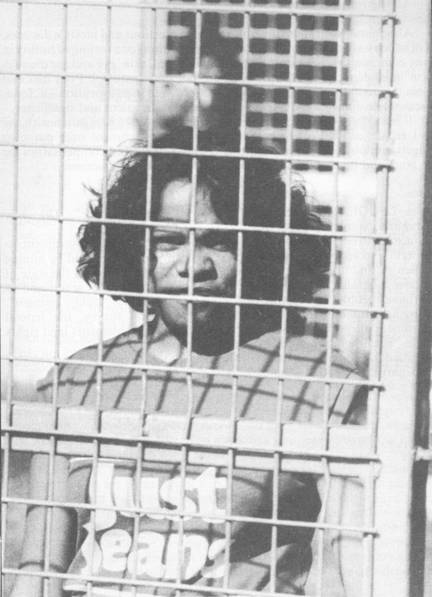
An
Aboriginal woman behind bars in a country town in Queensland, Australia. Of all the
Australian states, Queensland has perhaps the worst record for official mistreatment
and neglect of blacks. The conservative administration, however, refuses to
keep records of numbers of Aborigines imprisoned – because to differentiate in
such a way would be “racist”.
Photo: The Age, Melbourne.
48
non-Aborigines. This leads to
dependence on welfare which, rather than helping Aborigines, makes them poorer.
Aboriginal
Australians are prey to many infectious and lifestyle diseases, all of which
have their roots in poor living conditions or a feeling of futility in many
communities. Respiratory, gastro-intestinal, skin, eye and ear diseases occur
in epidemic proportions. They are not under control. Poor diet and unsanitary
conditions lead to malnutrition and malabsorption of
food. Diseases like diabetes and hypertension are also prevalent and
significant.
What
do we want? Aborigines realise that, in order
to regain health, we must regain control over our lives. This involves control
over our own budgets and our own affairs.3 It involves
land rights and compensation for lost land, and it involves the removal of
discriminatory practices.
Notes
1. See LEGGE, Kate, "Song
of the women of the rock". The Age, Melbourne, March 14, 1986, pll.
2. Since Ms Brennan presented this paper in
1985, the federal government — responding to an
hysterical anti-land rights campaign conducted by mining companies, and urged
on by another "left wing" government in the state of Western
Australia — has backed away from its promise to grant land to Aboriginal
people. It explains this injustice in terms of "public opinion":
relying on dubious
interpretations of a statistical survey, the federal government alleges that it
will not be re-elected if it implements land rights policies, because too many
Australians oppose them — ed.
3. The federal department which deals with
Aboriginal people is aptly named the Department of Aboriginal Affairs.