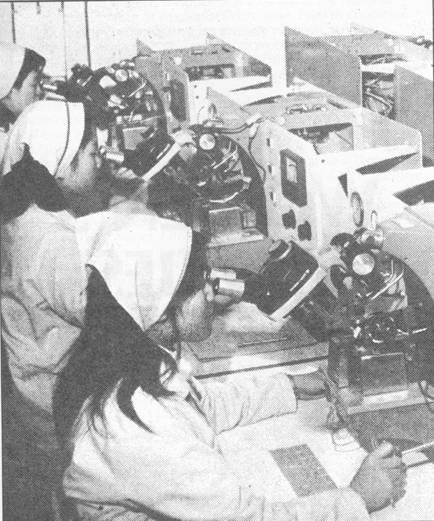
Korean women on the
semiconductor assembly line: the workers check the components for faults, using
microscopes for inspection because the parts are so small. The
result? Blindness (to varying degrees), headaches and sever eye strain.
In export-oriented or foreign-dominated economies, the workers are the losers.
Photo: Far Eastern
Economic Review.
Part 1 —
Women’s Stories
3
South Korea
“You had
to go on working even though you were sick”
Kim Soon-ja
In
March 1979 I was eighteen, a village girl, and what did I know? With hopes and
dreams in my heart—of unlimited popularity, making money, eating well, living
well, with the possibility of further education and an exciting life—I came up
to Seoul and found work as an assistant machinist in a shirt factory in the
Kuro industrial complex.
Machine fever
From
the beginning, working as a machinist's assistant was bitter work. I was
finishing the work on shirts—for example, cutting off the loose threads. But
within a few months the thick dust inside the factory blocked my sinuses, and I
had a sore throat all the time. The machinery was so noisy that when my
machinist (elder sister) said something, I couldn't hear her. In the summer we
could not even catch sight of a fan, and we had to work at the machines with
sweat running down our faces as if we had a fever.
In the
afternoons in the summer they gave us small amounts of cold water so we did not
collapse. But the place was so hot we could hardly breathe—we only survived by
drinking water.
The
dormitory housed five hundred of us, and there was only one matron. There were
supposed to be ten workers to a room—but there was not space for ten. In winter
there was a cold draft, coming through the window and cracks in the wall. We
got heating under the floor for one hour per night, and there was hardly anyone
who did not have a cold. There were only tired and sick people.
In all,
there were eight hundred women workers employed at this factory. The cafeteria
food was all right at lunchtime, when the staff (and commuters) were there
eating. But the other meals were not fit even for pigs. And of course we had to
pay for each of these meals.
After
two years of this life I could operate the machine by myself but they would not
promote me. So I felt like leaving.
Throughout
this time I often had to go to hospital and spent all my earnings on
medication. Sometimes, because I had no money, I had to work even though I had
a cold. One day I was so ill I stayed in the dormitory to rest, but the line
captain came and made me go to work. Saying there was nobody else to work, she
took me by force: "you must endure". It was the kind of place where
you had to go on working even though you were sick.
4
Wages
Doing
overtime almost every day of the month, I could get [the equivalent of]
ninety-seven US dollars (70 000 won)
a month, but basically it was seventy-six dollars (55000 won) a month. In order to get a job
as a machinist I had to resign and go to another factory. I found work at a nearby
clothing factory, but only as a second-class machinist. Wages were sixty
dollars a month (1550 won a
day). First-class machinists could earn eighty-nine dollars a month (2300 won a day). But the dormitory here was
slightly better, having only seven to a room.
Compulsory
savings plan premiums—$2.77 (2000 won)—property
savings plan premiums—$6.94 (5000 won)— and meal costs were all taken out of our pay
packet from the start. Without being asked whether we wanted it or not, a
medical insurance premium was taken out, and there were many local
taxes—despite the fact that we were below the poverty line—$138.88 a month (100
000 won).
Sickness
At this
place my health deteriorated and all my earnings went on medical treatment. I
went on working, for when there was no money there was no medicine. Once I was
so sick I could not do any overtime, but they forced me, even threatening to
fire me. They forced us all to do overtime even though we were in agony. We
were supposed to get one week's sick leave, but we did not get it.
I
resigned, and went home to the country to rest. With the peace and quiet, I
began to recover over the following one and a half years. I hated the factory
life in Seoul. At that first factory, I would sometimes ask for time off, but
this would never be allowed.
This
time, I went back to Seoul and found work as a housekeeper for an elderly
couple. I still had not fully recovered, but my strength was coming back. But
they had many children and grandchildren who would come to visit, and every day
there was much cleaning and entertaining to do. It was a big house; there was a
lot of work to do, and I became tired and sick again.
Tuberculosis
Even
though the pay was [the equivalent of] $ 115 a month, I found I could not save
on this. I finally went down-country again to get back to full health. I sought
medical treatment, and tests showed I had contracted tuberculosis. Since May last year I have had to take medication every day, and
for four months I had to have an injection every second day. For one
month I could not eat—I had an intra-venous drip instead. I could not even walk
during this time—I felt very bad.
I had
injections for four months but was told by the doctor to take shots for another
two months. But my stepmother opposed this and started complaining very loudly
that I was malingering. So I went up to Seoul again, still taking medicine
daily.
5
Return to Seoul
It was August
1983—just ten days before the Korean thanksgiving period (autumn evening
festival). I asked a friend in a textile factory in the Kuro industrial complex
if she knew of any places where they didn't force you to do overtime. I found
an electronics factory in Industrial Complex No. 1, and began work. But I was
not fully recovered and the work was arduous. I wanted to quit, but because I
could not live without food, I lasted seven months there.
I was
back on $97 (70 000 won) a
month. After three months, I got $3.88 extra, and after six months $1.94 extra.
We were not paid throughout the thanksgiving period, New Year or any public
holidays. Though they had told me there would be no overtime, after two or
three months they started pressuring us to do overtime.
At
present I am staying with my young brother, who is a day labourer.
I prepare meals for him, and rest. Because of the machinery noise and dust in
that textile factory I do not hear so well these days. It was there I caught a
chronic cold; this became bronchitis and, finally, tuberculosis.
While
working, I would remit home money to my parents every month. Over time, this
amounted to $138 dollars (100 000 won).
But they spent all this, for they have little money and their situation is
poor—they have medical costs too!
I hope
to live diligently, but this will depend on the condition of my health; I and
all my relatives will fight despair even though we have no more tears left. The
meaning of life has become unclear to me, and it seems good fortune is hard to
come by. Yet it is my dream to recover fully and become a factory worker
again—so I can work well, and do evangelism.