New
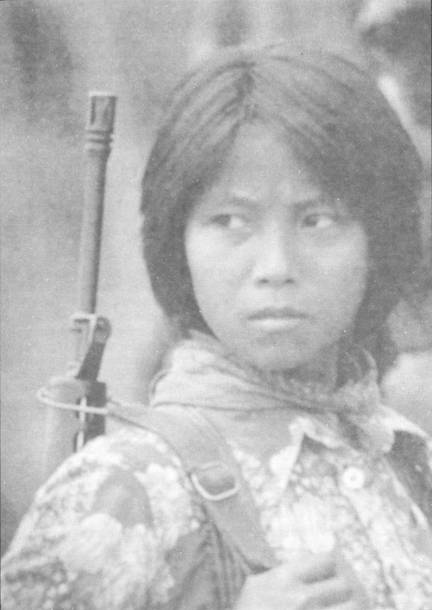
People’s Army fighter in the Philippines. Women as well as men take up arms
in the struggle for national liberation and justice.
Photo: Nagakura Harumi, Solidaridad II.
Part 2 —
Analysis and Reflection
73
Women and the people’s movements
Filipinas:
powerful agents for social transformation
This
article is taken from a longer piece entitled Women, from Alliance of Women Against Repression and Exploitation in The Philippines.
Often, women
ask each other about the basis for defining a distinct program for women's
participation in transforming society. Why the assertion that women take a
decisive role in realising the Filipino dream of a
free and just society?
There
are several arguments one can think of to convince women and men of the
importance of moving and organising women as a
political force: first, the economic participation of women has been largely unrecognised and maldeveloped.
Out of 24 million Filipino women, 70 per cent are unemployed. Think of 10
million females labouring as unpaid family workers,
and you have a vast pool of productive but marginalised
workers. Secondly, industrial and commercial practice is to employ women as
cheaper labour; they profit by hiring young women and
subjecting them to long hours of work, health hazards, sexual abuse, and union
busting. Export-oriented industry develop- ment
includes the employment of young women for their tractable characters. Thirdly,
the exploitation of women in the flesh market has become aggressive and organised to an unprecedented extent. Women as sex
commodities include erotic models, child prostitutes, mail-order brides and
domestic slaves, and troupes of dancing girls for overseas entertainment.
Fourthly, the use of sexual intimidation and terror by the armed forces and
paramilitary units has made women and children the most vulnerable targets in
the campaign for suppressing dissent. These four issues form the core of the
women's movement for a truly independent and democratic Philippines. Let us
focus on each in depth.
Women as a productive
force
The
majority of women are in rural areas, and they can be found in large numbers as
farmers and cottage workers. Ironically, official statistics on working women
call many females (48 per cent) housekeepers, masking the contribution of women
to the overall production of goods and services. The GNP takes no account of
all the labour hours devoted by women to childcare,
housekeeping, care of the sick, the ageing, the disabled, and the disadvantaged
members of society. The problem of unemployment takes on a more insidious
character in the light of the fact that women are barred from paid, meaningful
74
work because of
their class and gender. Women are culturally moulded
as subsistence farmers among the tribal groups — the "invisible"
tillers in many crop producing regions — as livestock farmers, as fish vendors,
and as housewives. The labour of women enables the
rural sector to deliver food to all, but is subsumed under the vague heading of
"agriculture". As a result, rural women are classified as
"unskilled" and enter many economic journals as
"housewives" and "domestic help".
There
are scholars who state that the situation of women cannot be explained in
purely economic terms. They distinguish between sex as a physical
characteristic and gender as a social and cultural construct. Within
this framework, we can inquire into the ideology of the family and its
interrelationship with economic issues. Questions on exploitation of women must
examine woman's role as daughter in a patriarchal clan, as wife in a monogamous
but double-standard marriage, as mother in a subsistence mode of production.
The analysis thereby takes account of economic, historical and social factors,
as well as the culture of colonisation. The Filipino
woman is analysed as a daughter, a wife, a mother and
a grandmother amid the rise of transnational corporations and the depletion of
natural and human resources.
Let us
find concrete support for the main thesis of this paper: that the Filipino
woman is doubly oppressed and exploited; that she has therefore every reason to
wish for democracy and justice, and move towards a more decisive role in
transforming The Philippines.
Case one: the women of the Cordilleras
"Every
day the women work in the highlands, carving the soil on deep mountains to
produce the food of the tribes; carrying the load on their heads and shoulders;
pounding the harvest into edible grains; preparing everything so that there is
a ready meal for all; eating after the men have been satisfied; not speaking or
complaining about their centuries of labour under
mountain skies. The elders rule and are divine, the women obey and move with
the rhythm of the skies."
Case two: the
peasant as a wife and mother
"When
I was sixteen years old, I married a farmer. We had a small piece of land in
which we planted vegetables and where we raised pigs and chickens. There was
always something to eat, even when the land was not so productive. I had two
children and the eldest had epilepsy. When my husband died, I lost the land to
my husband's relative, and I had to wash clothes to feed my family. But being a
laundrywoman could not meet all our daily needs, so I got married to an old man
who was very kind and had a piece of land. Being eighty years old, my husband
fell ill, and I had to sell the land to support the whole family. Now I am back
to washing clothes because having two ill persons — my bed-ridden husband and
epileptic son — demands that I work very hard in order to survive."
Case three: the woman as daughter of a fisherman
"I
came from a poor fisherman's family in Samar. There
were many times when we ate fish and root crops only twice a day. There were
many times when
75
we had nothing to eat.
One of my sisters eventually died of starvation. But I accepted our poverty as
normal. There were many people like us. In spite of our poverty, we worked to
get to school. My mother made hats, and I worked as a part-time maid to pay my
tuition fee. When my father could no longer feed us, he asked me to stop
studying. I felt so disappointed and began to cry. The only thing my father
could say to console me was, 'you should be happy, you have learned to read and
write'."
Women as cheap labour
These
three cases are among the many examples of women being hardworking but
marginal. Let us turn to the hypothesis of women as cheaper, more profitable labour.
Case four: the
garments workers
"We
work from 7 a.m. to 3 p.m., sewing pieces of jeans. Our quota is 400 pieces per
worker for the eight hours, but we are made to sew 350 more, and we usually end
up working for fourteen hours. Most of us complain of ulcers, headaches and
kidney disorders due to fatigue and hunger. What makes us feel very exploited
is the fact that we make jeans worth so many thousands of pesos, and yet
we get P291 a day only."
Case five: the
cannery worker
"Ninety
per cent of the workers in this cannery are women. Management claims women are
more diligent, easier to handle, and easier to fire. Thirty per cent of the
increase in the profits comes from the labour power
of the women, compared with ten per cent from the male workers. Why? Because
women receive only half the pay of the men. Besides wage inequality, women
become victims of sexual harassment and abuse by the employers. A single woman
worker is likely to get the 'lay down or lay off treatment. We are called
'cheap bananas', but I think the manager is the real cheap banana because he is
such a cheap exploiter."
Case six: the electronics
worker
"We
are aware of management's various ways of trifling with women, both single and
married. Sexual exploitation is made easy through the 'appraisal system'. Every
six months, promotions, salary increases, demotions, transfers to other
departments and firings are conducted. If an appraiser happens to 'like you'
and you won't accept his invitation for a date, he can rate you lower than your
actual rate of performance; so many women are left with no choice but to accept
dates."
Case seven: the shoemaker
"A
quota is imposed on us. Initially, we were forced to make twelve pairs of shoes
a day. Then it was sixteen pairs. When we could meet it and we did not complain,
the quota was increased to twenty, so we tried slowing down our stitching.
Management was forced to go back to sixteen pairs, but would threaten us with
suspension every time production was slowed down. We
76
work from 6 a.m. to
5 p.m. and get P30 a day as regular pay, with only P5 extra for
overtime. The management does not provide back wages, nor additional allowances
of P2 a day. It has also avoided paying our social security fees even
when the amount has been deducted from our wages."
Case eight:
the worker as wife and mother
"I
experienced how difficult it was to be a worker and at the same time a wife and
mother. Every day, I would wake up at 4.30 a.m. to prepare breakfast and the
meals for the rest of the day, and then the food for the baby. I would then
wait for my mother, before finally going to work. She would take care of my
child while I was at the factory. After work, I would rush home before my
mother left, to cook, wash and clean the house. Occasionally my husband would
help, but the chores still weighed heavily on me. So we decided to leave our
child with my mother, and only get to care for her on weekends."
These
five cases are indicative of the value of women in terms of the balance sheet:
less cost, but higher profits. The capitalist does not have to think of
offering incentives to attract women to become workers. The high incidence of
migration of rural women into the cities reveals the push of agricultural
dislocation and the pull of transnational corporations.
Women as sexual
commodities
The
third hypothesis — that women are marketed as sexual commodities — is alarming.
Conducting a statistical study is difficult, because few people will describe
the networks, and it is dangerous for women to divulge information about their
procurers and customers. Nonetheless, a team of women went to various provinces
to conduct an ocular survey and interview some of the women and girls.
Case nine: women
in Puerto Galera, Occidental Mindoro
"This
place used to be a quiet island. When the tourists started to come, the beach
got new huts, blonde men started 'making it' with brown girls, bars blared loud
music, and everyone tried to get a slice of the fun. If you ask those blue-eyed
men why they come here, they tell you that the girls serve them like kings,
that heaven is having many docile feminine playmates. If the coral reefs were
to speak, they would cry about the plunder of our women and their values, about
the pollution of the sea, about the skies witnessing the ebb of industry, watching fishing change
into soliciting."
Case ten: soldiers
and bases, camps and dollars
Olongapo and Angeles have been popular numbers with
US servicemen. There is no doubt that the "rest and recreation"
industry thrives on their dollars. What is not obvious is the connection
between military build-up, on the part of both The Philippines and the US, and
the use of women as sex objects. Visit any military camp, from Camp Bagong Diwa in Bicutan to Camp Catitipan in Davao, and you will
find women surviving by being mistresses of draftees, regular and reserve
officers, and paramilitary combatants. They are referred to as "common law
wives".
77
War and
guns have a way of making men turn to sex to arrest trauma or escape from fear and
guilt. With their pay envelopes, soldiers think they are entitled to
"liberty" — the privilege of using women. With their guns, soldiers
demand that this "liberty" is delivered at their feet.
Case eleven:
children and the sex trade
In the
streets of Manila, just a few metres from five-star
hotels, you can see children — aged between nine and fourteen — playing. Watch
for tourists, wait until they see these children, then
follow them as they make a connection. The fee ranges from fifty to one hundred
pesos; the service ranges from licking foul-smelling feet or squeezing the
"dick" under an armpit.
Or get
a Manila tourist guide and make the rounds of Australian or Japanese bars. The
magazine you buy in Tokyo says you can have any kind of fun if you drop in at
the right places. The ads say "use me, then toss me away",
"sizzling" and "adopt an orphan", and feature pictures of
girls in the nude romping on the
beach.
Case twelve:
mail order brides
Australians,
among other foreign tourists, often express their concern that many women who
apply for marriage to their penfriends are not
informed of the cultural and economic characteristics of their would-be
partners. They thus fly to a country where they hope to be free of poverty and
pain, but ultimately become traumatised wives.
Women as
targets of military intimidation
So the flesh market
expands because of sex tourism, military build-up and the presence of US bases,
the push of rural-urban poverty and the culture of female subjugation. Let us turn
to the fourth and last issue — that of the use of sexual intimidation and abuse
by the armed forces and paramilitary against women and children.
Case thirteen:
hamletting in Davao del
Norte
"In
November, 1981, our village was 'hamletted' by the
military. All the families were forced to destroy their houses, transfer to the
town centre, and leave our animals and crops behind. Many children fell ill
because water was scarce, the environment was unsanitary, and food was meagre. Hamletting was especially hard for the women: they
were molested by soldiers during dance parties 'sponsored' by the authorities.
Many unmarried girls were sexually abused. Some got pregnant and then were
abandoned. I was fortunate not to be abused. Perhaps it was because I am married
and not good looking. But in some cases, even married women were molested in
front of their husbands."
Case fourteen:
political prisoners
"I
was one of seven persons arrested and detained illegally in 1981. Of the seven,
I was the only one spared maltreatment and torture — because I had a
high-ranking military officer for a relative. But I witnessed the ordeals of my
78
female companions.
One of them was given the 'chili' treatment: they rubbed her eyes and lips with
pepper. They stripped her to the waist and when hey found out that she was a
high school graduate, they told her it s all right for you to be stripped —
you're just a high school graduate!' Another woman companion was also stripped;
then they turned off the lights and threatened to rape her Later, an official
gave her a jacket — he was trying to be kind and wanted to pacify her. A
married woman, who has four children, got the worst treatment. She was punched
over the ears, stripped — except for her pants, because she was menstruating —
molested by a nude soldier, and then guarded by ten drunk soldiers."
Here is
another political prisoner's account: "Four men took turns interrogating
me and abusing the upper part of my body. One said ‘putulin
na natin ang nipples’2 then stood up... They
continued to interrogate me and often took hold of my breasts. Finally, two
people took me upstairs. I was in a room and only one man was around. He was
half naked, and began abusing me insisting that I tell the truth to save myself
from being 'salvaged . Finally, he led me down to the place where I had been
before. I was still blindfolded and handcuffed, both of my hands tied at the
back with a belt . . . I was then handled by two men, one bringing out his
penis and making me swallow it, while
the other manipulated my vagina."
The
fourteen cases are sufficient to show evil in our midst. What do we do in the
face of such adversity? For women, this question becomes a choice between the
paved road and the less-travelled path.
The paved road of
development from above
Development
agencies make grandiose pronouncements about "integrating women into
society". Plans to improve conditions for women take forms like. observing
a decade of women, packaging technology and education in much the same way as
cosmetic products are marketed, powdering third world women with population
control, and giving power to token women in order to deceive people into
believing that women are well represented in politics.
We in
The Philippines have a reputation for being the most literate women in Asia.
But the education system does not develop critical or scientific attitudes in
women. Women's studies courses are limited to discussion of career aspirations,
marriage stress or sexual deviance. Historical studies on the subjugation of
women are rare, and few scholars take he women's side.
So women are vulnerable to the mass-media distortions of the women's liberation
movement, rejecting it as a western, bourgeois invention, and meekly accepting
as true the myth that women are the weaker sex.
If
there are attempts to tap the potential of women, they are frustrated by the
pre-emptive work of such powerful men as Rockefeller, who know
how to get women to identify themselves with the forces of moderation, the middle
of the road". As early as 1969, the power bloc of the Rockefellers noticed
the power of emancipated women. The influence of Rockefeller Foundation funds
on spreading "population" programmes has been well documented.
79
The less travelled
path: mass movement building
The
past few months have seen the fast growth of Alliance of Women Against
Repression and Exploitation. AWARE recognises the
decisive political role which women have to play in ending this treatment of
our people. The coalition's general objectives are: to work for the restoration
of democratic rights, to fight for the participation of women as an organised force in the solution of national problems, and
to ensure the defence of national wealth against
foreign exploitation. The major demands of AWARE are: justice for all victims
of repression, abrogation of all laws detrimental to women, meaningful
employment for women, an end to the use of women as commodities for sex, land
for the people who till it, representation of women in all key policy-making
bodies — government, industry, church, education and media — better living
conditions (subsidised care, health and housing
services) and expulsion of all corrupt government and military officials.
Notes
1. The
peso is equivalent to $ US 0.051; so the daily wage for each worker is
about $ US 1.50.
2. "Let's cut off the nipples."

“A woman’s place is
in the struggle”: a banner by GABRIELA, an umbrella organization for
progressive women’s groups in the Philippines.
Photo: Hiromi Nagakura, Solidaridad II.