7


EXPOSURES AND REFLECTIONS:


The participants were afforded with exposures to the urban and rural situations. The urban exposure lasting approximately three days in the earlier part of the programme was confined to Bangkok City and its outskirts. The group divided into three teams to investigate the social and political dimensions of "tourist industry", "urban development" and "educational and religious institutions".

The rural exposure was organised in villages about three hours away from Chiangmai. The three teams lived with people and worked with them in the fields for three days. One team lived in a very feudal village, another in a village that is fast influenced by urbanisation, and the third in a village of the hill-tribes.


8


The reflections spread over a number of sessions enabled the participants to examine the questions of economic relations within the 'tourist industry' and the underlying causes behind the evolution of a growing number of slums, and the role of the religious and educational structures in the development of Thailand. It has been rightly identified after the urban, exposure that. there is a visible collaboration of the capitalists of Thailand with international capital who in turn are being protected and guarded by the ruling junta.

To make a certain level of abstraction, one can say that the participants were able to successfully identify the menace of bureaucrat-capitalism, neo-colonialism and semi-feudalism reinforced by strong militarisation of Thai politics.
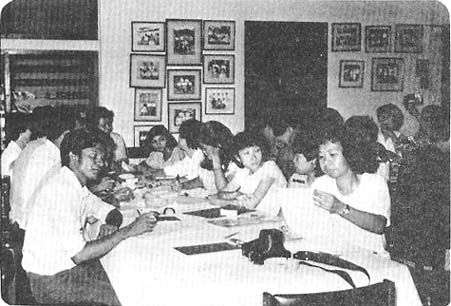


  Participants in the lecture room. In the foreground are

Rohita De Silva (Sri Lanka) and Gigi Balan (Philippines)


The role and oppression of women in the tourism industry were linked to the prevailing economic structure, especially in the rural areas from where the majority of the 'hostesses', 'bar girls' and 'escorts' in Bangkok's notorious Patpong district, hail from. The participants who talked with these, girls brought back stories of exploitative conditions of work, and most of them took to this profession to make quick money to support their families back in the villages. It was revealing to note that the "R & R" (rest and recreation) facilities first introduced due to the presence of American armed forces during their war in Vietnam continues to thrive. A major income for the tourist industry hails from the American sailors and soldiers whose, ships continue to ride the


9


waters of Asia. This is supplemented by "sex tours" organised by Japanese, Dutch and German tour operators.  These realities posed the question of the militarisation of the Asian region together with the growth of transnational corporations.  An attempt to link the Thai urban exposure brought to light the sad reality of the overwhelming presence of foreign powers controlling the economy and politcs of most of the Asian countries resulting in repression and exploitation of peoples.


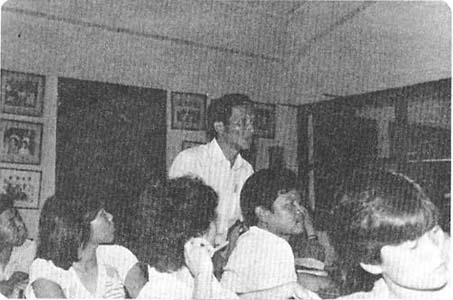
            Bob Hung (Taiwan) raises a point for clarification.