4
THE THAI SITUATION:
The inputs from external sources could be divided into three
types: one, focusing on Thai situation; two, the Asian reality; and three, the
theological and biblical understanding of peoples' aspirations in Asia today.
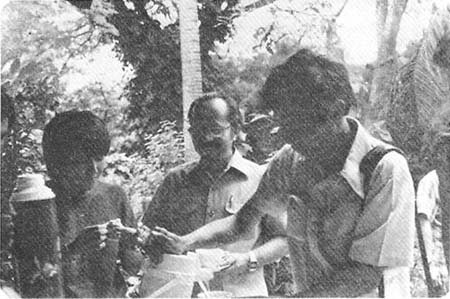
Prof. Bantorn Ondam (R), Acharn Direk (C), and Juliet (L).
Introducing the Thai situation and its various aspects were
friends of the WSCF who hailed from various walks of life. Prof. Bantorn Ondam, Consultant to the
CCA-URM in his lecture on "Nature and Pattern of Development in Thailand" made a concise presentation of
the political struggles of the people, of Thailand. Tracing the history of
development in Thailand,
he said that a culture of silence and a culture of subordination are being strengthened
by the civilian-military bureaucracy, thus excluding the vast majority of its
people from participating in the economic and democratic processes. To overcome
these obstacles, he emphasised the need of the powerless in organising as one
force for a radical transformation.
5
Two other sessions on Thailand,
one focusing on "Politics and the Democracy Movement" led by Dr. Kotom Arreya, and the other on "Human Rights and Politics" led
by Mr. Tongbal Tongpao,
brought to light: the specific issues in the struggles of the people of Thailand.
It was pointed out that Thailand,
though never a ‘colony’ in the traditional understanding of the
term is very much a 'political and economic colony of the Western powers'. Social scientists in Thailand today are beginning to
question the concept of 'colonialism' from the peculiar Thai experience, and it
was pointed out
the 'colonial days'. It has been evident in the last fifty years monarchy and
parliament), that coups and 'counter-coups are the order of politics in Thailand. During this period Thailand
witnessed 16 coups, 45 governments, 16 prime ministers, 13 elections and
another 13 constitutions. But in all these power struggles, the workers and
peasants are mute witnesses and the oppressed majority.
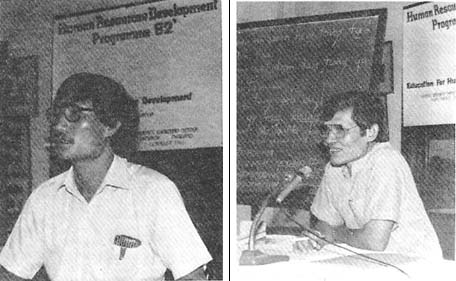
Dr. Kotom Arreya Mr.
Tongbai Tongpao
The
struggle for human rights in the face of a very repressive political system,
along with an exploitative economic order and cultural values rooted in feudal obligations
has often resulted in frustration and further repression. But
recent history of Thailand
especially in the 70's when the students took a major role in the struggle for
democracy has made its people look for a viable long-term strategy to overcome
the barriers that stand in their way of genuine development. It has
become a necessity to join forces today and there is a greater need for an
alliance of workers, urban poor, peasants, students and the intelligentsia.