10
WORKSHOPS:
The inputs from the sharing of national situations, lectures
and exposures were carried to the two workshop sessions on "Human Rights
and Solidarity", and "Education and Liberation". At the summation
session of these workshops, the question of human rights and the educational
system gained foremost attention. Both the workshops examined the concept of
development against the backdrop of peoples' movements.
The workshop on "Human Rights and Solidarity"
examined the strategies of the network for expressing solidarity with movements
in Asia and elsewhere, and was of the firm opinion that while national member
engage in the campaign against repression in other situations, it was equally
important that a major campaign to educate its own constituency on the
violations of human rights to be developed parallely.
The case of the Australian SCM was cited as an example of this two-fold
approach.
Some of the other movements in Asia
are posed with the limitation of communication, and it was urged that the
regional staff pay more attention in obtaining information from these
countries. In this instance, Thailand,
Malaysia, Taiwan, Bangladesh
and the Pacific Islands from where information was very
much lacking in the newsletters of the region, were cited. It was a point of
deviation in the programmatic approach of the WSCF to the question of human
rights when the group suggested, that as a student community, the
11
WSCF/SCMs should pay attention to the question of students’
rights within the campus also. It was brought to the attention of all that most
countries in Asia have very repressive
enactments to contain student activism. Therefore, a study of such instances
where basic students’ rights have been curtailed was recommended.
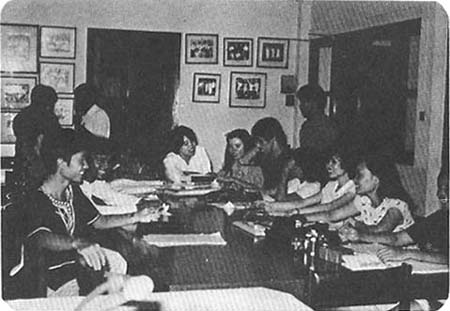
In a lighter mood - a Working Group.
The group working on "Education and Liberation"
brought out this aspect more clearly after identifying the general trends
within the educational system in Asia today. The
four major trends it identified were the increasing technocratisation
of education; the influence of western capital together with foreign values
that alienate students from the masses; the infiltration of the ruling class
ideology through subtle forms of 'moral education'; and the direct political
control over education turning the
educational system into a business enterprise. It was observed- that in the light of these
control mechanisms imposed by the political and economic structures, the struggle
of the students start within the campus and has to linked
to the larger issues within the society.
It was also observed that there are situations in Asia where
the students have developed the analyses to relate to the developments within
the educational system to developments within the rest of the society as in the
Philippines.
On the other hand the student activism in Korea,
Thailand and Sri Lanka are more concerned with the
developments outside the campus forgetting the oppressive nature of education,
while in India
the student activism is con-
12
fined to campus Issues. It was felt that the
WSCF should emphasise a strong integral approach to student activism in Asia if the student community has a role in the
liberation struggles of the people. It was further emphasised that students
have to ally with the workers and peasants in the national liberation
struggles. The tragic history of the student movement in Thailand was brought to attention and learning
from the lessons of history, "the student community in Asia
today should hold no illusion of being the leaders of radical transformation of
structures, but should be seen more as partners In the
struggles of the people."