3
IN-PUTS ON HONG KONG:
A primary consideration in locating this year's Programme in
Hong Kong is the live debate that focuses on the "destiny of Hong Kong". As one of the last vestiges of British
colonialism, Hong Kong, situated at the southern tip of the People's Republic of
China,
is currently embroiled in an international diplomatic tangle as to its future.
New China has consistently
maintained that treaties made by Britain
with the ruling dynasty of 19th century China from a position of strength
were "unequal treaties" but has never made any move to re-annex the
territory by force. Other considerations were the obvious commercialisation and
economic growth of the colony pushing a vast number of its population to the
brink of crises after crises - housing, employment, education facilities and
the like.
Detailed and yet concise presentations on Hong
Kong and the life therein were made by a number of eminent
personalities. Rev. Ralph Lee, a former staff of the HKCC and currently Chaplain
of the United Christian Hospital
spoke of the various living religions in .Hong Kong. However, he spent a good
deal of time speaking on the Churches in H. K. He delineated some salient
feature of the Church in Hong Kong which could
be summarised thus:
(a) Small,
individual and Independent local congregations are on the increase;
(b) the central concern is church growth;
(c) but a small vocal and active group has emerged in the recent
years advocating for church’s participation in society;
(d) the Theological foundations are still conservative, yet the
so-called "evangelicals" have shown a sensitivity to social problems;
(e) major denominations have become self-supporting;
and
(f) recently, HK Churches has become a "giving-church"
both financially and also in terms of sending personnel.
Rev. Ms. Lee Ching Chee, Associate General Secretary of the Church of Christ
in China (Hong Kong Council)
while speaking on "Education in Hong Kong"
brought out the privileged character of the Christians and churches in the
colony. She pointed out the heavy subsidies and incentives made by the colonial
government to the Churches in the construction of schools and that how
education has become a primary business concern for the Churches.
4
As an ardent critic of Hong Kong's
educational policy, she brought to light the competitiveness of the system
driving students to pursue the capitalist path of self-centredness and profit
maximisation. The values inculcated by the system, according to Rev. Lee, who
herself is an educationalist, are stifling to the growth of the individual and
does not enhance the quality of life. Students being perpetually engaged in a
"paper-chase" (for degrees and diplomas) are no totally unaware and
unconcerned about the wholeness of life, and such education in H.K. has
produced a callous society totally dedicated to the pursuit of material wealth
and false-consciousness.
Rev. Hans Lutz of the Christian Industrial Committee (CIC)
spoke on the "people and economy of Hong Kong". He began with a brief history of the
colonisation of Hong Kong and stressed the growth and importance of Hong Kong as a major industrial and trade port based on
the "laissez faire" system. He
said that in today's Hong Kong a total of
250,000 people are employed in 47,000 "factories". The word
"factories" are sometimes misleading, for in Hong
Kong most of them are production units of small entrepreneurs
engaged in the production of consumer items. To give an idea of the situation,
he quoted statistics to define the "small-ness" or
"big-ness" of the factory. One figure amply tells the tale of the
size: only 40 out of the 47,000 factories are said to be employing over a
thousand people. Such being the situation of employment, there is very little
scope for a territory-wide unionisation of workers. But the worker are
organised in small unions and there are a total of 378 of them with 60% of the
total workforce forming its ranks.
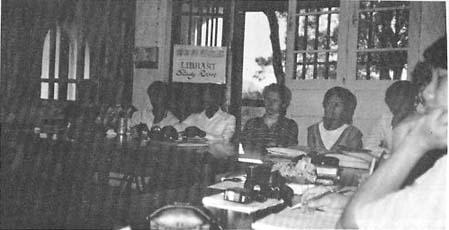
Participants in the Lecture Room
5
Rev. Lutz then elaborated in detail the work of the CIC
among the workers in Hong Kong. He stressed
the pioneering role of the CIC as concerned group acting in co-operation with
workers' unions on the questions of industrial safety, wages, compensations at
the time of closure and other monetary benefits. The CIC also act as a
"counsellor" in matters related to the spiritual life of the workers
by enabling them to open "workers' churches".
Complementing some of the "situational inputs" was
a session on he "Destiny of Hong Kong or the 1997
question" led by Mr. Victor Liu. Victor, former Chairperson of the SCM of
Hong Kong and a tutor at Chung Chi College
belongs to a small group of activities engaged in highlighting the
"1997" debate from the perspective of the people in Hong
Kong. He quoted in detail
the stands of the various groups on the debates. Basically, he said, there are
the "optimists" and the "pessimists" due to the peculiar
composition of the population of HK. He told the group to bear in mind that
approximately 3 million people of today's Hong Kong are "refugees" of
the era immediately following the liberation of China and that another half a
million are "new immigrants"
of the 70's lured by the consumerism HK had to offer, and that both these
groups are wary of any initiatives by China. Of the remainder, many are totally
a political and some are resigned to "fate". Nonetheless, in the
debate, two major lines seemed to have emerged, represented by the
"optimists" and "pessimists". The "optimists"
hold the view that China
would allow Britain to
administer Hong Kong as mere
"tenants" for an extended period; while the "pessimists"
see no other way except the relinquishing of "sovereignty" by the
British and the reclaiming of the territory by the PRC. Victor who is a member
of various "think-tanks" on this question says of the emergence of a
third line and that is "being pessimistic but positive". To elaborate
this he went into detail some of the constitutional constraints within the PRC's Constitution today as in the case of
"democratisation" struggle in China today. Calling this struggle
as the "Fifth modernisation", he feels that "Hong Kong should
change its "status quo" thus contributing to China the values and principles of "a
political democracy" and at the same time converting Hong
Kong "to a non-exploitative economic order".
On an Asian level, he opined, the current debate has great
significance when most Asian countries are caught in the throes of
semi-colonialism and bureaucrat-capitalistic exploitation. Its significance
assumes larger importance when we see today's Asia
struggling with the questions of national identity (nationalism) and the
principles of justice and freedom.