6
LOCAL EXPOSURES AND REFLECTIONS:
Following the input on Hong Kong the group was divided into
three teams to visit different sectors in Hong Kong.
The visit and study were spread over a period of three days and all the three
teams had opportunities to visit all the sectors identified by the local
organising committee. The local organising committee for the visits was led by
the members of the Hong Kong Student Christian Movement (SCM) and they sought
the cooperation of the Hong Kong Christian Council, the Christian Industrial
Community and the Society for Community Organisation.
The different sectors identified were the industrial sector,
the housing situation and the religious institutions. Some were able to find
time to visit the University campuses in Hong Kong and talk with the academic
community about the educational system in Hong Kong.
The visits to the industries were supplemented by visits to
an Association that supports the victims of industrial accidents. It was
discovered that the rate of industrial accidents in Hong
Kong is one of the highest in the world and that the safety
precautions and social security were at a minimum. One of the activities of the
Association is to visit the hospitals to find individual cases of victims and
to organise from into a group to petition the Government for the redress of
their rights. They also undertake visits to the families of those victims to
lend them the support and fellowship at a time of crisis like this and to
provide, if possible, recreation facilities for the young in their families.
Politically, they act as a pressure group to exercise pressure on the
Government to change the laws regarding industrial safety and accidents. The
teams of participants were able to visit some of the families and to engage in
conversations with them to understand the working condition in Hong Kong.
In the housing sector the teams were able to visit many
public housing schemes provided by the Government and also the temporary
housing facilities. While the former has a more permanent nature the latter,
though temporarily, seems to be of a long range arrangement since most people
evicted from the crowded city slums have to wait for an unspecified period for
housing. In both cases it was discovered that the facilities offered were
inadequate and that the surrounding conditions were unhygienic and unhealthy
for the growth of children. While it seems to be the reality of the majority of
the people, luxury housing estates are being promoted by real estate developers
to suit the comforts and needs of the few rich. It was also discovered that
most of the industrial workers and hawkers or individual traders in Hong Kong live in crowded slums. Some members of the
group were also able to visit
7

Local Exposure
Programme
"the boat people". These people have been living for
generations on boats that float in the South China Sea
and for various seasons they have not been able to find a place on the land
where either the temporary accommodation or the government housing facility can
be availed.
The teams also visited some of the major shrines and temples
in Hong Kong. Despite the cosmopolitan outlook
and apparent well-being of the people of Hong Kong
there are strange super-situations attached to their religious life. The visit to the churches brought out the
dismal factor of the privileged status of their existence under the colonial
government in Hong Kong. It was observed that
the churches had a major say in the educational matters and in setting up of
educational institutions in the colony. The character and composition of the
congregation of these churches in Hong Kong
are positively of a middle and upper middle class nature. Due to this factor,
Christians who belong to the working class or of a low economic status do not
feel comfortable in being part of these conversations. To
overcome this and to bring them into the fellowship, the Christian
Industrial Committee in the recent years have organised, with
the help of these workers, a new community calling them the
"workers' churches". The priorities and programmes and discussions in
this congregation are of an entirely different nature than from the other
congregations in Hong Kong. Here they discuss
their critical participation in production and also problems related to the
industries in Hong Kong.
8
The reflection sessions following the team visits, while highlighting
some of the points observed above also observed that the capitalist nature of Hong Kong's economy is stifling to the growth of the
totality of the human being. Due to the mad race for catching up with the
economic pressures in the society, the average person did not or could not have
the time for his or her own fellow beings. The callousness attached to this
type of system is seen in the problems related to housing and industry. As one
group observed "since people's participation in the decision making
processes of Hong Kong are at a minimum
due to the colonial status of the government, the representation of
people's voice are often left in the hands of smaller and
individual social action groups which can be called pressure groups. The
limitations of this group are that it is primarily oriented to tackling a
particular issue within a particular sector, and that
there is no alliance or a territory-wide level of these pressure groups".
One has to give credit to the growing awareness of the people to the problems
of the society and also to the efforts made by these pressure groups in
organising. In the words of the team report: "Groups like these continue
to spread the message of the Gospel to unshackle the chains of oppressive
structures that have caused the sufferings of the people".
It was the general feeling among all participants that Hong
Kong is not an isolated case in Asia and that
similar situations of varying degrees exist in their own countries. But the
peculiarity of the situation in Hong Kong is that it is a colonial government which most of the
Asian countries once had and it was a revelation for the participants who are
from the post-colonial generation to rediscover the historicity of colonialism and to feel once again how their own nations
have suffered and had been exploited.
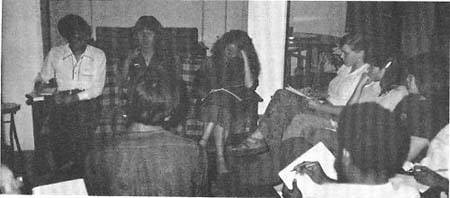
A Sharing/Reflection on Exposure