9
THEORETICAL INPUTS:
The theoretical inputs spanning the Asian reality were led
by Rev. John England, Dr. David Kwang-Sun Suh, Dr. M. M. Thomas and Rev. Dr. George Ninan.
Rev. John England, Research Coordinator, Tao Fong Shan Ecumenical
Centre, Hong Kong was invited to speak on "Living theology in Asia". He began his lecture with case studies taken
from the Philippines and Vietnam.
From these two countries he cited the examples of Fr. Ed De Le Torre and Fr. Bao and of their
involvement with people in small communities that exist in these countries.
Quoting Fr. De Le Torre, he asked the vital question
"Are we willing to listen to the people before we profess to serve
them"? Further he said, "The motive should be to struggle to bring
our life and action to a common point. This is both living theology and doing
theology". While summing up his talk he outlined a few points that
constitute the basic ingredients of a living theology:
a. The starting
point of this theology should be the struggle to resolve the contradiction of
the Kingdom in today's reality. In other words when people become intolerant of
the exploitative situation in the world they begin to think and analyse the society
in concrete sociological terms.
b. There should
be an act of faith: meaning that the analysis and understanding has to be
transformed into an action and it can be a leap into faith.
c. Complementary
to that is the self-realisation within
one's self to feel the agony of the struggle.
d. To make
oneself resolve the contradictions of words and actions and to feel the unity
of praxis. This is to say that our political involvements and meditations
should reach a point of concurrence.
e. The activist
should be willing to cooperate with others.
f. Above all,
there should be a willingness to take the "prophetic" as a model
since the prophetic tradition is the crux of the whole biblical message.
Rev. John England's well-annotated lecture on "Living
Theology" concluded with an exhortation to the participants "to look
at the past in order to change the present for a better and new future."
10
Three lectures by Dr. David Kwang-sun
Suh reflecting on the main theme of the programme:
"Asian Quest: Living Faiths in Ideological Plurality" spread over a
period of three days with discussions and study groups provided the main
theoretical input. His first lecture on "Faith, Praxis and Theology"
began with his own social biography. He spoke of the hot day in the summer of 1980
when he was called to the Interrogation Centre in the City of Seoul
by the Martial Law administration of Korea for his alleged involvement
in the political life of his nation. There he speaks of the military compelling
him to write his political biography in order to bring out his political convictions.
To enable him to do that the military provided him with certain theological documents
of which he was one of the signatories. The particular document he quoted
speaks of Jesus the Messiah who lived with the oppressed and the poor in Judea. It also spoke of the resolution of the Korean
Christian theologians to follow the footsteps of that Jesus who stood against
all political oppression and participated in the transformation of history and
society based on the realisation that it is the only way to attain the
Messianic kingdom. Apparently this document which is an expression of faith of
the Korean Christians was treated as a subversive document and hence
threatening to the stability of the powers-that-be. Dr. Suh
says in his paper that "Christianity is for the poor and oppressed and the
history of the Korean Christianity attests to that fact". Basing himself
on this experience in the summer of '80, Dr. Suh goes
on to make an analysis of the Korean political situation in the '70s. He talks
of the involvement of students and professors from his University, the Korea
Student Christian Federation (KSCF) and other organisations in the life and
politics of the Korean people. He particularly highlights the role of the
Korean students as to have provided the most forceful ideological leadership in
their society since
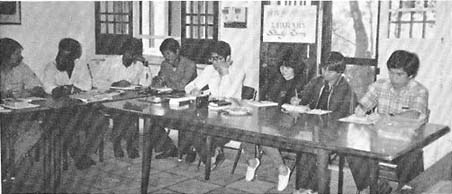
A Classroom Lecture
11
the beginning of the struggle against Japanese
imperialism, and also of their involvement in the 1960 uprising against the dictatorial
regime of President Syngman Rhee.
It is only in the continuation of this tradition that the students of Korea
today take the leadership role in the protest voice against military
dictatorship. However, in the '70s we find that the Christian student playing
the very important role in the conscientization of
other students to the realities of a rapidly industrializing society. The KSCF
which started a social programme called the 'Social Development Service Corps'
brings students together to enable them to learn about the slums and the
factories of Korea
and of the problems confronting the people and the workers. There they begin to
discover the Minjung (people) and the suffering of
the Minjung. There they learned of the total social
injustices imposed on factory workers and slum dwellers and their situation of
powerlessness. Due to this interaction the students became more conscientized, so did the Minjung
become more conscious of their situation. Together they mobilised the people to
change the situation "to become masters of their own destiny and subjects
of history itself". This is a pioneering venture and provided as new
thrust for the Urban Industrial Mission in Korea. In the first paper which is
the story of this faith of the people in to themselves and of their praxis in
fighting for a just and democratic system there emerges a new theology which is
now popularly known as "Minjung Theology".
The Minjung theology is an
expression used by the Korean Christian theologians to denote the reflections
that arise out of people's (Minjung) experience in
their own contexts. One of the basic starting points of this theology is
"social biography". Social biography is the subjective narration of
the stories of people. It is based on these stories that a theological
reflection begins. It is precisely this that Dr. Suh
pointed out in his succeeding lectures. In the second paper titled
"Shamanism: A Religion of Korean Minjung",
he talks of an ancient people's religion. The Shaman faith or custom which is
the most common from of religious culture in Korea is not an organised religion
like Christianity or other scriptural religions. It has no hierarchy, no
church, no buildings and no doctrines. It is practised inside and in the
courtyards of ordinary houses. Its very popular
expression is a ritual performed by a "mudang"
who is a female Shaman who dances to the tunes of heavy drums beating and
supposedly exorcising evil spirits. Due to the overriding belief of a large
section of the people-mostly poor and oppressed - one could say this religion
or religious practice is actually the people's expression of faith in Korea.
Here Dr. Suh takes Shamanism as a religion of the
powerless people and tries to see it in today's Korea where Christianity is a very
fast growing religion.
12
He talks
of how the Korean people's minds are set within the framework of this Korean
Shamanism and how although missionaries rejected it, the mind-set still rules
the Korean people in their thought and action. Hence for the powerless Minjung, the power of the Spirit, more particularly the
power of the Holy Ghost, is most respected. He says "to become Christian
is to believe in the power of the Holy Ghost which is more powerful than Shamam spirits. Korean Christians have made the Christian
worship service more casual and freer than traditional Western styled worship.
They sing loudly and well, like in the rituals of Shamanism and there is a
sense of joy and festivity". One can find parallels in both the Korean
Christian and Shamanist expression of worship. They share a close sense of
community and togetherness with other persons in the service. They also share
their sorrows sufferings and pains as the poor and deprived and oppressed, and
they also share a sense of liberation and salvation in the act of sharing. It
is this suffering and sharing in the lives of the people that enable them to
exorcise the evil spirits in the body politic of the society that Dr. Suh sees as the expression of the living faith in the midst
of today's struggle of people in Asia,
In the third lecture "Jesus, Minjung
and theology" he elaborates more on the development of Minjung
theology in Korea.
There he speaks of Jesus' identification with the ochlos
who may be called the minjung of his time. He drew
parallels from the social-historical class during the Roman Empire and today's Korea
to bring out the real content of the word Minjung.
Dr. Suh made an in-depth study of Jesus and his
politics of the messianic kingdom and how his preaching’s were a threat to the
authorities of his time. "Jesus in his freedom and critical transcendence
always presents a prophetic alternative to the status-quo that is oppressive
and alienating". To illustrate this point the speaker brings in the use of
the Korean mask dances. The mask dance which is the most popular form in Korea
depicts a particular situation where the ordinary people gather in a market
square to ridicule and point accusations at the mighty and the powerful. They
laugh at the foolishness of the so-called wisemen,
they laugh at the rich aristocracy and they also laugh at their own mistakes.
By doing so, the Korean mask dancers are able to convey a social message to the
audience and at the same time are able to transcend their own mistakes and to
come to grips with the prevailing situation. This "Critical
transcendence" one may say, is the essence of the prophetic vision for the
creation of a new social and political order.
Concluding the lecture he spoke of the ideological ferment
in Asia today. He criticised the ideology of development
sponsored by the ruling powers of today in the name of the people. He also
critically examined the various expressions or manifestations of state power
today.
13
Dr. Suh emphasised the need for
taking into consideration the people as the corner-stone of any
ideological manifestation and said that
if people are forced into an ideology
then the people become slaves of
that ideology and this would amount to
subversion of the ideology that is to serve the people. If people are denied
the freedom of an open future then that ideology has to be re-examined. He
calls for "a non-ideological interpretation of the Gospel" and says
that if we look at the Bible closely, free from ideologies we may be able to
see the people in our societies. Perhaps we could be critically transcendant as the people in the mask dances transcended
their own plot and themselves. His concluding statement beckoned the group to
unmask the false consciousness of any given ideology through a non-ideological
interpretation of the Gospel.
The discussion in small groups following these presentations
challenged the participants to examine their own social and political systems
from the perspective of the people and to see today's ideological ferment in
that light. Clarifying some of the questions raised by the participants Dr. Suh stressed the participation of the people in the
political processes of a nation and in the decision-making bodies to be the
central emphasis. Together with this process he said there must be an economic
system that is non-exploitative in character. He emphasised once again that
unless today's Asian movements for justice and freedom is liberated from
Utopian ideologies and unless they place their faith in the power of the people
there can be no new social order. These discussions and presentations enabled
the participants to critically examine the theological attempts made in their
own countries. It is a fact that the theological attempts in Asia
today are far removed from the lives of the people. Hence it is a challenge to
the future generations of Christian thinkers and activists to contextualise
their experiments in theological articulation so that it is more meaningfully
rooted in the lives of the people.

A working group
14
Two lectures delivered by Dr. M. M. Thomas, former Chairman
of the Central Committee of the World Council of Churches and former staff
person of the WSCF on the "Ecumenical Movement" and “Ideologies in Asia" synthesised the ecumenical thinking and
participation. In his first lecture he gave a graphic history of the ecumenical
movement which he described as "a rediscovery of the universality of
Christ". Beginning with the International Missionary Council (IMC) meeting
in 1910 at Edinburgh
and culminating in the 1980 MIT/Boston, meeting of the CWME, he gave a concise
history of the theological and political debates in the international
ecumenical movement. He briefly touched upon the founding of the East Asia
Christian Conference (EACC) now called Christian Conference of Asia (CCA) and
the contribution of Asian Christians to ecumenical history. Talking of the
present emphasis within the ecumenical movement for a creation of "a just,
participatory and sustainable society" he stressed on the importance of
sustaining the God-given resources that are available to humanity. This new
emphasis, he added, is in the right direction since the creation of a just and
participatory society without the natural resources that will eventually have
to sustain them is a meaningless one. One could say that it is true to the
meaning of the word "ecumenical".
In his second lecture on "Asian ideologies" he
traced the unifying point in Asia today. It is
a fact that there was a Western imperialism and that there is a growing Asian
nationalism. Most of the Asian countries, soon after its liberation from
Western colonialisation began to develop ideologies
based on a nationalistic outlook. One could see this as 'nation building' or
'national development' or the promotion of 'national integrity'. Thus
'nationhood' is a new phenomenon which is created by the Western impact and is
a result of their revolt against it. But according to Dr. Thomas the
traditional society which existed in Asian countries was not completely broken
up. It retained some of the characteristics of this traditional society. The
independence movement led mostly by Western educated nationalistic leaders very
often tried to combine the traditional and the liberal Western values. He went
on to cite examples of competing ideologies in Asia
which are either liberal democratic or liberalised traditional or socialist
democratic or of a totalitarian nature, i.e., capitalist or a martial ideology
or a combination of any of the above. He was of the strong opinion that
"the future of justice lies with the people's organisation at the
grassroots level and that the ideological expression of that society of justice
and freedom has to be determined by the people themselves". Hence in the
ecumenical movement today we could say that "politics is the realm that
the Kingdom of God has to be witnessed."
15
Dr. George Ninan's
talk on "Asian Reality. People's response and the
Ecumenical Task" at once supplemented Dr. Thomas' lecture and also gave
fresh insights to people's movement in Asia.
He said that today in most Asian countries nationalism is used as a weapon to
cover up the contradictions that exist within a society. In other cases the
argument of traditionalism is put forward. In both cases any protest of dissent
by the people are not tolerated. Dr. Ninan with his
involvement in the Urban Rural Mission (URM) of the Christian Conference of
Asia (CCA) as its present Executive Secretary is in constant touch with a
number of groups and people who seek to participate in the decision-making
processes and in the building up a just and humane society. Using his
experiences and contacts he cited various case studies from many Asian
countries to illustrate the nature of people's response to Asian reality today.
The frustration and anger of the people are very high in most of the Asian
countries he said. People, when they assert to be subjects of their own destiny
are met with brutal suppression by the ruling powers. Nonetheless the people's
movement in Asia is growing to challenge the
concept of development put forward by these powers.

Dr.George Ninan's Lecture
In the light of this growing resistance and growing peopled
movement, he said that the ecumenical bodies like the WSCF and the SCM has an
important task to play. Enumerating them, he said, the first of them would be
to participate in the development debate that is currently going on and to
mobilise support for people's movement through various researches and
solidarity action. Students particularly have the role to mobilise
intellectuals i.e. other students and academicians to explore the
16
possibility of establishing a counter-culture
that can challenge the consumerist and bourgeois values that are being promoted
by the authoritarian capitalist regimes in Asia
today.