10
BIBLE STUDIES
Rev. Barbara Stephens, Education Secretary of Christian
Conference of
Quoting from Phyllis Trible (cf. Trible, Phyllis, Texts of Terror Literary, 1984 Fortress
Press), Judges 19-22 is described as a 'text of terror'. The story tells of a nameless and voiceless
young chattel who is called a concubine. It is on one hand a story of betrayal, rape,
torture, murder and dismemberment while
on the other, it is a story of the horrors of male power, brutality and triumphalism; of female helplessness, abuse and
annihilation.
Rev. Barbara Stephens said the story of terror leads us to
realise and reflect that:
1) The whole
perspective is viewed from the tribal politics, coming from the patriarchal
social/tribal system.
2) In a male
analysis of a situation where rivalry, camaraderie and male solidarity are the
norm, women are of no consequence.
3) God was seen
to be urging the battle of struggle for power between the tribes.
4) Seen from the
perspective of men in the incident, interactions took place only between males.
5) The feelings
and views of women were totally left out. It causes one to feel the horror of
that woman's experience and the 600 women's horror and destiny,
11
6) The male
perspective of God misses out the perspective of women as they see things
differently from that of men.
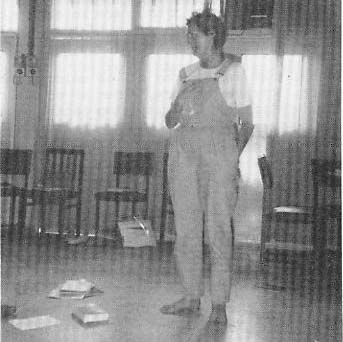
Chairs aside…creative Bible Studies
by Rev. Barbara
Stephens.
In her second Session, Rev. Barbara Stephens led a comparative
study of the four gospels in the New Testament. She role-played the story using
group interview and participation.
Upon reflection we only remember the woman as a sinner, not
why she did it or what prompted her into it.
But Jesus esteems Mary as a key person and one who is very much a part
of the Gospel proclamation. She comes
into the house and performs an act which the owner feels embarrassing and even
disgusting. Some believed that because
the act caused such a serious reaction, the woman did in fact anoint Jesus'
head. Rev. Barbara Stephens said, if this be the case, there are 2 possible
implications:—
i) an anointment to
Messianic or kingly function,
ii) the anointment to servanthood, not
to power.
She said that each gospel writer in retelling the story
gives a different emphasis according to the specific situation in the history
of the early Church and not immediately as the events happened. Hence, the purpose for writing and
remembering may be related and shaped by contemporary needs.
12
Thus it is important to remember that there is a time gap
between the actual events and the writing of the Gospels and what has happened
in this time gap.
Jesus preaches that the
Hence the woman in the story is anonymous or the 'bad'
sister. In Luke, she is said to be a
"sinful" woman.
Jesus' answer to the woman is that poverty and patriarchy
are signs of the same structure and are tied inextricably. Jesus endorses the
woman's action - that she has the right to make a statement and he endorses
also her statement.
The story is depoliticised, said Rev. B. Stephens. It has shifted from a radical statement and
action of the woman to a place where the "Spiritual" - crucifixion
and dying for sins, etc. - is emphasised.
The message of the injustice of structures and misunderstanding of
"power" is replaced with the glory of the act of dying for sins.
Another important thing to Jesus is that the women are
included as part of the human community on equal status and ground with
men. Jesus took an option for and worked
towards breaking down all the structures that prevent persons from being fully
human.