15
SPECIAL LECTURES
Federation
An essential mission of the SCM is to be in solidarity with
women in their struggle to reclaim their rights, says Bishop Poulose Mar Poulose, the Chairperson
of WSCF
He says for too long women have been denied the right of
participating in the church and society and given paternal protection in return
for unquestioning obedience.
The women's struggle is not for women alone, but for the
liberation of the entire humanity.
Paying attention to the women's struggle is not a token gesture. It is a total concern of the WSCF in its stand
for justice and humanity.
Bishop Poulose, speaking at length
about the SCM mission, says there should now be a new understanding of
'mission', according to the changing realities.
(Earlier, he pointed out the changing realities around us,
such as the decline of Western political control over the rest of the world and
the rise of nationalism and political control in Third World Countries; that
people in the Third World are ready to fight for development; the rise in
student protest against all forms of oppression; the growing self-consciousness
of the people in wanting to decide their own destiny).
The commandment is in Matt. 28 - to "go and make
disciples of the world". In olden
missionary movements, this commandment was taken in a literal sense, i.e. to
convert people to Christianity and countries were not only considered as geographical
areas, but as new social groupings where missionary activity needs to take
place.
Hence, there is the mission to infiltrate these new areas
and stand with the people in their struggle for the realisation of the 'good
news of liberation' from oppression and dehumanisation. It is not just to preach the Gospel to the
people but to be together with them, says Bishop Poulose.
The SCM, he says, should insist on a radical way of life to
demonstrate total commitment to missionary activity. To do this, the SCM should join hands with
all who are working for a just society, regardless of ideology or religion.
16
On having a firm theological position, Bishop Poulose says this does not mean just talking theology but
in doing theology.
He says God is in the midst of all the struggles of the
people in realising their aspirations for the future, and doing theology means
standing with God in the midst of these struggles.
Doing theology should not be pretentious. People want bread
- not just to eat, but for basic necessities of food, clothing, shelter,
medicine, education. This is the new meaning of
spirituality - 'Bread for me is a material problem. Bread for my neighbour is a
spiritual problem'.
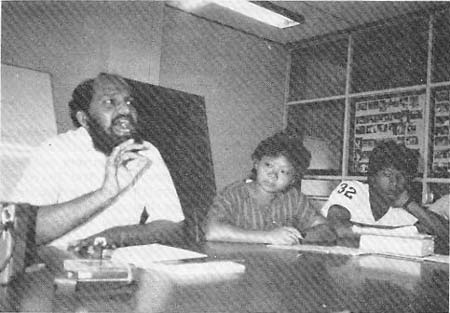
“Women's struggle is not for women alone, but for
the liberation of the entire humanity”
- Bishop Poulose.
He also spoke of the need to maintain a cordial relationship
with the Church as it is still an important tool to bring about change. The SCM should develop good strategies for
this purpose to maintain credibility.
In the discussion that followed, the problem of SCM's relationship with the Church was raised. Many participants expressed that it was
difficult for the SCM to maintain cordial relationship with the
institutionalised Church because of conflicting ideologies and practices, and
the Church's refusal to accept the SCM in some places, branding
17
them as "communists" and restricting
members from participating in the SCM,
In response, some commented that the SCM should redefine the
Church in its institutionalised and wider sense. The SCM as an institution too, is not beyond
criticism. The SCM sometimes tend to
alienate itself from the Church for want of a "big-time
revolutionary" identity of its own and this bias should be checked.
In closing the discussion, Bishop Poulose
said SCM should have a good understanding of the Church ecclesia - its
universality in meaning. Hence the SCM
needs to be part of this universal ecclesia.
For the purpose of strategy and being part of the Church's
resources, the SCM will have to stand even amidst contradictions - to be the
relevant, dissenting minority, he adds.

Women's Movement and the Ecumenical Agenda
- Rev. Sun Ai Park
18
Women's Movement and the
Ecumenical Agenda
"Classes compete, races coexist; the sexes
cohabit" – Fr. Tissa Balasuriya. In support of this statement, Rev. Sun Ai
Park, the Coordinator of Women's Commission, EATWOT [Ecumenical Association of
Third World Theologians], and the Editor of In God's
Image, presented a comprehensive paper on "Women's Movement and the
Ecumenical Agenda".
She said, for Women, men can be their oppressors and
simultaneously their lovers, fathers, sons and brothers! Women are 'trained' to
handle the development of others, the caring and nurturing of children, to
encourage their husbands and to serve all basic needs. Women are 'trained' to serve others first, a
trait indispensable for the sustenance of human life and yet devalued by the
established cultural value system and the ethos of the whole society. This we can see from the following angles:
i) Economically, household services do not
command pay and are regarded as an unskilled 'job'.
ii) Politically,
those engaged in domestic service do not have a decision-making power, which
therefore reflects in the hierarchical structure (dominated by males!).
iii) Culturally,
patriarchal domination disallows opportunities, incentives, etc. to the women
and reasons given are that women have an 'innate disability'.
All these lead to the sex role distinction which is
perpetuated and maintained from birth to death, thus, maintaining the vicious
circle.
Poverty, a class problem has forced women to work and a
meagre income is paid her l) taken as supplementary to the
husbands/fathers/brother's incomes, be it that they do the same work (or more)
and for the same number of hours (or more). 2)
the work load at home awaits her too - cooking,
ironing, etc. 3) and also become objects for their husband's release of
frustration and anxiety – wife beating, alcoholism, rape... etc.
And this is done to 'keep order’ i.e. by means of
oppression, subjugation and exploitation of all "others" by all
means... the largest category of "others" being women... women suffer
not double or triple but multiple burdens of oppression.
19
Historically, militarism accompanies prostitution. As
militarism becomes more sophisticated, so does prostitution from crude means of
hunting women like hunting rabbits to gratify the needs of soldiers (during W.
W. Il) to circumstances that are manipulated and fabricated to look like women
are indulging in it on their own 'free will’ (e.g. at the US army bases in the
Philippines and Korea).
All these phenomena, of patriarchy affect life in the Church
too. As in the homes and in society, the
women's role is in the service area.
Patriarchal ideology forms people's mind in such a way that female sex
and sacredness can never go together.
Many women who felt accepted fully by Jesus of Nazareth find themselves
terribly hurt in this Church. The Church is heavily tainted by this patriarchal
prejudice and its cultural value system which is basically divisive,
hierarchical and domination—orientated.
A dualistic outlook in theology separates body and spirit, men and women
and this world and the other world, reinforcing and legitimizing the divisive
way of life in the church. Churches seek
their own security in the small boundaries of their own local church or
denomination losing the challenge which comes from faith in the God of justice,
love and freedom.
Nevertheless, the spirit of God moves people. We have witnessed young students, workers,
peasants standing up against injustices and oppression in which women are
involved directly or indirectly.
Men should be freed from the self image of andocentric
domination and desire to control others and cultivate an attitude of sharing,
caring, serving and developing others, an attitude which is designated to women
only at present.
This new model of sharing responsibilities can be developed
at home and in church. Decision-making
bodies should be constituted by equal number of men and women and enhance equal
participation. In both individual and societal change, the underlying factor
must be equality between women and men.
The urgent need to overcome sexism among progressive male partners
should be realized. True unity must come
from inclusion and acceptance of all who are concerned in honest dialogue and
mutual effort to form a true community of women and men where everybody is
involved in developing others as well as themselves to their fullest potential.
Then will we see the renewed movement and unity between the
church and the world come together. As
Dr. W. A. Visser T'Hooft
says, "Unity by itself is nothing; it may even mean death. It is only when the breath of God comes upon
the bones that ‘the whole house of
20
Women and men are awakened to the urgent need of a new value
system, a solidarity to come as a power, not to be the
rulers on top to oppress others but to build a really humane community where
the spirit of justice and love is concretized for all.

Worship...a
daily Spiritual discipline.

National Report: Caroll Kohu speaking of Maori women