5
THEME LECTURES AND
DISCUSSION
Input 1: Geopolitics in
Asia/Pacific
The speaker for the topic "Geopolitics of the region:
In relation to women" was Dr. K. S. Jomo, a lecturer
in the Faculty of Economics, University of Malaya, and director of the
Institute for Social Analysis, Malaysia.
He says that in most parts of
Given the present conditions in the political and economic
spheres in the SEA and AP region, popular people’s movements not only struggle
against old issues but new ones as well in response to new situations.
There is ample room for present struggles for justice to be
based on common points of concern and to be unified according to common belief
in the universal values expressed in religion, in upholding equal rights, etc.
On women's issues, Dr. Jomo says
these are either centred around common concerns or around
specifically women's concerns. In the
latter, men tend to keep away, isolating the concerns as women's affairs
only. To counter this isolation, women's
issues need to be raised to the level of popular/common concerns, seeking to
identify common points/areas that affect both women and the general population.
He says SCM needs to look at concerns not only from the
Student Christian perspective, but also from the perspective of humanity,
working on common points of social forces, popular concerns, etc.
During question time, Dr. Jomo
commented on the increasing Japanese influence in work methods/ethics which has
resulted in a distortion of values; increasing female labour in the region; and
the negative effect of mechanisation in the rural agricultural sector,
depriving families of income, and reducing the responsibility of women in
contributing to labour and income.
6
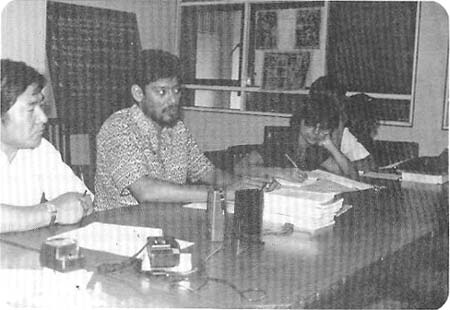
Dr. Jomo K. Sundaram delivering
keynote address
Input 2: Militarisation in Asia/Pacific
The "topic "Militarisation
in the region: In relation to women" was presented by Dr. K.S. Jomo.
He spoke of the use of violence by the State to suppress
those who challenge the status quo. If
the State is only concerned with the welfare of a small minority, it would come
into cold and open "war" with the rest of society, and hence would
justify and monopolise violence.
Violence, he says, can be both obvious and insidious. In the
latter, structural violence is an example as seen in dehumanising factory conditions,
oppressive laws and controlled education system. There is little need for obvious violence as
subtler ways are more effective to control and repress people, for example,
through culture and perpetuating hierarchies.
Closely connected to violence is the prevalent male ethos in
Asian patriarchal society, which is not dominated by Western culture,
re-emphasising the aggressiveness and particular realm of males. The need for justified violence and the
prevalent aggressive and dominant male presence contribute to the rise of militarisation in different forms.
7
On women and militarisation, Dr. Jomo says the opposers to militarisation are largely women, and they have the bigger
potential to curb it. These resources are untapped because women are generally
unorganised or poorly motivated, and are often not taken seriously. However,
there have been many successes made by women in opposing violence, e.g. in the
In the discussion following this talk, participants looked
at the root of violence and its alternative. Militarisation
is recognised to be linked closely with global economy and State ideology.
Input 3: Patriarchal
Society in Asia/Pacific
Women are oppressed not merely by the behaviour of
individual men but by a whole social system which allows a certain type of
behaviour to occur. It is the men who are powerful in this system and the women
are the subordinates.
This was stated by Ms. Irene Fernandez who spoke on
"Patriarchal society in Asia/Pacific". Ms. Fernandez is the Executive
Secretary of Selangor Consumers' Association in
She said there is increased violence against women, not only
physical but also ideological. Industrialisation has made the situation worse.
In employment, she said women are primarily household unpaid
workers in the capitalist world. In work outside, their wages are less and
their work done is underestimated.
In education, more women are illiterate, having a lower
level of education.
In politics, the power is in the hands of a male dominated
society.
In workers organisations, there is no women representation
and so, issues concerning them such as maternity leave are not taken up.
There are also regulations and laws that discriminate
against women. There is social conditioning through education, religion,
upbringing that women should find fulfilment in low-paid jobs or feminine jobs.
8
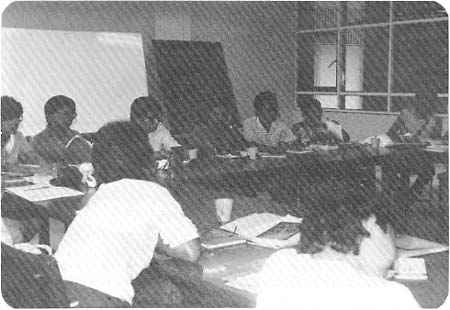
"Culture and religion has contributed
to legitimising
the inferior
role of Women" - Ms. Irene Fernandez
Also, in some Asian cultures male babies are more highly
priced than females.
She also spoke of Christian machismo that further reduced
women's status to inferior/secondary role.
In "the church structure, how many women are involved in the
decision making process?
So, culture and religion has contributed to legitimising the
inferior role of women.
Input 4: SCM Response to Women's Struggles for Change
The SCM and WSCF should integrate women in other issues -
e.g. militarisation, human rights, racism - because
in these issues, women tend to be more oppressed than men.
This was suggested by Mrs. Theresa Carino
in her talk on "SCM response to women's struggle for change". Mrs. Carino is a
lecturer at the
9
She said the SCM has also contributed to the socialisation
of oppressive values. Therefore, the SCM needs to support the just theology and
have reforms to enable women students and teachers to assert themselves in
leadership work; explore and penetrate fields that are dominated by men; and
break down structures that have perpetuated the oppression of women.
She said women in different social classes experience
different levels of oppression. Therefore in dealing with women's issues, me need to link them with economic inequality. Women are
oppressed according to their sex, race, class. It is
important to identify women who are the most oppressed and work in solidarity
with them. These are urban-poor women, migrant women, women in racial
minorities, women workers.
She suggested the following strategies:
i. It is important to keep in touch with women
at the grassroots, to spread consciousness and help them develop skills to cope
with existing oppression. It is also important to help women realise the risks
that are involved in their struggles and how to deal with these risks.
Therefore, there is a need to develop support groups as 1 individual cannot
achieve much. E.g. of support groups - professionals -doctors, lawyers,
businessmen, etc. These groups can provide protection as they are
non-political.
ii. Build-up
and sustain leadership, through training programmes, exposure trips, political
education.
iii. Build
alliances for support, not only with other women, but also with men. Involve
individuals, church groups, political groups and
organise joint projects, conferences.
iv. Mobilise for
mass action. This is the most difficult because it is hard to sustain and
involve risks. It has to develop according to the political situation.
v. Together
with the need to increase awareness, it is important to build up a network at
national and international level. This is where the USCF can provide a
structure to build up the network. This is important for:
10
– the exchange of ideas, information, strategies, material
resources and skills;
– provide media
attention and publicity in other countries;
– women in different countries can have different strategies and
perceptions on the same issues;
– provides psychological support - that this is a world-wide
struggle.