3
INPUTS
Input I: Militarisation
Mr. Clement John, Secretary
for International Affairs of the
Christian Conference of Asia enlightened the
participants, as concerned youth, on the growth
of militarisation in Asia.
He defined the term militarisation and dwelt
on the causes of its rapid growth in the region which inter alia
were:
1. the injustices
prevailing within our societies
coupled with the
inability of the
politicians to find a just and peaceful solution to the issues facing
the people.
2. the
interest of the superpowers
He stated that the Asian ruling elites after freeing themselves from the
yoke of colonialism were never able to rise to the expectation of the people.
These ruling elites got bogged down in wrangling for power positions. Having tasted the fruits of power they were
not prepared to share it and submit it to the will of the people. In order to
perpetuate their self-interest and hold on to their position they resorted to
brute force and this paved the way for army interference. The men in Jackboots being well organised and
disciplined soon came to have a major say in the affairs of the country.
Two specific examples of countries where there have been rapid growth in
military control were
Input II: Human Rights and Asian
Issues
In his second lecture on Human Rights & Asian Realities, Mr. Clement
John stated that Militarisation and Human Rights are
closely inter-related. When the military
takes over power, human rights violations become frequent. The three main
institutions, the executive, legislature and judiciary come under the control of
the military. Thus, the system of checks and balances, essential for a
democratic system is destroyed. Instead, the will of the military commander
becomes supreme and all decisions are made in accordance with his whims and
fancies.
4
The institution of Judiciary which is meant to provide safeguard and
redress for human rights violations is rendered powerless.
The United Nations Universal Declaration of Human Rights which was
adopted by the General Assembly in 1948 have had a tremendous impact throughout
the world. All civilized nations are expected to subscribe to the principles
enshrined in the International Bill of Human Rights. But, most of the third
world countries are guilty of ignoring them when it comes to the question of
implementation.
Towards the end of his lecture, Clement traced the role of the students
in the struggle for change. He said the students have often acted as the
conscience of the nation and have reflected the hopes and aspirations of the
people. In their desire to witness transformation for a just socio-economic and
political order, they have rendered many sacrifices - many young lives have
been lost - the struggle still continues.
Today, in the Asian Region, we see that practically every Government has
tried to impose restriction and control on student activity. This is primarily because the student
communities in general are against the status quo and the unjust and oppressive
structures of Asian societies.
After dwelling on the student movement in the Asian continent, Clement
raised a few questions with regard to SCM's
cooperation and collaboration with other national movements that are involved
in issues relating to socio-economic and political change in our society. He
said that the issues
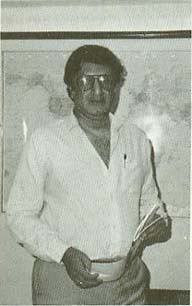
Clement John
addressing
the participants
5
of human
rights cannot be undertaken alone by
SCM, alliances have to be formed with others including people of other faiths
and other secular bodies.
Input III: People's Movements in Asia
Bessie Rifareal of SCM Philippines, an Executive
Committee Member of USCF Asia/Pacific, gave a presentation on People's
Movements in Asia/Pacific. She started
by enjoining the group in an exercise at identifying issues in the region. In
the next exercise, the participants exchanged notes with each other as they
tried to describe and analyze the different people's movements they are
involved in.
Through these exercises and the very approach of the presentation,
Bessie tried to impress upon the group that building people's movements is not
done by a single person but by the collective effort of a people who, despite
cultural and social barriers, together have the unbeatable power to bring about
social change. A people's movement, she
said, is any collective and long-term action of a people guided by the just and
moral interests and aspirations of that people who are either marginalized,
oppressed or exploited by a dominant class, race or sex.
This people should identify for themselves the issues and situations
which they want to confront and change based on their own experiences, and from
this, project their visions towards which steps will be undertaken such as
awareness-building, organising and mobilising people
to action. These steps must be guided by clear direction and objectives so that
people's power can be sustained and further developed.
Bessie stressed the necessity of coming together and sharing the
resources of each other's experiences and faith - faith in God, faith in the
people, and faith in the justness of the cause that move people and peoples to
band together and fight. She also
cautioned the participants that taking an active part in people's movements
involves a lot of sacrifices as she shared her own experiences in participating
in the people's liberation struggle in the
6
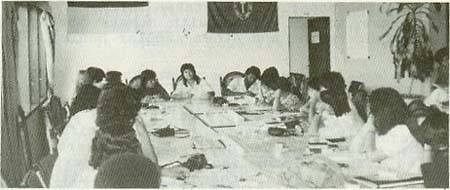
Bessie (centre) speaking on
Peoples Movement
Input IV; Peace Movement
Dr. Samuel Lee, Professor of the
He quoted the concept of peace as defined by peace researchers in three
dimensions:
The first defines peace in a negative way, as the state of the community
where war and violence are not present. Secondly in a more positive sense,
peace is the state of the society or nation where the causes of war and
violence - such as conflict, antagonism and
aggression - are removed,
so that latent war may not exist. Thirdly, real peace can be realized
when the bases of conflicts and antagonisms are eliminated, that is when a
peaceful social structure is established, and when relationships of equality
and human rights are guaranteed. The peace movement is, in the first sense, the
anti-war movement or anti-nuclear movement,
in the second
respect, the reconciliation and
co-existence movement and in the third dimension, the justice,
equality and human rights movement.
7
They
have taken all we’ve got… Helen Boyle ↓ ↑
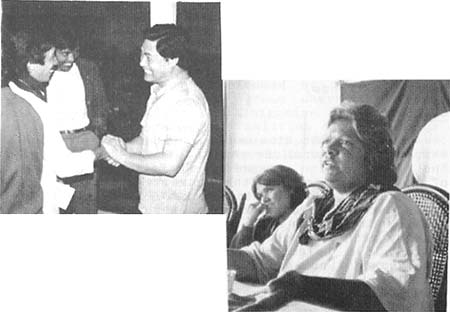
Prof. Lee meets local host committee members
Input V: Minority Movement
Ms. Helen Boyle, Director of Tranby Aboriginal
College,
Helen also drew in comments from Georgette Bartholomew (nominee of SCM
Australia) and made her relate her experiences as an aborigine. During the
lecture, the participants also actively participated by commenting on the
minority situation in their respective country.
8
Lively discussions followed every input presentation. All the participants felt that the inputs
were very enlightening, as it generated much interest in regional issues and
spurred many to continue to keep abreast of national, regional and even global
realities/trends.