40
THE
DEVELOPMENT AND STRENGTHENING
OF WOMEN LEADERSHIP IN
WSCF/SCMs
Preamble
This report should be read together with:
* Regional Women's Report – History, Visions and Programs published by WSCF Asia/Pacific 1987.
* Women's Evaluation Report at HRD Consultation 1988.
The workshop participants are in substantial agreement with the overall objectives and thrusts of the Regional Women's Report as provided in pages 20 - 23, as well as the initial evaluation of the program as pages 14 -19.
The workshop participants see the present lack of substantial support for the Women's Program as issuing primarily from weaknesses at the national movement level. Also, the present linkages between the National Movement and Regional levels are very weak and need to be addressed to. For more women to engage meaningfully in the life of the respective SCMs and in the Federation, there is the urgent need to face this issue with the spirit of self criticism, humility and repentance.
As a relevant and prophetic albeit minority movement, the SCMs must not only engage in the liberation of humanity from oppression and exploitation in the world at large, it is also imperative that the movement itself must embody and project as close as possible its ideals and aspirations, in particular, we see the position and status of women members of the SCM/WSCF ecumenical community as posing very concrete questions on how do we who espouse an alternative vision of the world order attend to our own household matters. Numerous studies and grass-root experiences have enumerated and confirmed the inferior status put upon women by the present world order; it is not necessary nor the task of the workshop to argue them out.
Whilst the degree of oppression undoubtedly varies from class to class and from culture to culture, nevertheless we do see the need to enable our own constituent women members to be empowered and in turn to be empowering agents of positive change for others. To do this, we need to take risks to move away from well-trodden paths and in the pioneering spirit of the SCM tradition be creative and dynamic within the contexts of our national and regional realities.
It is with this spirit that this report tries to embody and project in its proposal:
41
1. The Strategy
The overall thrust of the strategy to develop and strengthen women leadership in the SCMs/WSCF at both the national and regional levels can essentially be described as two fold, namely:
* overcome difficulties of women leadership development at the national and regional level.
* build mutual support between the national movements and at the regional level.
1.1 National Level
1.11 National Women Coordinators - appoint National Women Coordinators (if there is not one already). Her functions and tasks amongst other things should include:
* working together with the respective National Women Committees/Groups.
* raising awareness on women's issues and concerns.
* liaising with the Regional Women Committee (RWC)
* be a resource person.
* in-charge of publications and communications.
1.12 Women Committees/Groups - Form Women Committees/Groups at both local and national levels. Their function should include:
* planning and overseeing programs/activities for women (and men).
* networking with other SCM women committees in the sub-region and region.
* establishing and maintaining links with other women groups (secular and religious) in their own countries.
We suggest that these committees be represented at the decision-making bodies of the National Movement and a certain degree of autonomy be given in the planning and implementation of women programs.
1.13 Funds - Funds be secured and set aside specifically for Women Programs.
1.14 Constitutional and Policy letters - Begin deliberations to make amendments to the respective SCM constitutions for the purpose of enhancing women participation and leadership in the national movements. Two specific provisions in mind are:
* mandatory for equal representation of sexes at all decision-making levels.
* mandatory for the chairperson or vice-chairperson to be a woman every alternate term.
We suggest 1990 to be the target year for the full implementation of these provisions.
42
Further, we suggest that the national movements make it a point to send men and women delegates alternately for all sub-regional and regional events if their record is poor for women representation.
1.15 Regional Committee Representation - We propose that the National Movements nominate 2 names (1 male and 1 female) for future Regional Committee meetings and the Regional Office empowered to select whichever candidate is most suitable in the light of the respective National Movement's past record in terms of men-women representation.
1.16 Study Action Groups - units of change - To make Constitutional and Policy provisions is not enough, there is also the need to continually promote awareness and analysis of the changing status, condition and contribution of women in church, university and society in both men and women members. For this purpose, Woman Study/Action Groups be formed. These groups should look into two broad areas:
* social, economic and cultural analysis (legislation, employment, education etc.) of women in their own national contexts.
* ideological, theological and biblical analysis and reflections.
To draw a wide and critical perspective, we encourage strongly these groups to dialogue with women activists, oppressed women (rural and urban poor, prostitutes, tribals etc.) and women from other faiths and ideologies.
Conscious efforts should be made to collect and compile the outcome of such studies and dialogues to form part of the local resources. They can be shared to the rest of the network at sub-regional and regional gatherings.
1.17 Ongoing Conscientization and Leadership Formation Programs - We strongly urge workshops, consultations, retreats to be organized on a regular basis for SCM constituency. There should basically be two types of these programs:
* workshops, consultations (open to both men and women) which has the primary objective of raising awareness and clarifying women issues and concerns.
* Leadership Formation Workshops aimed at developing analytical and practical skills of women members.
The RWC members are recommended to form part of the resource pool for these programs.
1.18 Publications – We encourage strongly National Movements to initiate women publications. This is necessary to build up the overall consciousness and solidarity of the SCM Women Constituency. Either a separate newsletter/journal be created specifically for this purpose or alternatively a minimum of one issue per year be devoted to this area.
43
1.2 Regional Level
1.21 Conferences/Consultations – To affirm the experiences and work of women (sharing and networking) in a wider geographical area, we propose that the Regional Office organize:
* Sub-Regional Women's Conferences and
* Regional Women Conferences
in alternate years. The present format and duration as found in page 38 of the RWCs report is acceptable.
These Conferences should deal with specific themes and issues/needs pertinent to the region or sub-region.
1.22 Structuralization of Links - we see the present linkage between the national and regional levels as very weak. We therefore propose the structuralization of links according to the schematic diagram in appendix 1.
We advocate the sub-regions to be the intermediate units of operation for the entire WSCF Asia/Pacific region. This is for the purpose of closer networking, tighter monitoring and accountability and to cut down travelling expenditure.
1.23 Full-time RW Coordinators - The present scope and workload for the women's program is too wide and heavy for part-timers; we strongly propose to the Regional Committee to begin the process of engaging full-time Regional Women Coordinator(s) immediately.
1.24 WSCF Asia/Pacific Women Quarterly - As an important visible form of communication between women members in the Federation, we propose the creation of a WSCF Journal to be published quarterly. Amongst other things, the journal (to be the creative work of SCM women members) should include :-
* updates on the women's movement at the National level.
* indigenous stories, liturgies, songs etc.
* reports of conferences, workshops etc.
* biblical and theological reflections.
1.25 Inter-Regional Exchange Program - To build inter-regional links amongst women in the World Federation, we propose an exchange program every 2 to 3 years. The delegation should consist of balanced representation from the sub-region.
2. Mutual Partnership (SCM Men
and Women) at the National and Regional Level
2.1 What is partnership? - SCM Men and Women working together towards a common goal - in the liberation of both men and women in their SCMs and also in the wider circle.
44
During the course of our discussions we have noted that although women and men participate equally to fight injustices and oppressions in the respective countries, yet they are far behind in this partnership at home and in their workplace (National SCM). Therefore, National Movements should be conscious of these aspects:
a) Share responsibilities and burdens at home.
b) In workplaces, should initiate actions to incorporate womens' interests in their struggle for equal/active participation.
c) Women should be conscious that their situation at home is also on the same basis of equality and should constantly remind men about this.
d) Encourage men to caucus so that they can recognize their own strength and weakness and try to overcome this (transformation of mind and heart) through collective support of like-minded men.
2.2 National and Regional Levels
2.21 Men and Women caucus (separately and together)
The following ware observed and/or suggested:
* More often than not, it was difficult for man to say how they oppress women. Therefore, we need a religio-cultural framework to facilitate self-criticisms.
* suitable men facilitators for men's caucuses would help the dynamics greatly.
* have inputs on women's concerns/experiences before caucuses.
* encourage both man and woman to share at a personal level positive and negative experiences and not broad generalizations.
2.22 Education - In the light of the prevailing patriarchal sexual politics, we propose the following program/project:
* Sexuality workshops
–to know more about our bodies.
–scientific analysis to help unmask myths of double standards for sexual conduct and appetites that is propagated by patriarchal and capitalistic systems.
–develop a fuller understanding of the meaning of life so as not to be exploitative and oppressive especially in relation to sex.
–the lack of understanding of life is often manifested in our personal expressions.
* –compile a (select) bibliography of feminist materials in the Asia/Pacific as well as other regions for the national movenents to study and reflect on.
* –compile directory/address list of Resource Personnel to facilitate concrete networking especially when national or sub-regional movements need resources (resource persons or materials) to carry out women programs.
45
3. Doing Theology from Women’s
Perspective
3.1 Suggested framework for National Movements & Women's Committees
(a) What is "doing theology" (from women's perspective)? By whom?
* it is a quest for direction and meaning in life which involves human struggles in our contexts
* it is almost always said that only seminarians, academicians, ordained pastors (of which most are men) can do theology.
* it has to be done collectively as a community effort.
(b) What are the essential sources for women doing theology?
* ourselves (faith, personal experiences = church, family, school, society, inter-personal relationship etc.)
* women's oppressive situation; in the social, political, economic and religio-cultural dimensions
* the Bible (with renewed understanding)
* women's stories in the historical and other religio-cultural traditions
(c) Our understanding of the Bible in relation to women's experience - what are the messages that promote women's liberation?
(i) As Asian women, how do we understand Jesus?
* model for men to follow - his attitudes to and relations with women calls for repentance from men and women
* he sees women as somebody more than fitting into traditional cultural roles and values - capable of intellectual dialogue as well as being faithful disciples (Luke 10:38-41)
(ii) Stories of women in the Bible: Calling for solidarity, building sisterhood
* suffering women: drawing critical reflection on religio-cultural oppression in Asian context (Judges 19, Genesis 16, 2 Samuel 11)
* non-conventional women in Jewish traditions: women as an agent of change (Judges 4, Genesis 38, Joshua 2:1-24, Ruth etc.)
* women in Jesus' time: women with strong faith and initiative (Luke 7:36-50; 8:1-3; 21:1-4, Mathew 9:18-25, Mark 7:24-30, John 20:11-20)
(iii) feminine aspects of God: Understanding of God in renewing women (and men) self-images (Isaiah 42:14; 49:14-15, proverbs 31:10-31)
46
(iv) Visions of New Order where the whole human community and created order is in harmony (Galatians 3:28, Genesis 1:26-28)
(v) Critical Spirit in Prophetic traditions: sources of power to persist and hope for self-criticism for non-compromising attitudes
(vi) Hidden contributions of Women disciples, prophetess, deacons (minister) in early church: recognizing women's contribution in male-dominated society and Church: bringing up forgotten women in history (e.g. 1 Corinthian 11:1-16)
3.2 Further Work
We suggest that the theme of "doing theology" from a woman's perspective be further explored and elaborated in the near future (eg. Sub-Regional or Regional Conference) and the outcome published in the WSCF Book Series
4. Preparation for Regional Committee Meeting in January 1989
4.1 For the immediate future, we propose the following process for the purpose of evaluating more in depth the Women's Program thus far;
Sept. – Memo to all National Movements
* addressing to present state of women participation
* reminding movements of Federation Policies, Regional By-laws (quote relevant passages) concerning above
* requesting National Movements to prepare an evaluation report (concrete programs carried out, problems faced, type of help needed, suggestions/recommendations) and a calendar of their women's programs for the next 2 years
Nov. – Responses to Memo
Dec. – Written evaluation reports submitted by National Movements
Jan. – Regional Committee Meeting
4.2 To be discussed at the Regional Committee meeting, should be included the following proposals in addition to the proceeding paragraphs:
a) Mandatory for a session on the women situation and concerns at any regional event.
b) Mandatory to prepare national evaluation reports on women participation and leadership by the delegates to any Regional event (eg. HRD).
c) With reference to proposal 1.22, we further suggested that the National Movements send women delegates who are prepared if elected/appointed to become the Sub-Regional Representatives of the Regional Women Committee. This Committee can then meet immediately to work out concrete plans in the spirit of the earlier proposals; this will cut down costs and time.
47
Appendix
I
Composition
of the Regional Women’s Committee
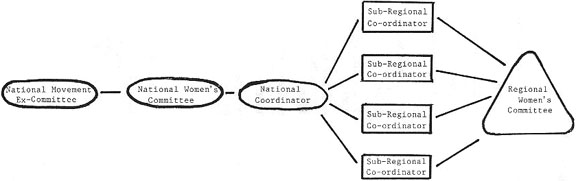
* Regional Women’s Committee consist of six members elected at the Regional Committee Meeting.
2 Regional Women Coordinators
4 Sub-Regional Women Coordinators
* Women participants elected at the Regional Committee Meeting automatically become members of the Regional Women’s Committee. Women Ex-Co Member(s) are appointed as Regional Women Coordinator(s)