10
ASSESSMENT
REPORT
OF
HRD PROGRAMS 1982 – 1987
BY NATIONAL REPRESENTATIVES
I. Preamble
The
countries represented were Aotearoa, Bangladesh, Hong Kong, India, Japan,
Malaysia, Singapore, Taiwan and Thailand.
II. Breakdown of HRD participants 1982-1987
Please
refer to appendix I for details in the breakdown of women student/senior friend
participants and men student/senior friend participants in the HRD programs
from 1982 - 1987.
a) The
total representation of women students was 39.5%. The Singapore delegates
themselves made up 36.7% of the total women participants (30). Seven countries
have sent less than 50% women student. India and Taiwan have yet to send
delegates in this category.
b) In
the women senior friends category, Aotearoa's
contribution is the most significant. Four countries (Hong Kong, Japan,
Singapore and Thailand) have yet to send delegates from this category.
c) In
the men student category a majority have less than 50% representation. Two
countries (Singapore and Taiwan) have yet to send delegates to this category.
d) India
is the biggest contributor to the men senior friends
category with 33%, whilst Aotearoa, Hong Kong and Singapore have yet to be
represented.
III. Expectations of the National Movement
The expectations of the HRD Program as
reported are listed and collated below in terms of priority:
a) Personal
development of participants, enhance participants' understanding of her/his
role in society.
b) Improve
understanding of SCM's vision and mission.
c) Challenge
and train participants to be involved in SCM Movement Building.
d) Share
experiences internationally.
e) Build
networks.
f) Facilitate
biblical, theological and ideological exploration.
g) Deepen
commitment to Student Movement and People's Movement.
11
h) facilitate international self-understanding.
i) Recruitment.
j) understanding the thane of HRD through preparations prior to
and during the program.
A
discussion as to whether the expectations were wet produced the following
comments:
item a) was met by the HRD programs.
item b) was generally met
item c) three countries (Aotearoa,
Malaysia & Thailand) expressed satisfaction. One participant commented that
because of the attitude of university students to social realities and the
absence of follow-up by the sending organization the training received could
not be fully implemented for the process of Movement Building.
item d) well met (unanimous).
item e) was ambivalent; two countries
(Japan & Singapore) expressed their observation that networking was more
along a personal basis.
item f) the majority feeling is that
the participants did not benefit greatly
in this area. The sessions were commented as not participatory enough,
dynamic or in scene case not too relevant to the respective national
situations, in order to seriously combat the strong conservative,
fundamentalist and reductionist forces in our
respective countries, this area needs to be looked into urgently.
item g) satisfactorily met.
items
h & i) were satisfactorily
met.
item j) Taiwan expressed
dissatisfaction with respect to this item, as they felt that the language
barrier, lack of preparation and participation were the factors that need to be
improved on.
IV. Overall evaluation of HRD and its impact on SCMs
a) It
is the general consensus that the HRD is a worthwhile leadership formation
program serving varied functions. The impact to the life of the respective
national movements is positive and significant.
12
b) The
HRD is seal as an important source of alternative education for the
participants. Critical and relevant
perspectives on the Church, University and Society are offered for study,
reflection and discussion. The structural nature of exploitation, oppression
and injustice are analyzed in juxtaposition with the Christian Faith in order
to understand and delineate what might be the contours of Justice, Love and
Peace in our national and regional contexts.
c) As
a leadership formation program, it has deepened the participants' perception of
the vision and mission of SCM.
d) The
programs have also facilitated the building of closer personal and corporate
links between movements in the region. In particular, the experience of
cross-cultural communication has been very beneficial to many.
e) A
large majority of the participants have been challenged to contribute
significantly to the life of their respective movements in various capacities.
More details are found in the next section.
f) A
number of national representatives also commented that the present HRD program
can still be developed and improved. Further, there appears to be certain
weaknesses of the HRD community, which needs to be addressed to and
self-critically dealt with. Details are provided in Appendix II to the report.
The
intention and hope of these criticisms and suggestions are,
that future participants of this program will stand to benefit more in the task
of enabling more members and friends to become active agents of the SCM's ecumenical vision and mission in this part of the
world.
V. Contribution of HRD Participants to the leadership and Growth of
the National Movements
Most
HRD participants have made significant contributions to the growth of their
National Movements upon their return from HRD. They have become more involved
in the leadership of their movements in some cases they have taken specific
initiatives within their movements. An example of this is the leadership
training program initiated by the Thai SCM participants after they had
participated in HRD.
List
of roles HRD participants have played in their National Movements after their
return.
Staff Persons Singapore,
Thailand, Hong Kong, Malaysia, Aotearoa.
Office Bearers Singapore, Thailand, Hong Kong, Malaysia,
Aotearoa.
13
National Committee Hong Kong, Aotearoa, Bangladesh,
Members Thailand,
India, Malaysia.
Program Committees Singapore, Aotearoa.
Local Committees Bangladesh, Thailand.
Note – In the case of India SCM,
HRD participants were chosen from amongst the full-time staff. On their return,
they have shown greater ccnrnitment to their work and
have been active in training and recruiting new members, as well as raising
awareness about justice issues. Taiwan SCM also sent a staff person as one of
their participants.
VI. Contribution of HRD Participants to Leadership and Decision Making
in the Churches and the Ecumenical Community
In
nearly all cases, where participants have become involved with their national
churches or ecumenical community, it has been at a leadership level. Many have
taken initiatives within these organizations.
List
of roles played by HRD participants after their return in churches and the
ecumenical community.
Church Workers Malaysia, Bangladesh, Thailand,
(or similar body) Hong Kong, Aotearoa
National Council Malaysia, Bangladesh, Thailand,
of Churches Hong
Kong, Aotearoa.
WSCF Malaysia,
Singapore, Aotearoa.
U.R.M. or U.I.M Thailand,
Hong Kong.
Y.M.C.A. Bangladesh
CCA YOUTH Singapore,
Hong Kong.
Catholic Justice and Singapore, India.
Development Commission
VII. Contribution of HRD Participants to Groups involved in Action for
Justice and Peace in the Larger Society
Following
is a list of groups that the BED participants have become involved with after
their return:
Women/Sexism Hong
Kong, Singapore, Aotearoa, Thailand, Bangladesh, Malaysia, Japan, India.
Human Rights Hong
Kong, Thailand, Malaysia, Singapore, Japan, Taiwan.
14
Social Awareness Singapore, Hong Kong, India, Malaysia, Taiwan.
Ethnic Minorities Aotearoa, Thailand, Japan, Taiwan, Singapore
Political Groups India, Thailand, Bangladesh, Japan
Urban Poor/Slums Hong Kong, Aotearoa, Thailand, Bangladesh
Farmers/Rural Fishermen Japan, Taiwan
Cultural Communication Bangladesh, Japan
Environment Thailand,
Taiwan
International Development Aotearoa
Agencies
Trade Unions Bangladesh
15
Appendix I
|
|
Aotearoa |
Bangladesh |
Hong Kong |
India |
Japan |
Malaysia |
Singapore |
Taiwan |
Thailand |
Total |
|
♀ stu. |
1 |
2 |
8 |
– |
1 |
1 |
11 |
– |
6 |
30 (39.5%) |
|
♀ st. |
6 |
1 |
– |
2 |
– |
1 |
– |
2 |
– |
12 (15.8%) |
|
♂ stu. |
1 |
4 |
4 |
1 |
3 |
2 |
– |
– |
7 |
22 (28.9%) |
|
♂ st. |
– |
2 |
– |
4 |
2 |
2 |
– |
1 |
1 |
12 (15.8%) |
|
|
8 |
9 |
12 |
7 |
6 |
6 |
11 |
3 |
14 |
76 |
key: ♀stu. – Women Students ♂
stu. – Men Students
♀
st. – Women Senior Friends ♂ st. – Men Senior
Friend
16
Appendix II
Suggested
areas of Improvement
a) More
care and thought should be given to the selection and preparation of
participants by the national movements taking into account:
* balanced representation of sexes
* priority for students
* participation of oppressed ethnic groups
b) The
resource personnel selected should be more from the national movements in the
region. Local theologians should be involved in the biblical and theological
inputs. More women resource persons should be invited.
c) Explore
new ways of varying the educational process in the HRD to be less a 'banking
system' and more a dialogue or process of learning and growth.
d) The
process of HRD should involve more participation and effort from the
participants. This could be done through the greater use of small group
discussions and workshops. Also creative activities (e.g. drama) should be
encouraged - this could be one way of getting round the language barrier.
e) More
attention and effort given to integrating the personal, spiritual aspects with
the intellectual aspects of the program. Celebration of life
(liturgy) as the core of Justice and Peace work.
f) Incorporate
some community building insights and skills in the program - What are the ways
and processes we can use and share in building/organizing students?
g) A
less structured program to allow participants to interact freely.
h) The
exposure programs are not long enough; this part of the program is seen as the
key to initiating reflection and action by the participants. More attention be paid to analyze the causes and forms of oppression and
exploitation.
i) A
re-evaluation of the way exposures are carried out. There is danger that they
merely put the poor on show and this further adds to
their exploitation. What is gained from the exposure needs to be analyzed more
deeply. Also, when possible contact with or information about powerful groups
are made, they should be included so that a better understanding can be reached
as to how they benefit and exploit people.
Finally, some women participants from Aotearoa have expressed anger at
how men have treated exposures to prostitution and night club areas.
17
j) More
serious efforts in providing translation facilities for non-English speaking
participants for maximum discussions is also very
important.
k) More
attention be paid to the community life of the HRD participants; there are
cases where dialogue and discussions have broken down because the interpersonal
dimension is overlooked.
l) More
consultation with the National Movements in the selection of the HRD themes.
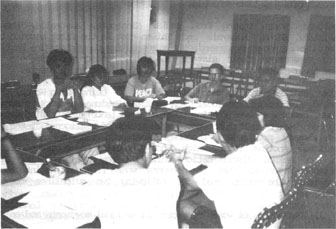
Working Group