1
INTRODUCTION
The
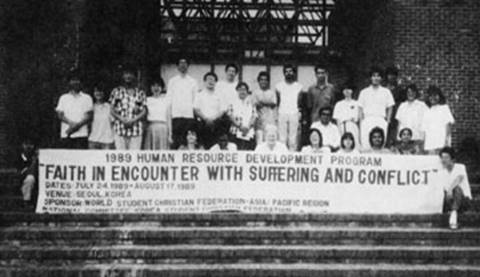
Human Resources Development Programme, the annual leadership building programme
of the WSCF Asia-Pacific was held from 24th July to 17th August 1989, in
The
programme hosted by the Korean Student Christian Federation (KSCF) provided logistical
support as well as translation services for the many Korean participants,
visitors and resource persons.
HRD
'89 was notable in that it was the first leadership formation programme of the
WSCF A/P which implemented the new HRD format produced by the 1988 Taiwan
Consultation on HRDI Leadership Formation and
2
INAUGURAL WORSHIP
 The inaugural worship was held in
the chapel of the
The inaugural worship was held in
the chapel of the
The
worship was followed by the programme orientation session in which the
participants introduced themselves and were then briefed by the Regional
Secretary, Yong Ting Jin, on the general programme outline and on logistics and
infrastructure by the local KSCF staff.
The
thirteen participants divided into two steering committees each to function for
half the programme duration. The steering committee elected their own
coordinators whilst the committee members took turns to be moderator of a day's
session. By this means every participant was provided the opportunity to work
as a moderator. A small group of participants formed a committee to conduct
the sessions of 'cultural expression'.
HRD THEME PRESENTATION
The
Chairperson of the World Student Christian Federation, Bishop Poulose Mar Poulose (
3
Abraham,
who is considered the 'father of believers', obeyed God's call and abandoned
his secure life, left his native land and began an adventurous journey to a
place not yet known to him. Similarly, God calls today to a new understanding
of life in its fullness; from inaction to creative action; from the fear of
hell to the task of destroying the demonic forces in human society.
Bishop
Poulose, who is the immediate past Chairperson of the
WSCF Asia/Pacific region argued that to be faithful to God required us to take
side with the oppressed and downtrodden in their struggle for justice. In the
Exodus event, the might and power of God was revealed to liberate the slaves.
God became a human reality in the flesh and blood of Jesus. Even in that great
event of the incarnation God stood on the side of the poor and oppressed. The
Bishop pointed out that the participants in the HRD programme were chosen people.
As believers, 'Christians' are called to be a people for others.
Our
calling is to respond to the Good News by acting as advocates for the
powerless. It is by being where God is working that we express our faith.
It is
possible, Bishop Poulose observed, that as we proceed
on this adventurous journey, we may, at certain times, be skeptics. "Doubt
is an integral part of the living faith", the Bishop declared, and pointed
out that Abraham at one point had been skeptical (Genesis 12: 10-20). The
Bishop recalled the story of the father who brought his son to Jesus. He
confessed: "I believe; help my unbelief! (Mark 9; 24)
MAIN INPUT ON KOREA
The
General Secretary of the Korean Christian Alliance for Democracy and
Re-unification, Hwang In-sung gave the principal input on
4
regime responded too
partially to the demands of the people by undertaking some reformistic
democratisation. However, this did not last long, and
soon the people encountered blatant repression. In its 'vicious and massive
violence' against the struggles of workers, peasants and other oppressed
social groups for basic socio-economic rights, the Roh
Tae Woo regime has now thrown off any pretension of undertaking democratisation, Mr. Hwang observed.
The
other reality to be found in
Mr.
Hwang identified the
At the
same time the US-backed Roh Tae Woo regime has
launched a concentrated repression against the mass movements, including a
propaganda campaign to brand the people's organisations
as "communist". At the same time there was an attempt to subvert the
integrity of the people's movements by seducing them into participating in the
constricted arena of institutional politics. Thus the national democratic
movement forces are today in a "defensive posture" against the comprehensive
offensive of the US-Roh Tae Woo regime.
Describing
the history and the role of the Church in
5
formation of Korean
society as well as the national democratic transformation of the
ASIAN REALITIES AND TRENDS
Dr.
Chandra Muzaffar, President of Aliran
Institute (a social reform movement) and prominent Malaysian intellectual,
internationally known for his human rights activism, was this year's resource
person on geo-politics in the Asia/Pacific region. In his presentation, Dr. Muzaffar observed that following the post-second world war
period of de-colonisation, Asian countries had
initiated processes of modernisation adopting three
different societal models. Whilst some countries had adopted the capitalist
model, others had chosen the socialist path and yet others had endeavoured to combine elements of socialism and
capitalism.
 However, Dr. Muzaffar
regretted to note that in all three models the failure had been greater than
the successes. In the countries which had adopted the socialist system,
productivity remained low and inefficient. Corruption was rampant at higher
levels of the administration. The political institutions were tightly controlled
providing little political freedom for their citizens. At the same time many
Asian socialist states had systematically attempted to manipulate the
development of culture and religious life.
However, Dr. Muzaffar
regretted to note that in all three models the failure had been greater than
the successes. In the countries which had adopted the socialist system,
productivity remained low and inefficient. Corruption was rampant at higher
levels of the administration. The political institutions were tightly controlled
providing little political freedom for their citizens. At the same time many
Asian socialist states had systematically attempted to manipulate the
development of culture and religious life.
In the
capitalist countries such as
Dr. Muzaffar considered
6
which was a result of
the capitalist dimension of the Indian economy. There was also massive
unemployment. Political freedoms were gradually being restricted and today the
dominant elite was more in control than ever before. There was also corruption
whilst ethnic and religious conflicts were becoming a volatile factor.
But to
Dr. Muzaffar what has become the great tragedy is the
predicament of the human being in all these three social systems in Asia/Pacific.
He felt that in the socialist countries the human beings had become simply a
tool for the purpose of enhancing the power of the elite. In the capitalist
countries the human being had been reduced to the level of "a consuming
animal". People were merely treated as animals with certain material
needs.
"Capitalist
economies maximize profits and minimize people. What we need is a society which
maximizes human beings and minimizes power and profits". Dr. Muzaffar, well known for his resistance to political
harassment by the Malaysian government, argued that the "root of the
problem in
Giving
a few examples of this human predicament, Dr. Muzaffar
pointed out that in nearly all Asian countries there is a degradation of the
natural environment. Most countries lack a programme to rationally utilize and
conserve natural resources. In the political sphere, even in the few countries
that do have elections, the mass of people are manipulated to maintain the
domination of the elite. There is no real participation by the people in
national politics and governments have no accountability towards the people.
Furthermore,
Dr. Muzaffar noted that "all over
7
Hope
for the future of Asia/Pacific lies in the increasing number of mass movements
all over the region which base their struggles "on spiritual values and ethics
derived from our own traditions". These movements are not yet strong
enough to overthrow the existing elites and the power of the trans-national
corporations. Nevertheless these groups are a challenge to the existing order.
MINJUNG THEOLOGY
Another
important input on
Rev.
Park said that Minjung theology arose from the experience of Christians
identifying with the general mass of the Korean people - the minjung. Minjung
theology sees the minjung (people) as the 'subjective force of history'. Rev.
Park, who himself has suffered political detention for his activism, recalled
how his experiences has helped him understand the primacy of 'praxis' over
theory. He categorized Minjung theology as a revolt against Western
Christianity which had for so long kept
8
The
action of the minjung (people) for justice is the action of God and the Holy
Spirit. The interpretation of this action of God through the Minjung is Minjung
Theology, Rev. Park explained. The person who has heard the cry of the minjung
and is participating in the action of the minjung for liberation is the person
who has received 'salvation'. It is only in the struggling minjung that we are
able to see a Jesus Christ who is alive.
Rev.
Park argued that if the Church is alienated from the Minjung movement, then it
could not truly be the Church. He described the experience of the growth of
"minjung churches". In these congregations there are efforts to
create new communal liturgies. In addition new middle class churches called "citizens'
churches" have emerged . All these new congregations are linked with the
larger movement of the Korean people for national liberation.
Finally
Rev. Park challenged the participants : "If you want to benefit from the
Minjung theology experience, you must strive to create your own theologies
within your own countries".
PATRIARCHY AND WOMEN'S STRUGGLES
In a
profound but lucid analysis of patriarchy, Ms Lee Mi Kyung, Vice Chairperson of
the Korea Women's Association United, introduced a theoretical framework to
understand the struggles for women's liberation in conjunction with the
struggles of the oppressed social classes. Ms. Lee stated that relations
between social groups could be seen both in terms of a contradiction between
classes as well as between 'strata'. Whilst 'class' categories could be derived
from the relationship of people to the means of production, 'strata' could be
categorized according to people's "natural" or "social"
identities, Ms. Lee suggested, according to this typology, the youth, the
elderly and the male and female sexes could be defined as 'strata'.
Women
are oppressed within the class structure, and are also oppressed by men within
the gender strata. Women in the upper classes as well as women in the lower classes
are oppressed by patriarchy and therefore women have a common identity
transcending class. But due to the class differences there are differences in
the values and interests of the
9
women of the upper and
lower classes. Thus it is more difficult for the women of the upper and lower
classes to unite than it is for the men and women within the lower classes to
do so.
Ms.
Lee argued that while the contradiction between classes could not be
compromised, the contradiction between the gender strata could be. She rejected
the proposition that  the oppression of women could only
be resolved after the resolution of the class contradiction. Rather, the
resolution of class as well as class contradictions are inextricably linked.
The liberation of women involves the resolution of class contradictions.
the oppression of women could only
be resolved after the resolution of the class contradiction. Rather, the
resolution of class as well as class contradictions are inextricably linked.
The liberation of women involves the resolution of class contradictions.
Ms.
Lee insisted that the 'principal subjective force' of the women's liberation
movement must be the women of the oppressed classes. Experience had already
shown that when the women's movement is
led by women of the upper class it becomes a hindrance to the larger national
democratic movement.
WOMEN THEOLOGIZING IN ASIA
Ms. Soh Eun Ha, who was resource
person for this subject, spoke on the "the direction and tasks of the
Korean Christian Women's Movement" as a case study. Ms. Soh, who is involved in urban industrial mission, described
her own experience in pastoral work with women industrial workers. For several
years she had lived with such women and shared their suffering. "In these
women I was able to see
10
Jesus' face" she
declared. She felt that the Korean women workers were "the minjung of the
minjung". With the decision of some Christian women to support the
struggles of women workers the Korean Christian Women's Minjung Movement was
born. Ms. Soh said that this movement of Christian
women was working to raise the consciousness of Korean women workers.
Christian
women, in their involvement in the national democratic movement, have two
specific tasks to achieve :
(a)
to
transform the Church and resolve the problem of sexual discrimination within
the Church and
(b)
to
resolve the problems faced by women in the general Korean society.
Politically
conscious Christian women are organised in the
minjung churches.
Ms. Soh stressed that the task of women's liberation is also a
task for men because men too face the challenge to become better human beings.
THEOLOGIZING IN PLURALISTIC SOCIETIES : PRAXIS OF FAITH
 Rev. Dr. Dhyanchand
Carr, Vice-Principal, Tamilnadu Theological Seminary,
vividly described his own experience of witness as a theologian- cum- activist
amidst the multireligious, caste-ridden and poverty
-stricken society of south
Rev. Dr. Dhyanchand
Carr, Vice-Principal, Tamilnadu Theological Seminary,
vividly described his own experience of witness as a theologian- cum- activist
amidst the multireligious, caste-ridden and poverty
-stricken society of south
Initially
stressing the multiplicity of religious and philosophical groups in
One
problem the Church faced in
11
mission. The preaching
in many churches is about the 'prosperity Gospel'. Indian churches were
dominated by minority higher caste groups and the richer classes.
Dr.
Carr related his experience in establishing and implementing the programmes of
the Rural Theological Institute in
"For
our part, we began to develop a new respect for the poor, especially for the
depth of the spirituality that lurked behind their apparent masks of
superstitious idiosyncrasies". Through their involvement in these peasant
struggles, Dr. Carr and fellow-Christian activists collaborated with activists
of other religions and also of other philosophies, including Marxists. The
cooperation with catholic priest activists provided opportunities for
spontaneous participation in each other's worship services. "Our Marxist
friends, who are used to dismissing religion as an opiate of the masses and a
legitimizing instrument in the hands of the rich and powerful, sincerely wanted
to know what in our faith made us what we were whilst mainstream Christianity
was happy to be the handmaid of the powerful". In all these interactions
with diverse groups of people the biblical stories came "wonderfully
alive" to Dr. Carr.
Dr.
Carr referred to the story of the Canaanite woman in Matthew 15: 21-28. He
argued that the Canaanite woman provides a model for all non-poor/marginalised people and shows how such people can belong to
the Kingdom by unquestioningly conceding the primacy of the poor in Cod's order
of priority.
THE CHURCH AS THE CHURCH OF THE PEOPLE
Before
making her presentation, Ms. Sharon Ruiz-Duremdes, National Council of
Churches Regional Coordinator for Western Visayas,
12
idea of 'building the
church'
 In describing the predicament of the
people, Ms. Duremdes said that the mass of people were victims of an unjust
social system who wallow in misery and want. The Church that arises because of
the Resurrection must be in conformity with the concrete life of solidarity
with the poor that is lived by its resurrected Lord.
In describing the predicament of the
people, Ms. Duremdes said that the mass of people were victims of an unjust
social system who wallow in misery and want. The Church that arises because of
the Resurrection must be in conformity with the concrete life of solidarity
with the poor that is lived by its resurrected Lord.
The
spirit of Jesus takes historical flesh in the poor. Therefore, the poor show
the direction of history, that is in accordance with Cod's plan. Therefore,
church that rises in solidarity with the poor protests against their material
poverty as being an expression of the world's sin, engages in a struggle
against poverty as a form of liberation, and allows itself to be affected by
this poverty and its consequences as an expression of its being.
Ms.
Duremdes argued that a 'church of the poor' must disbelieve in the God who
endorses a world system that is caught up in an exploitative and dehumanizing
global capital accumulation process.
She
contended that the church of the poor was "a community of
resistance". Such a church must embrace women rather than marginalize
them; allow their voices to be heard rather than silence them; and must
liberate men from a purely male perspective of salvific
history rather than reinforce the age-old subjugation of women in society and
the churches.
The
'faithful church' in the Asia-Pacific region must be communities that are
always directed to the creation of fundamentally new and better relationships
in the light of their understanding of Christ's revolutionary demand for
discipleship.
THEOLOGY OF STRUGGLE
Ms.
Sharon Ruiz-Duremdes spoke about the 'Theology of Struggle' that is emerging
from Churches which identified
13
with the struggles of
the people. She described the experience of the Church in the
When
the Church denounces the injustices of a society or of the world order, it is
doing an act of evangelization, she said. To evangelize, therefore, is to call
to task the powers and principalities that deprive people of the abundant life
that Cod promised everyone. "Thus, for a Filipino Christian, theological
and political work are one".
The
Filipino people, she said, continue to be 'nailed on the cross of foreign debt,
Identifying
the key elements of a theology of struggle, she stressed that such theologizing
begins with the 'objective reality' of the life of people. Faith is linked to
the everyday experience . God is the one who is concerned with the peasant's
need for land, the worker's demand for just wages, the slum-dweller's prayer
for decent housing, and the woman's struggle for equality. At the same time,
Satan's face emerges in the CIA, the IMF-World Bank, the Low Intensity Conflict
strategy. However such a perception can only arise through social analysis.
Only serious social analysis will bring alive the salvific
history of God amidst the struggling mass of people.
Finally
such a theology will motivate Christians to be "immersed" in the
movements of the suffering people towards a transformation of society. Ms.
Sharon Duremdes, who herself has suffered detention for her witness, described
such social transformation in terms of Isaiah 65 : 17-25. But Church people
should know, she warned, that the struggle for social transformation is not to
be led by the religious and clergy. The motive forces for social change will
always be the basic masses.
14
THE WSCF : HISTORY, FUNCTIONS, VISIONS
 WSCF Asia/Pacific Chairperson, Mr.
Marshal Fernando briefed the participants on the history and theological growth
of the Federation. He explained that in its formative years during the late
19th century and early twentieth century, the Federation had been much influenced
by the missionary zeal of Western Christianity. The Federation grew in
partnership with the Church, and was supported by the Church. In its turn, the
WSCF played a historic role in providing some of the key leaders who built the
worldwide ecumenical movement which saw founding of the WCC and numerous other
ecumenical agencies at national and regional levels.
WSCF Asia/Pacific Chairperson, Mr.
Marshal Fernando briefed the participants on the history and theological growth
of the Federation. He explained that in its formative years during the late
19th century and early twentieth century, the Federation had been much influenced
by the missionary zeal of Western Christianity. The Federation grew in
partnership with the Church, and was supported by the Church. In its turn, the
WSCF played a historic role in providing some of the key leaders who built the
worldwide ecumenical movement which saw founding of the WCC and numerous other
ecumenical agencies at national and regional levels.
Mr.
Fernando, who once served as WSCF staff in the Pacific and is currently
Associate Director, Ecumenical Institute for Study and
However,
Mr. Fernando, who was also once a Federation Ex-co member, confessed that the
WSCF today faced a crisis of identity. He warned of an "ideological
assault to subsume the hearts and minds of youth in our universities and
churches" by groups which are fuelled by "big money and political patronage".
As a result of this offensive, he observed that some SCMs had become defensive,
other SCMs had collapsed, and a number of SCMs were confused about their
response to this new situation. He urged SCMs to maintain a relationship of
'critical solidarity' with the Church. SCMers should participate in the
renewal of the Church whilst at the same time participating in movements which
are outside the Church but are inspired by Kingdom values.
15
FIELD TRIPS FOR EXPOSURE
The
participants were divided into two groups for the field visits. One group
visited the city of
They
also participated in a student demonstration in which some of the HRD
participants experienced teargas for the first time. The visit to the hospital
where the body of a student who had died in police custody is preserved, was an
emotional moment which deepened the group's realisation
of the martyrdom of the people.
The
group which visited the industrial city of
While
participating with catholic clergy in demonstration the group saw the arrest
of four priests.
On
their return to
In
The
participants also viewed two videos presented by Ms. Choi Nora, Urban
Industrial Mission,
16
ACTIONS OF SOLIDARITY
On two
occasions the HRD participants joined protest actions. On August 15 they joined
a rally and demonstration in
The HM
group also 'spent one evening with the youth representatives of the World
Alliance of Reformed Churches (WA RC) who were conducting a youth meeting prior to the WARC's general assembly
in
BIBLE STUDY
The
participants undertook ten intensive Bible Study sessions during their
three-week programme.
Study I : In
the first session the participants were introduced to a systematic basis for
interpreting the Bible. Professor Kim Chang Lak,
Study II : Ms.
Soh Eun Ha reflected on the
story of the faith of Abraham and Sarah. Whilst usually Sarah is given more
emphasis in this story, Ms. Soh focused attention on
the actions of Hagar. Hagar, who is oppressed by the social power of Sarah
finally rejects being subordinate. Hagar portrays a symbol of all women who are
oppressed in today's society.
Study III : Ms.
Lee Mee Hwa reflected on
the Exodus event and the 'covenant community'. She drew inspiration from the
vital features of that ancient covenant community for guidance in renewing the
world today.
17
Study IV : Dr.
Dhyanchand Carr, examined Paul's emphasis on faith,
especially in the texts Romans and Hebrews and compared this with the
understanding of faith in the Gospels and in James.
Study V : Dr.
Dhyanchand Carr surveyed the growth of the prophetic
tradition beginning with the life of Moses. He went on to describe the social
context in which the prophets consolidated during the Israelite kingdoms and
explained the role of the prophetic critique of society.
Study VI : Ms.
Sharon Ruiz-Duremdes employed an exercise in group dynamics in reflecting on
the meaning of a 'faith community'. She examined the life of the early church
as described in Acts and pointed out the essential strengths of its community
life.
Study VII : In
a study of "Jesus and the faith of women in the Gospels", Ms. Sharon
Ruiz-Duremdes again employed an exercise in group dynamics to reflect on the
strength and faith of women. She drew attention to Matthew 26:6-13, to the
determination of a nameless woman to express her love and respect for Jesus.
Study VIII : Rev.
Kang Won Don of the Korea Theological Study Institute, examined Mark 11:15-19
to draw out the politics of the confrontation Jesus had with the religious and
political hierarchy. Rev. Kang provided an intensive political-economic
analysis of the domination of the
Study IX : Rev.
Lee Won Don, pastor of a minjung church, used Matthew 6s24 in his critical
examination of the power of money in modern society. He challenged the
participants s who do we believe in, worship and serve? Who are our idols? He
drew attention to Acts 4:44-45 and 32-35 for inspiration for the faith
community in today's world.
Study X : Rev.
Lee Won Don used Luke 16 : 19-3i, and 19 : 5-10, to warn of the dangers
inherent in the individualism and consumerism of modern life. He proposed the
'meal table community' of John 6 : 41-51 as an alternative model for a new life
in God's Kingdom.
18
WORSHIP
The
participants shared the responsibility of organising and conducting worship
each morning. Each participant was provided an opportunity to share her/his
national experience in liturgical form.
Except
for the mornings reserved for 'cell groups', the participants shared in many
diverse and exploratory liturgies.
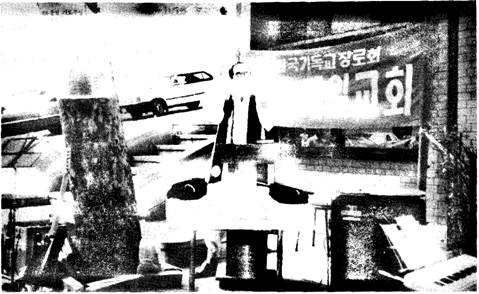
On one
Sunday the HRD group Joined a minjung church in worship, whilst on a second
Sunday the group joined the 'street church' of the congregation of Rev. Park Hyung-Kyu, a veteran activist-pastor who is famous
throughout
COMMUNITY LIFE
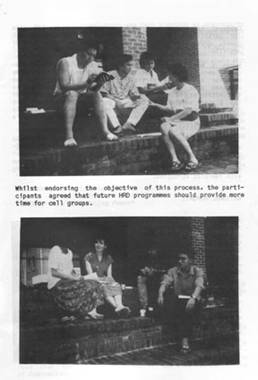
Cell Groups : An
activity implemented for the first time in an HRD programme, these groups of
four or five persons was meant to provide a place for participants to be more
open to each other and thereby build a more intimate and stronger fellowship.
However, a mid-programme evaluation of cell groups found that due to inadequate
time provided for these sessions in the programme these groups were not
successful.
19
20
Cultural Expression : Every
evening one hour was set aside for participants to share their national
cultures through games, group exercises, songs, dances and any other form of
activity.
Women & Men
Caucuses : The separate women's and men's caucuses were
intensive sessions. An instance of frivolous behavior by a male participant
during the plenary for the caucuses drew attention to the latent sexist
assumptions in the attitudes of men. This incident provoked an extension of the
plenary session over two days during which there was much frank criticism and
self-criticism. The tensions arising in the relationship between men and women
due to the women's liberation struggle were discussed.
The
women's caucus provided a place to build the sisterhood as the participants
shared their personal stories and struggles as women. In the men's caucus the
participants endeavoured to grapple with their own
oppressive attitudes (often subconscious) and shared their experiences in solidarizing with feminist struggles.
NATIONAL REPORTS
 A new method for the sharing of
country situation (as designed by the Consultation of HRD in
A new method for the sharing of
country situation (as designed by the Consultation of HRD in
21
Each
sub-regional group was then provided an opportunity to present a common report
to a plenary of the entire HRD group. Thus, there were four consecutive "sub-regional
panels". Additionally,' each sub-region could select and present a
particular country in their region which they felt was a special case requiring
the attention of the whole HRD group.
WORKSHOPS
The
final stage of the HRD programme was the time when the participants got
together on their own to reflect on their experiences and what they had learnt
during the preceding weeks and to arrive at some consensus regarding their
common concerns and vision.
An
initial open session of 'brain-storming' produced two broad themes and the
participants divided into two workshops under these themes :
WORKSHOP I: "Dominating Power"
WORKSHOP II: "Liberating Power"
REPORTS
WORKSHOP I : “Dominating Power”
What
is 'dominating power'?
Dominating
power is the capacity for a person or group to do what the holder of power
desires. It is the capacity to enforce, to dominate, to control.
The
structures of dominating power in our world:
Foreign
power (e.g. imperialism) has persisted in most countries in Asia/Pacific and has
established a form of dominance (political, economic, cultural)
in which the people are permanently trapped. This strong foreign power leads to
coalitions of power within local elites who employ state power to rule over
the masses. Asian society has also its own system of domination.
22
Apart
from these overall structures of domination, there are social groups and
minority groups who suffer double oppression e.g. women. As part of the poor
masses women suffer from the overall oppression and yet they are also victimised by patriarchy which employs racial, religious
and cultural values.
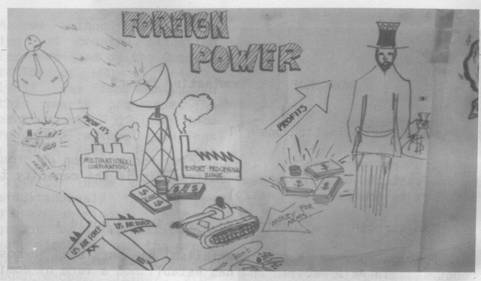
Foreign
power
: It is the system which controls the political,
economic and cultural life of underdeveloped nations to serve the interest of
an external power (a powerful nation). In the Asia/Pacific, the poorer
countries have been subject to the domination and exploitation of
Such
foreign powers support local regimes who are engaged in facilitating rapid
capitalist growth, including industrialization and the penetration of
multinational corporations. This support for local regimes is used by the
foreign powers to justify their own militarist expansion in the Asia/Pacific
region. Thus we see the maintenance of military bases of foreign powers.
23
Furthermore
the foreign powers impose the idea that their culture is superior to all other
cultures. This dominance have serious effects on third
world societies - corruption, economic crisis, civil wars, neo-colonization and
the suppression of indigenous cultures. This super power domination also tends
to divide the world into two conflicting camps s between the so-called
'democratic' and 'communist' worlds. The democratic world is regarded as
"heaven" while the communist world is considered "hell".
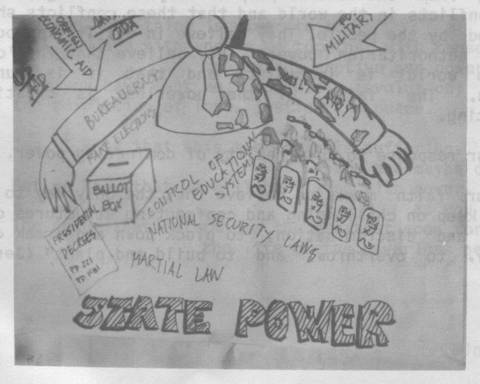
State
power
: The domination of state power in
Man
Rower
: Another form of dominant power is patriarchy.
The evolution of patriarchy has led to a male oriented and dominated social system.
The power of patriarchic structures are such that today we find difficult to
conceive of a
24
total equality of men and women. Even
women find it difficult to break loose from sexist values and change their lifestyles.
Under a patriarchic social system women have to struggle against a
discriminatory ideology, particularly in the education systems.
The
ideology of power : This is the ideology of
the powerful. They believe that their world is eternal (their values, their
"truth" and laws). They think that change will only come from
"above" (i.e. heaven) and, if change is threatened from below it
would be "evil". They say that humanity is individualistic in nature
and that people are in competition to further individual interests. They claim
that the everything in the world is in harmony and
that there is no conflict. They think that hierarchy and authority is
necessary to maintain social order.
The
powerful believe that the world is already complete and there is no room for
the transformation of society. The "faith" of the powerful is
destructive and enslaving.
The
ideology of the 'powerless' is different :
They
do not think that the world order is eternal. Because they have always been the
victims of the powerful, they want change. But they desire change from 'below'
- i.e. arising from the mass of people. They acknowledge that there are
conflicts in the world and that these conflicts should be resolved by the
people. They believe in egalitarian power and reject authoritarian power. They
believe that the 'creation of the world' is incomplete and that it is a un-ending process. The faith of the powerless is creative
and liberating.
Our response to this reality of dominating power.
Our
faith makes us believe that the only way to respond is to keep on challenging
and confronting structures of domination and discrimination; "to pluck
down and break down, to destroy, to overthrow, and to build and plant"
(Jeremiah 1:10).
25
Dear Jes!
I
wonder where you are today.
I have
heard of you when you were in
I saw
you shot to death in the
I
could smell your blood and sweat when you were wounded and trying to hide from
police in
I felt
the hunger you felt when you were with the poor and the powerless in
And I
saw the tears running down your cheek when you saw your sisters crying.
But Jes, this is all I heard, saw and felt.'
I
don't know what to do, what to think and how to act.
I
don't know if I have the strength not to hide from these cruel facts of
reality.
I
don't know if I have the will-power not only to feel with them, but also to
struggle with them.
I
don't know if I could follow in your footsteps.
Oh Jes, they are so powerful, so cruel, so strong, so heartless!
And we
are so poor, so weak, so isolated, so powerless.
But Jes, one thing is clear to me :
that
you are with and in me together with those oppressed, captive and powerless;
that
you have sent me to proclaim revolution;
the
revolution of love, justice and peace.
Jes,
I know that this task entails suffering, pain and maybe death.
But we
know that we will be filled with power, as you said.
The power that determines the greatest good for the life of
the powerless people.
Love
Minjung.
26
WORKSHOP II : "Liberating Power*
The
Workshop first defined dominating power - that which is self-centered in
interest, powerful and insensitive, and uses its power to oppress and subdue
anything or anyone opposing its actions.
Liberating
power: is given life through the suffering of the people (all those who are
poor, deprived, exploited and oppressed) at the hands of the dominant powers.
The
ministry of Jesus on earth was to the poor. He was in solidarity with the
victims; compassionate to the people; and often attacked those who considered
themselves as "mighty". Because of his life, many people have gained
a vision of liberation. As disciples of Jesus, we are called to be agents of his
mission today. This calling is for all of us, whatever our social backgrounds;
and this call persists throughout our lives.
Liberating
power is one which provides hope and works for a better future, unlike
dominating power. It acts with understanding; fighting for justice for those
groups of poor, oppressed, deprived and marginalized people. Such people gain
strength to reach their goal of justice by knowing that God lives and dies with
them in their struggle. Through our faith, we have a vision of a place of justice,
human dignity, peace, equality which we call the
However,
it should be remembered that each of us has the potential to dominate. Human
nature requires things to hold on to in order to overcome insecurity. This
often results in our domination of others as we aspire for more wealth, possessions
and power. This aspiration to dominate could be blunted by the understanding
that each of us is of worth: created equal in dignity. Experiencing the love
God enables us to love each other.
We
meet God through our experience of reality. In seeking to know the truth about
reality we seek to understand God better. This search for truth, which is the
raising of awareness, is a vital part of liberation from suffering. In the
words of Jesus: I was born and came into the world for one purpose - to speak
about the truth. Whoever belongs to the
27
truth, listens to me. (John 18:37)
Liberating
power in people's movements:
We see
the power of liberation most strongly in the many movements of oppressed people
struggling for liberation. These movements seek liberation from all systems of
oppression: political, economic, cultural, religious, ideological.
The
poor, oppressed and marginalized have to fight to first become aware of their
situation. They must see their own role in society as being of value. At the
same time they must also realise the oppression they
suffer. This realisation will motivate them to
struggle to improve their situation. They need to unite in struggle in a
single movement with common visions and objectives. This vision could be a
great one of a total transformation of society, but the movement must endeavour to achieve small steps along the way to attaining
the great goal.
It is
this liberating power that we see in the people (Minjung): the poor workers and
peasants who are organising themselves. It is the power that motivates students
and youth to join with the people for a better tomorrow - to change societies
now dominated by repressive states; states which are currently suppressing the
movements for change.
Workshop
II in presenting its report, ended its presentation with a dramatic act to
depict the human body as the world with God as the brain. The act showed that
the world has groups of people in conflict with each other but, as all parts of
the body are important to the brain, so is everyone important to God. As the
brain feels the slightest pain in the remotest part of the body, so Gad feels
for all creation.
EVALUATION AND CLOSING WORSHIP
At the
conclusion, the participants evaluated the programme. Comments and criticism
were freely made. The general consensus was that the programme was tight, nevertheless,
it was a source of motivation as participants grappled and analysed
different inputs and national situations.
28
For
most of the participants the encounter with the Korean national struggle was
enlightening as well as educative and informative. The participants felt highly motivated to return to their
movements to continue their involvement.
Closing
Warship ended with Holy Communion led by the participants.
* * * * * * * * * * *
PARTICIPANTS
Mr. Tim Connor -
Ms: Kwong Siu Kuen - HONG KONG
Ms. Pretty Lumbangaol
-
Ms. Yumiko Hiran
-
Mr. Hidefumi
Kitani -
Ms. Sawa Omon -
Mr. Yang Jai Hyuk -
Ms. Silvia Crane -
Ms. Angelina Gulrukh
Feroze -
Mr. Rudy Corro
-
Ms. Aruni Sujeeva Ranasinghe -
Mr. Wang Jung-Yi -
Mr. Duchanee
Anupong -
INTERPRETERS
Mr. Sitthipong
Kalayanee -
Ms. Yuri Yajima
-
Mr. Kim Sang Ho - KOREAN IN
RESOURCE PERSONS
Prof. Kim Chan Lak
Ms. Soh Eun Ha
Ms. Kim Hae
Rang
Rev. Kang Won Don
Rev. Lee Won Don
Mr. Hwang In-sung
Ms. Choi Nora
Rev. Park Seung
Joon
Ms. Lee Mi Kyung
29
Bishop Poulose
Mar Poulose -
Rev. Dr. Dhyanchand
Carr -
Ms. Sharon R. J. Ruiz-Duremdes -
PHILIPPINE
Dr. Chandra Muzaffar
-
Mr. Marshal Fernando -
HOST COMMITTEE
Ms. Lee Eun
Ju
Ms. Lee Chi Hyung
Ms. Kim Hyang
Gum
Mr. Kim Sug
Jin
STAFF
Ms. Yong Ting Jin
Ms. Iris Li
Mr, Lakshman
Gunasekera -
* * * * * * * * * *
A POSTSCRIPT
We place on record our sincere thanks to all those who have
supported this programme. In particular, we would like to express our deep
gratitude and appreciation to Mr. Lakshman Gunasekera for recording the entire proceedings of the
programme and helping to produce this report.
30
APPENDIX
STATEMENT BY THE WORLD STUDENT
CHRISTIAN FEDERATION ASIA-PACIFIC REGION TO THE WARD YOUTH ASSEMBLY
Dear sisters and
brothers in Christ,
The question asked two thousand years ago is still important to
us today: “Who do you say I am?” (Matt. 16 v. 15). In
our time we must ask again: who is Jesus today?
The fact that God became a human being in the person of Jesus
changes our whole understanding of life. The incarnation shows God’s love for
us. It shows that each one of us is important because we are all important to
our creator. It inspires us to love each other as we love ourselves.
In his own life, Jesus showed us how to love others. He came
that we might have life in all its fullness. Whenever the norms of society
denied people such fullness, he challenged such norms. This made his life one
of protest and resistance.
Jesus lived according to God’s will. His life proclaimed the
Jesus also called others to join this Kingdom. He calls us to
oppose all those forces which prevent people from living free and full lives.
The Kingdom is not one which we passively wait for but it is part of our lives.
It is not part of another world but it is in our world. It does not begin at
the end of the world but, it is part of our history. The coming of the
Jesus was a man who caused divisions. When we try to renew
society we confronted by those who do not want it to change. There are many
such people. Some benefit from the injustice and exploitation, and do not want
to lose these
31
benefits. Others do not receive such
benefits but are enable to see the possibilities of a better life. They may not
want to go beyond self-interest and join in a common struggle.
In Jesus’ life he came across all these people. Jesus stood for
justice and attacked people like the Pharisees who valued their own power more
than people’s happiness. Jesus challenged the ordinary people of his community
to give their lives to the service of God and their neighbours.
This led to a clear division in society between those who responded to Jesus’
call on the one side, and most of the Pharisees and their followers on the other.
“There was division among them.” (John 9 v.16)
All conflicts involve power struggles. The power the Pharisees
used was the sort of power we are all familiar with. It is the power to subdue,
to crush, to put down; the power of the State, the police, the army and the
bureaucracy. It is the power which sends innocent people to their death.
Jesus represents a different sort of power. AS
he told his disciples. “The kings of the pagans have power over their
people, and the rulers claim the title ‘Friends of the people’. But this is not
the way it is with you. Rather, the greatest one among you must be like the
youngest, and the leader must be like the servant.” (Luke 22 v.25, 26)
By his care for people, Jesus showed them that God accepted
them. This set people free from the struggle to get more personal power. Since
we know that we are loved by God, we are free from the struggle to gain
love. We are able to give love to
others. Thus we are given power to
confront worldly power. People thus empowered cannot be manipulated and therefore, cannot
be defeated. “For I am certain that nothing can separate us from his love;
neither death nor life, nor angels nor principalities, nor things present, nor
things to come, nor powers, nor height, nor depth, nor anything else in all
creation will be able to separate us from the love of God in Christ Jesus our Lord.” (Romans 8 v.38,39)
This new power is expressed in the struggle to free those who
suffer. Jesus identified with such people. Today, as he was then, Jesus is identified
with suffering people. When we respond to the needs of such people we respond
to Jesus. In his own words: “I was hungry and you fed me, thirsty and you gave
me a drink; I was a stranger and you received me in your home, naked and you
clothed me; I was sick and you took care of me; I was sick and you took care of
me, in prison and you visited me.” (Matt. 25 v.35,36)
32
Today, in our own region, do we not see the call of Jesus in
the cry of starving and malnourished people; in the outcry of the thousands of
political detainees; in the struggles of millions of exploited workers and
peasants?
Do we not also see Jesus in the powerful actions of love in
response to this call? We see him in individual acts of caring, as well as in
the organized actions by groups of people for justice and the healing of
Creation.
As followers of Jesus we share a vision of full democracy in
our countries, respect for human rights, and an end to the suppression of
people’s struggles for freedom and a better life. We seek an end to unwanted
interference in our countries by outside powers. In our commitment to peace, we
stand against the build up of armaments in our countries, and we long for the
withdrawal of all military forces of outside powers. We also do not want our
countries to economically exploit other countries.
Jesus’ death on the cross shows us the cost of such vision and
inspires us to try to love to the degree that He does. As students we are part of
a community which is developing its intellectual resources. As student
Christians we are part of a community which tries to use its intellectual
capabilities to serve God’s Kingdom. For us this learning process involves
being part of actions for justice and peace.
So in many countries of our region, for example, there are
members of the SCM praying and struggling together with exploited workers
defending the rights of oppressed ethnic groups; being imprisoned for
criticizing undemocratic rule; and campaigning for nuclear disarmament.
We see Jesus Christ in the poor and the powerless, and we seek
to build a strong movement of work in solidarity with them for justice and hope
for all people.
We, the representatives of Student Christian Movements in eleven
Asia/Pacific countries, are happy to meet other young Christians, and we hope
we can join together in our common calling.
From the participants of the Human Resources Development Programme
of the WSCF Asia-Pacific.
33