6
PATRIARCHY
AND WOMEN'S OPPRESSION
* A paper on this topic was read on the
2nd of May on behalf of Ms Nelia Sancho-Liao,
regional coordinator of the Asian Women's Human Rights Council. She pointed out
that while patriarchy and male domination are strong in many Asian traditional
societies, these have resulted in "unequal apportioning of social
afflictions with women getting the heaviest load and enduring the most vicious
and perverse forms." Many Asian governments' development thrusts have also
been most discriminatory to women. Political repression which
characterizes both authoritarian regimes and elite democracies in
WOMEN AND
MEN CAUCUSES
Separate caucuses of women and men were
held to allow freer exchange of ideas and feelings on the issue of women's
oppression and patriarchy. The exercise was specifically to find out how the
men viewed the problems and issues confronting the women
today, if they felt it was top priority to uplift the status of women,
if they agreed that women's issues needed a closer look, and if there was real
oppression of women. The women's caucus was for women to think of the top
priority to uplift them, what they saw as the major obstacle to the liberation
of women and to share in general what their views were on the issues of women.
After the caucuses a sharing of what happened in the two groups revealed the
following.
The men felt that women's issues are connected
to all other socio-economic-political problems. Therefore it must be seen
within the "broader perspective." They also felt that traditions,
culture, education and religion have been the major blocks towards the
liberation of women. Since the problem of women is also a problem of the men,
they said, there is a need to work together to eradicate the problem. One of
the men
7
participants however openly said he did not agree to all this and
to the general idea that women are oppressed. He maintained that men and women
just have their functional and role differences. He also went further by
quoting verses in the Bible to prove his point. This statement sparked a heated
argument between the men and women which was not resolved.
The women, for their part, aired their
honest feeling that men in general were hypocrites: they preached something
outside the home but practiced another thing at home. They therefore called for
more analysis of women's issues through gender, class and race perspectives.
They pointed out religions, scriptures and the religious institutions
(including the church) as instruments of oppressing women.
WORKSHOPS
ON RESOURCES FOR EMPOWERMENT
The workshops on Student Christian
Movement Empowerment were held for four days. They were facilitated by Fr.
Philippe Fanchette who used creative graphics and
participatory processes throughout the workshops.
As a way of starting off, the
participants were asked to list down the problems they were facing in their
particular contexts. These included the following: lack of leadership training;
dwindling membership; lack of organisational
strategies and tactic~;„ problem with fundamentalist
groups; problem of recruiting new members; lack of unity between the different
denominations; lack of communication; lack of resources; lack of specific
encouragement for women; lack of mobilisation for
change; problem of marginalisation; and different
viewpoints of the different SCM branches regarding various issues.
Empowerment
Fanchette then defined the word empowerment. Contrasting it
with development, he said empowerment has to do with people's power - - i.e.
people taking control of their own lives. It is generated as some kind of
movement because they want to do something about the world. However, the key to
understanding the world was to start with oneself.
8
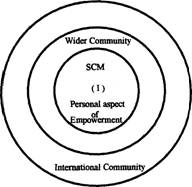
Each one is a part of society and so in
understanding ourselves, we understand society. Then it moves one to the group
to which one belongs -- for every person is not alone. We all belong to one
group or several groups -- i. e. the wider community.
Organisation Analysis Change
There are two elements of empowerment.
The first is questioning -- questioning our own culture and traditions, our
perception and understanding of things, our analysis of what is going on, etc.
One of the ways is to compare two different representations of the same
situation. For example, the map of the world according to Mercator and to Peter's projections. So we ask, who drew up the map so that we view the world in a
certain way rather than another way? The second is breaking away from set
models, from our socialized norms and schooled images of the world which we
have been taught in school.
Small Group Discussion:
1. What changes are happening around you?
2. Is there anything which shocks you and
which you can't accept? Which is against your idea and thinking?
9
Commitment
Fanchette then looked at the word commitment saying that the
starting point of commitment and action is strong feelings. It is strong
feelings about something that motivate one to commit himself
or herself to certain causes. Many movements began with strong feelings -- e.g.
the "Chipko Movement" of the women in
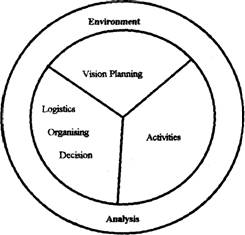
There is not one reason for joining a
movement such as the SCM but strong feelings play a very important role in
enabling one to join a group for the realization of one's dreams. Nevertheless,
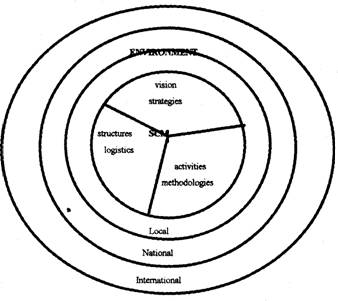
it is the common vision of a group that brings it together. It is this vision
that is then translated into action. And to effect such action, activities,
methodologies, strategies, structures and logistics are needed.
10
|
ENVIRONMENT |
SCM |
||||
|
International |
National |
Local |
Visions |
Structures |
Methodologies and
Activities |
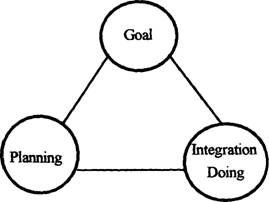
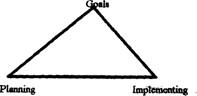
There are three factors for continued
commitment. One, we take part in fixing a goal and so are committed to
achieving it. Two, we take part in planning to achieve the goal. And three, we
take part in implementing the plan -- which is the integration of it all. They
are all linked together.
Small Group Discussion:
1.
What are your
visions?
2.
What are the
weak and strong points of your organization?
3.
What
methodologies and activities are you doing?
The Context of SCM
What is the environment in which the SCM
is working? Fanchette defined environment as all the
forces which influence both positively and negatively the work of SCM. It also
includes the things, both positive and negative, which are fast disappearing
from the community. The participants were asked to discuss what they were
doing now, what they felt would become obsolete and useless later, and what
were their projections as to what would became important in five or ten years'
time.
11
Social Analvsis
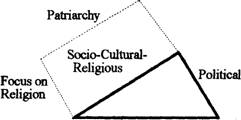
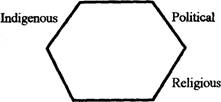
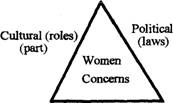
Philippe dealt with classification as a
way of analyzing situations. This involves: (a) listing down the things that
are happening around; (b) classifying them into the social, economic, political
and other aspects; and (c) seeing how they inter-relate. It also includes
asking who is doing what, who can do something against what is going on, etc.

12
In doing classification for social
analysis, each particular group can begin with those three angles, adding new
ones as the need arises, or focusing on those particular to the nature of work
of the group.
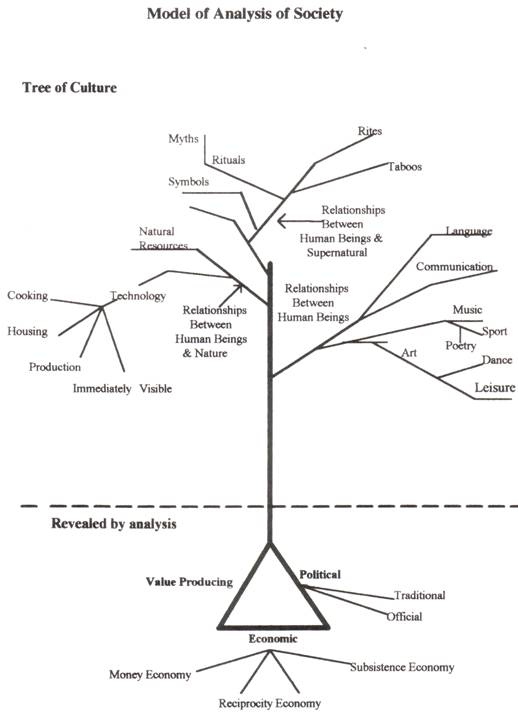
In the name of analysis, an activist can
destroy or subvert a culture by imposing his or her own model instead of
starting the analysis with the people. Analysis starts with the visible and
then goes on to the imrisible. For example, we begin
with what we see or hear -- language, customs, rituals, technologies, way of
using leisure time, dance, music and go to the less visible structures --
economic, political, social which sustain, reproduce or transform the more
visible elements -- why is English taken for granted as the dominant language? etc. Imposing a language also means imposing a different
culture, even a different social structure, in a society. (See model of
"Tree of Culture.")
Tools
for Working with the SCM
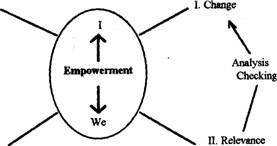
A process of empowerment must take into
account four elements: consciousness of change, relevance, problem
posing and participation dialogue. These four factors are key
to any education which is fully participatory.
(1) Change: There is a need for a sense
of history, a historical perspective, for change to happen. Peoples should be
made conscious of the changes that have been happening over a period of time.
Change does not just "happen." It is people who are the authors of
ongoing change.
(2) Relevance: Strong feelings are the
key to relevance. The people irivolved in a group or
movement bring out in the open their situation or problems or issues about
which they feel strongly. This reveals what is relevant to them. But strong
feelings alone cannot bring about change. Hence, there is a need for analysis
or cross-checking of the relevant issues and this can be done through
list-making and classifying and then by asking questions.
13
14
(3) Problem Posing: This is required in
any kind of training or empowerment. It begins with the "listening
survey" but depends on what one listens to and what type of listening team
is there is in the movement. The next step is creating a situation where
participants can reflect together. The facilitator's role is not to give
solutions but ask questions.
(4) Participation Dialogue: To check
one's own data, theories and hypothesis, it is important to interact within a
group either through dialogues, seminars, group discussions, etc.
Another aspect of empowerment is to
enable people to make their own analysis rather than wait upon others to do it
for them. Only when they can make their own analysis can they really begin to
take control of the situation and of their destiny.
15
What then is the role of a facilitator?
It is first of all to start a listening survey with a listening team which
includes both the staff and the youth together. An ideal situation of the SCM
should have 50 per cent staff and 50 per cent youth and student
representatives. This means that half of the members come from the community
and the other half from outside.
Culture has both inside and outside
perspectives. The inside perspective is from within the community either
through oral tradition or written history, which gives an identity to a
community and a sense of solidarity. But this belongingness and solidarity
within the community are not enough for the group to face change. The outside
perspective is provided by people from outside the community who raise
questions, relevant or otherwise, about certain issues.
The team should listen to all the
questions raised from an inside as well as outside perspective of the community
and then codify, represent them either by making popular theatre or plays,
films, etc. so
that the people can become more critically conscious of the problems faced by
the society/country and look for solutions which they can apply. Listening
helps create elements of learning about a community and their history,
problems, etc.
Small Group Discussion: .
* What were the latest themes on which
the SCM had worked?
* Where did you get those themes and how
relevant were they in the last two years?
* Did you choose the themes yourselves or
were they chosen by outsiders?
* Did working on these themes bring in
new members or not?
To make SCM work effective, it is
important to develop key change agents. These include the initiators who
usually are a small group of people who refuse to accept the existing situation
and envision a better one. Then there should be the supporters or people who
are supportive of change and are willing to help bring about change. There are
four other types of people needed to bring about change in the society.
16
a.
A group of
people who spread the idea and perspectives regarding change and prepare the
community, or melt and crack the community members to accept the change or
become more supple towards change.
b.
A group of
people who experiment with changing things or who can show the way.
c.
The organisers to get into the society to bring the people
together to evolve their own understanding of change. This group can be called
the implementors of change.
d.
The adopters or
people who adopt the changes -brought about by the people belonging to the
first three groups.
Discussion in Dyads:
1. What role do you play here?
2. What role is the SCM playing as a
community to bring about change?
The same people can play different roles
sometimes but most often different roles are played by different people. This
is one of the most common sources of conflicts and tensions in the movement
because very often those who play a specific role may not understand the role
played by others or because of many roles played by the same person. Therefore
it is better for different members to play different roles to minimize useless
tension and conflic within the group.
Work for change begins with a vision, and
from the vision we set our priorities. Once we start acting on the priorities
we find resources.
17
as well as obstacles. Possibility of conflict arises in
an organisation when people join the group at the
envisioning stage of it and then as they set the priorities to realise that vision many more would join. The people who
join a movement with some vision and set the priorities are the core people of
the organisation. Others join for either a particular
interest or activity, or to realise an objective and
afterwards leave the movement.
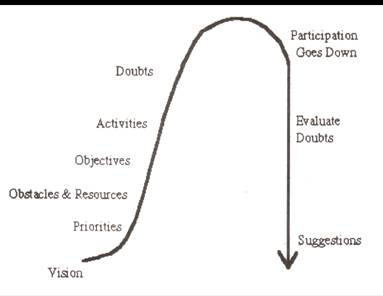
For any organisation
to work smoothly, there is a need to clarify doubts
regarding certain issues as soon as they arise. If doubts are not cleared
people may get frustrated and leave the organisation/
movement. Hence, the movement goes down as the participation decreases.
Therefore the staff members of the movement should always bring out the doubts
on the table for discussion and evaluation.
In evaluating doubts, there should be
more participation of the people/members. Evaluation involves examining their
objectives and activities. Doubts can be regarding priorities, too. After
examining the priorities they may also re-examine their vision. In a way,
doubts help a group re-examine itself through its priorities, objectives,
visions, etc. to make doubly sure if they are relevant.
Having done evaluation of doubts and
re-examination of the
18
whole structure of the movement, suggestions for action
should be welcome. From the suggestions, members make decisions as to the
priorities, who should do what, when and how. Here
members make decisions only if they are prepared to pay a price.
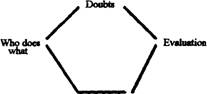
Planning is therefore an ongoing activity
which may even start with or arise from the doubts. This is known as the
"commitment cycle" - - the inter-relation between doubts, evaluation,
suggestion, choices and decision-making. But feedback is the most important
part of planning.
Commitment Cycle
Small Group Discussion:
What is the major doubt of the SCM
members in your respective countries today? Or what is the issue under attack
by the SCM members in your respective countries today?