64
Session 1 – Introduction to Conflict Transformation
I.
Introduction
Why conflict transformation
Discuss statistics in Diagram 1
· What could be some of the reasons
that Asia-Pacific accounts for almost one-third of all the armed conflicts in
the world?
· Where are some of
the hot spots in
Definitions
and terminologies
|
Exercise 1: Define
peace, justice in your own mother tongue. If
possible, give examples of how the words are used. *
Small group discussion (15 minutes) *
Report to plenary (15 minutes) *Select some of the words on peace in
different language to make the song “Pray for the Peace of Community” |
What is conflict?
(Open exploratory discussions with the group using diagrams at the end
of the section)
• Different types of conflict.
65
Why is it a negative word?
Does àß represent conflict?
Does ß à represent non-conflict?
What is the opposite of conflict?
• What are its causes? (Diagram 2)
immediate – triggered by a certain event or action
underlying – pre-existing conditions and situations
• What are its dynamics?
Issues involved in conflict: resources, ideology, religion, identity,
• How do conflicts develop? (Diagram 3)
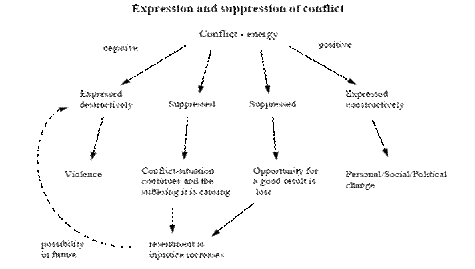
• Is conflict always destructive? (Diagram 4)
• How can conflict be resolved?
• what does the `peaceful resolution' of a
conflict entail? (Diagram 5)
What is peace?
Hot-peace
Hot-peace is defined as
the absence of war or direct physical violence; it is a condition in which
armies are not engaged in violence against foreigners or against people at
home.
Just-peace
This is a much more
comprehensive concept, including the absence of direct physical violence but
adding to this the absence of indirect forms of harm such as structural
violence, and including the presence of social values and institutions which
positively maintain a state of peace. It is peace in this much fuller, more
complex sense that is implied by the concept of conflict transformation. This
can be understood by examining several other meanings of the term peace:
Working with Conflict…
Conflict Management-realistic approach – conflict cannot be removed but can be
managed through force or legislation, etc. (e.g. Malaysian New Economic Policy)
Conflict Resolution– working to have conflicting parties to compromise and
66
changing their positions (e.g.
Management-union negotiations)
Conflict Transformation seeks out the root cause of the conflict by studying
the history and culture of the conflict. (e.g.
religious and ethnic based conflicts is difficult to manage or resolve because
of long historical and cultural and doctrinal roots. Such conflicts need to be
transformed into more positive)
Transformation is a particular approach which aims to recognise
the grievances, needs and issues of all the parties. It focuses on the
processes by which conflict develops into violence, rather than focusing
exclusively on how to bring a violent conflict quickly to a ceasefire or
settlement. It addresses the structural reality of inequality, rights and
injustice in the society(ies)
involved, and offers alternative ways of addressing those realities. This
approach aims to transform a conflict from violence and destruction into a
constructive force which produces social change, progressively removing or at
least reducing the conditions from which the conflict and violence have arisen.
The peace which develops can then be well-founded and sustainable.
Sustainability depends on changing the structural conditions which gave
rise to the conflict, and on discovering that those changes can be achieved
without violence. For peace to be sustainable, effective means of managing
conflict non-violently must be rooted in the social structure, in the form of
strong civil institutions, the rule of law and impartiality of police and
judiciary, representative government and effective participation of the people
in public life, for example.
|
Exercise 2: Tell
stories of how conflict is being dealt with in your own communities. What are
the traditional wisdoms and laws being practiced in your cultures? * Share
in small groups (15 minutes) *
Report to the plenary. (15 minutes) |
A Holistic Vision of Peace Education
The importance of developing peace education in all contexts
Peace education needs to be created through multiple levels and contexts.
67
In other
words, it is a vision, a process, and a struggle that needs to happen
simultaneously in all dimensions of life.
Peaceful pedagogy
The values and skills of critical and creative
thinking need to be promoted throughout the educational process. This should be
empowering for everyone, with teachers seeing themselves equally as learners.
One of the main pedagogical challenges is to develop the capacity, the will and
the courage for responsible and deep democratic action.
Transcending cycles of violence and counter-violence
People need to understand the root causes of the cycles of violence and
counter-violence in order to truly resolve them by getting out of these cycles.
The great need to dismantle “globalisation
from above” and to build “globalisation from below”
Current trends of “globalisation from above” need to
be countered and are being resisted by “globalisation
from below”. Many grassroots people’s struggles for development are relying on indigenous
knowledge and resources, so that people can have the space to make their own
histories rather than being squeezed and contained by the debt trap, and by
economic decisions about what they can grow or should not grow.
Critical empowerment and how we move
from despair to hopefulness
Thinking and
learning about all the conflicts and problems of the world is overwhelming. The
challenge is to move from critical thinking to empowerment, in order to take
constructive and courageous actions and practices. Here, we need focus on the
stories that evoke tears, empathy, outrage and joy. These stories reflect the
many incredible examples of people at the grassroots: the rural people, the
urban poor, the women, the indigenous peoples, the street children, the child
workers, and the migrant workers, who are organising and mobilising
for justice, human rights and sustainability, despite many obstacles. We don’t
hear about them because the media do not tell us about them. We have to search
for them, and this one for the advantages of information technology.
68
The need to build national and global civil society
The role of civil society is at a very
crucial and momentous point in human history. We are seeing that ordinary
people can organise themselves to think about issues
critically and to challenge, where appropriate, policies that re handed down by
their governments and by the powerful organisations
of the world; they are finding ways to access information and to network for
the purpose of deliberating about existing laws and institutions, and are
finding ways of holding organisations accountable for
their actions it is possible to build a global civic culture and a sense of
global citizenship.
Global solidarity
The work of building and educating for
a culture of peace all over the world needs global solidarity. We need to make
links across borders and regions, because the root causes of many forms of
violence originate outside for the places concerned. There are, of course,
local causes, but there are also global root causes, so this needs to be worked
on at the global level.
Healing and reconciliation
Where there are divisions and conflicts,
we need active, nonviolent healing and reconciliation. Given that the root
causes of conflicts are structural, conflict resolution needs to deal with
structural changes and transformation as well.
Spirituality
In educating for a
culture of peace through formal or non formal education programs, it is crucial
to reawaken the values, virtues, principles
and wisdoms for peace and nonviolence that are present in all civilizations and
in all groups of people, in all parts of the world. In relation to values
such as compassion, justice, love, sharing and forgiveness, different
civilizations, faiths and spirituality traditions may use different words.
Nevertheless, when we dialogue about it, we see that there are really no
differences. At the same time, of course, we need to be aware of, and be
willing to acknowledge, the contradictions that can happen within the theory
and practice of faiths and broader civilizations.
69
Diagram 1

|
Diagram 2 |
Causes of Conflict
|
|
|
|
|
|
|


70
|
Diagram
3 |
|
|

|
Diagram 4 |
|
|

71
|
Diagram 5 |
|
|
72
Session 2 – Seeking common ground
1. Acknowledging our differences
|
Exercise 1: Web of Connections or Barriers of Differences
Individually – 10
minutes Group of 4 – 10
minutes Whole group – 20
minutes 1. Construct your "Personal Web of Connections" using
the diagram provided on the next page. 2. Begin by writing your name in the center circle. 3. In the small circles, write the names of 5 groups with
which you personally identify. Refer to the list provided below the web
diagram to help you. You may add extra circles if you wish. 4. Take turns describing your web diagram to the members
of your group. You should address the questions below: ·
Was there a time when you were very proud to be a member of a certain
group (circle)? ·
Was there a time when you felt marginalised
or discriminated against because you belonged to a certain group (circle)? ·
Have you felt both pride and discrimination because of your membership
in any of these circles? ·
What is one thing you wish people would never say about one of your
groups? ·
Can you think of factors within yourself or your society that might
lead you to discriminate against others? To what extent are these factors
within your control? To what extent are they embedded in society? ·
What would you have to do to change society and/or yourself to change
discriminatory behavior, e.g., behaviour towards
people of other faiths? 5. Do you and members of your group share a similar
circle? If so, 73 write
your name in the other group member's or members' matching circle. Ensure that you share a similar understanding of the
meaning of the category you have in common. You may also want to alter the name of a category that you
have in common so that the names are the same. |
A critical step in
developing the capacity to understand conflict is to examine our personal
notions of rights and values. We often assume that our own viewpoints and
priorities are shared by everyone, and we rarely find the time in the crisis
situations in which we work to reflect on these basic assumptions.
Each of us must
recognize that our understanding of how things should work is based on a
personal value system, which reflects the culture and
region from which we come, as well as our experience in the many different
circles of identity, such as gender, class, religion, and family status, to
which we belong. If we are not aware of our own assumptions, we may presume
that we can speak on behalf of everyone. If we are unaware of how diversity
affects human interactions, we may fail both to appreciate its potential
richness and anticipate its inherent problems.
Only by acknowledging
our differences can we find common ground on which to work together.
Within any group there
is as much invisible diversity as visible diversity. Differences, whether
minute or great should be viewed as a resource rather than a hindrance or an
obstacle. To know each other in our diversities requires working at becoming
aware of significant "invisible" territory. The Web of Connections
activity provides us with the opportunity to acknowledge the diversity or
multiplicity within ourselves and others, and to explore how to deal
productively with multiplicity. The activity also invites us to explore how our
circles of identity can affect or inform our perspective or action in different
situations.
74

|
Some
circles might be: |
|
|
Religion Ethnicity/race Gender Age Social
status Profession Caste |
Belief/ideology Abortion
- yes/no Capital
punishment - yes/no Sexual
orientation Ban
pornography - yes/no Ban
prostitution - yes/no Most
important ingredient for peace Special
status for certain people - yes/no Main
cause for poverty Violence
- yes/no |
2. Understanding the other
|
Exercise 2: Town
Planning i)
Rules and directions a. Form groups of 3s or 4s b. Hold one pen or pencil together in such a
way that everyone is able both to write and draw with it. c. On the given
piece of paper, everyone should participate together in drawing a layout plan
of a small town and when drawing is completed, label the different parts of
your own drawing. 75 d. All keep silent during the drawing and
writing ii)
Discussion e. Next, each group who have drawn together,
sit together for about 10 minutes and discuss: i. What were your feelings and reaction
during the exercise? ii. What helped you and hindered you during
the exercise? f. Next, two groups come together to form a
larger group and discuss: "How
does this relate to our life and work together now?" Discuss this for
about 15 minutes and then share in the whole group. |
Lessons from this exercise:
Sometimes we think we are working
with other people, when in fact we are controlling the whole process without
realising it.
In the process of trying to execute our own ideas we often become
insensitive to the others.
Session 3 – Role of youth and student movements
|
Exercise 1: Dividing
17 camels. Long
ago, an old Bedouin died and left an inheritance to his three grown sons. His
will stated specifically that his first son should get half of his estate,
his second son should get a third, his third son should get a ninth.
Unfortunately, the man's entire estate consisted of 17 camels, so that the
division could not be made without slaughtering at least one of them, which
none of the sons wanted to do. Can
you help the three sons resolve their dispute? |
|
Exercise
2: The
Fish Head There
was once a young man who had to leave his home to seek work in another city.
While he was away, his young bride lived with his mother 76 in a small house. After being away for almost a year, the young man
returns home for a visit. There was much excitement in the house and a big
feast was prepared to welcome home the husband. However, during dinner, the
son noticed that his mother was not eating and there were signs that she was
unhappy. After dinner, the son went to his mother’s room to find out what’s
wrong. The mother brought out a bottle full of small stones and showed it to
her son and said “All these time while you were away, I have been mistreated
by your wife. Whenever we had fish, your wife would eat the body and I would
be given the head. Inside each fish head is a small stone and I have saved
all these stones as a proof that I have had nothing to eat but fish heads.” This
is a classic story of mother-in-law versus daughter-in-law. Discuss how this
young man could balance his role as a loving son and faithful husband. |
Lessons from this exercise:
· Neither the camels nor the fish head
should be the focus
· For effective mediation, the role of
the mediator must be accepted
· It is possible for solutions to come
from outside the context
· Most of the solutions suggested are
possible – only that all parties need to agree and abide by them.
Etc. etc.
|
Exercise 3: Read
the story below and answer these questions: Who
are the most and least honourable characters and
why? Who
are the most and least powerful characters why? *
Work in pairs (5 minutes) *
Work in groups of 3-pairs (10 minutes) *
Sharing at plenary (20 minutes) The Fatal River Story Once
upon a time, a young woman named Leit and a young
man named Han lived on either side of a great river that ran wide and swift
and deep. They met when their villages came together for fairs and 77 festivals, and soon they fell deeply in love and promised
themselves to each other in marriage. One
night Leit received a message from Han's family
"Come at once. Han is gravely ill and may not live. He is asking for
you." However, that same night a terrible storm washed away the bridge
that connected the two villages so that Leit could
not cross. Greatly
upset, Leit went to ask Roni,
who owned the only power boat in her village, to carry her across the river.
He agreed but only on one condition: she must go to bed with him. She angrily
refused. Leit went to her friend Anik to
explain her dilemma, but Anik did not want to be involved
in her dilemma and would not offer her advice. Desperate
to reach Han, Leit felt her only choice was to
accept Roni's terms. She fulfilled her part of the
bargain with Roni, who then delivered her safely on
the opposite shore that very night. When
Leit finally reached Han, she found his condition
had greatly improved, and in a few days she was able to tell him about the
hardships she experienced to reach him. When Han heard what Leit had done, he cast her aside, declaring he would
never marry such a woman. Heartbroken
Leit returned to her village. She turned to her
older brother Raon with the story, and in anger he
gathered a group of her male cousins. They laid a trap for Han and beat him
severely. When
she heard about the beating, Leit laughed. |
Further discussions
for the plenary.
Discuss the experience of coming to consensus.
· Did anyone find that they changed
their minds as a result of discussion? Why?
· Were any groups of four unable to
achieve consensus? What factors prevented consensus?
78
· What were the principal shared
values that shaped consensus?
· What were the principal differences
of opinion that made consensus impossible?
The following questions focus more specifically on the gender dimension
of the story.
·
Would
you change your opinion about who is honourable or
powerful in the story if Leit were a man and Han and Roni were women? If yes, why?
·
Do
terms like justice, honesty, power, or honour have
different meanings when applied to men or women?
·
How
do factors like culture, tradition, law, belief, and perception of justice
affect one’s judgment in this story?
NGO in peace building
The NGO sector cannot ‘mediate with muscle’ nor can it enforce solutions
to problems. Its strength lies in other areas. It has flexibility, and an
ability to respond to human suffering without being politically constrained.
In relation to the transformation of violence and the promotion of just
peace it can forge partnerships with locals in conflict zones and respond to
the immediate suffering while catalysing discussions
& dialogues with those in conflict about ways in which they might resolve
their differences, solve their problems and satisfy their human needs. It can
and does use its micro knowledge to try and influence the macro policy
decisions of donors and multilateral organisations in
relation to economic development and decisions about promoting human security.
Sometimes the NGO role is catalytic, facilitating communications between
conflicting parties. Other times its role is much more analytical and the
processes much more deliberate and prescriptive (e.g. as in interactive problem
solving workshops). In all of these activities the basic aim, however, is the
same. Most conflict transformation NGOs/academics seek to build on
79
the
unifiers rather than the dividers in society on the assumption that strong and
resilient communities are the fundamental pre-requisites for human existence
and security.
It is clear, however, from preceding arguments, that resilient and
tolerant communities are a necessary but not a sufficient condition for
conflict transformation and just peace. Because of their dispersed and
fragmented character, communities have difficulty mounting effective or
sustained critiques of organised economic and political power. In those areas,
however, where economic and political power is itself disorganised
a little community organisation can be highly
effective.
In order for the well intentioned, altruistic aspirations of
humanitarian NGOs to realize their purpose there is a much greater need to have
clear and coherent strategies which are linked much more deliberately and
explicitly to other official and unofficial Tracks. The challenge facing all
those concerned to find effective ways of dealing with violent conflicts and
promoting just and sustainable peaceful relationships in conflict zones is that
of sharing analyses, communicating these to all relevant actors, and seeking
higher levels of synergy between all peacebuilding
actors.
To develop better analytic and effective peacebuilding
processes, it is absolutely essential that there be a process of radical and
critical dialogue between the development and conflict transformation
communities since neither can deliver stable and lasting peace acting alone and
neither can resolve the differences between themselves by subsuming the
interests of one in the other. In other words, it is not just a question of
adding a development or justice dimension to conflict transformation work or a
conflict transformation perspective to development and justice work. Rather
development and conflict transformation theorists need to sit down with each
other in order to identify the comparative analytic and process advantages of
both perspectives and ways in which the theoretical and practical contributions
of each might be enhanced. This might produce contributions that are more
informed and wiser thereby aiding individuals, organisations
and movements working for social and political change, structural stability and
stable peace.
80
The task that conflict transformers and development specialists set
themselves in trying to transform violent relationships while helping catalyse processes aimed at challenging structural violence
and injustice is a formidable one. The challenge is nothing less than that of
devising ways and means of empowering citizens and societies so that they can
transform violent relationships while ensuring that economic, political and
social institutions are developed and or changed (when they are demonstrably
incapable of achieving their purposes) in order to minimize the prospects of
violence in future and to guarantee these processes through time.
To do this effectively, it is paramount that there be more hard headed
discussions between development and conflict transformation specialists about
ways in which some negative economic processes such as neo-patrimonialism,
or clientelist political networks (which benefit
certain groups and disadvantage others) can be challenged and changed. These
distorted economic processes generate malign social and political outcomes
which increase frustrations and thus dispose those in power to consolidate
their increasingly untenable positions by violent means or force marginal
groups to consider violent options. Too little attention is devoted to these
issues in most conflict transformation activities.
To facilitate such discussions, however, requires higher levels of
collaboration between development experts and conflict resolvers
than exists at the present moment. Instead of leaving such issues to the World
Bank or bilateral donors, it is vital to incorporate civil society stakeholders
as well because this will help focus attention on who is included and who
excluded from the allocation of scarce national resources. How to place such
issues on the negotiating agendas so that they can be talked through and
discussed is the central challenge facing those seeking not only to stop the
violence but also to generate a just and lasting peace.
Although reducing fear, building trust and restoring confidence are all
critical elements of any move towards a cessation of violence, they are not
sufficient. This requires a much more active politicisation
of the Track II conflict resolution process but it requires a different kind of
politics as well. It de-
81
mands a less adversarial problem solving orientation to
politics. Perhaps this is the major contribution that the conflict resolution
community can make to transform corrupt deficient state systems. It can begin modelling political processes which are collaborative
rather than competitive, unconditionally constructive rather than adversarial
and where the interests of all are placed at the heart of the political
process. This may sound rather utopian but it is essentially where most of the
major development donors are moving.
|
Exercise 4: 1.
Role of NGOs, Youth and Student movements ·
conflict prevention ·
conflict transformation 2,
Entry points for the SCMs in peace building and conflict transformation: ·
School ·
Community ·
Church |