121
EXPOSURE
23 – 28 September 2003
GROUP A “
A.
Exposure Schedule
|
Day and Date |
Place Visited |
|
a. Tuesday, Sept 23 |
1. 2. 3. COPA (Community
Organisation of People in Action) Homeless People in |
|
Wednesday, Sept 24 |
1. Ban 2. Forum 3. Thai Volunteer
Service: -
Foundation for Ecological Recovery -
Thai Action Committee for Democracy in |
|
b. MAE SOT Thursday, Sept 25 |
1. Orientation 2. KYO (Karen Youth
Organisation) |
|
Friday, Sept 26 |
1.
Mae La Camp – Refugee Camp -
-
Further Study Program 2. Home Stay –
Karen Family |
|
Saturday, Sept 27 |
1.
Dr. Cynthia’s Clinic – Burma Migrant Workers 2.
FKTU (Federation of Karen Trade Union) |
|
Sunday, Sept 28 |
1. Burma Issues Office Mae
sot Branch 2. Sunday Worship – |
122
B.
Exposure
Description
Bangkok
1.
Student Federation in
Aim: To
advocate democracy and social justice for people in
2.
COPA – Local Community Programme for Homeless People
Aim:
re-habitation programme for homeless people. The basic needs are food, shelter
and clothes. The pilot project of COPA is to provide shelter to the homeless
people in
3.
Ban
Aim: To
understand and learn the struggles of the Muslim Community who are threatened
by the loss of livelihood and land due to the construction of a wastewater
treatment plant next to the community’s village. Ban
4.
Forum
Aim: To raise
the Human Rights issues with 2 sections of activity that includes advocacy and
capacity building.
123
5.
Dr. Cynthia’s Clinic – Health Care for Burmese people in
Aim: To
provide free health care to Burmese people who could not afford Thai hospitals.
The clinic does not discriminate ethnic or occupational background, and among
those who came to seek medical treatment are Burmese, Karen people, migrant
workers, soldiers, etc.
6.
Foundation for Ecological Recovery – Environment Issues in
Aim: To
change the state policy regarding ecological issues. The 3 major issues for
change are water, forest/land and energy. Some of the main activities done by
this Foundation are monitoring, encourage local communities to participate
actively in the environmental issues that affect them, building up network
between local community and NGOs, and educational campaigns.
Mae-Sot Exposure
1. The
aims of this exposure for the participants are:
·
To gather more experience on the practical situation of
Karen People and Refugees
·
Listen, see, feel the community’s (especially the Karen
community) struggle in life
·
See and learn the real realities (practical situation) in
the society (compare theory and practice) in order to get a deeper
understanding and sharpen analysis and awareness on our own social context (knowing
– understanding – idea – actions)
·
To understand the why and how of ecumenical
leadership that could be practised (the three important ways of non violence,
democracy and self reflection)
2. A Short Karen History
The Karens
came from
124
ple to become Christians
and thousands of them became Christian at that time. In 1850 British occupied
the whole
In 1881, the
Karen National Association was formed under the leadership of Ji Tam Ya. In
1945, the British reoccupied
1.
Give us
2.
Show Karen Burmese one Kyat (equality)
3.
We do not want Civil War (Peace)
4.
We do not want Communal Classes (unity)
In 1949, the
Karen people took up arms for the revolution in
1.
To establish the Karen Federal Union that is based on
legitimate, executive and judicial powers
2.
Equal rights (human rights)
3.
Self determination
4.
Democracy
In 1962 a
military coup (that nationalised everything and rid all the foreigners) took
place. In 1988, a huge demonstration for democracy took place and in 1992 the
Manneplaw Agreement was acknowledged. This agreement aimed for peace and
justice for the ethnic groups which focused on self determination and against
Burmese Government on human right abuses. But in fact the military (SLORC/SPDC)
has total control on all the things in
125
|
Name of Organisation |
Focus |
Aim |
Objectives |
Activities |
|
( |
Karen Issues (IDPs) |
To bring a true and lasting peace to |
||
|
TACDB |
Local |
To deal with government and do research regarding
ecological issues |
||
|
KYO |
Education and leadership |
Building leadership through formation and educated
young people |
To empower young people actively share the current and future
livelihoods |
Conduct Training in politics,
leadership, management, Human Rights, Community Development, publications,
weaving projects, anti-drug education activities, sport activities, etc. |
|
|
Education |
To give provide education |
|
4 years of academic study in
subjects such as Theology, English, Social Politics, History, Education and
Economics |
|
FSP (Further Study
Program) |
Education |
To provide further education to students inside the
refugee camp as a preparation to enter University |
|
4 levels of academic study in 3
years’ time with subjects such as English and Vocational Training (eg.
agriculture, sewing and mechanics). |
|
FTUK |
Human Rights for IDPs and migrant
workers |
Safe guarding workers’ rights for job security;
promoting solidarity among workers |
Raising qualification of workers and assist the Karen people struggle
for democracy, Human Rights and ethnic rights in |
|
126
Rights such
as assess to food, shelter, clothing as well as health and other fundamental
rights).
3.
Organisations and Grass roots that are working on the Human Rights for Karen
people
The Conclusion:
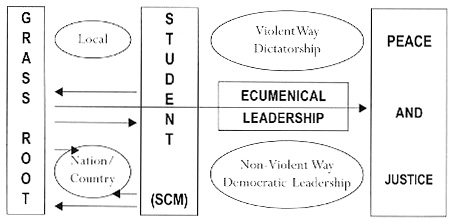
Group’s
Comment:
a.
Action Plan
Ø Sharing the real ethnic
(Karen) situation with our own SCM as well as with our own community
Ø Keeping in touch with
them through email and magazine (WSCF news letter, etc)
b.
Suggestions
Ø Open a SCM unit in Mae
Sot area with Karen Students and Youths
Ø WSCF organises one/two
days seminar with Karen students
Ø Send one/two interns in
Mae Sot to work with them
GROUP B “Bangkok
A. Exposure
Schedule
|
Day and Date |
Place Visited |
|
a.
Tuesday, Sept 23 |
1. 2. Thai Volunteer Service |
|
Wednesday, Sept 24 |
1. Foundation for Women 2. Committee for Asian Women 3. Media Reform |
|
b.
KUT CHUM Sept 25 - 28 |
San Ti |
127
B. Exposure
Description
1.
2.
Thai Volunteer Service – This service is set up in 1980 with
the agreement of 19 NGOs to set up a supporting organisation to promote closer
cooperation and coordination of the social development programmes of NGOs. Not
only will this closer cooperation and coordination increase the effectiveness
of Thai NGOs to develop sound strategies for the social movement, it also
recruit and train young people as part-time or full-time volunteers to the
social development programmes run by the NGOs.
3.
Duang Prateep Foundation – This Foundation works for the
slum communities in
128
became more crowded and
have insufficient and un-hygienic facilities. The slums are not legally
recognised by the government and because of this, the slum dwellers have no
legal rights to this accommodation and they could also be evicted anytime. The
Foundation provides support such as kindergartens, aid for the elderly and
children, and Aids Control project etc.
4.
Foundation for Women – Set up in 1984, the Foundation first
established a Women’s Information Centre providing service to Thai women who
were going abroad as migrant workers. In 1986, the Foundation opened a women’s
shelter for women embroiled in domestic violence. 2 years later, the activities
expanded into a village-based education project that seek to inform people
especially women about the sex industry in order to give women an informed
choice and counter the activities of the recruiters. The village-based project
works with women and children in the North and North-east areas of
5.
Committee for Asian Women – This Committee works on the
issue of women workers in the Asian region. Women workers are always bearing
the brunt of low pay, easy target for firing, limited opportunities for
promotion and un-favourable working conditions etc. The Committee works with
various unions for women workers in the Asian region to provide training and
education on their rights, documentation of women workers’ working conditions,
initiating workers’ rights appeals and publications on women workers etc.
6.
Media Reform – This is an NGO that monitors and critique of
the abuses made by the Thai government on the mass media. Media Reform
campaigns against un-fair and un-just media control by the government which has
not been keen in media freedom recently. The NGO also provides training and
education to the masses on the need for media freedom and democracy.
Kut Chum
Exposure - San Ti Sook
Village
San Ti Sook village is located in the
129
from
This village is one of the first to introduce their
own currency into the community, and of course face many problems from the
authorities with this introduction. The objective of issuing their own currency
is to increase self-reliance so as to lower the dependence on the external
markets. It is to reduce the flow of money (Thai Baht) and other resources out
of the village. By reducing the out-flow of Baht, the villagers are able to
save the remaining Baht for essentials such as electricity, water, school fees
for the children and tools for the farms. By having their own currency exchange
that purely serves as a circulation medium among the villagers to exchange good
and products, it encourages more local production and consumption in a more
sustainable manner, and also promotes the indigenous knowledge and wisdom such
as organic farming, use of traditional herbal medicine and medical care, and
understanding of basic and necessary needs, etc. Because of the constant
exchanges and self-reliant attitude, the villagers have more opportunities to
meet and discuss on the well-being of the village, this helps the villagers to
foster closer ties with each other and this enhances the community’s unity.
How the Bia (local currency) and Baht works in San Ti
The people can purchased Bia without interest but one
should be a member of the local currency group in the village in order to make a
purchase. Being a member of the group means that one can use and accept Bia in
trades of any product that was produced inside the community or as a service
payment. In this sense the dependency on the Baht is decreased.
By using the national currency, Baht, the people are
forced to follow the flow of the national market, in which people’s products
and labour are sold cheaply. That is the reason why, in many cases, the farmers
cannot eat or
130
afford to buy their own products. It is the same with the labourers
because the market dictates the price for distribution. Having a deep
understanding in this matter gives the villagers the idea to establish their
own market in which the concept of “Barter Trade” is somehow applied. But in
order to establish their own market the community should be self-reliant. As
much as possible the community should produce all their basic needs and should
minimize consumption from outside. Being self-reliant means to develop the
community’s potential to provide the basic needs of the village such as
medicine, clothes and food. These things had made a lot of changes to the
village. Commercial medicines was replace by herbal medicines, farm products is
now available and produced for the community’s consumption.
Exposure Sharing by group members
The members
appreciate the villagers’ courage, determination, willingness and unity to
overcome the problems in the village. The villagers were determined to seek an
alternative way of challenging the economic system that has driven a lot of money
out of the village and created many debts for the villagers as well. The local
currency system that was taken up by the villagers helped to encourage their
mindfulness in being self-sufficient and decreasing the dependency on the Baht
for unnecessary material consumption, instead focuses on having the necessities
in life. The high level of organising that was found in the village inspired
the members to empower themselves to think and seek for alternative ways in
resolving the problems in their own communities.
However, as
San Ti Sook is situated far away from the urban city, the impact of
globalisation and the invasion of Multi-National Corporations have not been too
visible, hence, the local currency system could still work in the village.
Unlike in some countries such as