152
“School for Ecumenical Leadership Formation (SELF) 2003”
Background
For a
long time, the WSCF has actively involved and contributed to ecumenical
movement through producing the much needed leadership in continuing and
fulfilling the spirit of ecumenism. The
importance of upholding ecumenism could be seen in its relation to holistic and
encompassing attitudes embraced by the elements of a Christian faith, that is,
peace, love, justice, freedom and equality.
Should ecumenism be perceived as a redundant element in the Christian
faith, the possibility of a surge in religious fundamentalism would likely to
be on the rise.
Hence
WSCF believes in the importance to uphold ecumenism through the tradition of
producing ecumenical leadership in movement.
However, this tradition is seen to be weakening at the present moment
due to several reasons. One of the main
reasons is that the ecumenical student and youth organisations are unable to
provide a challenging platform for the young people to receive the appropriate
training, knowledge, skills and network to improve themselves as qualified
ecumenical leaders.
It is
without doubt that the void in ecumenical leadership would definitely weaken
the ecumenical movement and could even cause the possible breakdown of the
whole movement.
Thus,
it is in this light that the idea of SELF was jointly developed by WSCF-AP
region and Christian Conference of Asia Youth Desk (however, in the year 2003,
SELF will be organised by WSCF-AP alone due to some logistical matters).
The
SELF is a response to what was seen as a lacking in ecumenical leadership. It hopes to re-examine the causes of
weakening and re-develop the scope of ecumenical leadership.
The
first SELF was organised in July, 2001 inviting 28 participants from the
region. As a bi-annual leadership
development project, the SELF targets second-line leaders aged between
23-29.
153
Objectives
Generally, this training project seeks to enable participants to:
· Sharpen their awareness and analysis
of Asian society and challenge to the churches through sharing of experiences,
exposure, studies and reflections.
· Study the biblical-theological
perspectives on ecumenism and on issues and ideologies related to
· Trace the history of ecumenical
movement in the national, Asian and global levels, identifying convergence,
challenges and possibilities.
· Search alternative approach to
communicate and advocate ecumenical witness among students and youth in the
concrete life of the peoples.
· Strengthen each other in their
ecumenical journey and aspiration.
An outline of the SELF module
Module 1: Orientation
Aims:
To be able to introduce participants themselves and have a sense of being part
of the group. Understanding the background and the organizers and to start
building community.
§ Introduction of participants
§ Introduction of WSCF-AP
§
Module 2: Defining our times
Aims: To have more critical understanding about the reality of Asian
plurality and the dynamic and complexity of such context.
§ Understanding host country and
Exposure
§ Personal history as Social history
§ Analysis of socio-political and
economic setting of
Module
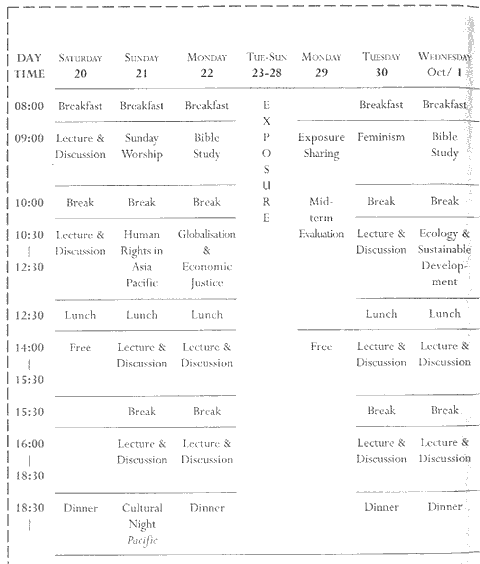
3: Reading the signs of the times
Aims: This is an intensive study module to clarify current theological
positions dealing with the context of
154
theoretical
as well as theological base. It also aims to challenge participants to doing
theology in context.
§ Politics, Ecology, Human rights,
Feminism, Inter-faith dialogue and actions
§ Globalisation and economic justice
Module
4: The ecumenical movement and Inter-faith dialogue
Aims:
To understand and challenge the prevalent practices and ideology in the
ecumenical movement in
§ An overview of ecumenical movement:
past and present
§ Problematizing the understanding and
perspectives of ecumenical movement
§ Understanding the
inter-faith-dialogue
Module
5: New Alternatives
Aims:
To set guiding principles for promoting ecumenical vision to the students and
youth and experiment the different forms of building and strengthening this
communication in order to “act locally”.
All participants will be asked to come up with new visions and
alternatives to challenge critically the ecumenical movements, particularly
from the youth and student perspective.
Module
6: Reflexive Learning
Aims:
To wrap up this extended training program by reflections on what the
participants have learned and to suggest ways to moving forward in challenging
the ecumenical movement, be it local, regional and global.
§ Articles writing on certain issues,
topics or possible actions and work plans.
Summary
Module
1&2: 3 days
Module
3: 2 days
Module
3: 12 days
Module
4: 2 days
Module
5&6: 4 days
Traveling:
2days
Total: 25 days
155

156
157

158
Participant List
Mr. Sandeep Pramanik
C/O Bart Hardar
27, Gobra Gorasthan Road
Calculta – 700 046
West Bengal, India
Ms. Vanda Lengkong
Jl. Stadion Klabat No. 43 Manado, North
Sulawesi, Indonesia
Ms. Angelina S.
GMKI
Jl. Salemba Raya No. 10, Flat 21
Jakarta Pusat, Indonesia
Ms. Lee, Yi-Ju
No. 8 Lane 296
Min Sheng Rd.,
Wu-Feng Shiang, Tai-chung county
Taiwan 413
Mr. Chang, Chi-Chen
Pin-Dong student center
6F, 1-6, Siang-Young Land,
Ping-Dong city 900
Taiwan.
Ms. Tess Windle
SCMA
PO Box 22-652, Christchurch
Aotearoa/New Zealand
Ms. Naw Doreen
University Christian Work
MESC Bldg., 610 Pyap Road
Kamaryut Town ship
Yangon, Myanmar
Mr. Do Bang Ju
KSCF, Korean Christian Bldg., 136-46 Yunchi-dong
Jongro-ku, Seoul, Korea
Mr. Lo, Kui Lok
Hong Kong SCM
Rm. 1-2, 18/F, 280 Portland St. commercial Bldg.,
Mongkok, Kowloon, Hong Kong
Mr. Ratan Deuri
World Vision Bangladesh
Satkhira ADP
Sultanpur, Satkhira, Bangladesh
Mr. Shelton Emerson Samadanam.
Attention: SCM Sri Lanka
PO Box 381, YMCA Building
Colombo 1, Sri Lanka
Mr. Dion Carlo Cerrafon
C/O NCCP
SCMP, 879 EDSAm Quezon City
Manila, Philippines
Ms. Azusa Nakamura
349-0144 1-26-8 Tsubakiyama
Hasuda, Japan
Shin Seung Min
Wong Wock Leng
Staff, WSCF AP, Hong Kong
159
Profile of Resource People
Dr. David Suh Kwang Sun
An ordained minister of the Presbyterian Church in Korea
M. Div from Union Theological Seminary in New York; Ph. D
from Vanderbilt University
Dean of the graduate school of Ewha Woman’s University
during 1990’s
Dismissed from Ewha University by military government in
1980
Chief drafter of the 1998 NCC- Korea Declaration of Peace
and Reunification of Korea
Served as the President of World Alliance of YMCA
Served as the Chair of the board of the Korea SCF (SCM)
Currently he is the
director of Asian Christian Higher Education in Asia. One of his major publications is “The Korean
Minjung in Christ”.
Dr. George Mathew
An ordained priest of
the Syrian Orthodox Church in India.
Ph.D in the area of
ecotheology (University of Kent, England).
Served for Kerala
Council of Churches as its Senior Faculty Member; the National Council of Churches in India as
its Executive Secretary for Mission and Evangelism; World Council of Churches
as Vice Moderator of the Commission on
World Mission and Evangelism (CWME)
Currently he is
teaching Theology and Ethics in the United Theological College, Bangalore and a
full member of WCC's Reference Group on Human Sexuality. One of his major publications is
“New Beings and New Communities: Theological Reflections in a Postmodern
Context" (1998).
Ms. Yong Ting Jin
Trinity Theological College in Singapore (1978)
Regional Secretary of the WSCF AP (1987-1993)
One of her major publications is “Our Stories and Our
Faith”(WSCF AP Book 15)
Currently she is the director of the Asian Women’s Resource
Center (AWRC).
160
Mr. Chan Beng Seng
Malaysia SCM treasurer (1986-1990); WSCF Exco member
(1989-1991)
Malaysia NCC Youth Department Coordinator (1988-1990)
Executive Secretary of the CCA Youth Desk (1991-1996)
Trinity Theological College in Singapore (1982-1984); PCK
Seminary in Korea (1986-1987)
Currently he is the director of the Documentation for Action
Groups in Asia (DAGA).
Mr. Wong Meng Chou
Master of Science in Environmental Management, University of London (1999)
Master of Ministry, Trinity Theological College, Singapore (1978)
Coordinator, Society of Christian Service, Sibu (1982-1987)
Pastor and Youth Secretary, Methodist Church, Sarawak Chinese Annual
Conference (1972-1979)
Currently he is director and project consultant, Ideal Time Sdn.Bhd,
Sibu. One of his major publications
is “Towards Sustainable Farming”(2000).
Ms. Nicola Bullard
Research Director of the “Focus on the Global South”