KEYNOTE
ADDRESSES
8
ASIA IS THE
SOURCE OF NEW VISION
From Youth Movement To Minjung Movement
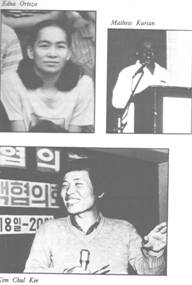
KIM CHUL KEE
Mr. Kim Chul Kee, General Secretary of the Ecumenical Youth Council of
Korea, was due to deliver a keynote address on a new ecumenical vision for
Mr. Kim’s paper traces the connections
between the colonial missionary enterprise and the deficiencies of the Western
based ecumenical movement. He sees
Today we have
gathered together as Christian youth who are working in the ecumenical
movements of our countries in
During this time, we in
At the same time, these endeavors
represented our efforts to overcome various Western influences which have been
penetrating both our churches and our societies. We realize that the schisms within our
national churches have their roots in the expansion of Western
denominationalism. The apolitical
orientation of the Western churches has been used to provide moral
justification for imperialism and dictatorial regimes. The Western value system has
9
implanted in our societies the desire to always
possess more — that is, consumerism and materialism.
As we have struggled to be faithful to our
Christian social responsibility, working to establish God's will for justice
and peace in society, we have also discovered a new meaning for Christian
mission. In particular, we have been
awakened to a renewed understanding of the church as a living community in
history, rooted in the life of the people.
As we have participated together with the people in their movement, we
have experienced shame and the threat of death, and have appeared to the world
as fools. However, even though we
appeared weak, we were able to overcome the strong; and our foolishness has
made the wise feel shame.
In the midst of our struggle we have been
convinced of the presence of Christ, in whom death and darkness are
conquered. At the same time, we are now
able to see the possibility of a future ecumenical movement in a broader and
deeper context.
Even more meaningful is the fact that we
have gathered as one in Christ, sharing our experiences, inspite
of our differences in language and culture.
I believe it is the work of the Holy Spirit that we are able to
encourage one another, strengthening our solidarity. I believe that our gathering here will be a
moment when the renewing wind of the Holy Spirit will bring the people of
Due to my limited experience and theological
background, this presentation will be centered on my personal experience within
the Korean church youth movement. If you
will accept me as one among the brothers and sisters in Christ, I will dare to
offer some insights into the possible direction and development of a new vision
li)r the Asian ecumenical
youth movement.
The Third World And The Minjung
Many people in Asia labor
extremely long hours under poor working conditions, for low wages that do not
even cover the minimum cost of living. This situation has caused many
to suffer from occupational diseases.
Each year, some 157,000 people are injured and die from industrial
accidents in
Through the use of poisonous pesticides,
more and more peasants are doing, and the lives of the consumers are threatened
with deformity or death. These same
pesticides are produced in countries
10
where their use is banned. Nature is
being destroyed. The urban scene is
marred by congestion and noise pollution.
Human relationships have become tainted by distrust and ruthless
competition. In the name of National
Security, people are massacred. Many
persons are sent to prison without trial.
The innocent are being killed in wars fought in the name of
"safeguarding freedom" but in reality to protect the interests of the
superpowers. The nuclear threat, the draining of natural resources,
and the contamination of the ecological environment are heightening the
possibility not only of human extinction but of the extermination of all
existing life.
This situation is not merely a human
problem; it is an outright revolt against God, the source of all life. Furthermore, human knowledge, scientific
technology, socio-political and economic institutions have lost their original
function and mission and have become devilish instruments of destruction. The tragic situation faced by humankind is
that "progress", "development", "modernization",
and "affluent society" are being worshipped as idols. The worldwide race for modernization, now
joined by almost every country in the world, has widened the gaps between
nations, regions and classes. This is a
world where the rich enjoy abundance while the majority are
slowly dying from poverty and starvation.
The most serious world problem today is the superpowers' economic exploitation and political control of the third world countries, and the maintenance of this control through militarization. What makes this problem even worse is that the third world dictatorial regimes — under the protection of the superpowers — are using such means as oppression, exploitation, torture, surveillance and massacre of their own peoples to serve the foreign capital interests. Using the police and military in their natural capacity as a physical force, these regimes conspire with the big financial powers and buy off the democrats and intellectuals; and they make formidable use of the media to manipulate the people's awareness.
A conference held by the Philippine church
in March 1980 pointed out the problem of the mass media.
—
The
ownership of the mass media at the national level can be seen as concentrated in
the hands of one family through friends or representatives in name only.
—
The
control of the mass media is facilitated by decrees and orders and enforced by
the regime of Marcos and his followers.
11
— Ownership of mass media guarantees the
interests and furthers the business of the privileged. To put it simply, they are not involved in
media work to provide service to the people.
— The following values arc circulated and
reinforced through the mass media:
1.
The
image of "development" under the Marcos regime.
2.
Consumerism
and the creation of artificial needs.
3.
National
security as the primary concern; submission to authority and good citizenship.
4.
The
instilling of false consciousness, through false images, escapism, romanticism,
the introduction of false hopes, and resulting in depression and fatalisms.
5.
Conveying
the impression that domestic problems are caused by external factors such as
inflation and manipulation of the oil price.
6.
Commercialization
of sex.
7.
Self-oriented
thinking: It is desirable to be first and to become rich.
8.
Western-oriented
intellectualism.
9.
Interpretation
of third world problems from the first world perspective: for example, poverty
is caused by dense population, laziness, lack of financial resources,
illiteracy, superstition, etc.
10.
Revolt
is always destructive and threatens the national security: i.e. a strike
against the government is terrorist activity.
11.
The
problems in society are caused by the disintegration of morality and thus need
moral solutions.
12.
Religious
conservatism.
The third world dictatorial regimes, taking
advantage of the superpowers' domination of the regions of the world,
manipulate and suppress public opinion by physical force, as well as through
social and economic institutions. These
puppet governments, in betrayal of their own nations' and peoples' interests,
become the channel for domination and exploitation by foreign powers.
Along with the "development" idol,
we are afflicted with an inpouring of
western-centered values. One of the
important functions of the media, as we already see it being used, is to
12
transplant western culture, with its white supremacist
mentality, into the third world. In
order to justify their selfish aggression and exploitation which has been going
on since the 17th century, the Westerners have indoctrinated us with their
value system. They even characterized us
as dirty, ignorant and barbaric, leading us to feel inferior and to want to
take on the western life style. The
expansion of western culture in the third world has brought the destruction of
our culture and traditions and the suppression of our people's lives and
consciousness.
What is western culture? Western culture is
based on a dualism which leads to a militaristic and antagonistic world
view. Pursuit of the western development
idol has caused the people of the third world to lose their sense of direction,
and the materialistic mentality. has thrust the people
of the whole world into a state of confusion.
In this situation we are deprived of our sovereignty and hampered in our
economic, cultural, social and political development. Due to these influences, we in the third
world have not been able to throw off the limited viewpoint of the first world
and establish our own independent perspective and stance in the world.
Even in this situation, we find hope in the
actions and thoughts of the nameless fighters who have sacrificed themselves in
the struggle for national liberation. We
can see that the life of people, like the reed, is strong and tough: the reed
bows before the wind, but rises up again as the wind passes. We can see new
hope not only for the people of the third world but also for the whole of
humanity, in the strength of life that has transcended generations.
To fully understand the Bible and our
commitment as Christians, we must remember and comprehend the context in which
we live and work, whether it be on the local, regional
or national ecumenical level. To develop
our mutual understanding for common struggle, we in
The
Meaning And Role Of Ecumenical Movement In Asia
I
would like to tell you a story, "The Tears of Lady Meng,"
quoted by C.S. Song of
13
In
order to keep them in check, he decided to build a wall along the whole northern
frontier of
This
happened in the reign of the wicked, unjust Emperor Chin Shih Huang-ti. He was afraid at
this time that the Huns would break into the country from the north and not leave him any peace.
Then
a wise (!) man said to him: "A wall like this, which is over ten thousand
miles long, can be built only if you immure a human being in every mile of the wall. Each mile will then have its guardian."
It was easy for the Emperor to follow
this advice for he regarded his subjects as so much grass and weeds, and the whole land began to tremble
under this threat.
Plans
were then made for human sacrifice in great numbers. At the last minute "an ingenious
scholar" suggested to the Emperor that it would be sufficient to sacrifice a man called Wan
“since Wan means ten thousand”. Soldiers
were dispatched at once to seize Wan who was sitting with his bride at the wedding feast. He was carried off by the heartless soldiers,
leaving Lady Meng, his bride, in tears. Eventually, heedless of the fatigues of the
journey, she travelled over mountains and through rivers to find
the bones of her husband. When she
saw the stupendous wall she did not know how to find the bones.
There
was nothing to be done, and she sat down and wept. Her weeping so affected
the wall that it collapsed and laid bare her husband's bones.
When
the Emperor heard of Meng Chiang and how she was
seeking her husband, he wanted to see her himself. When she was brought before
him, her unearthly beauty so struck him
that he decided to make her Empress.
She knew she could not avoid
her fate, and therefore she agreed on three conditions.
First,
a festival lasting forty-nine days should be held in honor of her husband;
second, the Emperor, with all his officials, should be present at the burial; and third, he should build a terrace
forty-nine feet high on the bank off the
river, where she wanted to make a sacrifice to her husband. Chin Shih Huang-ti granted
all her requests at once.
When
everything was ready she climbed on to the terrace and began to curse the
Emperor in a loud voice for all his cruelty and wickedness. Although this made the Emperor very angry, he held his peace.
But
when she jumped from the terrace into the river, he flew into a rage and ordered
his soldiers to cut up her body into little pieces and grind her bones to powder.
When
they did this, the little pieces changed into little silverfish, in which the
soul of faithful Meng Chiang lives forever.
C.S. Song likes to quote from the people's
stories. We can see in history how the
people have fought against cruel dictatorship.
The king treated the people like weeds, using the pretext of national
14
security to oppress them. But the king could not quell the han, (anguish over injustice) of Lady Meng. She was able
to fight against and overcome the king's strong force. Finally, the spirit of Lady Meng was resurrected in the small fishes. I don't want to elaborate more on this story,
but it is helpful in reinterpreting the ecumenical movement in the Asian
churches.
Generally, we associate the ecumenical
movement with the denominational churches, and with their efforts for
cooperation and unity. However, the
situation of the churches we see around us today — bound by localism and
denominationalism — is not originally an Asian phenomenon, but has its roots in
the western denominational church. The
western church was divided along class, regional and racial interests. About ten years before the U.S. Civil War,
the Methodist ministers in northern
These missionaries came and divided the
Asian territory among themselves. They made the third world church
apolitical. In the process they
separated the church from the people and from the national historical task, by
negotiating with the political powers and reinterpreting the original Gospel to
pacify the people. Ironically, the
western church, without repenting of these sins, now talks about
ecumenism. In other words, it is not
enough to carry out the ecumenical movement on the level of dialogue and unity
among denominational churches.
Let us take a look at the constitution of
the World Council of Churches, the section pertaining to WCC's functions and
purposes.
"The World Council of Churches is
constituted for the following functions and purposes:
1.
to call
the churches to the goal of visible unity in one faith and in one eucharistic fellowship expressed in worship and in common
life in Christ, and to advance towards that unity in order that the world may
believe;
2.
to
facilitate the common witness of the churches in each place and in all places;
3.
to
support the churches in their worldwide missionary and evangelistic task;
4.
to
express the common concern of the churches in the service
15
of human need, the breaking down of barriers
between people, and the promotion of one human family in justice and peace;
5.
foster
the renewal of the churches in unity, worship, mission and service;
6.
to establish and
maintain relations with national councils. and regional conferences of
churches, world confessional bodies and other ecumenical organizations;
7.
to carry on the
work of the world movements for Faith and Order and Life and Work and of the
International Missionary Council and the World Council on Christian
Education."
I don't want to confuse the spirit of the
ecumenical movement with the WCC constitution.
However, I am questioning whether the ecumenical movement is continuing
to make mistakes. 100 years ago the western missionaries came to save the third
world people by spreading the Gospel, but in reality they gave us a divided
church. Now the western church talks about ecumenism, which is really a
western-oriented kind of church unity.
I believe we have to define the Asian
ecumenical movement much more broadly, to include indigenization, dialogue with
other religions, and being connected with the people's lives. Today, our churches are very westernized:
they frown upon traditional customs and ceremonies. Ceremonies that are
originally Asian and of the people are disliked. Church people think it is very Christian to
use the piano and other instruments in the church. When we have used traditional instruments, we
are criticized for acting unchristian.
But as Asian people, we need to express our faith through our own
customs and ceremonies. Thus it is
crucial for us in our Asian ecumenical movement, to relate to the people's
traditional customs and shamanistic religions, which were formed through
centuries of the people's han and national tragedy.
Though our Asian church history is short, we
have learned that our church can become one by participating in the people's
movement and by uniting to carry out our national historical tasks. In the struggle to realize justice and peace
in society, there must be no distinction made between Presbyterians,
Methodists, and others; rather, we must focus on our oneness in Christ.
We must also transcend our view of
16
vision and hope for the worldwide ecumenical movement. This new vision is grounded in the church of
the minjung — the people — and in a movement for social justice that is
oriented to the people's needs and the needs of each nation. The contents of the new
ecumenical movement is the development of people's Christian communities
and promotion of dialogue among them.
B), fully identifying with the anguish — the han — and the lives of our national and
regional peoples, and struggling together in the people's movement, we can
overcome the westernized, divided, exclusive church. God's church can only grow in the context of
the struggle of the people.
Who are the minjung? They are the subject of history; they
participate in and accomplish God's creation.
They promote life against all life-threatening forces. God's church can only exist in the people's
struggle to realize their national historical task and the task of
However, we still have not been able to
overcome the western-oriented, individual church-centeredness which is so
deep-rooted in our thinking, and which has continued to divide the church for
centuries. In response to this problem,
the Asian Christian youth delegates to the 1982 Doi Suthep meeting gave the most appropriate answer. Their resolution stated, "We, in our
belief and faith, must support the people's struggle. If our faith does not include this function,
we too become a part of the oppressive structure that denies the human rights
of the Asian peoples, and we must oppose this." In particular, we can only
establish our theological base in the process of working together with the poor
and alienated; and we must designate all other theological stands as
representing the false consciousness of denominationalism. ("Theology:
Friend or Enemy?", 1983, CCA Youth
Committee). In other words, our faith
and belief must be rooted in our work to improve-the people's lives, within
their concrete situation.
At the 1982 Korean EYC Strategy
Consultation, Korean youth confronted the question of how to renew the
church. They concluded that it is
meaningless to distinguish between "Inside" and "outside"
the church when talking about its renewal.
That is, they refused to separate the world and the church. Even when we are accused by the traditional
ecclesiasts as having fallen from Christ and his teachings, we still recognize
the urgency of making ourselves more sensitive to the problems of our
neighbors. It is the minjung church,
with its diverse and vital community of people, that
is struggling to overcome the rule of oppression and the idols of national
security
17
and "development." And it is in this minjung church that we can
find the new Asian ecumenical vision.
The
Youth
"Lord with burned and averted face—
Even so, you are the one
and aged Lord.
Lord, did you die, are you crying in a dark
alley?
Were you buried in a garbage heap,
Our silenced Lord?"
Today, this kind of song is popular among
young people in
“Wherever you go in this world there is
sorrow;
We only
eat and sleep and labor.
What is the lord's meaning?
Lord, what should I do?”
In songs like this, the youth are asking
where we can find God's meaning.
"Our brothers and sisters are falling;
Guns and knives tear our breasts.
As we thirst for Peace,
we wait for you,
We wait for you.
What are you wandering in
search of,
With thirsty, outstretched hands?
O
Lord, now here,
Be with us.
Lord, be here with us now.
Finally, we want God's will to be revealed
in human history.
"Through
the long, hard ordeal,
Climbing
toward the treeless mountain top,
Voices raised as they go,
Hear the
people's loud outcry.
18
Eyes uplifted to the
sky,
Their fatigue is cleared away.
The river circling the mountain
Is flowing endlessly.
Our Father God, who art in
heaven,
If it is your will that I do so,
I will follow you to heaven's end."
This song is a resolution that we will
follow Christ. who first sang these songs, or when,
but we can see how the youth understand the church, and how the church can be:
part of the minjung.
I do not believe this phenomenon is only
occurring in
In conclusion, I would like to make several
proposals for our future Asian Christian youth movement. The youth movement is not just one part of
the official ecumenical program, but is the vision of the entire Asian
ecumenical movement. When we move beyond
the level of dialogue between church denominations, when the church becomes the
people's, by joining in people's local struggles,. and when we recognize that the road to ecumenism has a
broader. meaning, then how should we emphasize the
role of youth?
Under the widespread situation of mammon
worship and the reign of violence, the phenomena of excessive consumption,
indiscriminate development, murderous labor conditions, and destruction of the
ecological system threaten the existence not only of humankind, but of all
nature. The minjung, uprooted from the
land of their life and sustenance, are thrown into the industrialized desert,
the wilderness of the dark cities.
Together with the minjung, who are to glorify God through their propagation and
prosperity, all the youth in
Already this kind of awareness is being
voiced throughout the world. There are
anti-nuclear, anti-pollution, and peace movements in the developed countries,
and people's liberation movements in Asia, Africa and
19
from destruction by pollution, and to preserve the lives of the minjung from exploitation, suppression,
and murder, must unite together.
However, these movements must have a clear third world perspective,
based on thorough study and comprehension of the thoughts and ideas of the
prophets, thinkers, and leaders of the minjung
struggle. There can be no Asian people's
movement based on the value system and perspective of the West. Furthermore, a new culture should be formed
around the wisdom of the minjung, through
exploration of the traditions, folklore and stories of the people. Ever since the I 7th century, the West has
been persistently engaged in a process of destroying and wiping out the third
world cultures, enforcing Western values, and exploiting and suppressing third
world peoples. Now a new Asian order has
to be established to succeed to the pure and simple worldview of our ancestors,
who never gave up their universalism, even as they resisted the Western
encroachments.
The work and fellowship of our Christian
youth is directed to restoring mankind in the image of God, and to the
completion of God's creation by establishing a new heaven and earth; and this
vision has to be developed in solidarity with the minjung. The minjung church
in
While each of us participates in the
struggles of the minjung in our, own
context, we should come to a clear understanding of the Gospel through study of
the Bible and theology, and should discover the word of God, who is devoted to
the lives of minjung. Therefore, instead
of demanding devotion to itself, the church should become a' serving church - a
community of youth in solidarity who fulfill their role as light and salt in
the world.
I truly hope that we Christian youth will
resolve to become the new Asian church, by becoming the seed that will bear
fruit in the history of