III.
Charts for Workshop 4
Chart 1
Evolution of Militarization
|
Stage
1 Elites’ Control |
Control Class Society Masses |
|
Stage
2 People’s Response |
Challenge liberation movements student's uprising Masses labor movements peasant struggles |
|
Stage
3 Militarization |
Confrontation Masses |
|
Stage
4 Social Control |
A Higher Stage of Militarization = Systematic Social Control the ultimate stage: no more visible militarization required with propagation of State Religion = modern idolatry New Developmentalism Consumerism Industrialization “Look East” policy |


192
Chart 2
Marketing of a State Religion
-New Developmentalism
(A) The widely propagated ideology og New Developmentalism (in ecplaining why growth and stagnation co-exist in Asia)
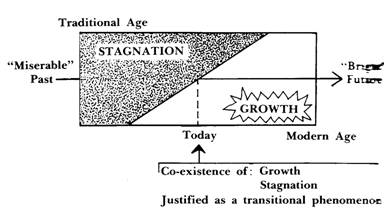
Therefore:
More rapid growth quicker solution of the stagnation by means of introducing:
1. more foreign investment
2. efficient management -government bureaucracy
-business sectors
3. population control
(B) Reality in 1980’s
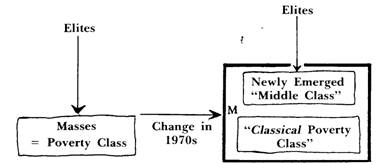
193
Chart 3
Covered Up By New Developmentalism
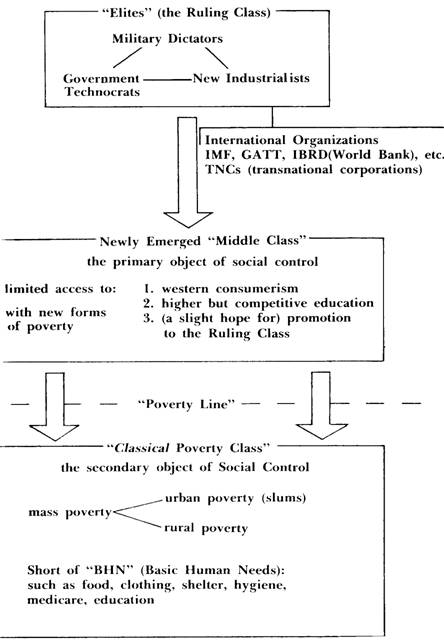
194
Chart 4
Package Deal for Modernization (the supposed goal of New Developmentalism)
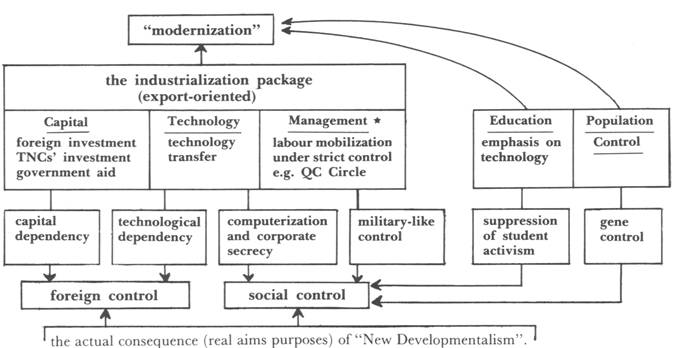
* A large scale production mechanism always requires a similarly large scale bureaucratic human organization to support the operation.
195
Chart 5
Symbols of “Modernization”
|
|
Bright Side (visible) |
Dark Side (not visible unless careful) |
|
Infrastructure |
High-rise buildings, hotels. Etc. Express highways Airports for jumbo-jet Large scale dams |
Relocation of residents on site = land grabbing Destruction of natural environment Loss of fishing ground and farm land Accidents Security checks |
|
Industrial production Green Revolution |
Large industrial complex Nuclear power plant Office computers Industrial robots Farm mechanization Use of farm chemicals Hybrid grains |
Industrial pollution Work hazards and occupational decease Low wages and poor working condition Radioactive pollution Totally controlled labor Unemployment Popularization of farmers Poisoning, water and soil pollution Instability of crop |
|
Militarization |
Sophisticated weapons system |
Threat to neighboring countries More casualties in counter-insurgency operations |
|
Consumerism Consumer goods Loans |
Cars, motorcycles, color TV sets, video sets Air conditioner Walkman, two in one Fast / instant food Synthetic detergent Credit cards Consumer’ loans Installment plans |
Traffic accidents Frustrations created by ballooning unsatisfied Standardization of desire Health hazard and pollution Bankruptcy Over-purchasing |
|
Entertainment |
(Japanese) toys, comics, TV programmes, popular songs, TV games |
Cultural imperialism |
196
Chart 6
Three phases of Poverty
For more comprehensive understanding of poverty
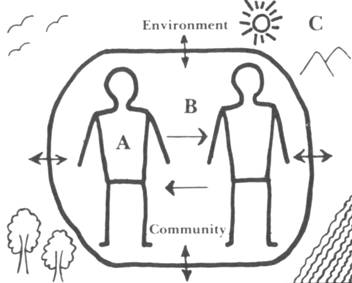
POVERTY - systematic deprivation of human rights for -survival
-well-being
- lack of instability of access to resources
|
Phase |
Subject Affected |
How |
Lost |
Results |
|
(A) Personal sickness and poverty |
Person Individual |
Biologically, physically and mentally |
Health and Personality |
Death Starvation Injury Sickness |
|
(B) Social Sickness and poverty |
Community Collective Family Society |
Spirituality |
Human relations initiative and organizing and self-governing |
Frustration Feeling of powerlessness Poor education Fear of insecurity |
|
(C) Ecological sickness and poverty |
Environment Ecology Nature |
Poisoning Destruction |
Eco-balance |
Pollution Deforestation Desertification “Natural” disasters: floods, drought, etc. |
197
Chart 7
New Poverty Syndrome
-If not yet, coming soon…
Phase A Personal Poverty Syndrome
·
 Suicide
· Accidents -Traffics
-Occupational
-Others
· Cancer
· Geriatric diseases among youth and middle age
· Overweight
· “Junk Food”: Fast food chains -Mc Donald’s
-KFC, etc
Take out lunch chains
Pre-cooked and instant additives
· Drug overdose
· Toxic chemical poisoning
· Inadequate housing
· Alcoholism, drug addiction, smoking
Phase B Spcial Poverty Syndrome
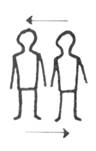
·
 Unstable
families
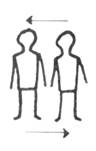
Unstable
families
· Education – competitive schooling
Examination hell
Drop-outs
Violence at school
· Medical over-treatment and over-dose of medicine, doctorless villages
· Mental hospitals used as prisons for social drop-outs
· Unemployment of aged people
· Loan economy – credit cards, installment plans, etc.
· Over concentration problems
· TV Commercials
· Sex tours, commercialization of sex
· Highly controlled labor mobilization
198
Phase C Ecological
Poverty Syndrome

· Destruction of nature
· Pollution import/export
· Dumping of heavily toxic agricultural chemicals
· Radioactive pollution
· Large scale development schemes
199
Chart 8
Youth as Primary Victims of Development and Militarization
|
Education |
Highly competitive No schooling opportunity for many Over emphasis on technological education, neglect of social science, arts |
|
Employment |
Limited opportunity for getting employment, high rate of unemployment Exploited labor under poor working conditions Unhealthy service industries |
|
Consumerism |
Instant/fastfood Fashion Comics, toys TV programmes |
|
Military Service |
Youth drafted and used for militarization to fight against youth uprising |
|
Human Rights Violation |
Suppression of youth/student activism Young political detainees |
200
Chart 9
Women as Primary Victims of Development and Militarization
|
Education |
Low female literacy Disregard for improving educational status of women Higher number of female drop-outs than male Sexist bias in education Educational forms reinforcing sexual stereotypes Sexual segregation in schools High cost of education lead women to prostitution |
|
Employment |
Female employment to augment family income Lower employment opportunities for women Higher rate of unemployment Unorganized Sexual harassment Overworked Lack of maternity and other benefits Lack of checks for children Double work |
|
Consumerism |
Sexual exploitation in advertisements and media Various pressures from society to buy more and more unnecessary household goods Western lifestyle alienating from own community |
|
Military Service |
Militarism and sexism Rape used as a weapon |
|
Human Rights Violation |
Sex specific forms of torture in jails Domestic violence on women Population planning |