Witnesses
EAST TIMOR: CHURCH IS THE NEXT TARGET?
Mimi Ferreira
Mimi Ferreira, an East Timorese u)ho
fled to Australia in 1975, told the Assembly about the invasion of her country by
Indonesia, the suffering of the people which is said to be similar to that suffered by Kampucheans under the Pol Pot regime) and of the continuing resistance. She came
to the Assembly as the representative of East Timorese refugees in Australia who collected money themselves to pay for her
travel expenses.
I Am
Timorese
I am a Timorese and have lived in East Timor until August 1975. Until then the East Timorese people were
looking forward to the future. We wanted
a progressive, just, peaceful and Christian East Timor; nothing less than
self-determination.
For the Indonesian Government, an independent East Timor right next door
was out of the question.
With false propaganda of communist activity in the territory and
constant threats of invasion, the Indonesians succeeded in creating tension and
ill-feeling within the political parties.
A brief civil war broke out. With
the Indonesian invasion imminent, I left my home country to go to Australia
several days after that. The sweet
memories of East Timor and of my heroic people will always have a special place
in my heart.
Why Is
East Timor An Important Topic Today?
The reason is, that in the last decade, a S.E.
Asian nation of less than 700,000 people has been invaded by the military might
of its large neighbour, causing the deaths of between
2 to 300,000 people, total (economic, social, cultural and religious
disruption, and untold horrors and sufferings, which continue to this very day.
I will explain further.
East
Timor Geography And Colonial History
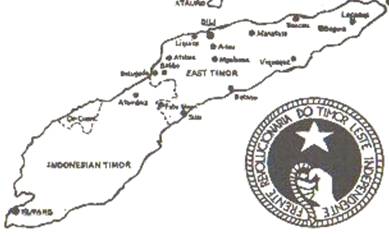
East Timor is 400km north-west of Darwin,
Australia, at the Eastern end of the Indonesian islands, as you can see from the
map. Further to the East is another land oppressed by Indonesia. This is the Western half of New Guinea, West
Papua (Irian Jaya). The struggle for self-determination and human
rights of the Melanesian people there has much in common with our own struggle.
East Timor shares a common land boundary with West Timor. The people of the island are of
Malay/Melanesian origin, with some Chinese and Portuguese also.
History
1974-75
Even with our history of oppression, the people were ready for the
chance for self rule that developed in 1974 and 1975. Political parties were started and plans
made.
The two main parties were called UDT and Fretilin, both moderates, with UDT
more to the right of Fretilin. Both were in coalition, wanting gradual
transition to independence.
However in August 1975 after visiting Jakarta, the leaders of UDT launched a coup against Fretilin,
resulting in a brief civil war for about 3 weeks during which 2000 people were
killed. After that, the country settled
down to rule by Fretilin, who had soon to cope with
an additional major problem — Indonesian land invasion. During this period the Portuguese colonial
administration decamped to a neighbouring island, Atauro, (now a notorious prison island), and would not
return.
The East Timorese put up strong resistance to Indonesian ground
forces. During one attack, on the 16th
October 1975, 5 Australian newsmen were killed at Balibo,
and to this day neither the Indonesian nor Australian governments have provided
honest reports on this matter. The Fretilin administration repeatedly Invited international
observers, newsmen and organisations to observe the
situation, but was largely ignored. It
seemed that established governments did not want to harm relations with
Indonesia, especially as that country had important oil exports.
In November 1975 the Australian Prime Minister Whitlam was dismissed
from office and an interim government took over. General Suharto
decided that this was the time for a major assault. His General Benny Murdani,
who professes to be a Christian, claimed that they would control East Timor in
2 days.
The full scale attack by Indonesian land, sea and air forces was
100
launched on 7th December
1975, but met fierce resistance. Huge
casualties resulted from battles and brutal reprisals. Within a few months, the casualties numbered
up to 100,000 killed.
History 1976-80
There followed a heroic resistance and stalemate that saw Indonesia
control the towns and coastal strip, whilst Fretilin controlled 90% of the interior mountain region.
In 1977 and 1978 the Indonesians stepped up their military actions using
Bronco aircraft supplied by the U.S.A. for that purpose. They concentrated on destroying villages and
crops, and keeping the people on the move.
This plunged the island into famine.
Hundreds of thousands of people surrendered, while about 100,000 more
people died of starvation and oppression.
All this was largely
hidden from the outside world until the Journalist Peter Rodgers smuggled
revealing photos to the world press.
Some aid was sent by world agencies, but very little actually reached
the people.
History 1981-84
Resistance activity was at a low ebb until 1981
when the forces re-grouped and launched effective attacks against the occupying
forces. Now the resistance
do not try to maintain a large
population in the mountains, in contrast to 1976-78.
The resistance was so effective that in March
1983 the Indonesian Colonel Purwanto travelled to Fretilin lines and
signed a cease fire agreement.
This lasted until a visit by an Australian Parliamentary delegation led
by Bill Morrison helped to end it.
Morrison was the Australian Foreign Minister in 1975 who denied any
knowledge of Indonesia round
attacks and is a friend of Murdani.
The Christian General Murdani vowed to wipe
out the resistance once and for all, and put a further 14,000 Indonesian troop into battle in 1983. Even this has failed.
Present
So the present situation is a country isolated from the world by the
Indonesian military, with gross violations of human rights at all levels, 2 to
300,000 people killed from an initial population of under 700,000, where
torture, disappearances, rape and all manner of brutality is a common
event. There is forced learning of
Indonesian
101
in schools, and denial of family, cultural, land,
language and religious rights.
Indonesia has lost 30,000 of its own troops,
and now plans to settle hundreds of thousands of imported farmers to complete
the genocide — as they are also doing in Irian Jaya.
Role Of Church
In all this, the role of the church has been
of utmost importance to the Timorese and more recently to the whole world
perception of events. Many Timorese are
Roman Catholic Christians and in the face of the horrors of war and the courage
of the Church, a vast majority of them became more committed Christians.
Since the early days of the invasion, priests
and religious leaders have been with the
people and suffering with them. An old
priest Fr. Leoneto Rego was
allowed to return to Portugal in late 1978 and his factual accounts were an
important source of information.
The Apostolic Administrator was for many years Mgr. Costa Lopes, a
Timorese patriot. After years of
enduring the sufferings, he became a public critic from about 1980, and has been
vilified by prominent apologists for Indonesia.
In 1983 he was invited by the Pope to retire, but his successor, Mgr.
Belo, widely viewed as an appointment less likely to offend the Indonesians,
has proved more successful in achieving a powerful statement of support for the
Timorese from the Indonesian Bishops' Conference. A copy of this statement is printed in papers
available here.
In 1984, therefore, for the first time Church property and personnel are
being directly harassed. The religious
leaders and the people of East Timor have wondered why they have been so
deserted. It's time this situation
ended.
International Solidarity
International Solidarity has been important to the Timorese, but has
never been influential in determining their struggle. They make their own decisions, and fight on
using their original Portuguese army weapons, and others captured from the
often unwilling Indonesians and some Timorese conscripts.
However, International Solidarity will be important to end the struggle
and restore human rights to the Timorese.
Although the United Nations each year from 1975 until last year
condemned Indonesia and told it to get out of East Timor, this has had little
102
effect. Indonesia has been supported by the U.S.A. in
its paranoia about independent or nationalist or leftist governments, and not
opposed by Australia.
It is important to get the non-aligned nations to put pressure on
Indonesia to stop its genocidal actions in Timor and West Irian. Pressure must be applied to politicians,
newsmen, churches, youth movements, and governments, and be made
effective. Rights under the U.N.
charter, and what we believe to be rights of human dignity under God, need to
be ensured by our own strong actions.
God's will be done through Us!
The Timorese appeal to you to support their right to life and their
right to freedom. They have shown by
their amazing heroic struggle against overwhelming military force that nothing
less than the right to self-determination will be sufficient.
This is their right. It is the
only way to stop the slaughter. We ask
for your support and God's strength.