137
Workshops
The Assembly did much of its work in small discussion groups which
reported back to workshop plenaries. With aliti4ist 300
young people debating the workshop topics, you can imagine that many issues
were raised, some resolved, some not. The workshop reports are summaries of the
common looking of the participants. They
reflect the depth and vitality of the workshop discussions. Certainly, hardly any item on the ecumenical
agenda escaped attention.
The workshop reports were drafted after each workshop plenary had
examined a rough draft. The final draft
was then submitted to a plenary of the whole assembly on the final day. We hope
these reports will not only inform readers what happened in Delhi but, more
importantly stimulate further debate and discussion around the region.
The Drama and Art Workshop did not present a written report. Their
presentation came at the closing act when a powerful play was presented and a
banner depicting people’s struggle was unfurled. However, the workshop did submit some
proposals for follow-up of their work which are being acted upon.
138
1. IDEOLOGY,
THEOLOGY AND A NEW POLITICAL VISION
In the past decades, Asian people have
been influenced by many ideologies. Most obvious have been the colonial ideology
of domination and service of a foreign
power which was replaced by the ideology of national independence and sovereigns.
The newly independent states then developed ideologies of "nation-building", "national
development" and, increasingly, "national security".
The peop!es' hopes have not beenfu4filled: unequal distribution of national wealth,
neo-colonial control by foreign powers which prop up dictatorial local elites, increasing repression and militarisation, cynical ideological manipulation of the people.
Asian peoples' movements have grown
during the past two decades into a powerful force. Their ideologies centre on self-determination
and national democracy and identify
neocolonialism as a major force to be opposed.
However, in each national situation a
need remains for a integrated new political
vision for Asia to be developed and articulated. Asian youth must be in the forefront of this.
Present Realities
Foreign influence and a modern capitalist sector (industrial and
business) characterise Asian societies to differing
degrees. Ethnic and religious diversity
typifies the Asian reality. Trends in
the operation of national governments include:
a. The state operates to advance capitalism. An elite clique of interest groups combine to
form a ruling class and to serve the interests of big monopoly capital.
b. The development of agricultural capitalism ensures
the continuing influence of landed interests.
c. The increasing power of the state and its use of
social control is seen in authoritarian regimes. These regimes sponsor militarisation,
undermine the independence of the judiciary and impose pervasive ideological
control in the name of democracy
139
and benevolence.
In some ways the role of religion seems to be increasing. This is seen both in terms of the church
hierarchy supporting the status quo with increasing vigour
and in the tendency of some Christians to work for social change by siding with
the poor.
Similarly, forms of Christian discipleship and youth participation are
changing form and polarising: the increase in
revivalist fundamentalists and charismatic groups as against the increasing
disillusionment of youth with theology and the church (especially in the case
of those youth involved in political struggles).
Ideology
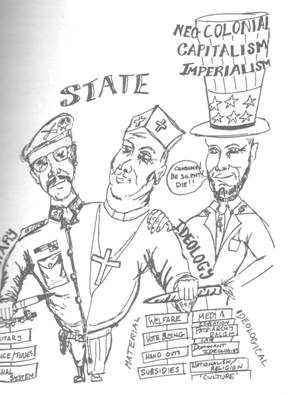
Ideology is the way a group of people views the world and their place in
it. Or it may be the motivation for a
group to act in a particular way.
Ideology may be hidden or brought into the open where it can be analysed and evaluated.
Churches, races, economic classes, political systems act to support and
sustain their own ideology. Their
ideologies may oppress or liberate people.
In the Asia-Pacific context there are ideologies which justify economic
exploitation, political domination and foreign intervention. There are also ideologies which challenge the
ruling ideologies, try to open the minds of the people, encourage the fight
against injustice and which promote a vision of a new life.
Does conventional Christian theology oppress or liberate?
Critical
Theology
Today, theology is in the hands of the powerful and is used by them to
subjugate the poor. The existing
theology of the powerful is concerned solely about the spiritual and has
nothing to do with issues of justice.
The available theology is Western and it is used as an ideology to
oppress the poor. The dominating group's
exclusive authority over the Gospel has also resulted in the alienation of the
Christians from their particular culture.
Western theology has expounded a wonderful, triumphant theology. But we find Jesus in our suffering. This is a new emphasis. Theology has something to say on the unjust
social structure. But theology should be
able to criticize itself — a theological critique of theology.
For example some Western theologians will quote Romans 13 and say that
authority should be universally respected.
But if we
140
have a critical understanding of the passage then we see that just the opposite is being stated.
Also theology must criticise ideology when it
claims to be absolute. National
chauvinism, totalitarianism, and patriarchy in any form must be theologically
and politically criticised. Theology itself must be criticised
when it claims absolute rights.
Asian Theology
The Christian responsibility is to liberate people. Theology comes out of the particular context
of the liberating experience of the people through a process of
reinterpretation and of being faithful to the scriptures.
Likewise an Asian theology should come out of the specific experience of
the people.
Jesus Christ's message was one of release from any kind of
oppression. He announced the Kingdom of
God which is:
-
hope for the
oppressed,
-
wholeness for individuals and society.
Because of our understanding of Jesus Christ as Liberator, we consider
that the essential aspect of our political vision must also be one of
liberation. Liberation: the
establishment of justice. justice: the release of the
oppressed from what binds them.
Our Vision
Our vision includes therefore:
-
struggle against foreign domination towards
self-determination.
-
transformation of the state, feudal and capitalist systems of
exploitation.
-
development of new social relations on the basis of equality and
justice.
-
faith and ideology giving strength to popular movements.
Agenda
We need to develop ways to free people from physical oppression,
ideologies which enslave the mind and spirit, and economic, political and
religious structures which oppress.
The struggles of the poor pave the way for the emergence of a new
ecumenism based, not on the unity of the established churches, but on the
universal unity of the poor. The
strategy includes a continuous critique of the existing ecumenical movement.
The ecumenical movement must work in two areas:
141
1. Participating in the Peoples' struggles and peoples'
movements.
2. Challenging the churches to be faithful to the
struggle of the people; changing the structures so that these may be used to
liberate not oppress.