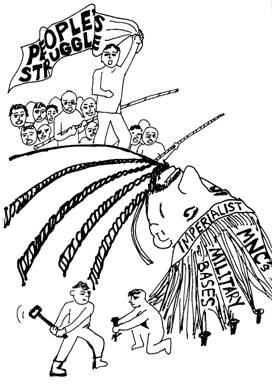
3. PEOPLE'S
MOVEMENTS IN THE ASIA-PACIFIC REGION
The emergence of people's movements as
a political force in Asia and the Pacific has changed the face of political
life and provided a major block to the designs
of the forces of domination.
Indigenous peoples' movements,
peasants' and workers' movements, movements of women and of minorities, peace
and anti-nuclearization movements, independence
movements, broad movements for justice and democracy have mounted a strong challenge to national
elites and foreign powers.
These powers have reacted with fear:
the have marginalised, imprisoned and
killed. Thy have militarized national
life and ensured that economic survival
is impossible without integration into the market economy they control by means of transnational corporations.
The task of youth is to understand the
Asia-Pacific region as one geographical area, to build links of
solidarity and to network between peoples' movements.
Asia-Pacific Is One Region
We consider the countries in Asia and the Pacific as belonging to a
single region on the basis of their geopolitical importance in the global power
game and the similarities in the structures and dynamics of external domination
present in them.
The region is important to the superpowers and the other industrialised countries primarily as:
-
a source of raw
materials (minerals and agricultural commodities);
-
a ready market
for products (including armaments) of the industrialised
countries;
-
a source of
cheap labour;
-
outports and springboards
for projection of military power;
-
providing
strategic economic and military maritime routes;
-
providing sites for nuclear testing and waste dumping.
External Domination
The structures and dynamics of external domination can be
149
categorised as follows: outright colonial occupation (e.g. New
Caledonia, Hong Kong, Aotearoa, East Timor) and neocolonialism or
pseudo-independence. The latter is
perpetuated by means of economic and technological dependence (e.g. direct
investment and joint venture companies usually involving transnational
corporations, retention of colonial trading patterns, tied loans and
conditional economic aid), ideological and cultural control (e.g. the
propagation of the free enterprise system, consumer culture, control of the
media and its use to propagate state ideologies and education of
“captives", the manipulation of religion) and, finally, political and
military control (e.g. presence of foreign military bases, direct or indirect
military aid, retention of military advisers).
It should be stressed, however, that the source of external domination
is not restricted to powers outside the Asia-Pacific region. Some countries within the region are exerting
increasing influence on other nations.
In terms of economic dominance, Japan and, to a lesser extent, Australia
and Korea, have become dominant economic powers
regionally. The TNCs
and other operations (e.g. consultancy and banking services) are able to
extract enormous surpluses by using sophisticated pricing mechanisms and by
taking advantage of tax holidays, cheap labour and
other incentives provided by host nations.
An added boon to Japanese and Korean interests is the preferential
status given to them by some Asian governments (e.g. the "Look East"
policy of Malaysia).
These countries are also assuming a military stance by supplying
military aid to other nations. Further,
the United States is encouraging Japan and Australia to develop their military
capabilities so as to fulfil a watchdog role in the
region. Some countries (Singapore and
Pakistan, for example) have emerged as arms suppliers to neighbours
(e.g. to Sri Lanka and the Asean-backed Cambodian
alliance).
Impact On The People
The effects of the domination of the region by extra-regional and regional
powers include the support of local oppressive structures and arms of
domination. These serve the interests of
the elite and dehumanise the people. Throughout the region the results of this
oppression are:
-
the destruction
of traditional and indigenous cultures;
-
religious and
ethnic oppression;
-
human rights
violations;
-
dispossession of
peasants from their lands and the creation of a landless class;
150
151
-
rural-urban
drift and the creation of slums in the cities and the associated problems;
-
economic
deprivation, pauperization and a high and increasing incidence of poverty;
-
more intense
exploitation of women and children; destruction of the environment; imposed nuclearization;
-
repressive
legislation which paves the way for military abuses, excesses and atrocities;
-
appropriation
and monopolization of scientific research for the benefit of TNCs and local elites; promotion of individualistic and
apathetic attitudes, e.g. the middle class syndrome;
-
neglect of the aged and handicapped.
People's Movements
People throughout the Asia-Pacific region have responded in various ways
to the imperialist domination of their region.
Workers in factories run by multinationals (notably in Korea) have
organised unions and have acted to promote issues related to their work, such
as higher wages, better conditions
and fair treatment. In these actions,
harassment by the military and thugs of the multinationals have led the workers
to develop a wider analysis. In the case
of the Philippines workers are seeing that workers' demands will only be met
when the U.S.-Marcos dictatorship has been dismantled.
The presence of foreign military bases, and the
dominating influence of U.S. military strategies have led many actively to
participate in peace movements calling, not only for nuclear disarmament, but
also for the removal of foreign bases.
The Nuclear Free and Independent Pacific Movement (NFIP)
advances the people's struggle to attain a
nuclear-free Pacific. This is based on a recognition of the racist roots of the nuclear powers, and
so is a call for an immediate end to the oppression and subordination of the
indigenous peoples. In Australia,
protests outside U.S. military installations indicate a growing awareness that
these bases link Australia with U.S. strategies in the region. French colonialism and nuclearisation
is the target of the protests of the Kanak people of
New Caledonia and of Micronesian people in general. People's movements have also found that the
struggle against imperialist domination has led to higher and higher levels of
struggle. In the Philippines the
extensive armed struggle against the Marcos regime
152
embodies the people's
aspiration for national liberation and independence. The people of East Timor have been engaged in
a nine year struggle against the Indonesian intervention in their country. In other nations, widespread organisational alliances have been fostered through various
sectors as a common appreciation of the perverse effects of imperialistic
domination develops.
Between nations, networking and solidarity actions are developing. Especially in 'advanced' countries such as
Australia, Japan and Aotearoa, solidarity groups recognise
the global nature of forces of domination, and that their own struggles are
bound up with struggles of the peoples of other Asian and Pacific nations. Furthermore, a recognition
is growing that the developing role of Japanese and Australian military
capabilities is linked to assisting the maintenance of present structures of
oppression. There needs to be developed
a consistent and linked movement in both countries to counter this strategy for
the oppression of the peoples aspirations for freedom.
Just as there are many forms in which the oppression of the people is
manifested the people's response is equally varied. They can be broadly categorised
as follows:
1. Indifference or apathy, suppressed silence.
2. Issue-oriented people's movements e.g. anti-racist,
antipollution.
3. Sectoral people's movements e.g. workers, peasants, women,
students, minorities, middle-class and intellectuals.
4. National liberation or independence or
self-determination movements.
Youth In The People's
Movements
Across Asia and the Pacific, young people continue to play leading roles
in the struggles for liberation. They
are also affected by the repression associated with imperialistic
domination. Unemployment, imperialistic
control of education, harassment of student and youth organisations,
young women going into prostitution and suffering abuses, especially rape,
compulsory military service, feature in the experience of young people
today. Youth and students have made and
continue to make strong challenges to these forces (e.g. Thailand, Korea, Sri Lanka).
Young workers often provide the active members of trade unions
struggling against multi-nationals. In
the Philippines and India, students join trade unionists on the picket lines.
153
Young people are also playing crucial roles through participating in and
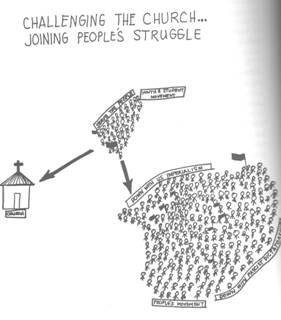
challenging existing people's movements with new vision and new energy. In the churches, young people are demanding
that the comfortable majority accept that the church must become a church of
the poor, and for the poor, and to link with those groups struggling for
justice and dignity.
It can be said that young people are participating actively in all areas
of struggle listed above. Involved in
these issue-oriented and sectoral struggles, they
also have their own independent mass movements.
Students are constantly working with the people, learning from them, and
using the advantages of their education in the service of the people.
For many young people their context and their conviction has led them to take the option for armed struggle.
All these developments affirm an ecumenical vision that envisages a
reshaping of the established order. It
is an ecumenical vision which recognises that the
struggle for justice is central to the proclamation of the gospel. It knows that the label "Christian"
is less important than the willingness to join in the people's struggle to realise their aspirations.
Solidarity Linkages
Given the intensity of struggle in our region, networking occurs as a
result of the strength of the people's movements in a certain place. Other limits also apply, such as the
resources available to the movement in a specific country or repression that
hampers communication with other movements.
However, several priority linkages are possible.
1. Between
indigenous people, especially in the Pacific.
2. Between Australia, Aotearoa,
Korea and Japan regarding the likelihood of their being drawn into U.S.
intervention in the region. At this
point, the Philippines appears the most likely country
for this.
3. Between Japan and also
Australia, and the nations to whom they are exporting capital and pollution.
Recommendation
We recommend that this Assembly recognise the
struggles throughout the region and that all movements and groups represented
here build up solidarity links. Publicly
we wish especially to express our support for the people's struggles in Korea,
the Philippines, East Timor, Sri Lanka and New Caledonia.
154