2. WOMEN’S
ISSUES IN ASIA
The emergence of movements of Asian
women claiming justice and self-determination for all women as part of
the total transformation of society has
been a major historical characteristic of the last decade.
In areas ranging from rejection of
sexual exploitation and role stereotyping to radical political analysis and the
genesis of a new political methodology, Asian women have been making a
distinctive contribution.
Conventional theology and the
structure, priorities and practice of Asian churches have been seriously
challenged on the basis of radical new insights gained by women from their theological reflection and life experience.
The women of Asia and the Pacific hold up half the sky and yet they have
for centuries been oppressed by different forces in society. Class and patriarchy have been the dominant
ideologies that have suppressed the productive capacities of women. We see the oppression of women in a larger
framework of the unjust economic, political and social structures in each of
our societies being reinforced by a decadent global economic system. The resultant militarization of Asian and
Pacific nations and the effects of imperialism have a deep impact on the lives
of women. Different sectors of women in
our societies face their own specific forms of oppression. Women are vulnerable at the point of their
reproductive capacities in this process.
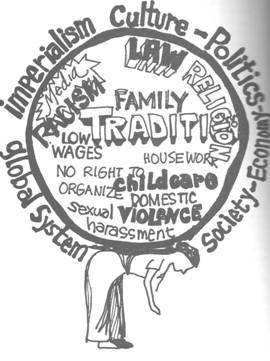
This is reinforced by traditions, culture, religion, family, law and the
media. There is a self-evident linkage
between classism, racism, militarism and sexism.
The church, because it reflects the same hierarchical and patriarchical structures of society, colludes in the
continuing oppression of women. In its
effort to maintain the status-quo it gives quasi-divine legitimation
for the inequalities it perpetuates, by utilising
theology (ideology) and consequent practices derived from the interpretation of
the Bible from a one-sided male perspective.
The Women's Movements
We affirm our conviction that the Asia/Pacific women's movements are
becoming the loud and resounding voices of women all
143
over Asia and the
Pacific. The concrete forms of
oppression they highlight are:
1. Women workers' struggle for the right to organise for justice in working conditions, for higher wages, for maternity and other benefits, childcare facilities, housing and transportation. This includes the struggle of women for employment and financial independence.
2. Peasant women's struggle for the right to land,
water, food, shelter, preservation of environment, health and literacy.
3. Women in minority communities face all these problems
and specific forms of discrimination such as forced sterilization.
4. Women in their families struggle against oppression
in the form of domestic violence, unjust marriage practices, divorce and
succession laws, dowry system, dowry deaths, female infanticide and subtle
expressions of female discrimination such as stereotypical role models.
5. In society at large women struggle against violence,
rape, prostitution and sexual harassment and the negative images of women as
sex objects in media, films, literature, etc.
6. Women struggle within the global imperialist
dominated structures of society which exploits them as producers and
consumers. They are exploited as producers
by the growing multinational corporations' domination of Asia/Pacific economies
which use them as cheap labour. They are also exploited as potential
consumers, for example, in the cosmetic and fashion industries and in the baby
food industry. The imposition of
technological development which directly affects the lives of women is
introduced without any reference to them.
7. The growing militarization of society in general, and
the growth of military structures in particular, encourages
the greater acceptance and incidence of violence against women. Women struggle against police violence and incommunicado detention, sex-specific forms of torture and
rape by state security and paramilitary forces, escalating prostitution and
international prostitution which are further consequences of the increasing
militarization.
8. The women in the church who struggle against the patriarchial domination of the church by:
a. Claiming
the right to participate in all the decision making processes of the church, by
demanding equal representation and the right to theological education and
ordination.
144
145
b. Working to
reinterpret the Bible from their concrete experience as women in society.
c. By seeking to
bring the resources of the church to the struggle of women in society.
Strategies
1. We urge the youth and student movements in the Asia/
Pacific region to recognise the strength of an
autonomous women's movement which continues to conscientise
women and men and which builds the self-confidence and collective leadership
abilities of women to play a full participatory role in the larger people's
movements for justice, equality and liberation.
We also urge youth and student movements to recognise
the different ideological strands within the women's movements which augment
the power of women. However, we place
the women's movements within the total struggle for human liberation.
2. The youth and student
movements of Asia/Pacific must actively support and stand in solidarity with
women in their struggle for human dignity.
3. Because much of the potential
leadership of the ecumenical movement and the church is found within the youth
and student movements, they must therefore:
a. ensure that their theological reflection includes the
insights which come from the reinterpretation of the Bible from the perspective
of women.
b. ensure that all the functions which are part of the
structure of the youth and student movements be equally distributed between men
and women.
c. ensure that they provide programmes for conscientization
on women's issues for women and men in student and youth movements.
Networking
Youth and student movements should take an active role in:
-
strengthening existing
networks through more systematic information dissemination, solidarity and
supportive actions;
-
establishing personal
links between women activists and groups;
-
urging CCA YOUTH in cooperation with the CCA Women's Desk
and the WSCF Asia/Pacific Region to take this networking process as a priority
for action.
146

147
Role Of Men In The Women's
Movements
Men in the youth and student movements in their support of women's
movements should:
a. be purely supportive of the women's decisions and
actions and in that way take directions from women who make the decisions;
b. support the initiatives of women to bring about change in
the hierarchical, male-dominated structure of the church and ecumenical
movement.
Recommendations
That WSCF Asia Pacific and CCA YOUTH, in cooperation with the CCA
Women's Desk:
1. Organise a regional conference on militarization and its
effects on women.
2. Organise solidarity campaigns which will support: a. women
political prisoners; b. opposition to continuing prostitution tourism; c. women
discriminated against by racism; d. action to reduce the plight of women
workers in MNCs and Export Processing Zones.
Conclusions
We believe in the power of women and that this power has the capacity to
challenge existing norms and structures.
Women, through their collective and people-oriented, non-competitive
forms of organisations, have shown that they have the
courage to experiment with new forms of political action and new models for the
transformation of society. By this they
contribute to the ecumenical vision for the future of the Asia/Pacific
region. Without the creative power of
women, any ecumenical vision negates the affirmation "Thy will be
done."