68
LIBERATING EDUCATION
NANAYAKKARA
Luis Segundo in his book 'Grace and the Human Condition'
refers to Rodo's book 'The Farewell of Gorgias'. In the book it is related that before he died one
of his disciples wanted all his other disciples to swear an oath of absolute
fidelity to each and every word of their master.
Gorgias responds to this by telling them
about a dream his mother had.
Luis Segundo relates it thus: 'In the dream Gorgias' mother was greatly attached to her baby boy's
innocence. So she obtained magic potion from a sorceress that would ensure his
continuing innocence. They worked many years, and his mother kept going back to
the sorceress for a fresh supply.
Then one day the supply ran out. She returned home
empty-handed to find herself confronted with a bitter old man. He reproached
her fiercely "Your savage egotism has robbed me of ennobling action,
illuminating thought, and fruitful love .... Give me back what you have taken
away. But now it was too late. It was time for him to die. All he could do was
to despise and curse his mother".
I have quoted this story at length because it exemplifies
and signifies the meaning of true freedom. True freedom is the possibility of
deciding our own actions. And there can be no true education unless it be education for freedom. Authentic human education is an
education in liberty.
This to my mind has to be at two levels.—
1. At the level of the individual's
liberty that urges him to fashion his own personal being.
2. At the level of the individual's total human condition (social context).
1. At the Level of the Individual.
In order to educate the individual to true freedom, it
should open up a broad range of human interests so that the person who is being
educated can combine them and balance them off in a more complete and fuller
way.
69
This presupposes that he chooses freely to be an active
participant in his education.
This leads us to the question of a critical attitude, needed
for an education that liberates. In fact liberty, to be real, must call into
question human security where it is devoid of commitment and decision making. A
critical attitude refuses to accept a situation that one finds himself in as
something that cannot be overcome. Generally this is due to the fact that some
people are classed as the people who know and others as those who do not know.
And the ones who do not know disclaim responsibility for the present situation
and even refuse to take responsibility for their own lives.
The transition from motives based on personal security to
motives based on personal responsibility will normally take place in the more
demanding sphere of the urgent problems of life. This is a pre-requisite for
self-reliance. It is education to participate in, to take sides i.e., to make an
option or to take a decision concretely in a given situation, despite the
possibility of being wrong.
It is in this context that the other element of liberating
education viz. Creativity must be mentioned. The whole point of true
education is to train the individual to exercise his creative faculties. Where
this is wanting the individual is less a man and is easily manipulated. He is
then made more an object than a subject in whom dwells
the possibility of self-determination, of true choice, and of fashioning his
own existence, which is the whole meaning of life. It is the business of true
education to equip the individual to fashion his own life into a mature fully
human existence, without which he never become self-reliant.
2. At the Level of the
Individual's Total Human Condition. (Social Context).
By social context I mean that every individual from the very
start is influenced by a system of human reactions and inter-relationships that
constitute him and form part of his total human condition. The individual is
confronted with a pattern of society, values, inter-relationships that are not
of his own creation but form the "given" or "datum" in his
life, and which he suffers or undergoes. The individual normally is not
conscious of these and is influenced by them inadvertently. They are ready made
and therefore hinder man's freedom to create values meaningful and relevent to a given situation. From the very beginning the
individual is prejudiced in favour of, what we may
call 'vested interests' within society.
These interests are generally institutionalised
for the sake of the ordering of society and the trend is then for individuals
to become unthinking cogs in a wheel, objects that are manipulated. Yet they
have within them the natural urge to fashion their own lives, creatively and
freely.
The main area of liberating education is to make the
individual conscious of those elements that hinder his personal liberty, and
vitiate his human personality. It is in this regard that educationists
speak of:
Awareness building
Conscientising
70
Politicising
De-schooling society, etc.
Many educationalists of the
The techniques for an education that will free the
individual from these disabilities that hinder his personal growth and maturity
are many, but none is fool proof. Perhaps the most efficacious method would be
involvement in the day to day life of society and reflection on same (Praxis).
This is not above or beyond the peasant and the worker. Society has perpetuated
a myth that considers only those who learn from books as teachers, and those
who have not learnt from books as the 'taught'. It is in the context of every
one becoming teacher and taught that the individual learns to be self-reliant.
The challenge to society today is to face the desire of the
youth to be critically free to mould their own life. It is the business of
education to guide this critical freedom to be a critical responsible freedom.
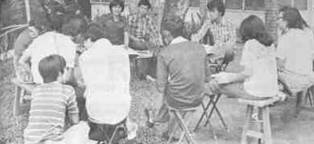
SEMINAR
GRQUP
1. What
is Liberating Education?
The history and realities of our society today consist of a
series of enslavement of the people in hunger and oppression and their struggle
to overcome them. It is along this inhuman condition of bondage that liberating
education plays a very significant role.
Liberating Education is a process in which there takes place
different stages of development of man's attitude, behaviour
and values moving towards critical consciousness. These stages are as follows:
a) Awareness; b) Responsiveness; and c) Effectiveness. Therefore, this type of
education develops man's ability to become conscious of the realities of
oneself and society, and to be able to criticize them constructively for the
common good. As a response to these realities, man is impelled to execute
appropriate actions that require a specific structure and definite methods
either for adjustment or manipulation of the environment. This structure refers
to different channels or mediums for more effective social functioning. The
methods are strategies and tactics for change and freedom. That is, a change
brought about by breaking down the structures of poverty and exploitation
whereby people, both the oppressed and oppressor are liberated in order to
exercise their inherent freedom with responsibility and discipline. In this
context, there are two dimensions of liberating education, namely:
71
A — CONTENT : Man in relation to
society and the brutalities of the existing social systems;
B — GOALS : i) For man to be able to defend himself against
these systems;
ii) The development of "Man" for
others.
2. Existing
Educational Systems.
In the early periods, the Asian countries had a self-reliant
economy, with rich culture and tradition. The then educational system was
geared towards the strengthening of this self-reliant community, and was
related to the needs of the people as a whole — whether social, economic or
cultural. The Buddhist Monastaries of Sri Lanka, and
the Universities of Nalanda and Takshila
in
We witnessed death of such a self-reliant educational system
after the entry of the colonizers in
Some of the characteristic elements .of this educational
system are:
a) It is
individualistic and injects self-centred satisfication to those who go through it;
b) It breeds a sense
of competition based on materialistic values;
c) The content of the
education is geared towards promoting capitalistic mode of production;
72
d) It alienates
people from their own cultures, surroundings and people;
e) It covers a very
small minority of people;
f) It is irrelevant
to the life of the people;
g) It makes one dependent on development
models of the imperialistic countries.
3. EXPERIMENTS IN
LIBERATING EDUCATION OF CHRISTIAN GROUPS.
Liberating Education takes many forms but the goal is always
the same for members of the group. The goal is to raise the level of awareness
among the people in order to solve their problems by bringing about fundamental
change in society.
In
In
In
Whether political education is conducted through the
cultural media, the workcamp method or the
seminar-cum-live-ins, they share a common factor, namely, working among the
oppressed people.