88
REFLECTIONS AND CELEBRATION!

O GOD OUR LOVING
FATHER,
we come before you knowing that you
have given us community, and that we
have broken it.
We are conscious that
we alone cannot
restore wholeness into our brokenness,
that our wholeness comes only from you,
Our
Creator.
Move us.. disturb us.. shake
us now,
O Lord,
That we may begin to
restore something
of the wholeness which you have created
and entrusted to us.
O GOD, OUR LOVING
FATHER,
we pray for this ASSEMBLY
which we are opening at this time.
That you may bless our
labours in
our attempt
to understand the Asian reality
informed by the rich resources of
your Gospel and your Spirit.
While we are together
here,
we want to be a sign of your community
of love,
which you have promised and demonstrated
in Jesus.
KUM
BAH YAH. OUR LORD. AMEN.
89
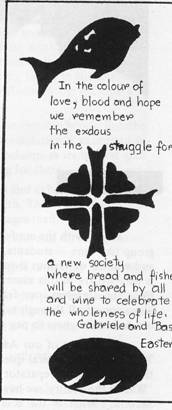
Come Lord, Jesus
Chorus:
Come,
Lord Jesus,
the light is dying,
the night keeps crying:
Come
Lord Jesus.
1. Christ, come quickly,
there's danger at the door,
Poverty a-plenty,
hearts gone wild with war,
There's hunger in the city and
famine on the plain. (Chorus)
2. Want demands a-hearing
in far too many lands.
The sick go unattended,
death deals a heavy hand,
The dreams of men are empty,
their cup of sorrow full. (Chorus)
3. World awaits in darkness
a mighty burst of light,
To set the lame man leaping,
to give the blind man sight,
We have the prophet's promise,
we await the Prince of Peace. (Chorus)
4. Clouds shall send a Saviour,
like softly falling rain.
Yet mighty in his power,
to free us from our chains.
His shield will be compassion,
his weapon liberty. (Chorus)
90
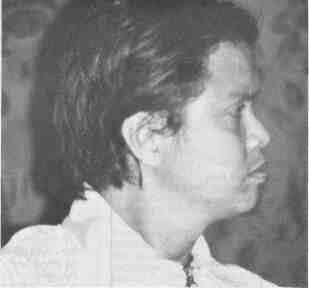
CORTEZ
I start with the confession that I find it difficult to
reflect for a mixed group like ours — students, workers among farmers and labourers, and men and women of various living faiths. But,
we must dare reflect — in fact this is why we are in this assembly — to gather
into one, if possible, our aspirations for ourselves, our fellow Asians, and
all of humankind towards the liberation of all through reliance on our own
capabilities and resources, on our own willingness to pay the price for a just
and humane society.
The theme of our Assembly — "The Struggle for
Self-Reliance in Asia Today"
— begs several questions which have been the guiding reference of the staff and the Preparatory
Committee in preparing for this meeting. First, "What is the 'reality' we
have to face in
The first two questions have been meticulously discussed and
expounded in the keynote address and seminar papers prepared for-the Assembly.
I am sure that that will not be the end of that — we shall be wrestling with
these, hopefully, with newer insights as we go on in the daily sessions and
even in informal conversations. It
is to the last two questions,
91
therefore, that I would like this short reflection to zero in.
The record of religions in
And it is not as if the living faiths in
Buddhism teaches the limitation of desire. Just think of the
simple mathematics of this. If desire (which can be extended to greed for
wealth and power or translated as simple unabated consumerism) is limited, then
there would be enough to pass around for all; the few (the elite) would not
want to gorge themselves with the vast resources and products and wealth of the
land. This sounds a bit simplistic, but it must work out if put into practice.
The truth is that the teaching has never been really taken seriously, at least
to a proportion that it would be a deterring factor in the unabated drive for
more and more material acquisition influenced by systems and forces of
exploitation and domination.
Islam is rich in teachings and traditions on brotherhood.
For the overcoming of the oppression of other Muslims, solidarity is expressed
in various ways and means. This particular faith proclaims as its highest goal
the good and well-being of others, loving and caring for them.
The Christian faith is replete with teachings and
exhortation centered on the need to establish justice throughout the earth.
This is the tradition of the Old Testament and is borne by one of the passages
read:
"O ye who turn justice to
wormwood, and cast down righteousness to the earth.
They hate him who reproves in the gate, and they abhor him
who speaks the truth.
Therefore, because they trample upon the poor and take from
him exactions of wheat, you have built houses of hewn stone, but shall not
dwell in them, you have planted pleasant vineyards but shall not drink their wine ...
But let justice roll down like waters, and righteousness
like an ever-flowing stream." (Amos 5)
In the New Testament, one discovers the same tradition in
the words and teachings of our Lord both in the Nazareth Manifesto (Luke 4) and
the account of the Last Judgement (Matthew 25).
"The
Spirit of the Lord is upon me, because he has anointed me to preach good news
to the poor. He has sent me to proclaim release to the captives and recovering
of sight to the blind, to set at liberty those who are oppressed, to proclaim
the acceptable year of the Lord." (Luke 4)
"When
the Son of God comes in his glory, and all the angels
92
with
him, then he will sit on his throne . . . Then the King will say to those at
his right hand, 'Come, 0 blessed of my Father, inherit the kingdom prepared for
you from the foundation of the world; for I was a stranger and you welcomed me,
I was in prison and you came to me'... " (Matt. 25)
Injustice is an ancient issue. It was true in the Old
Testament days, it was still a part of the reality
during the ministry days of our Lord as it is the dominant picture of the
social scene in most if not all of Asian countries and of other
Let us now hurry to the last question — which touches on the
role of Christian students in the whole arena of the Asian struggle. SCMers and
Catholic students present here who genuinely are part of people's movements in their own contexts,
working with fellow students and youth, with farmers, with the labouring masses, must have discovered the loneliness of
their own existential posture. For you, who have taken this decisive commitment,
are among those who respond to present day realities in
And some of us who still are groping and are faltering in
the search for meaning in it all, for some assurance that the contradictions
will finally find unity at some junctures of the struggle, should be able, we
hope, to take some further steps as we try to learn from each other during
these days of our coming together. For whether we belong to the first category
or the second, we all are, I am sure, among others in
TANG
The past few days we have spent on piecing together the
Asian reality and identifying the forces which have moulded
our countries, our peoples, ourselves. It was not a mere intellectual exercise.
The Asian reality is a challenge to our faith. A faith rooted in Christ — of
courage, strength and honesty. In our Asian situation we cannot afford to be
apologetic Christians,
93
especially since we are a minority. And secular society cannot be
ignored. This challenge came up clearly in yesterday's
plenary on the role of faith. Faith is not something to be taken for granted.
With this in mind I chose these verses. Perhaps we can reflect on 2 points.
Jesus said, "You did not choose me, but I choose you". I think it's
important to stress that even when we talk of self reliance, we must recognise that we are only self-reliant in Christ. We must
avoid making ultimates of ourselves, our ambitions,
our ideals, in the name of God and the people. There is joy in Christianity.
'These things I have spoken to you, that my joy may be in you and that your joy
may be full". My prayer for all of us for today and the next few days is
that we may bring the love and joy of Christ with us wherever we go.

B. KUMAR
When everybody returned to the Centre, I was observing that
some of us were not quite happy about the field trip. Some were complaining
that they didn't have enough sleep, their legs ached, the toilet was not good, the bathroom was not good. Well, that is the reality for us
today. And when we talk about our involvement and commitment to the people, the
biggest question that we face today is — are we ready to be involved as a
result of our commitment?
This is the challenge for us today. I would like to give a
small example. Let us take some water in a glass. Let us assume this as the
world. Let this sugar be the agent. If we want the water to be sweet, i.e.
change its status, we have to put the lump of sugar in it. The sugar cannot
melt outside and see that the water gets a new status. Unless it gets into the
water and dissolve itself, completely disfiguring itself, this water won't
change. Unless it gets into each and everyone of the water molecules and
identifies itself with the water, it cannot bring about sweetness in the water.
This is the task before us. Unless we get into society,
unless we sacrifice
94
ourselves for the task, we cannot bring about any change. This calls
for commitment. God's call today for us is towards commitment — which may mean
the cost of our own lives. And I leave this question before us — whether we are
willing to take up the task and the cost.

BALASURIYA
My thoughts this evening, first of all, is with the fire,
also with the surge of the student movement. You will excuse me if I refer to
the past many, many years of the growth of student movement. I remember, in
1964, in
95
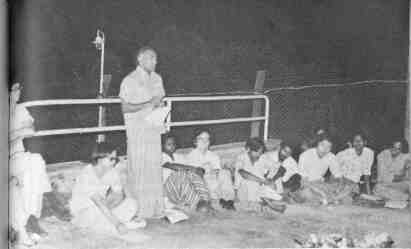
Let us think of fire, the fire that burns. If you want to
join two metals together you have to warm them and bum against sufficient heat
that they would get united. I think we don't want to get too united for the
moment, but in order to work together, we need to bum away some of our differences
and perhaps be wise enough to think of others.
I think also of the fire of the Old Testament, so often
mentioned. I am not thinking so much of the fire when there is a victim to be
found, but I think of the Lord leading the people to Liberation. He led them
because he saw his people suffering oppression under the Egyptians, and the
Scripture says the Lord did not like it. He asked Moses to lead them and he led
them through the desert under a cloud by day and a pillar of fire by night.
I think as we go through life, we will have many moments of
suffering. I can think of our own student movement, the Catholic Students - in
1971, while we were in
But we have to go through the desert, there is no
alternative. We can look for the fleshpots of
96
at one moment, he said, "This is not enough, I must go and join my
friends, my comrades". And he went out. Afterwards, you may agree or
disagree, lie was involved in the rebellion — he is now in prison, he will be
released shortly.
I do not say we agree or disagree but this is one of the
problems that we have to suffer. So, in that, let us spend this evening in a
reflective mood, so that in moments of suffering, when we have to take a
decision, when we are asked to go forward, or do we go backward? What type of
marriage do we take? What type of job do we accept? Are we going to join the
system and reap the benefits or go the hard way and join the struggles of
people, searching for a better situation? May this fire be a
strength to us. May it be a light to us. May it
warm us.
So I would like to invite you to pray for all, to pray for
our family, that they may understand — so very often, the suffering of option
is that they do not understand, we do not understand. The family does not make
an option together.
The idea was that whatever hopes and inspirations we have,
that we put it in the fire, perhaps to be burned - maybe the frustrations, or
maybe we hope that they will be so burned and be linked together - to form a
spirit, by which IMCS & WSCF forgetting their minor differences may be
linked together with the vast struggle of so many others in Jesus Christ. Jesus
Christ is more than Churches, more than Protestants, more than Catholics, it is
more than religion. It is the whole of mankind — that we may belong to that.
Finally, the fire is also a funeral fire. In our land, we
cremate, but to remember that death is a liberation.
When we accept death, we have no more fear. Fortunately, we don't live forever.
So, we can contest any enemy, any force, because our Lord says, "Do not be
afraid of those who can take life away". Because there
is something more worthwhile than life.
It is LOVE, it is Service, it is
living for one another. That is divine. That is God. So when we are prepared to
be put in the fire, then we have no more fear. That is the true inner
liberation.
|
PANANAGUTAN (PILIPINO) Walang sinuman ang nabubuhay para
sa sarili lamang Walang sinuman ang namamatay Ref.: Tayong lahat ay may pananagutan sa isa 't isa Tayong lahat ay tinipon ng Diyos na
kapiling niya. |
RESPONSIBILITY Nobody lives for himself alone Nobody dies for himself alone Ref.: All of us have a responsibility for each other All of us are gathered in the Lord as one family. |
97
O GOD, OUR FATHER
we thank you
for having been present
throughout these ten days with us
unseen,
but our faith told us that
you were with us.
With all our faults, our selfish interests,
you have accepted us.
Among our conflicts,
your unseen hand was there.
We ask pardon
and grace.
As we go forth
strengthen us in your hope.
Lead us in our courageous step,
and if we fall, forgive us.
Make us humble,
make us learn from others
as we go out to fulfill
our resolutions. AMEN.
(Bishop Leo)