110
Chapter 8:
SEXUALITY AND CHRISTIAN ETHICS
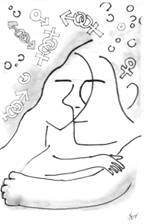
HUMAN CONTEXT
We live in a world of sexplosion. Television, movies, advertisements, innumerable
magazines and now the computer and Internet have accelerated the process of
exposure of sexuality in our time. It is publicised, glamorised, sensationalised and
deliberately commercialised. In the process it
becomes trivialised.
We think we live in a sex-saturated society as a result of mass media
and information technology, but in fact, people do not know the real purpose
and meaning of sexuality. There is so much misuse or abuse of sexuality that
prevents people from understanding it rationally and objectively. More than ever before there are several
sexual options or alternatives available: ‘living together’, homosexuality,
single parenting, teen-age sex, pre-marital, marital and extra-marital sex. The wide publicity given to relationships between
Princess Diana and Fayad Dodi
and President Clinton and Monica Lewinsky are good examples of how sexual
affairs can be blown out of proportion.
On one hand we realise that a sexual
orientation is the basic right of an individual anywhere. It is a fundamental urge or a necessity. But on the other hand, there is so much
confusion and misinformation about sex. Therefore, basically for these two
reasons it is important that we comprehend the issue from a Biblical point of
view. Where does it stand with regard to sex and sexual orientation?
111
OLD TESTAMENT BACKGROUND
In Genesis chapters one and two, human beings were
created in God’s image. Consequently, sexuality is a divine gift and a
privilege. Human sexuality is fundamental to the human structure. Adam was incomplete without Eve.
Then the Lord God said, ‘It is not
good that man should be alone; I will make him a helper as his partner’ ...
Then the man said, “This
at last is bone of my bones and flesh of my flesh; she shall be called Woman (ishshah), for she was taken out of Man (ish).’ Therefore a man leaves his father and his
mother and clings to his wife, and they become one flesh. 236
This ancient text makes abundantly clear that sexual
attraction is part and parcel of the divine plan. They are meant for each other, is not just
biologically but also social-spiritually. The distinction of sexuality is not
superficial, according to this Biblical narrative. It is not limited to certain parts of the
body. Consequently, human personality is nothing without this sexual
distinction. Thus leaving, cleaving and
ultimately becoming one is in the nature of human existence and is divinely
ordained. Therefore, it should not be
considered as inherently evil.
In the Old Testament,
the Hebrew word for soul is nephesh. It refers
to the whole human being, including the body with its senses. According to them, a human being is the unity
of body and mind. Thus human sexuality cannot be reduced or limited to the
sexual organs. It embraces the whole
range of feelings and actions dominated by the relations between people. Thus
the ancient Jewish people had a naturalistic and realistic perspective on human
sexuality. There are several stories of sexuality or sexual relationships found
in the Old Testament, good and bad, natural and ‘unnatural’, public and
private. Some of the best-known ones are
Samson and Delilah,237
David and Uriah’s wife,238
and the stories of Ruth and Esther239.
They demonstrate the strength and weakness, possibilities and limitations of
human sexuality. They do not hide or
feel guilty about these relationships. However, abuse
_____
236 Genesis 2:18, 20b; 23-24
237 Judges 16
238 II Samuel chapter11-12
239 The Book of Ruth
112
or misuse of sexual relationships is vehemently condemned
whether committed by commoners or kings, such as the case of Solomon and
foreign women240 ; Miriam and Aaron241; Joseph and Potiphar’s
wife in Egypt242; Tamar and Amnon243; Abigail and Nabal244.
It is interesting and significant that in spite of
their deeply-entrenched, male-chauvinism, the ancient
Jewish leaders had put some great words in the mouths of women as illustrated
in the Song of Hannah, the mother of Samuel 245 which anticipates
the Song of Mary, the mother of Jesus246. We also hear the Song of Deborah, the prophetess247.
The Old Testament takes note of and appreciates the bravery of a woman
like Rahab248 the leadership of the queen
of Sheba249; and the partnership of David
and Bathsheba. So it would be wrong to think that the ancient culture and
society in Israel did not give a significant place to women. As cited above some were leaders, queens or
partners of great repute.
Having seen the positive side of
human sexuality in the Old Testament now we turn our attention to the negative
side. Obviously,
the ancient writers legitimised and supported gender
discrimination. They viewed female sexuality in a poor light. There are certain
texts in the Old Testament that are downright derogatory towards human
sexuality. The Bible is the product of the patriarchal society. Consequently, it is essentially a man’s book
where the woman appear for the most part as an adjunct to men, significant only
in the context of man’s activity. The language of the Old Testament is
male-dominated and andro-centric. We will cite few
examples to illustrate this dichotomy in human sexuality.
_____
240 I Kings 11
241 Numbers 12
242 Genesis 39
243 II Samuel 13
244 I Samuel 25
245 I Samuel 2:1-10
246 Luke 1:46-55
247 Judges 5:2-31
248 Joshua 2
249 I Kings l0
113
The story of Lot’s decision about his two virgin daughters250 and of Jephthah’s
vow to God which later led to the sacrifice of his only daughter251
are indicative of woman’s total submission or subservience to the will of the
father or husband. The notion of women as property could be directly traced to
the Judaic, patriarchal family structure.
It is mentioned,
You shall not covet your neighbour’s house; you shall not covet your neighbour’s wife, or male or female slave, or ox, or
donkey, or anything that belongs to your neighbour252.
She is a possession like the ox or the donkey. Her consent for marriage was never thought of253 as for example when Ruth was finally
bought along with the field that Boaz had redeemed254.
A newly wedded wife, if she did not show the sign of virginity, was considered
to having violated the honour of her father and her
husband and thereby deserved death by stoning255. It is mentioned in the same chapter, that in
the case of adultery, both man and woman must be put to death but not because
he is equally guilty in the act but because he had violated the exclusive right
of the woman’s husband256. It is only the husband and not the wife who
can charge infidelity in the partner and thereby demands his spouse to submit
to the ordeal of testing257. Only man
could initiate a divorce and it is referred to as ‘putting his wife away’ as if
she was an animal with some kind of an incurable disease258. It is also asserted,
When a man is newly married, he
shall not go out with the army or be charged with any related duty. He shall be free at home for one year, to be
happy with the wife whom he has married259.
______
250 Genesis 19:8ff
251 Judges 11:29-40
252 Exodus 20:17 and repeated in Deuteronomy 5: 21
253 Ex. 22:16
254 Ruth 4: 5 and 10
255 Deut. 22:13-21
256 Lev. 20:10
257 Num. 5:11-31
258 Deut. 24:l-4
259 Deut. 24:5
114
Thus it is the happiness of the husband that is paramount.
Wife’s joy is not at all taken into consideration. Woman was considered as
unclean in the Old Testament period because of the taboo related to menstruation260 and childbirth261.
Every Hebrew male regarded himself as carrying the seed in his loins. He was to
plant the seed and a woman’s womb was considered to be a kind of an
‘incubator’. Her role in the process of reproduction was essentially passive
and subsidiary. Obviously, the Levitical and Deuteronomic sex
codes were downright derogatory and discriminatory against woman. What is worse
is that such laws were legitimised by the religious
establishment of the time and consequently, considered sacred and holy!
The creation of humanity as found in the Book of
Genesis reflects the relationality and complementarity of the two sexes. They ought to be
considered as equal partners of God’s nature and purpose. In that ancient Book
it is categorically stated,
Then God said, ‘Let
us make humankind in our image, according to our likeness; . . . So God created
humankind in his image, in the image of God he created them: male and female he
created them. God blessed them...’262
In the second chapter of the Bible, we need to take
note specifically of 18b which states ‘a helper fit for him’(RSV);
“a suitable companion to help him”(Good News); “a partner for him’ (New
English). Thus different sexual
orientation is considered to be necessary and good. The two stories of human
creation on Genesis need to be taken together and interpreted properly to
advocate sexual equality and freedom.
APOSTOLIC WITNESS
The early Jewish Christians seem to entertain such
negative attitudes towards female sexuality. Paul was naturally influenced by
his culture and society of his own time. His rabbinic upbringing also endorsed
negative thinking about woman in
_____
260 Lev. 15:19-24
261 Lev. 12:2-5
262 Genesis 1:26a, 2
115
particular. A Jewish man’s daily litany was that he was
grateful to God that he was not born a woman.
Woman was not permitted to read the Torah (the law). It was
better to burn it rather than place it in the hands of woman! Paul was nurtured and nourished in that
tradition. Therefore it is not surprising to hear in the Pauline epistles,
Let a woman learn in silence with
full submission. I permit no woman to
teach or to have authority over a man; she is to keep silent. For Adam was formed first,
then Eve; and Adam was not deceived but the woman was deceived and became a
transgressor. Yet she will be
saved through childbearing . . .263
It is most unfortunate that the apostle Paul should
perceive of woman in such a manner and issue instructions about their dress,
hairdo and a code of conduct in public on the basis of the Genesis narrative!!
Similarly, Paul in his exhortation to the husband and wife states publicly,
Be subject to one another out of
reverence for Christ. Wives, be subject to your husbands as you are to the
Lord. For the husband is the head of the
wife just as Christ is the head of the church ... Just as church is subject to
Christ, so also the wives ought to be, in everything, to their husbands. 264
Here again the Pauline analogy is the relationship
between the church and Christ. If we read this section carefully, we will
discover that the conservative Paul is struggling with this analogy. He wants
to understand the relationship in terms of mutuality or reciprocity. He does write about “Be subject to one
another”; “love your wives” and finally, retraces to the ancient adage, “the
two will become one flesh.” It indicates that Paul is attempting to transcend
his cultural-societal conditioning. Writing to the Corinthians, Paul instructs
woman to cover her hair and keep it long on theological-Christological ground.265 Obedience and submission were the
watchwords for woman according to Paul in particular. But his conversion experience did give him the
vision of equality and freedom for woman and man. Although he belonged to the male-dominated
society, he was able to grasp or be
_____
263 I Tim. 2:11-15a; read also verses 9-10
264 Ephesians 5: 21-24; read also verses 25 to 33
of the same chapter.
265 I Corinthians 11: 2-16
116
grasped by the grace and love of God in
Jesus the Christ. This prompted him to
utter,
For through faith you are all
children of God in union with Christ Jesus.
Baptized into union with him, you have all put on Christ as a
garment. There is no such thing as a Jew
or Greek, slave and freeman, male and female; for you are all one in Christ Jesus266.
Evidently, Paul is wrestling with himself about the
nature and function of woman. On the one
hand, we are disappointed with Paul about some of his instructions and
exhortations to woman. But on the other
hand, we rejoice that even in that ancient world, he was able to affirm woman’s
God-given image and consequently her equality with men. He was unconsciously and consciously mixing
theology with sociology of his time.
GOSPEL TRUTH
When we turn to Jesus himself, we are amazed at his open,
honest and non-hypocritical attitude and action towards woman in general. There
is a surprising element of iconoclasm towards the traditional subjugation and
subordination of women in Jewish life. Jesus refused to conform to the status
quo or the establishment of the time. He openly and directly questioned,
challenged and sought to change the gender relationship. For him human
sexuality must promote and strengthen higher goals or ideals.
Jesus’ close, male disciples were astonished (or
irritated) to see him holding a conversation with a Samaritan woman in public
near a well. 267 The Jewish rabbi, Jesus, had violated the standard
norm, of the time by deliberately entering into a dialogue with a Samaritan
woman in public. He was obviously offending the sense and sensibilities of the
surrounding people and his own male disciples in particular. They were confused.
_____
266 Gal. 3:26-28
267 John 4:4-30 particularly verse 27
117
In the story where a woman is condemned for adultery268, Jesus refused to condemn her and
indirectly questioned and challenged the Jewish judicial system that was prone
to misinterpretation. Such a system easily victimised
the woman, the man in the act was permitted to go scot-free and the people in
general and the Pharisees In particular, are ready to stone her to a cruel
death. Such was the gender-bias of the
law of the time and Jesus rightly refused to yield and acquiesce to such gender
injustice. It is not surprising that the sex-workers of Jesus’ society felt
free in his presence, not because he was easy with them, but he did not look at
them as sex objects to be exploited and deliberately marginalized. Unlike the other rabbis of those days, Jesus
had quite a number of women friends and disciples like Martha and Mary269; Mary of Magdala270
and others. Many of Jesus’ examples or
illustrations were taken from the life and work of ordinary women -
faithfulness of poor widows271 and love
and loyalty of a woman of dubious character272.
Jesus did not tolerate double standards and a hypocritical attitude and action
of his society and was particularly harsh on Pharisees. He maintained and
sustained an open, healthy and wholesome relationship with all kinds of people
- woman and man; young and old; sick and apparently not so sick. More
important, human sexuality or different sexual orientations did not pose a
problem for Jesus. Even as a young rabbi, he did not entertain any unhealthy,
repressive perspective with regard to people of the opposite sex. On the
contrary, he held them in respect and honour.
According to the Johannine
declaration, Jesus is “the Word became flesh and lived among us”273.
There is no dualism or dichotomy between flesh and spirit in the economy
of God’s liberating work. On the
contrary, the human flesh is sanctified and even glorified in the incarnation.
Therefore, there is no reason to reject the flesh and be ashamed of the human
body in the plan and purpose of God. I
may also mention that “the resurrection of the body” reinforces and strengthens
this positive, wholesome orientation towards human sexuality. It is true that Jesus was not married because
of his own unique mission and ministry.
But his beloved disciple,
_____
268 John 8:1-11
269 Luke 10: 38-42; John 11
270 Matthew 27: 55-56; 28:l;
Luke 8:1-3; John 19: 25
271 Luke 21:1-4
272 Luke 7:36-50
273 John 1:14a
118
Peter was very much married and Jesus had no problems
Jesus did not ask Peter to leave his wife.274
Jesus was born and bred in a family environment. The gospels mention his
mother, Mary, his father, Joseph and his brother James. 275 Of
course Jesus expanded the meaning and significance of a family, making it
spiritual-theological. He had said,
They (people) said to him, ‘Your
mother and your brothers and sisters are outside, asking for you.’ And he
(Jesus) replied, ‘Who are my mother and brothers?’ And looking at those who sat
around him, he said, ‘Here are my mother and brothers! Whoever does the will of
God is my brother and sister and mother’. 276
There is no negation of sexuality, marriage and family
by Jesus but enriching and giving them bigger and higher meaning, Jesus had
repeated and reinforced the ‘one flesh principle’ when he definitively
declared.
Have you not read that the One who
made them at the beginning ‘made them male and female,’ and said, ‘for this
reason a man shall leave his father and mother and be joined to his wife, and
the two shall become one flesh’. So they are no longer two, but one flesh.
Therefore what God has joined together, let no one separate.’277
In this context it is important and necessary to note
the role and function of Mary, the mother of Jesus, according to the gospel
writers. In the Magnificat, 278
Mary is conceived as a politically aware woman who suffers humiliation of her
people and hopes that God in the person of the messiah would bring about
much-needed transformation. She is presented as a socially sensitive woman. She
does not disappear after the birth of Jesus. According to the gospel writers,
Mary appears at crucial moments in the life of Jesus, just when something new
is about to break in. She realises that loyalty to the kingdom of God is higher than
and prior to the loyalty to parents and family as mentioned above. Mary provided for Jesus and the latter provided
for the former before his death on the cross of Calvary.279
Thus unlike John the Baptist, Jesus is not an ascetic but portrayed as familial
and social.
_______
274 Matt. 8:14; Lu. 4:38
275 Lu. 2:52; Mark 6:3
276 Mk. 3:32-34; repeated in Matt. 12:46-50, Luke
8:19-21
277 Matt. 19:4-6
278 Luke 1:46-55
279 John 19:25-27
119
THEOLOGICAL-ETHICAL AFFIRMATIONS
On the whole Christianity is not anti-sex. It appreciates the God-given gift. It has to be exercised with love, freedom and
responsibility. This means that the Bible is not pro-sex promoting promiscuous
sexual behaviour, There must be a place for eroticism
in human life but ultimately, human sexuality must be governed by agape
or hesed love. Both in the Old and New
Testaments, we find analogies and illustrations drawn from conjugal and
familial relationships. The relationship between God and Israel; Jesus and his
followers and church-Christ-members are conceived in terms of bride and the
bridegroom; husband and wife; sons/daughters/children; household or family of
God and such others.
God in Jesus did not suffer from inhibitions within or
did not indulge in prohibitions without about human sexuality. He was not characterised
by dos and don’ts, by fear, anxiety or any unhealthy guilt-complex about
it. He refused to be authoritarian and
legalistic about it as were the scribes and Pharisees. Asceticism and other-worldliness
were not the modes of Jesus’ thought and action. Mortification of the flesh and suppression of
the natural desires and instincts were not encouraged or supported. According to the Biblical
writers, human sexuality has to do with the whole range of feelings and actions
dominated by the relations between persons. It is not some blind impulses but
an expression of the selfhood or the personhood.
QUESTIONS FOR GROUP DISCUSSION
What has been
done or could be done in your church and society to achieve gender-justice?
Is there sex
education in your school system or in your church? Is it adequate? What can be done to improve it?
What are the
reasons for and against divorce? What can your church do to encourage and
strengthen family life?
120
FIELD EDUCATION
Make an empirical study of your congregation with
regard to sex and sex education. Make
sure that you select the group carefully - a proper proportion between women
and men; young and old; educated find not so educated; well off and not so well
off; clergy and laity. Make suggestions
to improve the situation.
QUOTATIONS FOR PERSONAL AND GROUP
REFLECTIONS
It must be admitted that deeply rooted organic drives
and intense and complex human emotions are components of sexuality. Indeed, sexuality seems to be precariously
poised on the boundary between irrationality and rationality, anarchy and
sobriety, as to nullify every attempt to bring the counsels of judgement and virtue to bear upon the guidance of sexual behaviour . . . Sexuality is a kind of a sacrament. Lust must, of course, be overcome. But the basic sexual attraction is a gift of
the Creator to the creature and thus is good . . . Marriage is a symbol of the
eschatological marriage in which Christ is the bridegroom of humanity as such.
Cultural forces often affect the ideals that constitute
a ‘good’ marriage and family life. Social and economic forces have changed and
continue to change marriage and family patterns in many parts of the world. The
exploitation of persons for the sake of sexual gratification alone is judged to
be morally wrong. It is demeaning to the meaning of personal life, and surely
not a solid basis for sustaining, human relationships, for persons to treat one
another merely as objects for physical gratification. There is a natural
revulsion on the part of women who have been subject to sexual exploitation and
harassment; there is a violation of their ‘natures’ as human persons.
There can be no self without a body, for it is in
virtue of the body that we are in the world.
Only as embodied selves can we act on the world or be acted upon by the
world. The body is ‘appendage to the self,
still less an encumbrance to the self, but
121
an essential part of personal being. Body is the condition for our participation
in a world and for our attainment of personal being - a
condition so essential as it is correct to say that a human being is a body
rather than has a body. The body is the
basis, the subject of personality.
When a woman thinks alone, she thinks evil. . I have
found a woman more bitter than death, and a good woman subject to carnal lust .
. . They have slippery tongues. . Since they are weak, they find an easy and
secret manner of vindicating themselves in witchcraft. They are feebler both in mind and body. It is not surprising that they should come
under the spell of witchcraft . . . As regards intellect, women are like
children . . . And it should be noted that there was a defect in the formation
of the first woman since she was formed from the bent rib, the rib of the
breast which is bent in the contrary direction to man. Women have weak
memories, she is a liar by nature . . . Let us consider her gait, posture and
habit, in which she is vanity of vanities . . . Woman is a weedling
and a secret enemy. For the sake of
fulfilling their lusts they consort even with the devils.
REFERENCES
Cole, William Graham, Sex in Christianity and
Psychoanalysis
Lehmann, Foul, Ethics in a Christian
Context
Kapur, Promilla,
Love, Marriage, Sex and Indian Women
Phadnis, Urmila
and Malani, Indira (ed.), Women of the World:
Illusion and Reality.
Bartdn, Mukti., Creation and Fall
and the Women of Bangladesh: A Contextual Study
Sinha,Indrani and Sleightholme,
Carolyn, Guilty Without Trial: Women in the Sex Trade in Calcutta
122
Faria, Stella, Scott, Corinne and Tellis-Nayak, Jessie (ed.) Biblical Women: Our
Foremothers
Women of Courage: Asian Women Reading the Bible