1
THIS ISSUE
This special issue, the thickest so far, of PRAXIS
spotlights the mounting solidarity and determination of the South Pacific peoples
to end the political and economic colonial powers of
Invariably the writers whether in an analytical stance
or in a reportorial style or in a deep reflective mood look hard into the
complex roots and results of imperialism and colonialism in the region. Again
and again they point out that economics are at the root of the problem –
economic exploitation and the subjugation of peoples through the application of
a superior technological strength. So while some are working for political
independence, an indispensable step in breaking down colonial territorial
dependence, all are struggling for economic emancipation. Foe indeed for
the few countries who have been “given their independence” the same economic
strangulation and imperialistic conditions prevail.
One author would delve into the racist motive of
imperialism, especially white racism. His point is bolstered by the reports on
continued discrimination and injustices against the Aborigines and migrant
workers in
The land question is brought to fare in more than two
articles. This problem, like any other colonial question, is handled by the
colonial powers in such a way as to yield maximum profits for their
investments. The continuous alienation of lands, which rightfully belong to the
people, is one cause of the poverty of the majority of the populace. Among the
colonialists land alienation tactics is the enactment of military defense acts.
This has contributed to the militarization of the region where nuclear weapons
delivery systems of the superpowers are deployed and tested. The rape of the
seas has been the cause of urgent action and organizing from the peoples of the
Pacific and others who would join them.
Two rays of hope pierce through the throes
o6 the peoples’ political, economic and military struggle. One is the POWER of aware,
concerned and organized people as seen in the Kanaks
in New Caledonia, the nationalists in the New Hebrides, the FRETILIN
in East Timor. Taking some cues from the
experiences of their brothers in Asia and Africa, these groups are attacking
their problems in 2 fronts: a fight for political independence and the building
of implementation of structures and programs, even at this stage, to carry out
their program of self reliance. The
second is the active support of some segments of Christian community to the
struggle. Would that the whole Church
come to repentance, a turning away from identifying itself and its institutions
with the structures and the systems that perpetuate the oppression and exploitation
of the poor and the powerless.
2
Analysis
The much
– heralded political "independence" for emerging Pacific nations is a
farce and a gross cover – up for the prolongation of the capitalist market
system and strengthening of neo-colonialism.
This is
the view of many activists in the liberation and revolutionary movements
emerging in the Pacific islands.
It is
also the new survival strategy of the colonial and imperialist powers in the
Pacific in the face of the fatal blows being dealt to them in Asia and
The
scenario of the colonial powers is simple: we think we can keep all our marbles
and the same old game if we merely change the players. For marbles, let us
substitute investments and profits; for players, localized administrations; and
for game, capitalist exploitation.
The
effectiveness of this neo-colonial Pacific strategy is shown by the rising
number arid widening scope of existing and planned investments or multinational
corporations in the Pacific islands. It is shown by new "aid" grants
and programs from western governments and supra-national funding agencies. And
it is reflected in the French nuclear testing program in French Polynesia, in
the
It is
also reflected in a recent comment to me by the land department chief of one
of the largest developers in the Pacific in answer to how his company fared,
under colonial domination and after "independence": "We find
little difference before and after independence”.
Others
believe that multinational corporations often do much better under politically
"independent" regimes than under colonial administrations. The
multinationals blame bad conditions on the old colonial regimes while claiming
credit for any sign of progress.
Localization
is a term used to describe political home rule, decisions made here rather than
in
Localization
achieved through non-revolutionary transfer of colonial powers is a new
hang-loose phase in capitalist operations. It is the adaptation to the
transition of political power from old corrupt overseas colonial regimes to new
servile local regimes.
*By John Kelly, who recently attended the Conference
for a Nuclear Free Pacific in
**The largest of these will be the 9000-megawatt
3
Rather than a power struggle, we
see surprisingly smooth transitions of power from remote to local elites made
possible by training programs. Under the new regimes, the selling of cheap
labor and resources goes on as efficiently as before but without many of the
colonial stigmas of the past.
Those who
suffer from the deception, of course, are the masses of working people whose
labor power is the prime target of foreign investors. It is these Pacific islanders who would be
willing to fight for full economic as well as political self-determination if
it were not for the blandishments of liberal politicians who do not hesitate to
use the currently popular rhetoric of revolutions yet fear and distrust the
masses and subvert direct action by them against their enemies.
The shift
from colonial to local administrations carries with it a change from overt to
covert racism, the use of local, black administrations to cover policies and
practices of benefit to colonial powers, most of which powers happen to be
conspicuously white.
At
another level, examine the budgets and foreign trade accounts of the new
national administrations. In these
accounts, we find internal revenues are small or practically
non-existent. How then do the
"independent" regimes pay their costs of operations? How do they finance the urban infrastructures
including roads, power and water supplies, schools, government buildings and
civil service salaries that accompany development?
These
costs are paid from large "aid" grants from the colonial mother
countries. Most of the new Pacific
island "nations" are predominantly rural subsistence economies or
still outright economic colonies.
Lacking the flow of taxable consumer commodities and the buying and
selling of taxable labor services of developed capitalist market systems, the
new nations have no internal tax revenue base other than grossly undervalued
foreign owned exports.
Controlling
the purse strings in the name of "aid" during the transition period
to "independence" doubtlessly is the best way known of controlling
the policies of client states. This
condition is endemic among the newly emerging Pacific nations and territories
with localized administrations.
An
example of how this works is shown by the
Where the
facts were available, the people opposed the new status. But the scheme was pushed over on the people
this year without adequate access to information or time for full discussion
of alternatives. Lacking viable
alternatives, they thought, a majority were persuaded to vote for
Independence or neo-colonialism?
It is obvious that the aforementioned
“aid” programs and loans will continue only so long as the local regimes
continue to follow policies favorable to exploitation by foreign companies of
island labor and resources.
While new localized
regimes are nurturing conditions at the economic base that enable the
capitalist market system to expand, these conditions in turn generate a new
local bourgeoisie with a stake in the system. How long the people will allow
this condition to continue, in this epoch of anti – colonialism and revolution,
will make the transition from pre – capitalist and colonial conditions directly
to socialism or pass through a longer epoch of capitalist development with the
maturing contradictions that arise between bourgeois and working class.
For the emerging Pacific
nations to extricate themselves from the quick sands of the capitalist market
system and its colonial and imperialist influences, the people and their
leaders must be willing to “go it alone”, to “bootstrap” their developments,
foregoing some of the illusory comforts associated with bourgeois dominated
urban commodity market economies. This means shifting the crisis from the poor
countries back onto the colonial and imperialist countries.
Today, the emerging
Pacific nations have not only the successful example but also the helping hands
of several large Pacific nations now moving confidently forward on the road to
socialism and self – reliance. To these nations, the pacific islanders can turn
for help, free of hegemonism and self – interest, help that was not available
but one generation ago.
*This reference to islanders’ readiness to fight is
shown in the recent rebellion of copper workers in Bouganville
during which widespread damage was done to mining machinery, vehicles, houses
and roads of Bouganville Copper Ltd., a foreign owned
multinational corporation.
4
DEVELOPMENT FOR WHOM IN FIJI
“Nations should develop if
they must, but they should also arm themselves with safeguards lest they gain a
pyrrhic victory”.
Denis
Goulet
After 96
years as a colony of
The
economic and geographical proximity of
Post-Independence
Colonial Rule is Through Corporations
As a new
nation,
Although
the roots of foreign capitalism in


*By
5
Development
is Dehumanizing
Development
as currently conducted in
The
general rural picture is one of stagnation and population growth, falling
welfare and rising inequality...It has become clear to me that there is a close
connection between rising inequality and the tightening of political control
... growing inequalities between cities and villages alike make harsher
political controls necessary." (Asian Information Bureau, Australia).
Granted
that cynics may argue that
People Versus Foreign Investors
We must
face squarely the fact that increases in foreign investments, both in the
short term and long term, are inconsistent with the goals of our development
plans. It is the aspirations and needs of
the people of
The
benefits of foreign investment are pretty well advertised: more jobs, roads, government income, etc. Foreign investors want a quick return on their
capital and it is obvious that in this respect many foreign hotels in
The
proper approach is for the government to insist that the investors pay the full
cost of services they need – even outside of taxation arrangements. Moreover,
external interests should devise legislation to restrict the purchasing of
local companies. The Government must also be critically selective of the type
of investment it allows into the country and must regulate the expansion of
established foreign firms.
We may
have to start thinking small instead of thinking big. This delusion of
"catching up" with more advanced societies by importing uncritically
their technology, their culture, institutions and ideas of solving human
problems needs a re – appraisal. Foreign
firms come economic systems that function on the assumption that there is a
"scarcity of resources" hence, for efficient utilization of these
resources, industries have to be more capital intensive. We, in
We do not
have to continue to build big hotels, which will be out of reach, both
financially and organizationally, of locals to take over. There is enough land,
too, to develop a small – scale farming to satisfy internal demands and save
foreign exchange used on imports, which we can produce locally. The government
has to provide the stimulus financially and institutionally for development projects
aimed at self – reliance. If the
government is serious about rural development, it has to make clear policies
that new investment by government and commerce must go to the rural areas. Big
projects must be designed so that they can function in small packages, with
low-level technology in rural areas.
The aim of development is to improve the qualities of
life. If we want to foster the qualities of life we already possess, then we should
redefine the categories of efficiency, complexity, sophistication, etc. that
make up our current conception of “development”. Development has to be defined
in normative terms as well, so that we look at our problems from the point of
view of the majority of people for whom the advertised “higher living
standards” will not be attainable. It is when we mentally as well as physically
move in such a direction that we can then claim that we are developing this
country,
“My great
grandfather ate 99 of his
dinner guests. Nowadays we’re a little more hospitable”.
Even as late as the 1980’s, in
These days, things are much different.
And legends like the one about Udre Udre,
the greedy old chief who ate 99 of his dinner guests, are mercifully, only
legends.
Today, the Fijians feast on simpler fare.
Like fish, pork, and turtle, pickled in
lemon juice, chili and coconut milk then wrapped in banana leaves and steamed
beneath glowing coals.
And to wash it down, they drink kava, made
from the crushed roots of the peppermint bush.
Delicious. And you’re invited.

Hoping for the Invasion
6
RACIST ROOTS OF IMPERIALISM
Despite the
fact that at our last W.S.C.F. General Assembly in Addis Ababa we acknowledged
that Racism, especially White Racism, was a key issue to be dealt with in our
global struggle for Liberation; and despite the fact that the General Assembly
declared its full support for the W.C.C. Program to Combat Racism, I see little
evidence to suggest that these commitments have been much more than just that –
verbal commitment.
Why
should this be so? One conclusion I
reached after, spending some time in various Asian countries was that White
Racism is not seen as a critical factor, because, apart from ineffectual
tourists, there are very few whites present in
Another
factor encouraging a dismissal of the race issue is the conviction that
international capitalism is the keystone to imperialism. To introduce the
concept of white racism is to divert attention away from the root cause of
oppression; and could in fact disrupt the realization of solidarity between
workers, who, regardless of age, race and sex, must unite. Seen from
this perspective, the concept of white racism could be feared as a decisive
factor, which could well divide the ranks of workers and peasants. This fear is perhaps more evident in white
controlled countries where there is relatively commitment to radical change
amongst whites.
While it
may be argued at a theoretical level that racism is a consequence of
imperialism, and should be treated as of secondary significance, the historical
reality is that modern imperialism with its roots in capitalism was initiated
and controlled by whites and with the exception of
Rather
than attempt to downplay one factor against another, it is important, in the
context of the contemporary struggle for liberation, to deal with racism
alongside the other factors relating to imperialism. It is not a question of racism and
capitalism; it is rather a matter of appreciating that racism and capitalism,
along with sexism, go to make up imperialism.
If we are
to effectively combat imperialism, it is not sufficient to deal with and
understand the outward products of those who are involved in imperialism, but
we must also come to grips with the inner motivation of those involved in
initiating, participating in and controlling imperialistic systems. Unless we do so, then, we are liable to find
ourselves forever battling yet another outbreak of western imperialist
aggression at the very time a previous battle has just been won. Despite the defeat of the
In other
words, throughout the white world we have a majority of people who have become
programmed (oppressed) into becoming auto-
*By Don Borrie, former General Secretary, New Zealand
S.C.M
7
matic imperialists. For centuries whites have slowly undergone a
process of dehumanization, which has taken them away from the humanizing
forces of the village, extended family and soil into the concrete environment
of town and city, which themselves have come merely outgrowths of the
machine. Industrialization, which at
first may have been a force for freedom and creativity, became divorced from
the social and ecological controls of agriculture and developed into a dominant
force of its own. Instead of people
controlling the machine, the machine controlled the people. The symbiotic relationship between
environment and people was replaced by the all-pervasive theme of exploitation
and production.
Exploitation
has been the prevailing experience of reality for whites for at least three
centuries. Exploitation of resource,
first at home and then abroad, involved the total environment, including
people. At home the work ethic,
developed by the owners of production and sanctified by the Church, provided
the poor, landless and disenfranchised with a philosophy sufficient to impress
most with the "good sense" to become industrial slaves. Abroad the white traders, missionaries and
soldiers were motivated with a similar desire to control, exploit and
"make like us". People in "newly explored countries" were
either- ignored as being of no significance or exploited for labor, and
frontline troops. Similar to the workers
at home, "the natives" were expendable, being there to be used by the
white imperialists and colonialists.
Unlike
the white workers, the colonized people were labeled by their color as units of
production for life. Dress a white in a
suit and he could become a master; dress a black in a suit and he could become
an upstart, an Uncle Tom. Paternalist
whites, especially missionaries, imbued with the challenge of the Gospel, but
ignorant of the pervasive influence of a racist culture, which in fact had
transformed the Gospel of Christ into an ideology of the State, did their
utmost to "churchify" and Europeanize Third World people. The
"Noble Savage" was to be tamed, civilized and trained to live in the
manner God intended, "the white man's way of life".
To make
the world like
In the
face of a "foreign" culture and socio-political identity which so
often has a spiritual depth which transcends the history of Man, whites,
incapable of dealing with people on anything other than their own mechanistic
terms, are, and continue to be faced with an almost total identity crisis, and
loss of faith. Whites have almost lost
the ability to communicate on equal terms with any one else but
themselves. (This is especially true for
the males who for generations have never experienced a threat of their
monopoly of power.)
Trained
to overcome obstacles with technologically oriented socio-political power
systems and institutions whites are thrown into desperate confusion when
The critical danger for world survival is that dehumanized and
oppressed whites will attempt to commit suicide-using weapons, which will
exterminate all life. The challenge is to find a way to liberate those whites
who have still the ability to communicate in live and redirect the whites’
technological resources into work for social justice.
The major forces for change will continue to be in the hands of the
poor, specially the poor of the
8
SELF – DETERMINATION: A SLOGAN
OR REALITY FOR ABORIGINES IN AUSTRALIA
(When Captain Cook landed at
a place he called Botany Bay, and fired guns at the kuris, he started a great
white tradition of forcing blacks from their own areas, taking their own land and
causing the break – down of Aboriginal society.
As the years went by, this
practice was repeated many times. Blacks, if not killed were driven from their
homeland, at first by physical force, and later, by economic force. The people
were confined to Reserves and Missionaries were left the job of watching while
the people slowly died. Later, when it was obvious that blacks were not dying
out, the Government adopted the new policy of assimilation.
Assimilation assumes that
white culture is better than black culture. It started by breaking up the
Reserve communities after they had suffered a long period of neglect and
terror. Force was not necessary to get people to move because there was not any
real choice. The Government, by its policy of neglect, had made it very hard to
live humanely on the Reserves. Any opportunities were open only to blacks who
moved away.
The scheme of ‘relocation’
was developed for the government and has been in operation for the last three
years. The Homes for Aborigines (H.F.A.) is their main weapon. H.F.A. is run to
achieve assimilation, enforced assimilation. One way is done by
isolating the houses for Aborigines among white families, with black having no
say in the design of the town layouts. Assimilation is also achieved through
building no houses or few houses where there is a great need, and building
relatively large number in towns where the need is less.
Relocation is anti –
Aboriginal. It has been a major weapon in the attempted destruction of
Aboriginal societies. Assimilation has never worked elsewhere in the world.
Aboriginal communities want survival and independence through land rights and
economically productive activities, not destruction and assimilation into
white, capitalist society as factory fodder).
The policy of assimilation assumed that Aborigines, whatever their
background, urban, rural, tribal, etc. would be absorbed into the wider
Australian community. Aborigines naturally resisted but they at least
understood what was expected of them in unofficial policy pronouncements.
The policy of integration, however, was less precise and caused a great
deal of uncertainty especially in the field of education. Thus, the argument of
“integration or assimilation” is virtually meaningless.
We, the Aboriginal people,
are trapped by slogans! In this article I intend to
examine the ways in which the slogan of self – determination can be used.
If self – determination means self – sufficiency in economic, social
and political terms then the slogan is inappropriate for 1975. Self –
sufficiency depends on Land Rights and freedom to a large degree from monetary
aid of the Australian government. Self – sufficiency could be measured in terms
of compensation for already misappropriate lands – however, calculation and
distribution of such a fund is not even a serious political by the major
political parties in 1975.
Too many Aboriginal people totally dependent on the
*By
Natasha McNamara
9
No massive training
programs, no observable criteria for programs, no over all planning and chop
and change program with multiple rules have created uncertainty and maintain
only the status quo. In addition, the investigation procedures used by the
department have been derived from consultants none of whom were Aborigines.
If the only way Aborigines
can participate in the self – determination process is by being absorbed into
the government bureaucracy then the future looks grim. It is hard to reconcile
the slogan of self – determination with the fact that most of our influential
people are directly or indirectly paid from
Self – determination must
at least mean freedom from special regulation and unsolicited advice. Too often
in the past Aboriginal groups have been wrongly influenced by incompetent
advice from Europeans when better advice and assistance could have become from
Aboriginal people.
If self – determination
means that Aborigines obtain and handle their own incomes then this is a step
forward. If self – determination means that the grant to Aboriginal agencies
will be cut off – then the situation looks far from promising.
In this state and
elsewhere, significant numbers of urbanized Aborigines are employed in
specially created jobs inside government departments and on Aboriginal
projects. Cuts in funds would create severe employment.
Few real attempts have
made to train the people holding these special jobs so that if these present
jobs become redundant they could enter the European work force. Thus, the
government has trapped many Aboriginal people because of employment immobility.
It is often said that
Aborigines engaged in the broader industry now have access to an increased
number of training and economic support systems designed to increase both his
skills and mobility. However, access is more in words than in practice.
Funds, which find their
way into the institutions, are virtually absorbed by those institutions and
accountability so hard to pinpoint as to be useless. This is especially true of
education.
Efforts need to be made to
facilitate Aborigines becoming technically and academically qualified on a
large scale. Many people who have been qualified feed Aboriginal people the
line that Aborigines do not need any further qualifications; their
Aboriginality is enough. A half – truth that amounts to
mysticism instead of practical policies.
Education has already
created an elite which is comparatively articulate and
influential. This creates a major problem for bestowing power and prestige on a
few through education and appointments separates rather than solidifies
relationships.
Self – determination or
what Margaret Valadian calls as self – management concept requires educated,
skilled personnel. But these people need to have rapport and contact with their
own people not as authority figures but as competent men and women. This does
not mean that the single models of success should be University or Tertiary
Graduates. If Aboriginal communities even approximate a goal of self –
sufficiency or self – management the success models must be diverse. Unless the
white and Aboriginal community realizes that a woman with six children on a
reserve, or a man who has a laboring job is also a success, the advancement is
slowed down.
Alternative to the present
ad hoc political reaction seem necessary. Let me suggest a few.
First, the over all
approach to education in the context of national, state and local communities
needs to be attempted. The Aboriginal Consultative group to the Schools
Commission is a major step forward in Aboriginal education but it needs further
support and work to turn out viable programs and advice.
Second, the funding game,
which conditions Aborigines to receive direction and advice from the Department
of Aboriginal Affairs, must be rationalized. Attempts at recruiting, employing and
putting up with public servants who are incompetent, inexperienced and
frequently misinformed (or uninformed) about areas on which they advise or
control is tragic. Alternative systems have to be quickly negotiated to make
the voluntary agencies and projects operative.
Thirdly, in the areas of
housing, health and welfare rationalization, assessment of needs and training
of competent Aboriginal staff are necessary. But most important is the
necessity to provide concentrated experiential programs and training for the
managers (who should be Aboriginal) to run these programs.
But no alternative can
work without some common purpose or goal to be realized and the slogan of self
– determination just does not fill this vacuum.
10
MILITARY ASPECTS OF THE PACIFIC REGION*
The
Of
particular concern with regard to the militarization of the
The
possibility that new nuclear weapon powers will emerge in the Pacific region,
while perhaps not large, is by no means negligible. Ten countries –
The data
on the types and, where possible, the number of nuclear weapons and
nuclear-weapon delivery systems deployed in the Pacific serve to underline the enormous task which this
conference has initiated. Proposals for
nuclear-weapon-free zones have recently been made for Africa, the Middle East
and
It is
unlikely that anyone underestimates the magnitude of the task of achieving a
nuclear-weapon-free Pacific.
Nevertheless, it still seems useful to dwell a little on this
point. Given the number and variety of
nuclear weapons deployed in the Pacific, the achievement of a
nuclear-weapon-free zone in the region could well imply a substantial degree of
nuclear disarmament. The alternative
would be a redeployment of these weapons leading to a
congestion elsewhere, most probably the
Two
obstacles to rapid progress towards a nuclear-weapon-free Pacific can be
briefly discussed. The first is that
five non-nuclear
*By Ron Huisken, excerpt from his paper presented at
the Conference for a Nuclear Free Pacific,
11
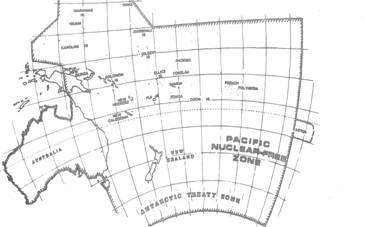
refused to join the NPT to
undertake zonal agreements.
The
suggestion that ratification of the NPT is a virtual prerequisite for any
commitment to a zonal agreement is mainly applicable to regions where are: 1) no
existing nuclear powers, and 2) major outstanding political disputes between
countries of the region. The
A second
obstacle to the achievement of a nuclear-weapon-free Pacific is the
nuclear-powered ballistic missile submarines.
Because of their invulnerability these boats are highly regarded for
the strategic deterrence role and it is virtually impossible to-conceive of
their removal except in connection with a comprehensive nuclear disarmament
program. To put it another way, if one
were to stretch the imagination to breaking point and consider such a programme
it is virtually certain that the last system to be given up would be a
nuclear-powered ballistic missile submarine.
At the
present time about 20 of these vessels are deployed in the Pacific out of a
total world-wide of about 100. This
proportion is unlikely to fall and may well increase. The new Trident strategic submarines under
construction in the
If
follows that I would recommend that this conference propose an escalatory
sequence of steps culminating in the total abolition of nuclear weapons from
the
The first
step in this escalatory sequence is a total ban on the testing of nuclear
devices in the Pacific whether in the atmosphere or underground. A possible
next step is a ban or a limitation on the testing of nuclear weapon delivery
systems in the Pacific. The third step might be the withdrawal of forward –
based nuclear weapons, especially
The
sequence of steps proposed here is obviously not immutable. A thorough
examination of the issue could well suggest a more logical or attainable
sequence. The main point is that nuclear weapons exist in abundance in the
12
REPORTS
EAST TIMOR - ANOTHER VIETNAM?
While
there will never be another war on the scale of the
Politics has only been allowed in East Timor
since
Another
party, the UDT, was formed from the more pro-Portuguese elements in
FRETILIN
very rapidly got the upper hand in the competition for members and
supporters. APODETI tried some
ridiculous ways of getting members, such as bribing local chiefs with
transistor radios to give out membership cards.
But the transistor radios had another purpose to listen to the
Indonesian government controlled Radio Kupang, which quite early in the
struggle began beaming in anti-FRETILIN propaganda to
*By Helen Hill, research student in Politics at
13
ly in popularity and APODETI’s support sunk very low.
In
February 1975, FRETILIN went into coalition with UDT as a way of strengthening
all the anti-integration forces.
Together they represented over 90% of the population and demonstrated
the real failure of the Indonesians policy of supporting APODETI. But, Ali
Murtopo had been appointed by President Suharto as head of 'Operasion
Konaodo', which was designed to integrate East Timor into
The UDT
coup in August 1975 was a logical outcome of the hostility, which the
Indonesian government had created between UDT and FRETILUN. The UDT probably
expected that the Indonesians would send in troops to help them fight FRETILIN,
but
The
Portuguese governor and his advisors retreated to the offshore
On
Despite
these two invasions, FRETILIN was able to retain control of over 70% of East
Timor’s territory; the main parts held by Indonesians being the border areas
they gained before the full-scale invasion. A so – called ‘Provisional
Government’ was announced by the Indonesians from the deck of one of its
warships in
FRETILIN
has also had major victories in the United Nations with a unanimous security
resolution calling on
The
FRETILIN leaders in East Timor communicate with the outside world via a radio,
which is monitored in
In
In
Australia and other countries many actions of solidarity with the Timorese
people have taken place: waterside workers have refused to load ships for
Indonesia, trade unionists in Canberra have put a ban on the Indonesian
Embassy, the Victorian branch of the Australian Labor Party has called for an
end to military aid to Indonesia and cutting off all aid until the Indonesians
withdraw from East Timor. Australian students and unionists are planning a huge
protest along the lines of those held against the Vietnam War. Diplomatic
activity at the U.N. is being planned to try to get
The
Indonesian National Youth Organization KNPI, under the leadership of Major
Guffur, has been conducting a campaign internationally in support of the
Indonesian invasion of
International
organizations can play an important role in informing their members in various
countries of the true nature of the Indonesian actions in
14
THE YOUNG KANAK'S STRUGGLE
AGAINST FRENCH COLONIALISM IN NEW CALEDONIA
Before,
and especially after, the taking of New Caledonia by the French Government on
September 24,1853, Kanak tribes from one end of the country to another rose up
against this foreign occupation.
The
biggest revolt, which took place against French colonialism on the island, was
that led by the venerated High Chief ATAI in 1878. Another revolt – less
important according to the number of participants – occurred in 1917. It was ironic that while this revolt was
taking place, other Kanak people were fighting on the European front to defend
the flag of the "motherland".
From that
time onwards, the bloody repression of rebellious tribes, the organized pillage
of land, the corpses caused by the introduction of alcohol, the cultural
genocide practiced by the missionaries, the abuses of the settlers protected
by the defense forces of the Colonial Administration imposed a "silence of
death" on the Kanak people, which lasted from 1917 to 1969.
Up until
1946, Kanaks did not have the right to leave the reserves, which the Colonial
Administration had forced them into, without police permission. Until 1946, there was, on the one side, the
white society of settlers in charge of all the political and economic affairs
of the country, and, on the other side, the Kanak society slowly dying in the
reserves.
The
generation of Kanaks born just after WW II was the one, which directly
confronted the problem of integration in the white world. This generation, having studied in white
schools, was cut off from its traditional values. The white Caledonian world does not accept
the Kanak, for it is a society built on the racist principle of the
superiority of the white person over the colored person. Exiled from their own country, tossed around
between two societies, the post-war Kanak youth are in ruins. To put it simply, they do not know where they
are going.
It is
against this background that one of the young Kanaks, Nidoishe NAISSELINE,
organized meetings in Noumea starting in July 1969 with the aim of encouraging
this generation to define its own cultural identity. Nidoishe was the son of a traditional High
Chief of Mare, one of the
He was
arrested and imprisoned, as were several other young people on
*By Dewe Gorodey, Group 1878 (New Celedonia).
Translated from French by Chris Plant, Fiji.
15

September 25, 1974 Non –
Violent Demonstration at
The mouthpiece
of the Foulards Rouges was the journal "Reveil Kanak" (The Awakening
Kanak) which denounced all the misdeeds of the French Colonialism in
On
Towards
the end of 1973, the leaders of the UMNC started to make concessions to the
Administration and began to regard the Foulards Rouges as
"extremists". The Foulards
Rouges stopped their support of the UMNC party in January 1973.
In March
1973, some young white Caledonian sympathizers of the Foulards Rouges started
the Union of Caledonian Youth (UJC) and worked with the Foulards Rouges with
the goal of forming the basis of a "Caledonian Nation", comprising
all the ethnic groups of the territory.
But certain problems, such as the question of land, were not
considered. This now is the only problem
separating the Kanaks from the young white Caledonians.
At the
end of August 1974, Elie POAGOUNE, Gabriel MONTEAPO, and other young Kanaks
from the Grand-Terre and myself decided to form a
group in which the young Melanesians from our island could begin to discuss
among themselves their prime problem – the LAND problem. For it was on the Grand-Terre
that the Kanaks had been pushed off their ancestral lands to be surrounded by
barbed wires on their reserves right next to the immense properties owned by
the settlers. This was not the case in the
On
At
present, the young Kanak militants have divided themselves into four groups
(one group per island) so that each can work from his own region. These four
groups are WAYAGUI (on Mare), ATSAI (on Ouvea), CICIQADRY (on Lifou) and 1878
(on the Grand – Terre). The present objective of the four groups is to form and
organize a political party for the
16
THE LIBERATION OF THE NEW HEBRIDES
(The following is an interview of Barak Sope,
Secretary General of the
Q. WHAT KIND OF WORK HAVE
YOU BEEN INVOLVED IN SINCE YOU LEFT U.S.P. AND IS IT WHAT YOU HAD ALWAYS
INTENDED TO DO?
Before I
left U.S.P. I had always wanted to work for my people. As I am a second New Hebridean
with a degree, I naturally had many offers to work for the colonial
administration and private companies with higher wages. But I refused because
they stand against my principles. Instead, I decided to work for the New
Hebrides Cooperative Federation and also accepted the job of Secretary General
of the New Hebrides National Party (N.H.N.P.). About 95% of rural masses are
involved in the cooperative movement and I see this as the basis of socialism
in my country. Capital economies in the Pacific do not coincide with our
communal way of life. It should be changed.
In both
jobs, I feel that I am helping my people in their struggle against economic
exploitation and political domination. The work I am doing for the N.H.N.P.
coincides with our program, which is the mobilization and political education
of the New Hebridean masses and those outside the
Q. WHAT, IN YOUR OPINION,
HAVE BEEN THE MOST SIGNIFICANT ACCOMPLISHMENTS OF THE N.H.N.P. TO DATE?
The major
objective of our liberation movement now is to get the support of the New
Hebridean masses. Where there is oppression and domination there is always
resistance. This is exactly what we are doing – resisting colonial domination
and capitalism in the
Q. WHAT, IN YOUR OPINION,
HAVE BEEN THE
MOST SIGNFICANT ACCOMPLISHMENTS OF THE N.H.N.P TO DATE?
The most
significant accomplishment of the party to date is the growing political
consciousness and nationalism throughout the country. The French have tried to
destroy this feeling by forming opposition parties to rally the support of the French
speaking New Hebrideans. Our party tries to unite all new Hebrideans –
preaching the message that all New Hebrideans are the children of the land.
Q. WHAT INDICATION CAN YOU
GIVE OF THE STRENGTH OF YOUR SUPPORT?
I cannot say offhand because at
this stage we have not issued membership cards. Another reason is because we
have no universal franchise as yet and there is no democratic body to vote for
anyway. I can only say that we are the strongest National movement in the
Q. DO YOU HAVE ANY CONTACT
WITH SIMILAR MOVEMENTS OUTSIDE THE
Yes, I am
on my way to
17
Q. MANY LIBERATION MOVEMENTS TODAY HAVE RESORTED TO
VIOLENCE TO ACHIEVE THEIR AIMS. ARE YOUR PEOPLE PREPARED TO DO SO?
Sometimes
I have my doubts because it may come to a stage where the French will use
force. We do not want to see another
Q. WHAT DO YOU THINK OF THE
VIEW THAT THE FRENCH MAY NOT WANT TO LEAVE THE
The
Q. APART FROM THE EFFECT THAT AN INDEPENDENT
The other
reasons why the French want to remain in the
1. They hope
that by holding on, the British will leave, and the can dominate the country on
their own.
2. The
French now own 36% of the land in the New Hebrides, which is fertile and very
favorable for cattle raising. At the same time, the New Hebridean population is
small – only 90,000 – and the French hope to increase immigration from France
as they have done in New Caledonia in the last 10 years.
3. For
strategic reasons. Now that France hopes to become a superpower, she would like
to keep her slice of the Pacific.
Q. HAVE THE BRITISH PURSUED ANY POLICIES TO SHOW THAT
THEY ARE WILLING TO LEAVE THE
The
British have most conservative and unprogressive colonial administration in the
Q. WHAT HAVE BEEN THE
TACTICS OF THE CONCOMINIUM ADMINISTRATION TO COUNTER THE N.H.N.P.’s ACTIVITIES?
They just
do not know what to do but use force. There have been two demonstrations this
year and during one of them, the administrations brought security forces from
Q. WHAT HAS BEEN THE ATTITUDE OF THE CONDOMINIUM
ADMINISTRATION TO YOUNG EDUCATED PEOPLE LIKE YOURSELF?
I don't think they like educated
people like myself. For instance, after spending on me at U.S.P. I refused to
work for them. I felt uneasy when I first started working for the party because
the administration keeps a close watch on my activities, but not anymore. If
they eliminate me or anyone else in the Party, there will always be someone
waiting to continue our struggle.
Q. WHAT ABOUT OTHER POLITICAL PARTIES THAT HAVE BEEN
FORMED IN THE
The
French planters have formed their own parties since they don’t want to see
themselves under a black New Hebridean government. The first party is called
Movement Autonomy of the New Hebrides (MANH). The second French – dominated
party was formed in March 1974 as a result of the National Party’s policy to
nationalize all alienated lands when we get independence.
Q. DOES THE N.P. HAVE ANY DIRECT REPRESENTATION IN THE
CONDOMINIUM GOVERNMENT?
Since we
don’t have any body of representation, we are not just waiting to be taken in
our strategy towards forming an independent government has already begun. We
have started building schools and sending students overseas without colonial
administration support. We also have development plans in the rural areas. This
is a part of our policy of “self – reliance”, “self – determination”. Once we
get strong support from our people, we will set up our own government and
declare independence.
Q. WHEN DO YOU THINK YOU’LL GAIN
If you
are saying getting independence from the colonial powers, I cannot say when. As
far as our party program goes, independence is being implemented now. We send
our own delegation outside
Q. WHAT IS YOUR VISION OF THE FUTURE OF AN INDEPENDENT
I am a
socialist and I believe that the
18
APARTHEID - AUSTRALIAN STYLE
Few Pacific and other people in
The Queensland Act governs
all aspects of Aboriginal movement and living and has been used to allow the
illegitimate takeover of Aboriginal lands by whites. Aboriginal people in
Most insidious of all are the
by-laws and regulations of the Act since there are many of them and are not
made public to the same extent the Act is.
Many people are thus 'charged' for offenses they are unaware of. Furthermore, the by-laws allow for corruption
and underhand practices by the law enforcers, and can be used at any time to
regulate, control and discipline Aboriginal people living on the reserves.
LANDRIGHTS IN TOMORROW WORLD
Bill Ryan is about 40 now. His father was European, his mother
Gurundji, and for being a half-caste, he was brought up in an institution. He has been a Christian evangelist, and more
recently a field officer for the Darwin Aboriginal Legal Service. He is now working in the Kimberleys1 as
an Aboriginal liaison officer, based in Halls Creek, at the request of the
people there.
A month before the stories about
brain damage appeared,2 he was
in
"The early 30s was the last
massacre3 in the
Kimberley’s – the legal killing of Aboriginals in places they call the
underworld, a
*From POVAI, Vol. I, No. 1
**By Virginia Fraser, “The Digger”, November 5 –
1. A region in Western Australia, the original land of some 30 living
Aboriginal tribes; now mostly controlled by whites.
2. According to a report, as many as half of the children born in Kimberley
are suffering from incurable brain damage as a result of protein deficiency.
3. The last massacre was 1931
.
19
place where you can get a bullet through
your brain.
"The
white pastoralists and the policemen and the black trackers did the killing
because the black fella was a menace to the pastoral leases because sometimes
he might kill one bullock for the sake of feeding families. He didn't kill for
the sake of killing; he killed to eat just like the black man always does. But
the whites didn't kill one, they wiped out the whole
tribe.
"You
can't talk against the
"The
" And that land. EVERY INCH OF THAT LAND is still ours!
"They're
not going to give the land back to the blacks. Why should they when they can
exploit their labor?
"There's
agricultural industry- they grow cotton there, one of the biggest cotton
industries in
"At
"It's
no good talking to
"And
you see, the Catholic Church and the others have been
in the east and west
"But
you go to a place like
"Once
I went into the schoolhouse and I said to the schoolteacher: 'Can I have a look
at your program of education?' Every thing was the same as if you'd walk into a
school HERE!
"I
said, 'Don't you ever consider these people as being different to European
society? That it'd be more natural if you educated them to deal with the yams,
their fish, with their natural lakes? Talk to 'em in that line, educate 'em in
that way.
“The Catholic
Church is the main church doing this damage. The other churches at least
they’re giving a bit of consideration, but they are all patterned to the white
way of thinking. If they get Aborigining that way at an early stage, then they
can make their way successfully in time to come”.
“The
Aboriginal people like myself, they want the Mirrawang tribal land. And once
they get to understand, they can fight. It’s a matter of getting up and saying,
‘OK, you guys, this is our land so get off it. I don’t want to see you
anymore”.
“And when
they are approached by a social welfare department, Aboriginal affairs
department, police department, they will say to them: ‘We’re not moving back,
we’re not working for white man anymore. WE’RE
STAYING RIGHT HERE, WE’RE GOING BACK TO OUR STATION WHERE WE WORK IT OUT
OURSELVES!”
CAMPAIGN FOR SOLIDARITY WITH
FRETLIN
For any assistance you would
like to give to the campaign, you may write:
DEMOCRATIC
Australia
For further information on:
1.
the current
situation in East Timor, see Timor Information – Service bulletin
published regularly and The Timor Story, a history of East Timor from the
coming of the Portuguese to the Indonesian invasion, Timor Information Service,
1st floor, 100 Flinders Street, Melbourne, 3000, Australia.
2.
the situation in
Indonesia regarding Timor, see Ernst Utrecht, Can Indonesian Army Survive in
East Timor?, a background paper published by the Trans – National
Cooperative, G.P.O. Box 161, Sydney, 2000, N.SW. Australia.
20
THE EXPLOITATION AND STRUGGLES OF MIGRANT WORKERS IN AUSTRALIA
”The so – called underdevelopment
is only a consequence of the political and economic domination exercised by
some countries over others. In the course of historical process, they have
achieved a rapid growth and have thus become yester years’ colonialists and
today’s imperialists”.
The
General Declaration, Approved
By
the Cultural Congress of
January
1968.
Immigration
is not and never has been a matter of free choice, but results from abnormal
processes of unequal development and the impoverishment and underdevelopment of
large areas from which numbers of workers depart in search of employment and a
living wage. Using this concept as a premise is fundamental, I feel, to a
proper analysis of the interrelation of immigration and imperialism. Many Western
political commentators talk of under-developed countries as reserves of labor
for the developed countries. This source of labor is used, especially in times
of economic turmoil like today, as valves of manpower to be increased or
decreased, without any social responsibility.
The
Australian migration system is different in character from the European market
in that in
Australian
post-war immigration has reached well into the 2 ½ million figure, with the
biggest non-English speaking groups being Italians and Greeks. When migrants
arrive in
Any
society has to be judged by its production relationship".' In Australian
society, this relationship is such that those who produce goods, that is the
workers, are not guaranteed the right to a job and thus can be manipulated by
the non-producers. In any society, and in particular developed societies, we
must use this reference point to judge the degree of justice between the
producers and exploiters. In
*By Joe Caputo, trade union activist.
21
in which the migrant is constantly made unsure of
himself through language problems, cultural differences. All these amidst a
racism fostered, partly, through the original Australian workers being
unprepared for an influx of migrant labor.
All of
these problems have been aggravated in Australia because of the lack of
planning to cope with migrants in social services, etc. But this lack of planning
was in a sense inevitable when we consider that maximum profit is the end goal
of all the plans of the ruling class.
In the
last few years in
It was
only as recently as October 1973 that the first migrant workers' conference was
held in
Another
significant gain for us has been for ethnic groups to achieve considerable time
on 'Access Radio', a very new concept of community participation, in radio, in
To
further illustrate this sprit of self-determination, we can look at the Migrant
Workers' Conferences. Whereas at the
First Conference (October 1973), the migrant workers demanded their right and
denounced the system as such, the Second Conference (November 1975) emphasized
the concept of creating a principle and policy of struggling together with the
whole working class.
To see
the change, we only have to look back a few years ago, to see that all social structures worked around the concept of
quick assimilation of migrant workers into the Australian culture. But, in fact, what we had was 'passive
assimilation', i.e. an assimilation that was to be deliberately rejected by
migrants because it denied them the basic rights of their own identity based on
their own culture.
Although
many institutions are still adopting the same views and methods, they have been
forced, at leaf at the level of rhetoric, to admit that they no longer want
migrants to assimilate but to integrate.
We agree with the concept of integration because in a sense thousand
migrants are already integrated with the workers’ movement, in order to
transform this reality for the better. The World Confederation of Labor, in a
recent document on immigration, recognized this fundamental aspect:
“The principle of equality of all people, independent
of their origin, is fundamental to a pluralistic society that recognizes and
appreciates all its worth in the values transmitted through the commuting of
migrant workers, and the evolution they determine, be it in the country of
origin, or be it in the country of migration. They are the occasion of lively
and stimulating exchange between diverse cultural worlds. It is only in this
perspective that a development of real solidarity amongst people can be
realized”.
*C. Levi founded FILEP (Federazione Italiana
Lavoratorie Famiglie) in
22
THREE STATEMENTS
THE ROLE OF P.C.N.H. IN THE POLITICAL LIFE OF THE NEW HEBRIDES
(This statement
was sent to PRAXIS by Peter K. Tawoakato, Convenor of the P.C.N.H.
(Presbyterian Church of the New Hebrides) Church and Society Committee and one
of the founders of the
It
is traditional for most New Hebridean societies in the past and present to
choose their leaders by heredity and election. These two methods are wifely
accepted and respected throughout the
The
traditional chiefs who form the local governments work in partnership with the
traditional priests. The two are dependent on each other for their existence,
and most important, for the good and future of the people they serve. Without
each other, each is useless.
Therefore,
it is right that the Church and the present and future governments of the
As
the prophets of the Old Testament helped to shape the future of God’s chosen
people, the leaders of the Christian churches should follow this example by
helping shape the future of the people of the
“He has
showed you, O man, what is good; and what does the Lord require of you but to
do justice, and to love kindness, and to walk humbly with your God?”
The
words of the prophets were fulfilled when our Lord said, “The Spirit of the
Lord is upon me, because he has anointed me to preach good news to the poor. He
has sent me to proclaim release to the captives and recovering of sight to the
blind, to set at liberty those who are oppressed”.
Since
the traditional religion and the traditional government work in partnership for
the good of the people they serve and from the words of scriptures, we see a
great need for religious leaders to be involved in the task of building up a
new nation. This role of the Church is seen in four specific areas: 1/ to help
in building up the nation’s unity; 2/ to be the “conscience” of the nation; 3/
to foster high moral values and standards throughout the nation’s life; and 4/
to meet the particular and changing needs of (New Hebridean) society.
The
majorities of New Hebrideans are Christians and as such demand on the religious
bodies for guidance. The Churches must take part in building this new nation to
safeguard its belief in God as its sure foundation. Failing this, the religious
bodies are guilty of neglect of responsibility…
The
true believers of One who is righteous, just and holy
cannot
23
remain silent while there are people waiting to be
liberated from the manners of injustices. We believe that such believers
receive divine calling to participate in decision – making and in all forms of
new developments to prevent further injustices.
The
P.C.N.H. is an independent church. It is a
The
concept that the Church must not take part in politics is foreign, non-religious
and is against the New Hebridean belief in the unity of the government and
religion.
The
P.C.N.H. has played a major role in promoting education and health services for
the people. As these services have political implications, it is now too late
in the day to say the church must not take part in politics. These services
have been taken over by the government and the Church is free to look into
other ways of serving and meeting the needs of its people.
The
declaration on independence passed by the P.C.N.H. General Assembly in 1973 on
Tanna was not the first time the P.C.N.H. was involved in politics. It has been
in many ways in the past.
The Church and Society Committee pledges its
solidarity with all religious leaders who are concerned and are involved in
politics to help shape the present and the future government.
THE MAORI CAUSE
(On
"To
the pakeha, land has merely an economic value. It is worth so much an
acre and is farmed for profit.
To the
traditional Maori people though, land is more than that - it has deep spiritual
value. In the words of T.W. Ratana: 'The Maori is like a potato, without the
land he will not grow'.
Before
the arrival of the white man, the Maori people had 66 million acres of land. By
1891, despite the Treaty Waitangi, which promised undisturbed possession of
their lands, the total acreage was brought to a dismal 11 million acres.
Acts and
legislation followed alienating more Maori land, till by 1930, the acreage was
4 million. Now there is less 2 million acres. The legislation was aimed at
'Europeanizing'
'Europeanization'
has been equated with civilization and there has been a failure to give
coverage to Maori feelings and view points.
The media
and the
24
And one
of the greater skeletons in the closet that still has to be confronted is the
situation of the continuing alienation of Maori land today... For example, take
the 1967 Maori Affairs Amendment Act, this aimed at the final Europeanization
of all Maori land by 1973.
Many
Maori groups protested7 strongly against this act and some changes
were made, but it only slowed the process of land alienation. Other Acts such
as the Town and Country Planning Act and the Counties Amendment Act designated
thousands of acres of Maori land
for other uses.
It is
this continuing alienation of lands that has led to the formation of TE ROOPU
OTE MATAKITE and the birth of their protest march on Parliament.
TE ROOPU OTE MATAKITE has declared the following demands:
1)
the abolition of monocultural laws pertaining to Maori land, and the
establishment of new laws based on Maori cultural attitudes, and
2)
Communal ownership of land within the tribes, with communal title equal
in legitimacy to individual title. And an end to all sales of Maori land
outside the tribe.
The march
on Parliament is the only way left for our Maori people to make a determined
effort to change racially-biased legislation and to make sure that we keep our
remaining land for our children."
A FIJI
(Action by Pacific islanders against racism, imperialism, foreign
military bases and the mounting danger of nuclear war are in the following
declaration issued by the Conference for a Nuclear Free Pacific held in
The
Conference was held in a crucial time in Pacific and international developments.
Expressing the rising awareness of the indigenous peoples of the Pacific and
emerging independence movements in the French territories, the Conference
condemned the present series of French nuclear test bombs on Mururoa.
Also,
proceedings for the status of
The
Conference was told by experts on nuclear weapons and strategy that the
building of planned U.S. Trident nuclear submarines in
The
Pacific peoples must unite efforts to prevent continued use of the Pacific
area by the
Racism,
colonialism and imperialism lie at the core of the issue of the activities of
the nuclear Powers in the Pacific. The Pacific peoples and their environment
continue to be exploited because Pacific Islanders are considered insignificant
in numbers and inferior as peoples. For these reasons, nuclear bombs were first
used and continue to be tested in our region in blatant disregard of our
expressed opposition, rather than in areas with large concentrations of white
people.
The
Conference urged the Pacific peoples to assert themselves and wrest control
over the destiny of their nations and their regions from foreign power.
A
People’s Treaty, embodying the findings and proposals of the Conference,
appeals to the people as the real power and calls upon them to strengthen their
movements for independence from foreign domination.
The
Conference demanded in the light of the urgency of the situation that the
governments of the Pacific nations come forward to support the Treaty and work
for its recognition and implementation in the Pacific. The
The
Conference rejoiced over the victories of the peoples of
25
REFLECTIONS
SOME THEOLOGICAL REFLECTIONS ON MIGRATION
(Bishop P. Finau from the Tongan
Islands delivered an expose on the above topic at a seminar on Land and
Migration on September 1975 in Nuku’ Alofa, Tonga. He gave stimulating ideas on man’s inherent nature
emigrate and posed the fundamental question: Why are people not free to come
and go from one country to the next? Below are some significant excerpts from
his talk.)
Both Old and New Testaments witness to the fact
that man essentially is a migrant.
Abraham had to leave his home and kindreds, his familiar environment and embark on the
adventure of traveling into the
unknown, looking forward to the
future (Gen. 12.1). A believer is a
migrant. This was part of the kerygma much emphasized in the early Church but which has become
forgotten when the Church became
established and felt at home in the world!
The New
Testament looks at the life of the Church as the wandering of the people of
God in the wilderness (Acts 7:38, 1 Cor. 10:1-4) The Church inherits the Kingdom of
God which is not a certain geographical area but the ruler ship of God which
extends over the whole of creation. The Kingdom is not of this world;
therefore, his people are strangers in the world. In the New Testament, the People
of God are chosen by grace in Christ (Ephesians 1:4) and instead of being bound
to a particular nationality, they comprise all nations of the world. The
prophecies which proclaimed salvation to all people have been fulfilled (Isa.
56:1-8, 66:18-21; Zech.
The New
Testament contains many exhortations to
be kind to strangers. The Samaritans were considered outsiders by the
people of
In helping the migrant,
the Church herself may be
helped in rediscovering her role of being a congregation of fellow migrants sharing and using the things of this world to reach to a better
land. It is a comforting fact that
we often serve God without our
explicitly knowing it is He. And it is also a disturbing truth
that in some vital matters, we
can refuse to share our goods with God in poor people. Again, we close our doors and our hearts on
God. Sorry, there is no room and
no work in our country for you!
One of the most basic rights is the right of everyman to use
this world's goods. The Christian
tradition has always distinguished the
right to use from the right to
own. It gives primacy to the first right – the right to use. Paul VI reflects on this tradition: “Private
property does not constitute for any one an absolute and unconditional right. No one is justified in keeping for his exclusive use what he does not need
when, others lack necessities”.
The State exists not only
to protect human rights,
but also to facilitate their
exercise. But no State can ever act
to protect its own
citizens at the expense of the basic rights of people beyond its borders. To
neglect the poor of the world, when one’s own country has more than sufficiency
of material wealth, is to infringe justice, to infringe the basic rights of the
brotherhood of men.
The joys and hopes, the grieves and
the anxieties of the men of this age, especially those who are poor or in any
way afflicted, these, too, are the joys and hopes, the grieves and anxieties of
the followers of Christ. Indeed nothing genuinely human fails to raise an echo
in their hearts. The Church has always had the duty of scrutinizing the signs
of the times and of interpreting them in the light of the gospel.
The
Church has to realize that emigration is a permanent phenomenon of its
life. The Church must not be allowed to
make a repeat performance of clerical unconcern as exemplified by the parable
of the Good Samaritan. We cannot be silent pretending to know. The Churches have to be sensitive to the
agonies of their grass root people.
Migrants are people – fathers and mothers of families – they need decent
housing while sacrificing themselves on the hope of a better future for their
children. The Churches must not be
satisfied with merely binding up the wounds resulting from migration, but must
get at the roots of the social malaise.
In order to bring about justice and to help remove the lot of poor
people, the Churches of the sending country must work together and speak as one
on social issues with the Churches of the receiving country. Above all, the Churches must speak out
together to protect and promote the dignity of men and human rights. When need be the Church must exercise its critical task of denouncing injustices.
The
mission of the Church is to defend and promote the dignity and fundamental
rights of the human person. Christians
who refuse to share in this mission, who decide to stand apart, inevitably face
the condemnation of the prophets and of Christ Himself. It is not the function of the Church to offer
technical plans for justice in society. It has no special competency in
technology. But its
special competency and its obligation lies in drawing to the attention of
governments and other areas of
possible or proven injustices.
26
THEOLOGY OF SELF-RELIANCE: THE AUSTRALIAN EXPERIENCE *
Domesticating
Theology
A
theology of self-reliance means that for me in writing this article, and for you
in reading it, we must both be involved in wrestling for meaning, in a mutual
search. But without you this article would not be written, and you support me
because I have been forced to reflect a little more about the Australian
experience of a theology of self-reliance.
Too much
of our theology has been domesticating, meaning that people have been treated
as objects rather than subjects, conditioned to serve ecclesiastical and
community power structures, socialized into conformity, robbed of initiating
power, self-respect, self-reliance.
Praxis
Theology
There is
now a movement of considerable strength away from such dependence. It involves a growing realization that very
often lay women and men know more than professional
theologians of the historical reality about which theological reflection needs
to be done. More people are realizing that without commitment to action, theological
reflection is in the air; reflection on reflection rather than reflection on
action. The acceptance of theological responsibility,
of reflecting on the raw experience of life is being seen as inescapable for
every Christian.
In
Clearing
Theological Debris
My own
hunch is that in
Personal
Faith and Social Transformation
Charles
Peguy said, "Everything begins in mysticism and ends in politics".
Some of us are struggling to understand more clearly the relationship of
personal faith, of interior transformation rooted in faith in God to the
transformation of oppressive, exploitative dehumanizing structures of
economics, politics, and culture. To
know Christ in personal faith liberates us from meaninglessness, from guilt. It sustains us in the struggle against evil
forces. When action is taken, threats arise and evil in its stark destructive
power is revealed, focusing the mind in theological reflection.
For me
personally, faith in God involves at times a non-phoney "hurrah"
shout, spontaneously bursting out as on resurrection morning. It is related to
deep, honest listening, no, not to others, but to myself; listening to the
universe of meaning throbbing, pulsing in astonishing complexity within me; the
Beyond right in my inmost being. It is certainly not my own creation, for I am
a part of humanity. Such 'centering down', using the 'inward ear' can bring
astonishing strength and shalom. The way is opened then to personal communion
with others rather than technologically conditioned, de-personalized communication.
There is liberation, self-affirmation, self-reliance
not in aggressive self-assertion, but in a self-affirmation that makes possible
an independence, which is the ground for inter-dependence. Such faith overcomes
meaninglessness and despair and gives strength for the social struggle. I see
this as a rather neglected aspect of a theology of self-reliance.
Commitment
to Act
When we
come nearer to the Christ of the cross, in action and reflection, struggling simultaneously
with evil forces in society, and ourselves we learn more about true holy
living, about what it means to daily "make our Easter". The struggle
for liberation from injustice and for true community becomes a divine
imperative to avoid neutrality. The same
is true, as insight comes, in
respect to ruthless violence towards our physical environment, so typical of
advanced technological societies. Failure
to act becomes a breach with God, whom we know in Christ.
It is in
the social struggle that the meaning of reconciliation is clarified. True
reconciliation can often be achieved only through conflict, not through lyrical
call for social harmony while injustice remains entrenched. (Jeremiah 6:14 –
"They have healed the wound of my people lightly, saying 'Peace, peace',
when there is no peace".)
Insight
comes through praxis, through involvement and commitment. Non-specialists often
know this in a way not grasped by the professionals. Theological self-reliance, in dialogue with
others (including specialists), is essential for each of us.
*By Cliff Wright, Australian Council of Churches,
Commission on Education Executive Secretary.
27
DOING THEOLOGY WITH THE PEOPLE
My work
takes me to the village people and their problems and their aspirations. For
the last 18 months or so, I have been involved with a programme called
Spadework, which is one of the programs of the Christian Education and
Communications Program of the Pacific Conference of Churches (PCC). The program
came into being in January 1974 to focus on community development and
especially on stimulating awareness at the grassroots. I spent the whole of 1974 visiting villages
in
It is not
my intention in this article to theologize at length on the whole philosophy
surrounding Spadework because the kind of theology that we have worked out in
the rural areas is of a practical nature.
As such, I will reflect briefly on my experiences in working with the
people. For the benefit of readers in
One of
the outstanding landmarks of the Fijian race is that they are Melanesian in skin
but are Polynesian at heart and in their way of life. So the social structure
at the village level is more akin to the Polynesian authoritarian mould. The Melanesian social structure such as
prevalent in the
We Are Men
I think
it is appropriate to begin by dwelling for a while on the most important subject of any development program – MAN.
We may not have the benefit
of modern education
We may have nothing
We may be lazy
We may not listen to advice
But we are MEN.
This
poetical wisdom was spoken by a villager in the course of our
conversation. Man is not only an
integral component of any development plan; he is, in fact, the most important
component. All other components should
be subservient to him. Not only should development institutions be endeavoring
to satisfy the needs and wants of man, but more importantly any development
plan should solidly be based on the aspiration of man. Development should be
based on what the rural man wants and aspires after instead of what is thought
is best for him. If we are really honest
with ourselves, we have to admit that most of the development plans we have
devised are motivated by the latter category.
We can only blame ourselves by the apparent lack of interest displayed
by rural people. The Pacific rural man
is already well off in more ways than one and his needs economically are very
simple. He wants to enjoy some luxuries
like sugar, tea, washing soap, kerosene for his light, a good strong house with
some modern furniture, some clothes. He also needs to invest some money for the
future education of his children.
Some
rural people may aspire after some other things but basically they are very
simple". There has been talk about
modernizing the rural area to stop the internal brain drain. This is far beyond the rural man's idea of
development. As time goes on, his
concept of development may change but we should be concerned with his present
needs and experiences.
This
leads us to the need for people to be made aware of the possibilities there are
for development. To ensure the full
participation of people, they must know.
The first
step in this awareness building is to confront the rural man with the reality
of his situation and from there to go on to the question of how he can exploit
fully the resources at his disposal; things that he understands; things that
have always been a part of his life. In
the village where we live, the people and I have been trying to explore other
uses of coconut. This kind of basic down-to-earth project does not only supply
basic needs but it can build up awareness, stimulate, and pave the ground for
bigger projects.
The rural
man will only participate fully in any project, which he understands. This will
mean that we must make sure that all the people involved are clear about the
full implications of the project. This calls for some solid groundwork. The
role of the resource person – an extension officer / school teacher / minister
/ cooperative organizer – should be to expose people to resources available
but the direction of the project should be determined by what people want.
The
Resource Person
All
resource people in the rural areas command a considerable amount of respect in
virtue of their profession. This has proved to be one of the most difficult
obstacles to overcome. It is up to the resource person to break through this
barrier to enable him to communicate effectively with the people. He should enter into the spirit of village
life. In this way, he will be accepted
by the people and will gain their confidence.
If one is really prepared to help people, then he must completely
identify himself with them, their way of life, their problems, and their
needs. It is not a matter of stooping;
one must plunge bodily into the lives and affairs of the people.
A
resource person must be a learner too.
He must be a patient listener and on top of that, he must be a
servant. A servant is characterized by humility,
a willingness to listen and learn, and a sincere desire to serve. He must be committed not only to his work but
also to the people, he is going to serve.
A
Theology of Action
All that
I have been saying have theological implications. They amount to a theology of
action, a doing, practical, grass root theology. Our overall objective in development should
not be the increase in G.N.P. Rather it
should be the fruition of human potential and a full realization of other ways
to be fully MAN.
The Church
through its village ministers can play a very important role in this
development process. Unlike the
extension officers, the ministers do not possess the technical skill and
know-how. However, they do have some knowledge of the more important foundations
of a good life such as justice, love and human welfare. These should be brought to bear on any
development decision taken at the village level. The minister with his intimate knowledge of
the life and problems of the people can render a significant contribution to
rural development.
*By Sitiveni V. Ratuvili
28
TOWARDS AN ALTERNATIVE TO
THEOLOGICAL EDUCATION NEW ZEALAND
This is
the experience of a number of us at
When we
entered College, we discerned a number of assumptions, which were accepted by
most staff and students. We had been sent here to learn things from others, who
would pass on the truths, who could be trusted to make
decisions for us; people who could initiate change because they knew what was
necessary and relevant for us, as well as the larger Church. It is generally
believed that the institutions are human enough, creative, just enough to
treat us fairly, sensibly and honestly. One day, it would be our turn to take
responsibility for the Church, for others and for ourselves.
The
academic study focused primarily on the past – Biblical work, the history of
the Church and its doctrines. It was assumed that all of us (and rightly so)
would be working in a traditional parish situation, doing the work parish
clergy have been doing for the past 200 years. Most of the teaching staff are
fairly liberal and open in their understanding of academia and the task of the
Church. But the status quo is still seen, at least implicitly, as of major
import.
This way
of learning, which reflects the rest of
After a
few months of increasing frustration, we had given up on our exam courses, our
lectures and assignments. We began to question the relevance of our course
work for the ministry, the philosophy of education behind the teaching and the
structure of the system that administered the course. We wanted to work as a
group, working by action and reflection through a number of issues, which were
of importance to us now and which we felt had significance for our future in
the Church. It was no longer teaching by a few for the majority. It was now
learning for all by all. It was not someone else taking responsibility for
your learning. It was you taking responsibility for your own learning in
consultation with others. "Consultation" had to be a mutual discourse
rather than the familiar one-sided affair where you chose one of the options
others had provided.
We met
with a mixed response to our proposal from other staff and students – ranging
from guarded encouragement to deep-seated suspicion. Over the 14 months since
then there have been times of great personal conflict, of suspicion, jealousy
and ill will. There have also been times of growth, fruitful discussion, new
insights and the flowering of friendship. These incidents teach us that any
movement for change is accompanied by conflict. We were many times tempted to
give up our program simply because of the bad feeling within the College and
beyond. We learned to live with the pain our innovation engendered, trying
always to keep a sense of humor and particularly to avoid any romanticizing of what is
happening.
From the beginning, we saw that this could not be
an optional extra
29
on top of our normal college work. So we decided to
drop the degree course in which we were enrolled. This meant that we could structure our day
free of the demands of an institutional timetable. This gave us the chance to involve our wives
(two of us are married) in what was happening.
This has proved to be one of the greatest advantages of our work. We made mistakes and still do – mainly by
arrogantly ignoring the contribution the women had to offer and by failing to
consult fully with them as we worked. The ministry and the Church in general,
is still very much an all-male affair, despite the fact that
We decided
that we had to commit ourselves to one another in the group. This has proved to be invaluable and has
far-reaching implications for our future work.
This year, four other people opted for an alternative style of learning
and we have worked as a group of seven. Considerable discipline is needed to
abide by group decisions rather than follow the individualistic pattern, which
is encouraged in our society. But it has
also meant a sense of strength from the solidarity which emerged. Often, staff
members wanted to meet us individually, but we resisted this effort. As we began working together we discovered
how much fruitful a number of minds are than just one. We tried a variety of patterns – one person
presenting some writing / reading / thinking he has done or every one working on a common issue. But whatever method, we
found a variety of views and insights which helped us to see any issue from
several perspectives, consequently, more creative and imaginative answers. At all times, we have striven to be honest
with one another and have sought for mutual criticism.
One of
the most persistent criticisms of our work is that we are not gaining the
biblical, theological and historical information needed for the ordained
ministry. This stems largely from an
understanding of the minister as "the carrier of tradition", the one
with specialized knowledge to "feed" his flock. We would reject this model as one, which is
ineffective in furthering the mission of the Church and in realizing the
potential of people. But what has
happened to us is that the Bible, for instance, has come alive to us. We read of the liberation of the Hebrew
people from
As the
months drew on, it became increasingly clear that we were spending more and
more of our time reflecting on what was happening to us and the implications of
our actions... Originally, we had seen the debate as one about educational
method. But it quickly became evident
that education is only a part of a larger cohesive system which serves to
validate, strengthen and continue what has been. For us, this link was made clearer because
the teachers were the same people who played a large part in making other
decisions about us. As we faced the reality that education is inextricably
bound with a political order, we saw we had to fight with the College to take
control of our own learning. Through this, we have come to see the vital
importance of solidarity, of faithfulness, of having clear goals, of living out
the reality for which we strive. We
believe all this learning is important because it will shape our futures and
will better equip us to cope
with the future. For the right to
participate in the
30
decision-making concerning learning is a greater task than
the immediate one of taking a local political hold – it means a vision of
change, political change, throughout all of the Church's activities.
In 1976,
things will change once again. Two of us are going out to begin working in a
parish setting. We want to work out in
that setting the same principles by which we have operated in College. We want to help build up a network
of people committed to working ecumenically for a relevant and authentic
Christianity. One of our group as well
as two other 'alternative learners' remain in College to further work at the
option, which has been started. And in
the College itself, there is a plan to change radically the style of working to
one which allows for and encourages a diversity of learning processes. There
are many hopeful signs. In many ways, it
is only because of the liberality, particularly of the College staff, that we have
been able to get as far as we have.
Other
*Reported by John Boanas,
Chris Tremawan, Peter Glensor, St. John’s
-Pages
31-38 are continued pages-
39
NEWSBITS
WSCF EXECUTIVE COMMITTEE MEETS IN
The Executive Committee of the WSCF met in
3 ALDECs HELD
Three ALDECs were held from
October to December last year on the themes of “land and poverty”, “militarism”
and “students, peasants, workers alliance”. The first took place in
PAA PREPARATORY COMMITTEE MEETS
The Preparatory Committee
for the Pan Asia Assembly in May met last 14-16 December in
Immediately after the PC
meeting, the WSCF
MALAYSIAN SCM RE – ORGANIZED
A new council was formed at
the 5th Annual General Meeting of the National SCM last year.
Elected officers are Rev. Chin San Seong, Chairman, Mr. T. Kamaraj, Hon. Gen.
Sec. and Dr. Raymond Wong, Hon. Treasurer. Renewed cooperation between the CCM
and the SCM is expected.
The
ASCM NATIONAL CONFAB
The Australian SCM held its
National Conference from 1-7 January at Ocean Grove,
Stronger solidarity links
and support have been forged between
NEW WAVE OF ARRESTS IN THE
In the wake of strong
opposition to the martial law regime of President Marcos by militant workers,
students, workers and churchmen, the military resumed arresting and detaining
hundreds of students, workers and church leaders. The alliance showed great
strength last December when more than 8000 people joined in a religious service
at Plaza Miranda in