21
Presentation II
A CRITICAL REFLECTION ON ASIAN ECUMENISM FROM A
THEOLOGICAL-ETHICAL PERSPECTIVE
Somen Das
INTRODUCTION
In this
paper I would like to examine and evaluate the life and work of the ecumenical
movement of our time in terms of certain selected documents. Finally, I would
like to indicate the thrust and thinking necessary for the ecumenical movement
in
Christian
ecumenism has become quite evident both at the micro-level as well as
macro-level. There is an increasing recognition of the richness and diversity
of various denominations and churches. We "share a common understanding of
the apostolic faith", "mutual recognition of baptism, the eucharist and ministry", and "common ways of
decision-making" which demonstrate qualities of communion, participation
and corporate responsibility" (taken from Gathered for Life, official
report, VI Assembly of the WCC, 1983 p. 45). This augurs well for the future
and provides us with the brightest prospect for ecumenical cooperation,
formation and sharing at all levels. Much hostility and suspicion among
churches and denominations are behind us and before us lies the possibility of
active cooperation and dynamic co-existence or pro-existence. Indeed the
Edinburgh Conference of 1910 was not convened in vain! Our mutual recognition
and relationship have to be structured and sustained systematically. This is
both desirable and necessary as an ecclesial community as well as a human
community in
22
PROBLEMS
FOR THE ECUMENICAL MOVEMENT IN ASIA
Inspite
of the ongoing ecumenical co-operation, formation and sharing at various
levels, splits and divisions are common these days. Proliferation of parties
within the "Body of Christ" is a disturbing phenomenon of our time. I
can describe this divisive situation with the help of the following words:
The political parties in our country are far below on the evolutionary scale.
ALL parties, no matter what ideology they propound, multiply by splitting into
two like amoeba, the earliest form of life that appeared on earth. Indian
politics is positively in the amoeba stage and how much it has to evolve to
become an effective instrument of social reconstruction and radical change is
still an enigma engulfed in ignorance. The distance from amoebic stage to the
atomic one is aeons. And the vast qualitative difference between the
amoeba-splitting and atom-splitting has to be grasped in proper perspective. If
a split produces additional creative energy, it is to be encouraged. The
political situation prevalent in
What is said
about the political parties in
There is one
problem which I think is very much inherent to the ecumenical movement of our
time. There have been
23
innumerable ecumenical assemblies and conferences making many statements
and declarations for a long period of time. Such statements are quite
comprehensive in nature but their very strength becomes their weakness. They
are too general. They want to say many things and in the process they do not
say much because they lack a clear focus, a greater sense of particularity and radicality. This is the bane of the ecumenical endeavour of
our century. To substantiate my point, I would like to draw your attention to
just two documents - "An Assessment of Mission and Evangelism; An
Ecumenical Affirmation, WCC, July 1982" and "Witnessing in a Divided
World, WCCC Assembly, July 1983". Generally they are good statements but
they are not good enough because they lack in specificity and concreteness. As
a result ecumenical statements by and large are innoucuous
and insipid without demanding radical risks. It is time to name names and call
a spade a spade because people like President Ronald Reagan can claim to be an
evangelical because he is crusading for school prayers and anti-abortion in his
country. With people like Jerry Farwell and Rev. Wurmbrand
around, talking about spiritual awakening, it is important to spell out in
detail and in very specific terms, the kind of spirituality the ecumenical
movement would like to pursue, promote and encourage. The people mentioned
above consider Rev. Canaan Banana and Bishop Tutu of
24
midst of this existential predicament, countries spend billions of
dollars for armaments and human destruction. The arms race is jeopardising the
future of the human race. We urgently need disarmament for development. In the
context of this human predicament the ecumenical statements cannot remain vague
trying to hold every one together and thus satisfying everybody. I discern this
problem from the time when the "Christian Community within the Humane
Community" (containing statements from the Bangkok Assembly, EA.CC,
February - March 1964) was written till Living in Christ with People: A rail
t-o vulnerable Discipleship (CCA Seventh Assembly, 1981).
Related to
this lack of radical particularity is the problem of the affirmation of the
universal Church at the expense of the local congregations. We must realise
that when we talk about our ecumenical vision or the unity of the Church we
mean unity of the people in their radical particularity. We have to affirm
boldly diversity in the midst of unity in the name of Asian ecumenism. We
cannot just talk about unity in diversity. At this juncture we realise the
value and significance of grassroots ecumenism. It is at this level ecumenism
achieves thrust and direction. At this point the problems related to the
ecumenical process are precipitated and issues become crystallised. Indeed
divisions have to be overcome but rich diversity must be preserved and
encouraged. Increasingly we are realising this in
EXISTENTIAL
CONTEXT IN ASIA
We know the
condition in which we are living in
25
is eating into the very fabric of the nation. There are deliberate
attempts to abet and aid the communal forces in our countries.
At the
global level, centrifugal forces are let loose by racism, war-mongering and South-North
Divide. Conservative forces are quite pervasive. Politicisation protects and
promotes such conservative forces which are detrimental to an authentic
ecumenical spirit. Vast majority of the people of
ECUMENICAL
FORMATION IN ASIA WITH A FOCUS
Consciousness
of the large ecumenical community in
Our vision
seems to be fragmented and broken, lacking in coherence and relevance to the
Asian condition. We must self-consciously focus or be focussing. Without a
focus we have a blurred image producing a lack of clarity which results in an
incoherent response. How do we derive this ecumenical focus?
26
We have to
evolve this ecumenical focus on the basis of two focii
- religio-cultural heritage and history of
A
THEOLOGICAL-ETHICAL PERSPECTIVE
The parable
of the Good Samaritan (
Theologians
and ethicists have written about the necessity
27
of this sense of radical particularity. Paul Ramsey had asserted:
Love for man in general often means merely a bi-focal
"self-regarding concern for others", a selfish sociality, while love
for neighbour for his own sake insists upon a single-minded orientation of a
man's primary intention toward this individual neighbour with all his concrete
needs ... It (Christian love) begins by loving "the neighbour", not
mankind or manhood. (From his Basic Christian Ethics, 1952. p. 95).
Gustavo
Gutierrez alluded to this idea of radical particularity with the help of the
parable of the Good Samaritan and affirms, "It is not enough to say that
love of God is inseparable from the love of one's neighbour. It must be added,
love for God is unavoidably expressed through love of one's neighbour"
(From his, A Theology of Liberation, 1973, pp. 198-200). More recently he has
elucidated this sense of radical particularity in terms of the preference for
the poor. He states:
His (God's) love is universal, yes, but it is from a point of departure
in His preference for the poor that He manifests His universal love, His love
for all humanity. Our own love for all men and women, too, if it is to be
concrete, must pass by way of this particularity ... Precisely what so many
find insupportable in the preferential option for the poor is its claim to
announce the Gospel within the dialectic of a universality that moves from and
through the particular, from and through a preference (From his The Power of
the Poor in History, 1983, pp. 106 and 128).
The Asian
theologian, C.S. Song, has articulated this concern in his own way. According
to him this particularity is not an affirmation of exclusiveness or individualism
but is the very basis of universality. He gives the example of the Filipino
mother who loves the child and holds her in her arms. Her love is directed to a
particular human being and this is the way in which she can express her love.
But in that particular expression of love, we see something of the love, which,
say, a Polish mother, shows to her child. A mother does not start with the
universal love of a mother for her child. Song also uses the example of the
story of the Good Samaritan to corroborate this idea (See his, Third-Eye
Theology; Theology in Formation in Asian Settings, 1980, pp. 90-98). This means
that in our new ecumenical vision we must avoid both the extremes of narrow particularism as well as
28
exaggerated universalism. More recently, Song has expressed this concern
in terms of particularity of people. (See his, Tell Us Our Names: Story
Theology from an Asian Perspective, 1984, pp. 194-198).
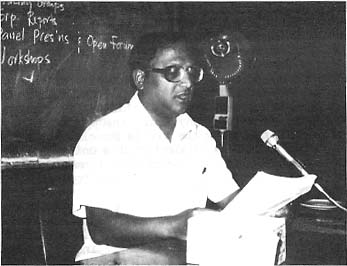
Dr. Somen Das