45
HONG
KONG REALITIES AND 1997: AN ASIAN PERSPECTIVE
Shum Yun Shan
SOCIO-POLITICAL
REALITY IN ASIA
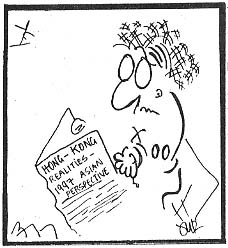 People in Asia are poor and largely rural except
for the following countries where percentages of urbanized population are higher:
Japan 77%; Singapore 100%; Hong Kong 93%; Australia 86%; New Zealand 84% and
South Korea 65%. Apart from these the rest of Asia is rural, starting in India
whose population far outnumbers the combined populations of all the urbanized
countries mentioned above. India is 75% rural, Indonesia 78%, Bangladesh 84%,
Pakistan 72%, Thailand 83%, Sri Lanka 78%, China 80% and the Philippines 59%.1
People in Asia are poor and largely rural except
for the following countries where percentages of urbanized population are higher:
Japan 77%; Singapore 100%; Hong Kong 93%; Australia 86%; New Zealand 84% and
South Korea 65%. Apart from these the rest of Asia is rural, starting in India
whose population far outnumbers the combined populations of all the urbanized
countries mentioned above. India is 75% rural, Indonesia 78%, Bangladesh 84%,
Pakistan 72%, Thailand 83%, Sri Lanka 78%, China 80% and the Philippines 59%.1
Since the nineteenth
century or even earlier, many Asian countries were colonized by Western powers.
Indo-china, Vietnam,
Laos and Cambodia were
French colonies since 1887. Burma,
Malaysia, Singapore, Brunei,
Bangladesh, Sri Lanka, Pakistan
and India
were British colonies and protectorates. Indonesia
and Borneo were Dutch colonies. The Philippines was
under Spanish rule. It was also in this period that China
was imperialised by the Western powers, Russia
and later by Japan.
Many foreign spheres of influence were formed in China after wars were waged against
the European powers and many unequal treaties were forced to be signed. Hong Kong became a British colony after the Opium War in
1842.
Asia is a multi-racial, multi-cultural and
multi-religious region, very rich in raw materials and natural resources.
However, people in Asia are poor and
oppressed. The abundant natural resources, raw materials and labour force have
been ruthlessly exploited by the colonial powers. They use the cheap natural
resources and produce high-value products for export to maintain the capitalist
economy which ensures them big profit. This has led to dependency and
subjugation of many Asian states. The plunder of resources, cheap labour,
taxation, and export, monoculture has reduced many Asian states to
under-development.2)
People have struggled
to be freed from colonial rule. Millions have been killed, enslaved, uprooted
from their culture, native land, and deprived of their wealth. The history of
our people is a history of struggle against oppression and suffering. However,
the eviction of
46
the
colonial powers and the attainment of "freedom" did not severe the
socio-political and economic tie-up between Asia
and the Western (colonial) countries.
Although economic
exploitation under direct colonial political rule has been terminated, the job
of colonial administrators and trading companies is now played by powerful
commercial institutions - the World Bank, the International Monetary Fund, the European Economic Community, etc. These institutions and
their subsidiaries continue to subjugate the economy in Asia
and extract the surplus labour and natural resources. They establish "Free
Trade Zones" and "Economic Processing Zones". Thus, Asia is linked to the international economic system
through the giant "Multi-National Corporations" (MNC).
The total wealth
transferred from India
by British imperialism has been variously estimated at-t 500 million and •£
1,000. In 1970, the Philippines
had a total foreign debt of US$ 1.96 billion to be repaid to about 25
governments and international institutions. If the rescheduling of the debts
had not occurred, the Philippines would have paid 480 million US dollars by way
of interests in 1970, accounting for 33% of the estimated earnings from exports
of commodities and services.3 The investment and official
repatriation of profits from Asia by MNC's in 1970
was 200 million (investment) and 2400 million (repatriation).4
The dependence of some
of the Asian countries for developmental assistance poses a serious threat to
their economic independence and self-reliance. In the case of Indonesia, for example, 40.3 % of official
international assistance in 1970 was from USA. The Philippines
relied on USA
for 34.9% of total external assistance. Despite appeals to the developed
capitalist countries to soften the terms and conditions of loans advanced by
them to the underdeveloped countries, no tangible results have been
forthcoming.
Asian people are also
oppressed by the dominantly feudal, male-oriented, political-economic and
cultural structures of Asian societies, at the same time, under the
authoritarian and military regimes. These oppressions have become even more
glaring as a result of the development of capitalism and its cultural
attributes. People are struggling for their identity as they are being forced
to fit into internationally defined roles and standards.
The people of Asia
have kept their lands viable for thousands of years, their forests lush and
green, their rivers and seas pristine, their wildlife diverse, and their
traditions vibrant. Now Asian forests are exhausted, rivers and seas polluted
by industrial and nuclear waste. Asian soil is ravaged by chemical fertilizers.
And the cultural identity has become merely a tourist commodity which enhances
the sexual industry and the prostitution and exploitation of women.
47
CHRISTIANITY AND COLONIAL RULE
Many of the Asian
countries were colonized by European nations which claimed to be Christians.
Thus colonization and evangelization happened at the same time. In general,
Christianity was with the rich and powerful colonial rulers. Yet, there were
few Christians on the side of the people who struggled against the colonial
rule. The missionaries started to come to China together with the foreign
business in the nineteenth century. The unequal treaties signed after the war
with the Western invaders legitimized the activities of the missionaries in China.
Western ideology was
infused to the urban educated and wealthy elites in the colonized countries,
who looked upon western civilization as better and more desirable. The
traditional values and attitudes continued to prevail in the rural areas. In India, British
rule facilitated the spread of Christianity. Along with colonial rulers
Christian missionaries started to flow into India in increasing numbers. They
came to the countries of Asia under the label
of "spreading Christ's Kingdom among the heathens".
The missionaries gave
the impression to the natives of being part of the European imperialism and
domination. They came as agents of that same culture, as exporters of European
religion. Politically, they were conservative, and went along with whatever the
imperialist rulers did.
The churches
established another power structure and authority within the colonial rule
through the requisition of huge properties with funding from foreign capitalist
companies. The people's movement has always desired to overthrow the
exploitative colonial and capitalist system that has been threatening the
churches.
In India,
missionaries organized a network of educational establishments for the training
of local officials who were recruited from the higher castes. Alongside these
schools which were producing a new, urban, westernized social class, the
missionaries founded orphanages for the rural and the popular urban classes.
They converted the children and trained the more intelligent of them as village
catechists. They expressed the superiority of their western culture over those
from Asia.
The colonial rulers coopted the educational efforts of the missionaries to
perpetuate and strengthen their power. Thus, the churches became tools in the
hands of the colonial masters.
48
HONG KONG IN RELATION TO THE PATRIOTIC AND DEMOCRATIC MOVEMENT
Historical
Perspective:
Hong Kong Island became a colony of the British with the signing
of the unfair treaty after the Opium War in 1842. In 1860 Britain enlarged its colonial territory by
invading China
and another unequal treaty was signed. In 1898, the rest of the land area (92%)
of the existing Hong Kong was leased to Britain for 99 years until 1 July
1997.
Hong Kong's British
Colonial Government is not representative of Hong Kong
people's interest. The British government sends a senior official as governor
to rule Hong Kong. The governor of Hong Kong has immense power. He handpicks his chief
advisors to form the Executive Council which  deals with all the important policy matters. The
majority of the members of the law-making body, the Legislative Council (Legco), are also appointed.
deals with all the important policy matters. The
majority of the members of the law-making body, the Legislative Council (Legco), are also appointed.
In the beginning, most
of them were British. Only a minority of seats in the Legco
have been indirectly elected since 1984. Direct elections were introduced in
1984 in the District Board which however, is not a decision-making body. It
only acts in a consultative role by collecting people's opinions and it does
not have any real influence or power.
In 1984 the government
published a white paper stating that Hong Kong
would have direct legislative elections in 1988. But the government ruled out
direct elections in 1988, on the pretext of the division of public opinions
over the timing to introduce direct elections. Finally in 1991, Hong Kong had its first direct elections for 18
legislative seats; 21 seats were indirectly elected through the functional
constituency, and 19 seats were appointed.
Even today the
British-Hong Kong government is representing the interest of Britain and the rich Hong
Kong people. Hong Kong is divided
between the powered and the powerless in political terms.
49
In September 1982, the
Chinese government started to negotiate with the British government over the
sovereignty of Hong Kong in 1997. In 1984, the
Joint Declaration between the two governments was signed. Its main principle is
"Hong Kong people ruling Hong Kong" under "One Country, Two
Systems" which allows Hong Kong to have
high degree of autonomy except in matters of defence and foreign affairs.
However, in the
process of their negotiation, the local Hong Kong
people were not consulted. When the British government decided to return Hong
Kong to China, it forgot the
fundamental right of the local Hong Kong
citizens - the right for self-determination. Opinions of Hong
Kong people for direct elections in 1988 were neglected by the
British-Hong Kong government.
Hong Kong People and the Democratic Movement in China, 1989:
The 1989 democratic movement
started by the Chinese students received support from the Hong
Kong people. Thousands of Hong Kong people supported them by
organizing demonstrations, releasing statements to the media, donating things
and money, and even bringing the things to them all the way from Hong Kong to
Tiananmen Square in China.
At that period, hundreds of local organizations came together to form a
"Joint Alliance in Support of the Patriotic Democratic Movement in China" to
coordinate their actions and to strengthen their voices.
The Christian churches
and organizations also formed the "Joint Committee of the Hong Kong
Christians in Support of the Patriotic Democratic Movement in China".
Most of the churches
and organizations organized the Christians to voice their support for
democratic change in China.
At this period the "patriotic" consciousness of the Hong
Kong people was raised up. They felt their Chinese identity was
affected by what was happening in their motherland, China. They tried to take action to
support the betterment of the Chinese people. However, the crackdown of the
democratic movement in Tiananmen Square on June 4, 1989 made the Hong Kong people, from the youngest to the oldest, women
and men cry out of sadness and despair. They lost hope and confidence in the
Chinese and British governments and the "Joint Declaration" signed by
them on the future of Hong Kong after 1997.
"Confidence Crisis":
Actually the
"Confidence Crisis" started in early 80’s when the people knew Hong
Kong would be returned to China
after the agreement signed between the Chinese and British governments. The
local middle-class professionals and businessmen are the most frightened and
have the least confidence in the future of Hong Kong.
They are afraid that when Hong Kong is returned to socialist China, they
will lose their
50
interests
and profits from business, the freedom arid privileges to enjoy life. Thus,
many middle-class intellectuals and professionals have emigrated and are
emigrating to western countries. They move business overseas to secure their
profit, and to get a foreign passport to secure their own lives. In five years
since the "Joint Declaration" was signed between the Chinese and
British governments in 1984, nearly 150,000 Hong Kong citizens have emigrated,
mostly to Canada, the U.S.A. and Australia.
After the crackdown of
the democratic movement in China
in 1989, the "Confidence Crisis" in the future of Hong
Kong reached its highest point. More Hong
Kong people wanted to emigrate. In early July 1989, when Singapore
government announced it would take 25,000 middle-income families from Hong
Kong, more than 350,000 application forms were handed out within a few days.
Also, according to the Hong Kong government,
by 1996 about 426,000 people would have emigrated. Although only 10% of Hong
Kong citizens can emigrate according to the qualifications required by the
western countries, this emigration or "confidence crisis" hurts Hong Kong more as much of the wealth, the brain and the
money is lost to the western countries. This at the same time affects the
remaining 90% of the local Hong Kong people.
Whose
Responsibility:
How about the 90% who
are less better off in the social structure of Hong Kong?
They have to remain in Hong Kong. If "the
youth is the future of the society", the young people of Hong
Kong need to reflect on their role in this social reality. We can
easily blame China for
causing the "Confidence Crisis" in Hong Kong.
However, the British government is also one of the main causes. In 1962 and
1981, the British government had taken away the right of entry to and the right
of abode in the United
Kingdom.
Although Britain is the colonial government of Hong Kong, it does not take up the responsibility to take
care of the people whom it has ruled and benefited from. It has not tried hard
to bargain and fight for the interests and rights of the Hong
Kong people with the Chinese government.
Hong
Kong
government itself is another cause of the confidence crisis. It depends on a
few hand-picked "elites" to govern Hong Kong.
It keeps its people in the darkness. Its policies are mainly to protect the
interests of the minority middle-upper-class elites, professionals and
businessmen. Thus, Hong Kong has become a
place for the rich only. Although in recent years, the economy in Hong Kong continues to do well, the profits mainly go to
the hands of the very few. There is no real improvement of the quality of life
for the lower-middle-income groups and especially the majority working class.
51
Instead of improving the
social welfare of the majority working people who are the real workers for Hong Kong, the government has paid the greatest support
in the HKS127 billion (US$16.3 billion) project - PADS (port and airport
development strategy). According to the government budget for 1991-92, because
of this big project and the high inflation rate, the government suggested to
increase the revenue from the expenses of the majority middle-income and
working class people, e.g., rates for housing, the registration fees for motor
cars and motorists and the tobacco tax. Sale
tax may be introduced in 1992. Even though it is the businessmen who earn the
most, the profit tax or corporate tax for them are the least likely to be
increased. The government has also decided to charge the hospital and social
welfare services which in the past were either free of charge or just needed
minimal fees.
Today in Hong Kong, there are still 330,000 people living in
squatter huts on the hillside and 32,100 in small junks. Another 4,000 elderly
and retired people are living in crowded bed spaces. They are called the
"caged" men. There are also nearly a thousand street-sleepers without
any place to stay and no one to take care of them. Their existence is unnoticed
and their voice is unheard. The government does not take any responsibility for
this lowest class of people in society. Instead, their policies continue to
maintain the unfair social and economic system which only benefits the minority
wealthy middle-class professionals and the very few rich and powerful people.
Although the big gap between the rich and the poor is existing, the government
only wants the people to see the superficial beauty in Hong
Kong society.
The present social and
political system in Hong Kong is not really
democratic. The voices of the Hong Kong people
are also unnoticed and neglected. In 1991, the Hong Kong
people were given the right to elect less than 1/3 of the councillors in the
legislature. However, the voting turn-out was just 750,000 or 39.15% of those
registered eligible voters. But actually only about half of the 3.8 million
eligible voters have been registered to vote. The 18 elected legislators do not
really represent the interests of the silent majority who comprises 80% of the
eligible voters in Hong Kong.
Another 1/3 of the
legislative councillors were indirectly elected by the functional constituency
which is just a system to ensure that the elite share the power in the
government structure and, at the same time, to protect their own interests.
Few in the government
really represent the voice of the people. Some people even say that the present
political system in Hong Kong is just a power
game for the few elite. To a certain extent, it reflects the thinking of the
people that the government is not working for their welfare and benefit. It
cannot govern the society with social justice to the people. So in fact, we
cannot say the present Hong Kong government is
representing the majority people and, thus, it is not "democratic".
52
THE FUTURE PROSPECT OF THE PATRIOTIC AND DEMOCRATIC MOVEMENT
The majority Hong Kong
people are neither rich nor particularly inclined to leave, torn between a
sentimental attachment to the "motherland" China and an Irrepressible desire
to make money; they are likely to stay and make the best of it.
When we say that
"the future is in the hands of the youth", it is just the same that
the future prospect of the patriotic and democratic movement is in the hands of
the people themselves, especially the younger generation in order to create a better
society or country which is for the benefit of the mass.
Firstly, we should not
forget the people's history of our own country. History is the one to link up
our sentiment with the people in the motherland, to develop the sense of
belongingness to our own country and to make people identify with their
culture. History makes people understand the present reality; mistakes or
lessons from history make us have a clearer analysis of the present
socio-political and economic situation.
One of the problems of
the youth in Hong Kong is that under the
present educational system, they do not receive the education which can help
them to develop their own potentials and interests and to learn to be persons
with humanity. The present educational system is just preparing students to
pass various kinds of examinations and to graduate with high marks in the
university: then expect to work in big multinational companies, climb up the
social ladders, and maintain the present system by accepting the dominant
values in society. They are being molded to become
the elite group. This is how we define a person to be successful and to be the
hope or future leader of society.
The educational system
never emphasises the history of our own country and culture. There is no civil
and political education in Hong Kong.
Recently, few schools started to emphasise this but it is still very inadequate
because of the shortcoming in the whole educational system or for lack of
government support in terms of finance, resources and training qualified
teachers. What the Hong Kong government is
most concerned about is the GNP the increase of which does not necessarily
reflect the living standard of the majority of the people. Thus the number of
conscious Hong Kong people to take up the
social responsibility is small; the majority are not aware of their social and
political rights in society.
We need to understand
the social, political and economic reality of society. We have to put more
emphasis on those unheard, unnoticed people and the silent majority of the
working-class because they are the ones most neglected. We need to analyse the
causes of all these happenings, and from the causes try to find the solutions
and take action.
53
We also need to
reflect on our values in life. In a typical capitalist society, like Hong Kong, materialism, consumerism, individualism,
making lots of money and becoming famous are the prevalent values. The
definition of being a successful person depends on how much money he/she earns,
how many luxurious things he/she possesses and how high the social status
he/she has.
Nowadays, many people
in Hong Kong especially the young people have
the habit of reading newspapers or magazines. However, they look at the items
on film stars, their idols, horse-racing, the classified post or shopping,
entertainments and job opportunities where they can earn the most but work the
least; rather than local or world news.
We want to continue
the patriotic and democratic movement to create a better society. We need more
people who are concerned and committed to the people and their own society. We
need people who can understand their people's history, identify with them and
their suffering, at the same time, understand the present situation. We also
need more people who believe and take initiatives and actions to create a world
with the values of freedom, justice, peace and love - caring and sharing in the
community.
THE SIGNIFICANCE OF 1997 FOR THE REST OF ASIA
On 1st July 1997, the
western powers will lose the last colony, Hong Kong, in Asia.
It is the period that Asian people should be more consolidated and cooperate
with each' other. Asia, as a developing
region, should be strengthened and developed culturally, socially, politically
and economically to have our own Asian identity which is not defined by others
but our own Asian people.
Asia has a very long people's history - over
thousands of years. It is very rich in culture. The population of Asia is over
three billion which is over half of the world's total, and with 1/5 of the
world's total land area.5 So we see that Asia has the richest human
resources with the rich lands producing many natural resources like timber,
rice, and various kinds of agricultural products. Asia
has all the potential to develop to be a strong region, socially and
economically. However, when we review the events in Asia
in the last fifty years, we can notice amidst the exploitation and oppression,
poverty and despair, the vibrant and hopeful movement of the people: marching,
demonstrating, moving, shouting, demanding from authorities their due,
overthrowing the colonizer and their oppressors.
We remember the
massive people's movements that forced Great
Britain to grant independence to India, Pakistan
and Sri Lanka in 1947 and
1948; the people's movements which drove out the Dutch in Indonesia in 1950; and the British from Burma and Malaya
in 1948 and 1957, respectively; the victory of the Chinese people in the
fighting of
54
World
War II against the invasion of great powers; the victory of the tiny
Indo-Chinese nations in 1975 and 1976 over the most powerful country in the
world; the mass movements which deposed President Marcos in the Philippines in
1986 and Chun Doo Hwan of Korea in 1987; the mass
movements which brought Benazir Bhutto to power in
Pakistan in 1988; and the workers-farmers movements which ended martial law in
Taiwan in 1988.
People's movements in Asia are manifested through many types of mass actions
which proclaim people's sufferings and demands in order to be liberated from
all types of oppression and exploitation, to create a more equal and just
society.
There is a South
Korean song which says "Reunification is our hope. Reunification is our
dream. To it we dedicate our lives. Reunification come soon!" If the
"1997" issue were to happen in South Korea, many Korean people
would probably be preparing how to celebrate when the day came. How are Hong Kong people facing reunification with the
motherland? The Hong Kong people should try to understand, feel and identify
with the Asian reality as we are part of Asia, and learn from the experience of
the people's movement in Asia.
CONCLUSION
The future of Hong Kong depends on the committed people who would like
to stay and work for the needs of the people. Now the urgent thing that Hong Kong people need is not how to maintain
"prosperity and stability". I think the most urgent thing to do is to
develop more people who will follow the experience of the historical liberative Jesus: to give up what they possess, to be
compassionate to the weak and oppressed, to suffer together with them, to voice
the needs of the voiceless, to confront violence with non-violence. The Bible
(Phil. 2:1-11) teaches us to "be united in our convictions and united in
our love", with a "common purpose" and a "common mind",
"no competition", "no conceit", "always consider the
other person to be better than yourself, so that nobody thinks of his own
interests first but everybody thinks of other people's interests instead".
Without the
willingness of the Hong Kong people to suffer, there is no future either for
Hong Kong or China.
Furthermore, without the willingness of the Asian people to continue the
struggle for justice against the exploitative rich and the powerful, oppression
and exploitation will remain. Then the mission of the "God of
Peoples", to create the Kingdom
of God, will never be
accomplished.
The Asian reality
depicts a picture of poverty, landlessness, corruption, unemployment and ethnic
conflict within states or with each other. We realize the local elites are
closely linked with foreign elites, with the support of advance technology like
fax,
55
E-mail,
modems and telephones. The international exploitative rich elites all over the
world exploit the poor all over the world. The national states do not uphold the
human rights of the people and cannot decide on the common interests for their
people's future.
The Multinational
Companies (MNC's) control the situation of the world
and national states. They decide which country to be economically open and
which to be more exploited. The MNCs benefit from
sucking the blood of the poor people.
The young people in
Hong Kong need to analyse and study the role of the MNCs
in exploiting the poor people in the world, especially the developing Asia. We should openly reject the benefits received from
the exploitation of the poor.
In our history,
Christianity came along with exploitation, colonialism and neo-colonialism.
This happened as those people who believed in Christianity forgot Jesus who was
with the poor and oppressed. They remade Jesus to suit their own interests and
dreams.
Let us rediscover the
"original Asian face of Jesus". We need to rediscover the meaning of
redemption and Jesus' relationship with people in terms of social justice to
return to the original Jesus' gospel - the expression of love, sharing and
caring for each other.
Let us unite in our
struggles, actions, beliefs and prayers to bring the Good News of liberation
and justice to the suffering poor and oppressed.
NOTES
1. "Asia
Yearbook, 1989", Far Eastern Economic Review.
2. Normal Girvan, "The Question of
Compensation: A Third World perspective" Vol. XVI, No. 1, July 1974, p.56.
3. Dr. Matthew Kurien,
"Socio-Economic and Political Reality in Asia",
IMCS-Asia Document Reprint Service, March 1979. ,
4. "United Nation Report", 1973.
5. "Third World Guide 91/92",
Institute del
Tercer Mundo, 1990.
REFERENCES
1. Kinder and Hilgemann,
"Atlas of World History", Vol.11 Anchor Books, London, 1978.
2. Stan Lourdusamy,
"Religion as Political Weapon", Multi
Book Agency, India,
July 1990.
3.
"Tripod", Vol.XI-No.63, Holy Spirit Study Centre, May-June, 1991.
4. "Working Youth - Faith, Action"
report by International Young Christian Workers - Asia-Pacific, November 1988.
5. Jean and Hildegarde
Goss-Mayr, "The Gospel and the Struggle for
Peace", by the International Fellowship of Reconciliation, 1990.
6. "Newsletter" by the Hong Kong
Christian Institute, 1989, 1990, 1991.